Wiz Acquisition Puts Israeli Intelligence In Charge of Your Google Data

Spread the love

Original article by Alan Macleod republished from MPN under a Creative Commons Attribution-NonCommercial-ShareAlike 3.0 International License.

Google recently announced it would acquire Israeli-American cloud security firm Wiz for $32 billion. The price tag — 65 times Wiz’s annual revenue — has raised eyebrows and further solidified the close relationship between Google and the Israeli military.

In its press release, the Silicon Valley giant claimed that the purchase will “vastly improve how security is designed, operated and automated—providing an end-to-end security platform for customers, of all types and sizes, in the AI era.”

Yet it has also raised fears about the security of user data, particularly of those who oppose Israeli actions against its neighbors, given Unit 8200’s long history of using tech to spy on opponents, gather intelligence, and use that knowledge for extortion and blackmail.

Israel’s Global Spy Network

Wiz was established only five years ago, and all four co-founders — Yinon Costica, Assaf Rappaport, Ami Luttwak, and Roy Reznik — were leaders in Israel’s elite military intelligence unit, Unit 8200. Like many Israeli tech companies, Wiz is a direct outgrowth of the military intelligence outfit. A recent study found that almost fifty of its current employees are Unit 8200 veterans.

“That experience showed me the impact you can make when you combine great talent with amazing technology,” Rappaport said of his time in the military.

Former Unit 8200 agents, working hand-in-glove with the Israeli national security state, have gone on to produce many of the world’s most infamous malware and hacking tools.

Perhaps the most well-known of these is Pegasus, spyware used by governments around the world to surveil and harass political opponents. These include India, Kazakhstan, the UAE, and Saudi Arabia, the latter of which used the tool to spy on Washington Post journalist Jamal Khashoggi before he was assassinated by Saudi agents in Türkiye.

In total, more than 50,000 journalists, human rights defenders, diplomats, business leaders and politicians are known to have been secretly surveilled. That includes heads of state such as French President Emmanuel Macron, Pakistani Prime Minister Imran Khan and Iraqi President Barham Salih. All Pegasus sales had to be approved by the Israeli government, which reportedly had access to the data Pegasus’ foreign customers were accruing.

Unit 8200 also spies on Americans. Whistleblower Edward Snowden revealed that the National Security Agency regularly shared the data and communications of U.S. citizens with the Israeli intelligence group. “I think that’s amazing…It’s one of the biggest abuses we’ve seen,” he said.

For the Israeli government, the utility of these private spying firms filled with former IDF intelligence figures is that it allows it some measure of plausible deniability when confronted with spying attacks. As Haaretz explained: “Who owns [these spying companies] isn’t clear, but their employees aren’t soldiers. Consequently, they may solve the army’s problem, even if the solution they provide is imperfect.”

Today, former Unit 8200 agents not only create much of the world’s spyware, but also the security features that claim to protect against unwanted surveillance. A MintPress investigation found that three of the six largest VPN companies in the world are owned and controlled by an Israeli company co-founded by a Unit 8200 veteran.

Exposed: How Israeli Spies Control Your VPN

How Unit 8200 Controls Palestinians

It is in Palestine, however, that Unit 8200 has been most active. The unit serves as the centerpiece of Israel’s hi-tech repressive state apparatus. Using gigantic amounts of data compiled on Palestinians by tracking their every move through facial recognition cameras, monitoring their calls, messages, emails and personal data, Unit 8200 has created a digital dragnet that it uses to snoop on, harass, and suppress Palestinians.

It compiles dossiers on virtually every Gaza resident, including their medical history, sex lives, and search histories, so that this information can be used for extortion or blackmail later. If, for example, an individual is cheating on their spouse, desperately needs a medical operation, or is secretly homosexual, this can be used as leverage to turn civilians into informants and spies for Israel.

One former Unit 8200 operative said that as part of his training, he was assigned to memorize different Arabic words for “gay” so that he could listen for them in phone conversations he was eavesdropping on.

Unit 8200 is also reportedly behind the even more controversial Project Lavender, a giant, AI-generated kill list of tens of thousands of Gazans that the IDF uses to target the densely populated strip’s civilian population.

Palestanian workers cross the Eyal checkpoint into Israel under the watchful eye of IDF cameras, January 10, 2021. Keren Manor | Activestills

Every Gazan (including children) is assigned a score of 1-100, based on their perceived proximity to Hamas. A wide range of characteristics will increase an individual’s score, including living or working in the same building or being in a WhatsApp group with a known or suspected Hamas member.

If a person’s number reaches a certain threshold, they are automatically added to a Unit 8200 kill list. This, one IDF commander explained, solved Israel’s perennial targeting “human bottleneck,” allowing them to carry out tens of thousands of strikes into Gaza during the first few weeks of the post-October 7 attack alone.

Unit 8200 is also widely reported to have carried out the Lebanon Pager Attack, exploding thousands of electronic devices at the same time, killing dozens and injuring thousands more. The operation was widely described, even by former CIA director Leon Panetta, as an act of terrorism.

This long history of violence, skulduggery, and spying raises troubling questions about whether a corporation founded and staffed by dozens of individuals from such an organization can be trusted with billions of users’ private and personal data.

Google’s Ties to Israeli Intelligence

Google’s purchase of Wiz deepens its already close ties to Unit 8200. In 2013, the tech giant acquired Waze, an online maps service founded by three Unit 8200 veterans, for $1.3 billion. It has also directly hired dozens of former spooks and spies to fill its ranks; a 2022 MintPress News investigation found at least 99 former Unit 8200 agents working at the Silicon Valley behemoth.

Among these figures is Gavriel Goidel, Head of Strategy and Operations for Google Research. Goidel joined Google in 2022 after a six-year career in military intelligence, during which he rose to become Head of Learning at Unit 8200. There, he led a large team of operatives who sifted through intelligence data to “understand patterns of hostile activists,” according to his own account.

Google is far from an outlier when it comes to hiring former Israeli spies to carry out its operations. Facebook, Microsoft, and Amazon have all hired a significant number of ex-Unit 8200 agents. Even TikTok, supposedly a hotbed of anti-Semitism, employs a considerable number of ex-spooks. Perhaps most surprisingly, a number of top U.S. media outlets, including CNN and Axios, have recruited former Unit 8200 spies and analysts to write and produce America’s news about the Middle East.

Revealed: The Israeli Spies Writing America’s News

Google has invested heavily in Israel, first opening offices there in 2006. Longtime CEO Eric Schmidt is known to be a vocal supporter of the controversial state. In a 2012 meeting with Prime Minister Benjamin Netanyahu, he declared that “the decision to invest in Israel was one of the best that Google has ever made.”

But the Wiz deal is undoubtedly the company’s biggest Israeli investment yet. The all-cash acquisition represents a massive injection of money into Israel’s flailing and war-weary economy, equivalent to 0.6% of the country’s GDP. The money, the Israeli press excitedly reports, will allow the government to continue without enacting major austerity measures, reduce the nation’s deficit, and enable Israel to continue on a wartime footing for longer. As such, it represents a move critics say amounts to a financial intervention on behalf of Israel. Moreover, it also sends a message to the rest of the business world to invest in the country, boosting investor sentiment at a time when it is most needed.

The size of the deal also surprised many. The price is similar to that of the sale of JPMorgan Chase and Wells Fargo in 2008, Visa Europe in 2017, and Twitter in 2022. Yet Wiz is a new and relatively unknown company, raising questions about its valuation.

Ultimately, though, these considerations are secondary to the main issue that such a group will now be charged with providing security for the data of billions of users worldwide. Given Unit 8200’s role in monitoring and targeting the Palestinian population, many will be wondering if, going forward, Google products are at all safe to use.

Feature photo | Illustration by MintPress News

Alan MacLeod is Senior Staff Writer for MintPress News. After completing his PhD in 2017 he published two books: Bad News From Venezuela: Twenty Years of Fake News and Misreporting and Propaganda in the Information Age: Still Manufacturing Consent, as well as a number of academic articles. He has also contributed to FAIR.orgThe GuardianSalonThe GrayzoneJacobin Magazine, and Common Dreams.

Original article by Alan Macleod republished from MPN under a Creative Commons Attribution-NonCommercial-ShareAlike 3.0 International License.

Continue ReadingWiz Acquisition Puts Israeli Intelligence In Charge of Your Google Data

As Trump II Begins, Bezos Swaps Scrutiny for ‘Storytelling’

Spread the love

Original article by Julie Hollar republished from FAIR under a Creative Commons Attribution-NonCommercial-NoDerivs 3.0 Unported License.

As the Washington Post faces a staff rebellion and plummeting subscription rates, billionaire owner Jeff Bezos has introduced a new mission statement: “Riveting Storytelling for All of America.”

The Washington Post‘s new slogan, “Riveting Storytelling for All of America,” is “meant to be an internal rallying point for employees,” the New York Times (1/16/25) reported.

The new path forward, as introduced in a slide deck to staff by Suzi Watford, the paper’s chief strategy officer, demands that the paper “understand and represent interests across the country,” and “provide a forum for viewpoints, expert perspectives and conversation” (New York Times1/16/25). It will do this as “an AI-fueled platform for news” that delivers “vital news, ideas and insights for all Americans where, how and when they want it.”

This appears to mean shifting resources toward opinion, specifically opinions from the right. According to the New York Times report:

Bezos has expressed hopes that the Post would be read by more blue-collar Americans who live outside coastal cities, mentioning people like firefighters in Cleveland. He has also said that he is interested in expanding the Post’s audience among conservatives.

The Post has already begun to consider ways to sharply increase the amount of opinion commentary published on its website, according to two people with knowledge of the talks. An adviser to the Post, Lippe Oosterhof, has conducted brainstorming sessions about a new initiative that would make it easier to receive and publish opinion writing from outside contributors.

How AI is meant to play into this is unclear.

The Post already has more columnists than you can shake a stick at. This new direction sounds like the Foxification of the Washington Post, a move away from any attempt to hold the powerful to account, toward inexpensive clickbait punditry.

‘Make money’

The red area represents the proportion of Jeff Bezos’s total wealth that would be required to cover the Washington Post‘s losses for a year.

Watford’s slide deck presented three pillars of the Post‘s new model: “great journalism,” “happy customers” and “make money.” The Post lost roughly $77 million in 2023. (It also lost some 250,000 subscribers after Bezos killed the paper’s planned endorsement of Kamala Harris—FAIR.org10/30/24.)

In order to make money, its new “Big Hairy Audacious Goal” (yes, that’s what the Post slide deck apparently called it) is to reach 200 million “paying users.” The paper currently has about 3 million subscribers, making it an “audacious” goal indeed. As the Times pointed out, even if the Post could achieve the impossible task of monetizing every visit to its website, no major corporate media outlet has been getting more than 100 million monthly unique visits—paying and non-paying—outside of the spike in traffic around the election.

Back in 2019, the Post was claiming 80–90 million unique visitors per month. Those visits peaked in November 2020 at 114 million, but quickly and steadily dropped after Biden’s inauguration. The Post stopped posting its audience numbers online after January 2023, when they were down to 58 million.

Of course, most online corporate media have been struggling. The thing about the Post is that its absurdly wealthy owner, the second-richest person on Earth, can easily afford to lose $77 million a year. That’s 0.03% of Bezos’s current net worth.

‘We are deeply alarmed’

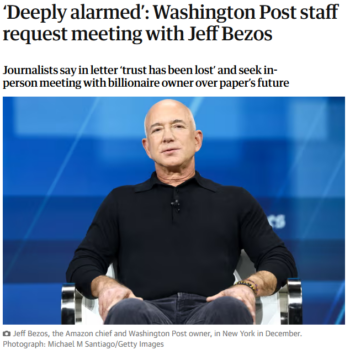
Guardian (1/15/25): “The plea from staff…comes a week after the Post laid off roughly 100 employees…roughly 4% of the publication’s staff.”

No doubt the Post needs help. Just days before the new mission statement was revealed, over 400 staff members signed a letter to Bezos asking for a meeting (Guardian1/15/25).  The letter read:

We are deeply alarmed by recent leadership decisions that have led readers to question the integrity of this institution, broken with a tradition of transparency, and prompted some of our most distinguished colleagues to leave, with more departures imminent.

Bezos’s response—a slide deck about “riveting storytelling” on “an AI-driven platform” that prioritizes churning out opinions to draw in conservatives—is hardly likely to ease the mind of any serious journalist at the paper.

Nor is trying to “expand the Post audience among conservatives,” while still paying lip service to “great journalism,” likely to solve the Post‘s problems. As CNN‘s former CEO Chris Licht discovered (FAIR.org6/8/23), you can’t do good journalism while trying to appeal to both sides in the context of an increasingly radical right, because that side demands acceptance of lies and conspiracy theories that are incompatible with actual journalism.

When Bezos bought the Post (Extra!3/14), he assured the paper’s employees that “the paper’s duty will remain to its readers and not to the private interests of its owners.” That sentiment was repeated in Watford’s slide deck this week. But Bezos’s actions in the past months—including the killing of the Harris endorsement, Amazon donating $1 million donation to Trump’s inaugural fund and paying Melania Trump $40 million for her self-produced documentary, and, most recently, Bezos appearing onstage with other multibillionaires at Trump’s inauguration—make clear that the principle is as meaningless to Bezos as the slogan that debuted after Trump’s first election: “Democracy Dies in Darkness.”

That slogan will continue to adorn the front page for the time being, perhaps in the hope that readers searching for an actual news organization that holds those in power to account will be fooled into subscribing.


ACTION ALERT: You can send a message to the Washington Post at letters@washpost.com.

Please remember that respectful communication is the most effective. Feel free to leave a copy of your message in the comments thread here.

FAIR’s work is sustained by our generous contributors, who allow us to remain independent. Donate today to be a part of this important mission.

Original article by Julie Hollar republished from FAIR under a Creative Commons Attribution-NonCommercial-NoDerivs 3.0 Unported License.

Continue ReadingAs Trump II Begins, Bezos Swaps Scrutiny for ‘Storytelling’

Knowing less about AI makes people more open to having it in their lives – new research

Spread the love

Anggalih Prasetya / Shutterstock

Chiara Longoni, Bocconi University; Gil Appel, George Washington University, and Stephanie Tully, University of Southern California

The rapid spread of artificial intelligence has people wondering: who’s most likely to embrace AI in their daily lives? Many assume it’s the tech-savvy – those who understand how AI works – who are most eager to adopt it.

Surprisingly, our new research (published in the Journal of Marketing) finds the opposite. People with less knowledge about AI are actually more open to using the technology. We call this difference in adoption propensity the “lower literacy-higher receptivity” link.

This link shows up across different groups, settings and even countries. For instance, our analysis of data from market research company Ipsos spanning 27 countries reveals that people in nations with lower average AI literacy are more receptive towards AI adoption than those in nations with higher literacy.

Similarly, our survey of US undergraduate students finds that those with less understanding of AI are more likely to indicate using it for tasks like academic assignments.

The reason behind this link lies in how AI now performs tasks we once thought only humans could do. When AI creates a piece of art, writes a heartfelt response or plays a musical instrument, it can feel almost magical – like it’s crossing into human territory.

Of course, AI doesn’t actually possess human qualities. A chatbot might generate an empathetic response, but it doesn’t feel empathy. People with more technical knowledge about AI understand this.

They know how algorithms (sets of mathematical rules used by computers to carry out particular tasks), training data (used to improve how an AI system works) and computational models operate. This makes the technology less mysterious.

On the other hand, those with less understanding may see AI as magical and awe inspiring. We suggest this sense of magic makes them more open to using AI tools.

Our studies show this lower literacy-higher receptivity link is strongest for using AI tools in areas people associate with human traits, like providing emotional support or counselling. When it comes to tasks that don’t evoke the same sense of human-like qualities – such as analysing test results – the pattern flips. People with higher AI literacy are more receptive to these uses because they focus on AI’s efficiency, rather than any “magical” qualities.

It’s not about capability, fear or ethics

Interestingly, this link between lower literacy and higher receptivity persists even though people with lower AI literacy are more likely to view AI as less capable, less ethical, and even a bit scary. Their openness to AI seems to stem from their sense of wonder about what it can do, despite these perceived drawbacks.

This finding offers new insights into why people respond so differently to emerging technologies. Some studies suggest consumers favour new tech, a phenomenon called “algorithm appreciation”, while others show scepticism, or “algorithm aversion”. Our research points to perceptions of AI’s “magicalness” as a key factor shaping these reactions.

These insights pose a challenge for policymakers and educators. Efforts to boost AI literacy might unintentionally dampen people’s enthusiasm for using AI by making it seem less magical. This creates a tricky balance between helping people understand AI and keeping them open to its adoption.

To make the most of AI’s potential, businesses, educators and policymakers need to strike this balance. By understanding how perceptions of “magicalness” shape people’s openness to AI, we can help develop and deploy new AI-based products and services that take the way people view AI into account, and help them understand the benefits and risks of AI.

And ideally, this will happen without causing a loss of the awe that inspires many people to embrace this new technology.

Chiara Longoni, Associate Professor, Marketing and Social Science, Bocconi University; Gil Appel, Assistant Professor of Marketing, School of Business, George Washington University, and Stephanie Tully, Associate Professor of Marketing, USC Marshall School of Business, University of Southern California

This article is republished from The Conversation under a Creative Commons license. Read the original article.

Continue ReadingKnowing less about AI makes people more open to having it in their lives – new research

How the UK’s plans for AI could derail net zero – the numbers explained

Spread the love
Data centres use an enormous amount of electricity for cooling and to power servers. Andia/Alamy Stock Photo

Tom Jackson, Loughborough University and Ian R. Hodgkinson, Loughborough University

The UK government’s goal to increase public-controlled artificial intelligence computing power twentyfold by 2030 would significantly raise electricity demand. Can renewable energy supply meet it – and still have enough left over to electrify sectors like heating and transport, which must be fully decarbonised by 2050?

First, let’s discuss why AI is so energy intensive. AI systems demand a huge amount of computing power. The creation and use of AI involves training the programmes on models and algorithms that must be invented and calibrated, all of which demands computing power. Then, that AI model must draw conclusions from the new data it is fed, which is another energy-intensive process in itself.

The need for more and more computing power has risen sharply as AI has become more sophisticated. Computing power is becoming scarce as a result and is a major bottleneck for the further development and use of AI. Indeed, the UK’s national AI strategy published in 2021, recognised that computing power capacity must be increased if the potential of AI is to be realised.

The more sophisticated the AI, typically, the more energy intensive it is. This has significant implications for the UK.

How much energy does the AI rollout need?

Data centres (facilities that store, process and distribute data) are a significant and growing consumer of electricity. From training complex AI models, which requires immense computational power and data storage, to running data through trained AI models to make predictions or solve tasks, data centres are central to every stage of AI’s use and development.

According to estimates by the International Energy Agency, data centres globally account for approximately 1%-1.3% of total electricity consumption. One recent observation suggests that developing the most sophisticated AI systems currently requires a fourfold increase in the amount of computing power annually. The total amount of data required for AI training has also risen by 2.5 times a year, increasing reliance on data centres.

Pylons at sunset.
Britain’s electricity grid will strain to meet rising demand even without AI. SuxxesPhoto/Shutterstock

In the UK, AI and related infrastructure consumed around 3.6 terawatt-hours (TWh) of electricity in 2020. If this consumption increases twentyfold, as per the government’s target, it could reach 72 TWh by 2030. This would represent over one-quarter of the UK’s total electricity consumption in 2021, which was approximately 261 TWh.

The rapid growth in AI computing requires careful planning. However, data centres are only part of the equation. The devices that use AI, such as sensors in smart homes, gas and electricity meters, routers, wifi hubs, streaming devices and social media platforms, could add significant energy demand that is difficult to estimate.

These additional components of AI’s total energy consumption are often overlooked.

Renewable energy growth is insufficient

The UK has made significant strides in renewable energy production, with wind and solar power contributing over 40% of electricity in recent years.

However, our projections, reported in the journal Energy Policy, indicate that global renewable electricity supply will not meet surging demand from global digital data growth.

Our research considered different scenarios for AI’s energy use. The UK’s target of a twentyfold increase in AI computing power by 2030 is certainly a high-consumption scenario, in which energy demand from digital infrastructure alone could outpace the growth of renewable energy capacity.

At the same time, the UK’s decarbonisation hinges on electrifying transport and heating, sectors traditionally reliant on fossil fuels: replacing natural gas boilers with electric heat pumps and combustion engine cars with electric vehicles. These will require substantial increases in electricity supply.

A row of electric cars plugged into public chargers.
Britain’s electric vehicle charging network will need to expand to decarbonise transport. Shutterstock

However, solving this problem will not just require expanding renewable energy production. The energy efficiency of AI systems and related technologies must improve too. Ensuring that the energy needed for AI and other digital advancements is sustainably sourced, without compromising broader net zero goals, will require a combination of government policy, technological innovation and public awareness.

AI’s growing electricity needs could exacerbate competition for limited renewable energy resources. This competition risks increasing reliance on fossil fuels, especially during periods of peak energy demand. If additional renewable capacity cannot be deployed quickly enough, the UK might face a scenario where AI-driven electricity demand increases overall emissions rather than reducing them.

The UK’s commitment to a twentyfold increase in public AI computing power by 2030 presents an immense challenge for the country’s electricity system. Meeting this goal sustainably will require balancing AI’s energy needs with broader electrification goals and renewable energy limitations.

Without immediate and concerted efforts to expand renewable energy and improve efficiency, AI’s electricity demands could hinder the transition to a net zero future.


Don’t have time to read about climate change as much as you’d like?
Get a weekly roundup in your inbox instead. Every Wednesday, The Conversation’s environment editor writes Imagine, a short email that goes a little deeper into just one climate issue. Join the 40,000+ readers who’ve subscribed so far.


Tom Jackson, Professor of Information and Knowledge Management, Loughborough University and Ian R. Hodgkinson, Professor of Strategy, Loughborough University

This article is republished from The Conversation under a Creative Commons license. Read the original article.

Continue ReadingHow the UK’s plans for AI could derail net zero – the numbers explained

There is a green elephant in the room with government’s AI plans

Spread the love
Green Party Co-leader Adrian Ramsay. Wikipedia CC.

Responding to the news that Government plans for AI to be “mainlined into the veins” of the nation, Green Party Co-Leader, Adrian Ramsay MP, said

“The potential for AI is huge and Greens welcome the potential it holds, especially in research and innovation. However, this plan comes almost exclusively from engagement with industry and investors and does not account for the views of the public, or the people working in our public services, about where AI should or should not be used. If AI is to serve our public services, its uses must instead be driven by the voices of those most affected by this technology development and deployment. This of course has to include addressing concerns around privacy and rights over their information”

“In addition, there is a green elephant in the room with neither government nor business truly addressing the environmental impacts of AI. One estimate said AI-related infrastructure may soon consume six times more water than Denmark, a country of 6 million people. And a request made through ChatGPT consumes 10 times the electricity of a Google Search. Yet the action plan does not address these crucial questions of environmental sustainability, let alone the debate about the relative gains from AI versus these obvious harms.”

Continue ReadingThere is a green elephant in the room with government’s AI plans