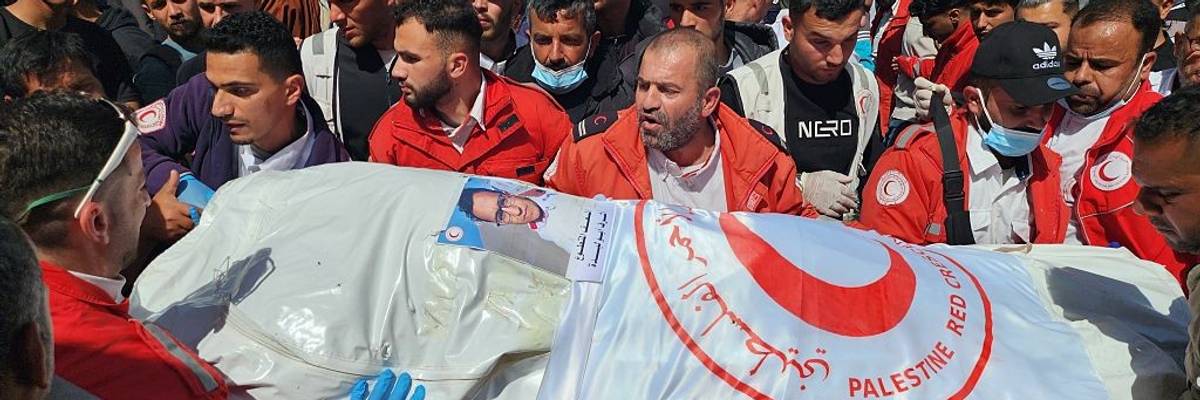
Funerals are held at Nasser Hospital in Khan Younis in southern Gaza , for eight Palestinian first responders massacred by Israeli forces in Tel al-Sultan on March 23, 2025. (Photo by Hani Alshaer/Anadolu via Getty Images)
“What this investigation reveals is that there was a shoot first policy, and that is unlawful under international law,” said one legal expert.
An investigation published Monday meticulously dissects last year’s killing by Israeli soldiers of 15 Palestinian aid workers in southern Gaza and the Israel Defense Force’s subsequent efforts to cover up the massacre, which the Palestine Red Crescent Society called “one of the darkest moments” of the US-backed genocide.
IDF soldiers fired nearly a thousand bullets—at least eight of them at point-blank range—during the March 23, 2025 attack on a convoy of Palestine Red Crescent Society (PRCS) and Palestinian Civil Defense ambulances and a PCD fire truck in Tel al-Sultan north of Rafah, according to the investigation by Forensic Architecture and Earshot.
“Our investigation confirms that Israeli forces attacked the aid workers while they were traveling in clearly marked humanitarian vehicles, in the absence of any threat or exchange of fire,” a summary of the report states. “Spatial and audio analysis conducted in partnership with Earshot reveals the positions from which Israeli soldiers fired on the aid workers—in at least once instance within one to four meters of their victim—over a period of more than two hours.”
Our new report in collaboration with Forensic Architecture (@ForensicArchi) is now live. In the early hours of March 23, 2025, the Israeli Army conducted a series of attacks on clearly marked emergency vehicles and personnel in Tel al-Sultan, Gaza. Fifteen aid workers from the… pic.twitter.com/SK98alnYOl
Eyewitness and survivor testimonies and analysis of various recordings showed that some of the aid workers—who included eight PCRS workers, six PCD employees, and one staffer with the United Nations Relief and Works Agency for Palestine Refugees in the Near East. They are among the hundreds of Palestinian humanitarian aid workers killed by Israeli forces since October 2023, including more than 370 members of UNRWA, according to the agency.
The new report shows how IDF troops ambushed and attacked the convoy, firing on its vehicles. IDF spokesperson Col. Nadav Shoshani claimed that unmarked convoy vehicles “were identified advancing suspiciously toward IDF troops without headlights or emergency signals” and that nine of the first responders were “terrorists from Hamas and the Islamic Jihad.”
However, as is often the case, IDF officials could not support their claim with evidence, and video recorded by PRCS worker Refaat Radwan before he was killed shows clearly marked ambulances traveling with lights on and sirens wailing.
The IDF’s lies poured fuel on the fire of international outrage over the massacre. Trey Yingst, chief international correspondent at staunchly pro-Israel Fox News, said that Israel’s version of the massacre story was “clearly not true.”
New video shows Israeli forces open firing on medics in Gaza.
I’ve spoken with the IDF multiple times about this day and was told “several vehicles were identified advancing suspiciously toward IDF troops without headlights, or emergency signals.”
Gaza authorities previously reported that some of the victims had apparently survived the initial attack and were handcuffed and executed before being dumped together into a deep hole and buried along with their destroyed vehicles.
Survivors Munther Abed and Assad al-Nassasra testified “that Israeli soldiers opened fire on the rescue convoy as the aid workers exited their vehicles and approached the ambulance on foot,” according to the new investigation.
“Asaad recalled crawling toward an ambulance where two colleagues—Muhammad Bahloul and Saleh Muammar—had taken shelter,” the publication continues. “Muhammad had been killed, and Saleh was severely wounded. Muhammad al-Hila crawled up behind Asaad, and as the two men embraced, Muhammad was shot and killed.”
Autopsies revealed that some of the slain aid workers were shot in the chest and head, with one doctor who examined the bodies calling the “specific and intentional location of shots at close range” indicative of an “execution-style” killing.
Of the bodies found in the mass grave of victims, “one was beheaded,” according to PRCS spokesperson Mahmoud Basal, who said that “the least harmed among them had at least 20 bullets fired at him.”
Jonathan Whittall, who headed the UN humanitarian affairs coordination office in Palestine at the time, toldDrop Site Monday that “following our discovery of the mass grave, the narrative from Israeli forces shifted multiple times; we were fed several versions of a blatant lie.”
The IDF cover-up attempt was underway. The new investigation says that the IDF “deliberately concealed and disturbed evidence, and in the weeks after repeatedly mischaracterized the incident and denied any wrongdoing.”
Meanwhile, survivor al-Nassasra was captured by Israeli troops and taken to the Sde Teiman military prison in Israel’s Negev Desert, where he was jailed for 37 days and tortured during interrogations. Sde Teiman gained global infamy following reports of torture, rape, and murder of detainees. The IDF is investigating the deaths of at least 36 Palestinians at the lockup, including one who died after allegedly being sodomized with an electric baton.
Israeli soldiers pulled Abed, the other survivor, from his ambulance, bound his hands, beat him, and detained him on the ground near where the other vehicles had been ambushed. Abed testified that he was stripped, beaten, threatened with death, and interrogated before being released later that same day.
Katherine Gallagher, a senior staff attorney at the Center for Constitutional Rights, told Drop Site that the new investigation “presents a very compelling case, and honestly, a very devastating one.”
“What this investigation reveals is that there was a shoot first policy, and that is unlawful under international law,” she continued.
“When you zoom out and look at this in the context of the way the Israeli assault has been carried out over many months and years in Gaza and we see that there is a pattern and practice of attacks on medical personnel—similar to journalists and other groups that are explicitly and uniquely protected as classes of civilians in international humanitarian law—it raises even more questions and deep concern about the lack of accountability, because what we know is that impunity breeds repetition,” Gallagher added.
There has been no accountability for those who ordered, carried out, and tried to cover up the paramedic massacre, for the killers of tens of thousands of Palestinian civilians in Gaza—most of them women and children—or for the countless victims of Israeli arbitrary imprisonment, torture, sexual violence, and other thoroughly documented crimes.
Adding insult to injury, the US-backed Gaza Humanitarian Foundation—whose aid sites have been called “death traps” where more than 1,000 Palestinians have been killed—established a distribution center atop the mass grave where the massacred paramedics were buried.
“Now, the US, under the so-called Board of Peace, plans to build a ‘New Rafah’ over this crime scene,” Whittall told Drop Site. “Without meaningful accountability, ‘New Rafah’ will be a monument to impunity.”
Genocide denier and Current UK Prime Minister Keir Starmer is quoted that he supports Zionism without qualification. He also confirms that UK air force support has been essential in Israel’s mass-murdering genocide. Includes URLs https://www.declassifieduk.org/keir-starmers-100-spy-flights-over-gaza-in-support-of-israel/ and https://youtu.be/O74hZCKKdpAKeir Starmer objects to criticism of the IDF. He asks how could anyone object to them starving people to death, forced marches like the Nazis did, bombing Gaza’s hospitals and universities, mass-murdering journalists, healthworkers and starving people queuing for food, killing and raping prisoners and murdering children. He calls for people to stop obstructing his genocide for Israel.Orcas discuss Genocide-supporting and complicit Zionists. Donald Trump, Keith Starmer, David Lammy, Rachel Reeves, Angela Rayner and Wes Streeting are acknowledged as evil genocide-complicit and supporting cnuts.
Genocide denier and Current UK Prime Minister Keir Starmer is quoted that he supports Zionism without qualification. He also confirms that UK air force support has been essential in Israel’s mass-murdering genocide. Includes URLs https://www.declassifieduk.org/keir-starmers-100-spy-flights-over-gaza-in-support-of-israel/ and https://youtu.be/O74hZCKKdpAUK Labour Party government ministers Keir Starmer, Angela Rayner and Rachel Reeves explain that they are partners complicit in Israel’s Gaza genocide. The UK has provided Israel with arms, military and air force support. They explain that they don’t do gas chambers but do do forced marches, starvation, destroy hospitals, mass-murders of journalists and healthcare workers.
Ward Nar (left) reacts as she speaks with the photographer after returning empty-handed from attempting to receive donated food for her family, including her husband Mohammed Zaharna (centre right) and their children, Sally (right) and Raed, at a communit
AID workers expressed strong criticism today of plans by a group of US security contractors, former military officers and humanitarian aid officials to take over the distribution of food and other supplies in Gaza in line with proposals drawn up by Israel.
The newly created Gaza Humanitarian Foundation is reportedly attempting to implement a new aid distribution system that supplants the current arrangement run by the United Nations and other international aid agencies.
The UN and aid groups have rejected the Israeli authorities’ attempts to control aid distribution.
Israel has blocked food, fuel, medicine and all other supplies from entering Gaza for 10 weeks, worsening a humanitarian crisis affecting 2.3 million Palestinians, and said that it won’t allow aid back in until a system is in place that gives it control over distribution.
The 14-page proposal circulated this week among aid groups and UN officials lays out plans similar to ones Israel has been discussing privately with international aid groups for weeks. For the first time, the proposal reveals plans to create the foundation and names the people who would be in charge.
A UN official said last week that Israel’s plans would “weaponise aid” by placing restrictions on who is eligible to receive it.
Aid workers have also condemned the plans, which would centralise distribution at four hubs under the protection of private security contractors.
Norwegian Refugee Council communications adviser Shaina Low warned that by forcing the population to relocate around aid hubs, the system would “depopulate entire parts of Gaza” and could be used to potentially expel the population.
Tamara Alrifai, communications director for the UN agency for Palestinian refugees, which has led the aid effort it Gaza, described the plan as setting “a very dangerous precedent” for countries to use “full siege as a tactic of war” to force the abandonment of “existing aid structures and the entire international system that exists and is recognised and start creating a new system.”
UK Labour Party government Keir Starmer, Angela Rayner and Rachel Reeves explain that they are participants and complicit in Israel’s Gaza genocide providing Israel with army and air force support. They explain that they don’t do gas chambers but do do forced marches, starvation, destroy hospitals, mass-murders of journalists and healthcare workers.
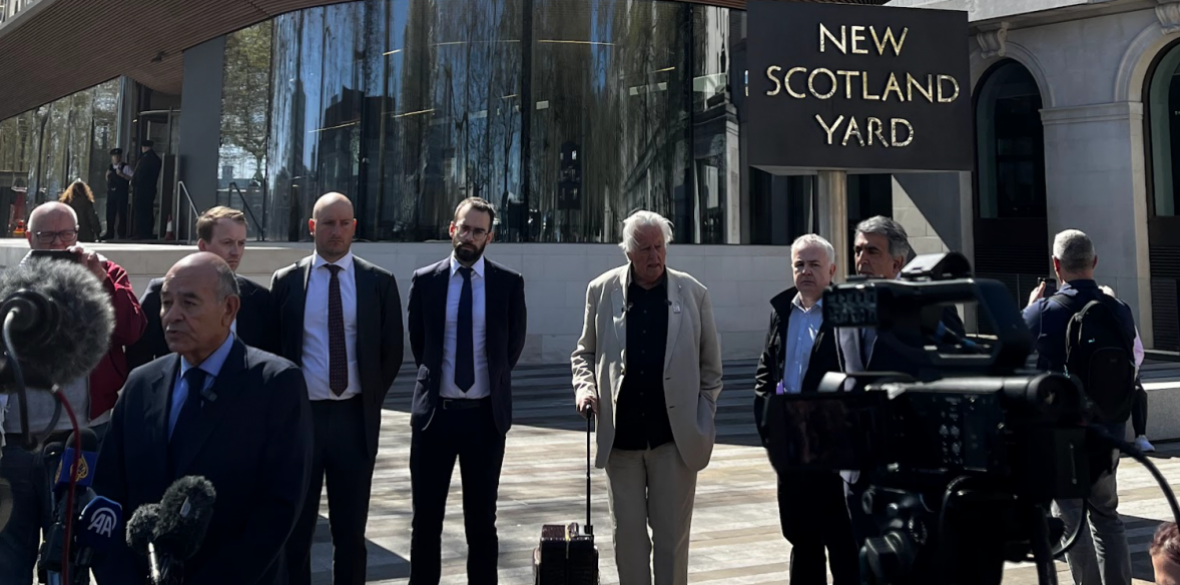
DOSSIER: The lawyers hand in the evidence to New Scotland Yard
POLICE are assessing evidence that 10 British nationals committed war crimes in Gaza including sniping down children and aid workers.
Lawyers handed evidence accusing the group of the murder and torture of civilians while on active service with the Israeli military to the Metropolitan Police’s war crimes unit yesterday.
Speaking outside New Scotland Yard, they said their 240-page dossier is “just the tip of the iceberg,” with reports of more than 100 Britons having served with Israeli Defence Forces (IDF) since October 2023.
Nearly 100 legal and human rights experts have signed a letter urging the War Crimes Team to investigate the dossier by the Palestinian Centre for Human Rights (PCHR) and the Public Interest Law Centre (PILC).
PILC legal director and founder Paul Heron said that the report is based on six months of extensive evidence-gathering using open-source evidence and witness testimony.
It shows 10 Britons “committed war crimes and crimes against humanity while serving for the Israeli military on active service in Gaza,” he said.
SINCE the Netanyahu government engineered the collapse of the ceasefire, Israel’s crimes in Gaza have escalated horrifically, killing 400 people in one night and more than 100 children a day on average since last month.
Israel has been exposed executing paramedics and rescue workers and hiding their bodies and vehicles and has killed more journalists during the genocide than died during the US civil war, both world wars, Korea, Vietnam, Cambodia, Laos, Yugoslavia, Afghanistan and Russia combined.
Police wait for migrants to disembark in the port of Catania, Italy, 2023 | Fabrizio Villa/Getty Images. All rights reserved
Deploying ‘anti-mafia’ tactics against migrants and those standing in solidarity with them is solving nothing
In November 2023, Italy’s prime minister, Giorgia Meloni, gathered the country’s top prosecutors at the headquarters of the powerful anti-mafia and anti-terrorism directorate, the DNAA. The far-right leader flattered them, boasting about the Italian judiciary’s global prestige.
“Italy used to export mafia,” she said. “Now it exports anti-mafia.”
She was trying to smooth over tensions around her government’s plans to limit the powers of organised crime investigators. Yet there was more to Meloni’s statement than she perhaps realised.
Over the past decade, the DNAA shifted focus from fighting Italy’s mafia to tackling undocumented migration. The directorate became central to Europe’s response – a hub for national police forces and European agencies like Frontex and Europol to exchange and refine anti-migration tactics.
The DNAA’s success lay in its apparent ability to throw investigative findings behind an idea that politicians were keen to believe: that undocumented migration is essentially a matter of organised crime and should be dealt with as such. A prosecutor in Palermo branded this approach “the Italian job” – but Italy wasn’t alone in this effort.
In recent years, many European border countries have seen an explosion of court cases against people thought to facilitate migration in some way. Driving a dinghy, providing shelter or medical assistance, even receiving a distress call from a sinking boat is now enough to make someone vulnerable to prosecution.
Migrants, as always, have been the main targets. But prosecutors have also set their sights on European activists and aid workers in what can be described as a campaign to criminalise solidarity.
Since 2013 this judicial policy has been turbocharged with unprecedented funding, but its roots stretch back over two decades. The technical and legal groundwork was laid after the fall of the Soviet Union and reinforced following the 11 September 2001 attacks in the United States – an inflection point that saw migration become ever more intertwined with security concerns.
The policy has run long enough to be assessed. And, at least at the practical level, it has been a complete failure.
Searching for a mafia to take down
Critical smuggling scholars agree that large, hierarchical smuggling rings are rare. Their contribution to migration flows is insignificant. The vast majority of migration facilitation instead comes from loose chains of actors who do not share a common employer. A migrant finds somebody who can help with a step or two, and then finds someone new to help with the next step, building out this ‘chain’ as they go along.
European prosecutors ignore these inconvenient truths about migration, but that doesn’t change the result. Smuggling ‘kingpins’ are not ending up in the dock, and the people who do are rarely worth the judge’s time.
European governments used to conceal these deals, with investigative journalists scrambling to dig them up. But they are now official policy
The failure of this policy is not lost on its proponents. They are well aware of the reports that confirm these findings. So when it comes to reducing the number of undocumented arrivals, politicians resort to much cruder methods than the formalities of court procedures, such as so-called ‘border externalisation’ policies.
These are bilateral agreements between European states and various foreign entities in what Europe labels transit countries – governments, militias, autocratic rulers, law enforcement bodies, and security services. They typically include provisions for military equipment, technology, training, political support, and fat contracts for European and local companies and aid agencies.
In return, beneficiaries commit to intercepting, incarcerating, or taking back undesired migrants. European governments used to conceal these deals, with investigative journalists scrambling to dig them up. But they are now official policy, having shown some effectiveness in curbing migration flows, at least along specific routes and long enough to scrape through an election year.
So if the campaign against migration and solidarity offers, at best, a short-term dip in movement in some places but no real long term results, why is it pursued with such fervour? Authorities claim it’s about justice: smugglers exploit migrants in distress for profit and migrants infringe on a country’s sovereignty by entering without permission, both of which are morally unacceptable. They can’t just let that slide.
Campaigners take a different view: criminalisation, they argue, serves as a political tool to deflect blame from the real culprits of migrants’ suffering. “Tens of thousands have died at Europe’s borders over the last two decades,” says Sara Traylor, an activist in Palermo. “Policymakers push the false narrative that punishing facilitators of border crossings will solve this crisis. But these deaths stem directly from Europe’s closed doors and neo-colonial policies.”
Making a smuggler
Traylor co-authors “From Sea to Prison,” a report tracking the arrests of individuals accused of being “crew” on small dinghies arriving in Italy. Her group in Palermo is part of the broader European Captain Support network, a coalition of grassroots organisations providing information and legal support to those accused of maritime smuggling.
“Since 2013, nearly 3,000 people have been arrested in Italy alone,” she said. “Thousands more have faced similar fates in Greece and Spain. The UK and France have also stepped up prosecutions for those attempting to cross the Channel.”
The Captain Support network often highlights blatant miscarriages of justice. Their “Free the footballers” campaign seeks to exonerate eight asylum seekers from Libya, Tunisia, Syria and Morocco serving 30-year sentences in Italy. Included among them are professional football players. Arrested in 2015 and accused by the DNAA branch in Catania of steering a dinghy where 49 people suffocated, they were identified by witnesses who received residence permits for their cooperation. Initial testimonies had denied the presence of smugglers.
In court, it emerged that suspects were pre-selected based on their appearance on a military rescue boat. Frontex officers found them “suspicious” due to their clothes, and they had stood out to the Italian police on board “because of their lighter skin”. Witness statements collected by the police were nearly identical, with entire sections copied and pasted, and were largely retracted in court. Interpreters often didn’t speak the right languages.
Yet despite evidence that at least five were paying passengers, their sentences were upheld. A final ruling this April said only a presidential pardon could address the “disparity” between the sentence “and the moral dimension of their actual culpability”.
A volunteer rests as migrants disembark in Salerno, Italy in July 2023 | Ivan Romano/Getty Images. All rights reserved
According to Traylor, this case is not extreme: police interrogations after traumatic crossings, manipulated witness statements, lack of interpreters, inadequate legal defence, and the use of intimidation or inappropriate incentives to secure cooperation are recurrent in smuggling cases.
Traylor doesn’t claim that everyone helped by the Captain Support Network is innocent in a legal sense; a few may have acted for profit, but avoiding profit motives doesn’t prevent convictions. “Criminalised individuals come from diverse backgrounds and motivations,” she said. “The only common factor is that they’re accused of helping someone to cross a border.”
“The term ‘Captains’ restores agency to those on the move, who often don’t see smugglers as morally reprehensible,” she said. “Sometimes, boat drivers are even celebrated as heroes.”
The views Traylor holds today are considered fringe. They were once mainstream.
Shifting perceptions
In 1980, the highest criminal court in Germany heard a peculiar smuggling case. The smuggler was the plaintiff, and was referred to as an “escape helper”. He had sued a refugee for unpaid fees after a failed attempt to transport him from East to West Germany.
The court ruled the fees must be paid with interest, stating the refugee had made “use of his fundamental right to freedom of movement” and that helping someone exercise this right, even for profit, “does not in principle act contrary to morality.”
The court backed the Berlin Senate’s view that smuggling becomes criminal only when “capitalising on the personal distress of others” turns into “a permanent source of considerable income”.
Since then, the notion of what warrants criminal punishment has stretched to absurd extremes. It now includes everything from walking up to a border unaided to being related to someone crossing illegally, or even posting on social media about wanting to cross.
Refugees, once seen as freedom-seekers, have become ‘undesirable’ economic threats
In June 2022, 23 migrants were killed in clashes with Spanish and Moroccan security forces while trying to enter the Spanish enclave of Melilla. Though the victims had reached the border on foot, Pedro Sanchez, the Spanish prime minister, blamed “human trafficking mafias” for the tragedy.
Later that year, Tunisian mothers protesting the mass drowning of migrants were met with a shocking response: Vincent Cochetel, a special envoy for the UN’s refugee agency (UNHCR), suggested “symbolically prosecuting parents for putting at risk their children.”
Just weeks ago, the Moroccan government, eager to appease Spain in externalisation talks, arrested 60 teenagers for social media posts about swimming to Ceuta, a Spanish town on the North African coast. They even placed barriers to prevent access to the sea in towns near the enclave.
This massive shift in perceptions is often traced to the post-Soviet era: refugees from the Eastern Bloc pouring into Western Europe, once seen as freedom-seekers, transformed into ‘undesirable’ economic threats. In this period European countries tightened asylum and visa laws, forcing refugees into illegal routes.
By the late 1990s, an influx of mostly Kurdish refugees from Iraq raised alarm in Germany, where politicians started to speak of “illegal immigration organised by criminal gangs” and pressured coastal states like Italy and Greece for tougher action against smugglers. Around the same time, Italy began prosecuting Kurds arriving by boat. And in the UK, a report from the late 1990s found that courts in coastal towns were seeing “two or three trials for facilitating illegal entry every week”, with sentences ranging from one to three years.
This process accelerated dramatically after the 11 September 2001 attacks. In Western political discourse, migrants became increasingly associated with security threats and terrorism. But political rhetoric alone doesn’t explain these changes.
In his seminal study of the subject, The Politics of Insecurity: Fear, Migration and Asylum in the EU, French sociologist Jef Huysmans argued that security agencies played a pivotal role in constructing migration as a criminal threat. Political visions, he noted, rely on “evoking fears and emergencies” while offering “credible methods” to control these insecurities. Security agencies then step in, using their expertise to provide competing solutions to the problems politicians present.
Italy’s DNAA proved to be a master in this game.
Power grab
On 3 October 2013, over 360 people, mostly from Eritrea and Somalia, drowned off the coast of Lampedusa. Authorities ignored their overloaded boat for hours, until a passenger lit a makeshift torch that sparked a fire, capsizing the vessel.
Days later, in an official resolution, EU leaders declared that the tragedy “had shocked all Europeans”. To avoid more deaths, they pledged to “step up the fight against trafficking and smuggling.”
DNAA prosecutors were already at work to make that happen. The previous day they had met in Rome for the first in a series of “coordination meetings to fight maritime illegal immigration”. These meetings came to be attended by Frontex, Europol and Eurojust representatives alongside Italian law enforcement. The DNAA leveraged the credibility it had gained from decimating Cosa Nostra to assert its ability to tackle this new security threat.
That anti-mafia prosecutors could claim jurisdiction over undocumented migration, though, wasn’t a given. Before 2013, the DNAA’s remit was limited to trafficking, where people are forced across borders for exploitation, often through organised networks. Smuggling, however, involves voluntary crossings and is an offence against border laws, not people.
The Lampedusa disaster blurred this line: the journey was so deadly it seemed no one would take it willingly. With the public still emotional and desperate for solutions, the DNAA made the most of this confusion.
Handbooks said investigators should exploit the emotionally charged moments after a rescue, targeting the “weakest subjects” for statements against boat drivers
After the first meeting, the agency published guidelines expanding Italy’s jurisdiction into international waters for anti-smuggling operations. By invoking laws ranging from the slave trade era to the American war on drugs, they framed migration as part of a broader criminal continuum.
These guidelines referenced provisions of the 1958 Geneva Convention allowing high-seas police operations against the slave trade and piracy; the 2002 EU Facilitators Package that criminalises aiding undocumented entry and stay; and even the Reagan-era Maritime Drug Law Enforcement Act.
Subsequent governments codified the DNAA’s expanded role. After the 2015 Paris attacks, the agency was granted the anti-terrorism mandate (“thanks to the work we did from 2013 on,” said Franco Roberti, then DNAA chief). Two years later it was assigned migrant smuggling.
With the jurisdictional groundwork in place, the DNAA moved on to securing arrests. Working with police and European navies, they formalised the investigative methods at work in the case of the Libyan football players.
Law enforcement handbooks advised identifying smugglers based on details like clothing and attitude toward the police. They also said investigators should exploit the emotionally charged moments after a rescue, targeting the “weakest subjects” for information and witness statements against boat drivers. Because civil rescue ships operated by NGOs interfered with this activity, in a 2017 coordination meeting attended by EU law enforcement the DNAA top brass discussed charging them with aiding and abetting smuggling.
The arrests made through these methods led to outlandish stories eagerly reported by the media: smugglers branding migrants’ heads with knives, boat drivers tossing a toddler overboard to hinder rescue efforts of their own sinking boat, and human rights activists making under-the-table deals with traffickers. Though debunked in court, these accounts made lasting impressions on the public. And because they targeted people arriving in Italy on dinghies, those arrested weren’t even smugglers or traffickers.
The only high-profile target of the DNAA was the alleged trafficking kingpin Medhanie Yedhego Mered, an Eritrean accused of organising numerous sea journeys from Libya. The investigation, a collaboration between the DNAA and the UK’s National Crime Agency, culminated in a dramatic press conference announcing Mered’s arrest in Sudan.
However, it soon emerged that the man flown to Palermo from Khartoum on a military jet was actually Medhanie Tesfamariam Berhe, a carpenter from Asmara. Prosecutors held him in prison for three years before partly admitting the mistake.
Calogero Ferrara, the DNAA prosecutor behind the case and the proponent of the “Italian job” approach, responded by wiretapping Guardian journalist Lorenzo Tondo, who exposed the error, and later sued him for libel. He recently called to strengthen international legislation against migrant smuggling.
In a 2022 interview, even Franco Roberti, the former DNAA boss, recognised that the anti-migration strategy put in place after the Lampedusa shipwreck was a failure. But, he attributed it to a lack of cooperation from foreign police rather than any conceptual shortcoming. Lessons were not learnt.
Doubling down
After yet another shipwreck killed at least 94 people 150 metres from the Italian shore in February last year, Giorgia Meloni’s government doubled down once again. This time it established unprecedentedly high prison terms for those convicted of smuggling. Last January, she asked the DNAA to start investigating regular migration flows for potential document fraud as well.
Keir Starmer, the UK prime minister, recently visited Italy to learn more about the Italian model of combating irregular migration. At a joint press conference, Meloni said that she and “Starmer agree that the first thing to do is to step up the fight against the trafficking in human beings”. She emphasised that Italy’s strategy was inspired by Giovanni Falcone, the judge murdered by the Sicilian mafia in 1992 shortly after founding the DNAA, and called for a stronger role for Interpol and Europol in anti-smuggling efforts.
Starmer concurred, spelling out the goal of his Italy trip: “to share intelligence, share tactics, shut down smuggler routes, and smash the gangs”.
And around we go.
Explore the rest of the series
This series looks at how the UK, EU and bordering countries are increasingly treating migration as a criminal offence, and targeting migrants and solidarity actors in the name of ‘anti-smuggling’ and ‘border control’.


 Ward Nar (left) reacts as she speaks with the photographer after returning empty-handed from attempting to receive donated food for her family, including her husband Mohammed Zaharna (centre right) and their children, Sally (right) and Raed, at a communit