Temperatures above 15C ‘very strange’ say scientists, as snow melts and rain falls on glaciers in usually frozen region
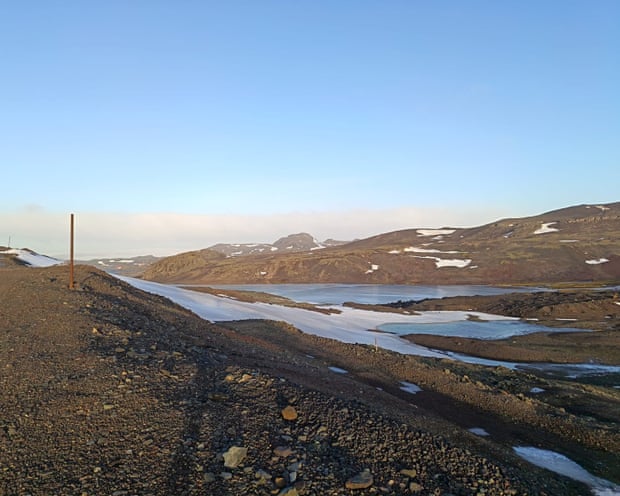
On King George Island the landscape has changed from mostly white to brown, grey and green. Photograph: Luis Muñoz
Temperatures in the Antarctic climbed above 15C this month, shattering the previous winter heat record for the usually frozen region and raising concerns about the speed of climate breakdown.
The new winter peak temperature was logged by the Argentinian Esperanza base on the Trinity peninsula on 6 June amid a protracted heatwave, when the maximum daily temperature exceeded zero degrees for three consecutive weeks.
Scientists said the high of 15.4C broke the previous record set at the same station in 1998 by 2C. “This is absolutely crazy,” said Raúl Cordero, an Ecuadorian climate professor at the University of Groningen. “It is also about 20C above normal for this time of the year. That is a huge anomaly.”
Unusually strong warm winds from the north blew across much of the Antarctic peninsula. One Chilean weather station, Boonen Rivera, registered temperatures of close to 13C, Cordero said.
On King George Island, 100 miles (160km) from Esperanza, researchers said the landscape had changed from mostly white to brown, grey and green after temperatures hit 4.6C on 6 June.
“Last weekend was very strange. The temperatures here went very high so everything outside melted,” said Luis Muñoz, a Chilean glaciologist. “Usually there is 20cm of snow and a lot of ice on the ground at this time.”
Nigel Farage urges you to ignore facts and reality and be a climate science denier like him and his Deputy Richard Tice. He says that Reform UK has received £Millions and £Millions from the fossil fuel industry to promote climate denial and destroy the planet.Donald Trump urges you to be a Climate Science denier like him. He says that he makes millions and millions for destroying the planet, Burn, Baby, Burn and Flood, Baby, Flood.Elon Musk urges you to be a Fascist like him, says that you can ignore facts and reality then.
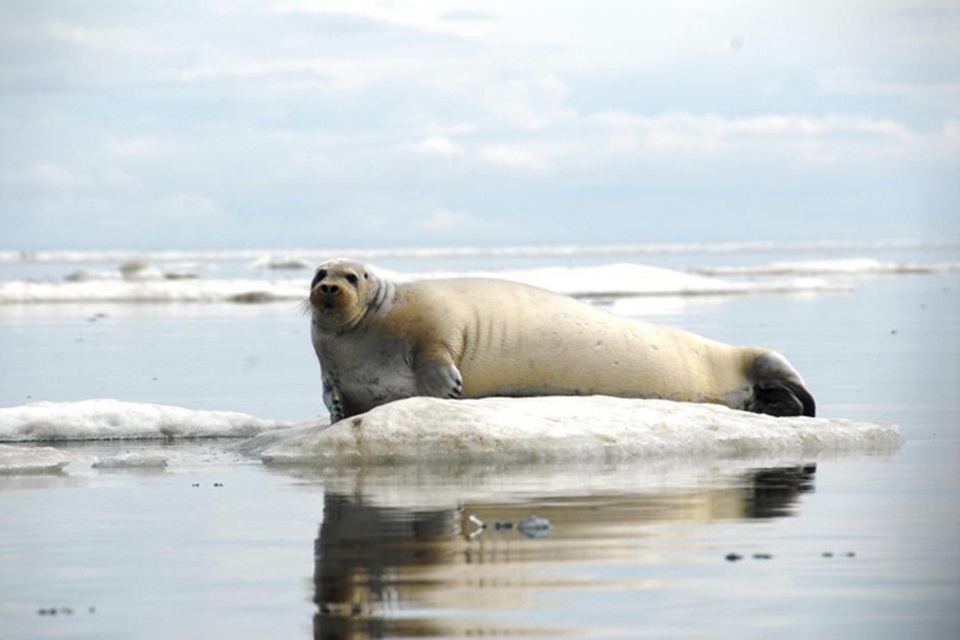
A bearded seal on ice off the coast of Alaska. | John Jansen / National Oceanic and Atmospheric Administration’s Alaska Fisheries Science Center
The Arctic is rapidly heating up, and that’s already spelled trouble for other parts of the world. 2023 has become the warmest year since 1900, and now, at the Earth’s southernmost point, an iceberg three times the size of Manhattan has broken away—and it’s on the move. When it comes to the ravaging effects of global warming, the world’s poles have proven themselves to be Exhibit A.
On Dec. 12, the annual Arctic Report Card was released by the National Oceanic and Atmospheric Administration. It found that the Arctic is warming four times more quickly than the world’s average, chiefly as a result of climate change caused by the burning of fossil fuels. The effect of that has already been felt south of the region, with Juneau, Alaska, stricken by a glacial outburst flood and Canada enduring a record year of devastating wildfires. Experts say the changes in the Arctic are early signs of what to expect globally as the planet’s temperature continues to increase.
And then there’s A23a. That’s what scientists have called the icy behemoth that was dislodged from an Antarctic ice shelf and—since 2020—has been wending its way through the sea; as of November, it was observed moving past the Antarctic Peninsula’s northern tip and approaching the Southern Ocean. The iceberg is about 1,500 square miles in size. It and other ice shelves are breaking off at rapidly increasing rates due to the climate crisis, and experts are concerned about the implications of its movement.
“It’s just astonishingly big, and it’s a reminder of how much risk we’re at from sea level rise,” said sea scientist Robbie Mallett, an honorary research fellow at the University of College London. “Antarctica has historically been quite a small contributor to sea level rise, but it is growing, and it is taking up a bigger and bigger share of the sea level rise that we see every year. So, it’s a symbol of the growing dominance of Antarctica in the sea rise equation.”
This is such a critical matter because it’s a symptom of a much larger and more worrying issue. The World Meteorological Organization (WMO) described it as a “deafening cacophony” of record-breaking that is fueled by global warming, and said that it was putting mankind in jeopardy of losing the fight to control sea level rise.
WMO Secretary-General Professor Petteri Taalas remarked, “We risk losing the race to save our glaciers and to rein in sea level rise. We cannot return to the climate of the 20th century, but we must act now to limit the risks of an increasingly inhospitable climate in this and the coming centuries. Extreme weather is destroying lives and livelihoods on a daily basis, underlining the imperative need to ensure that everyone is protected by early warning services.”
Gail Whiteman, professor of sustainability at the University of Exeter, described it this way: “The Antarctic used to be seen as this sleeping giant, nothing was happening. It was just big and really cold – that’s my non-scientific way of saying it. And now it’s clear based on the sea ice that it is actually destabilizing. The discussion here should be about the polar regions because they are flipping first, and once they do, the issue of adaptation becomes that much more critical.”
Back up north, ice sheets are causing just as much concern; in Greenland, they’re melting. That nation lost an amount of ice in 2022 that could have covered West Virginia in a foot of water, according to reports. The vanishing ice is also creating an unfortunate self-perpetuating cycle: sea ice reflects solar energy back into space, but as it melts, the dark water of the ocean absorbs that heat – meaning that the more it melts, the more quickly the entire process accelerates.
These simultaneous events are, at the end of the day, proof of one thing: “Climate change is not something that’s coming down the pipe somewhere in the future,” said Daniel Schindler, an ecologist at the University of Washington. “Whether you’re talking about fish, or people, or birds, there are going to be real impacts that we need to deal with right now.”
Two-thirds of Antarctica’s native species, including emperor penguins, are under threat of extinction or major population declines by 2100 under current trajectories of global heating, according to new research that outlines priorities for protecting the continent’s biodiversity.
The study, an international collaboration between scientists, conservationists and policymakers from 28 institutions in 12 countries, identified emperor penguins as the Antarctic species at greatest risk of extinction, followed by other seabirds and dry soil nematodes.
“Up to 80% of emperor penguin colonies are projected to be quasi-extinct by 2100 [population declines of more than 90%] with business-as-usual increases in greenhouse gas emissions,” it found.
Published in the journal Plos Biology, the research also found that implementing 10 key threat management strategies in parallel – which would cost an estimated US$23m annually – could benefit up to 84% of Antarctic organisms.
…
Emperor Penguins Huddle for Warmth | Nature on PBS