Tag: arrest

  • Around the world, people fight for Palestine as authorities crack down

    Spread the love

    Article by Nandini Naira Archer republished from OpenDemocracy under under a Creative Commons Attribution-NonCommercial 4.0 International licence.
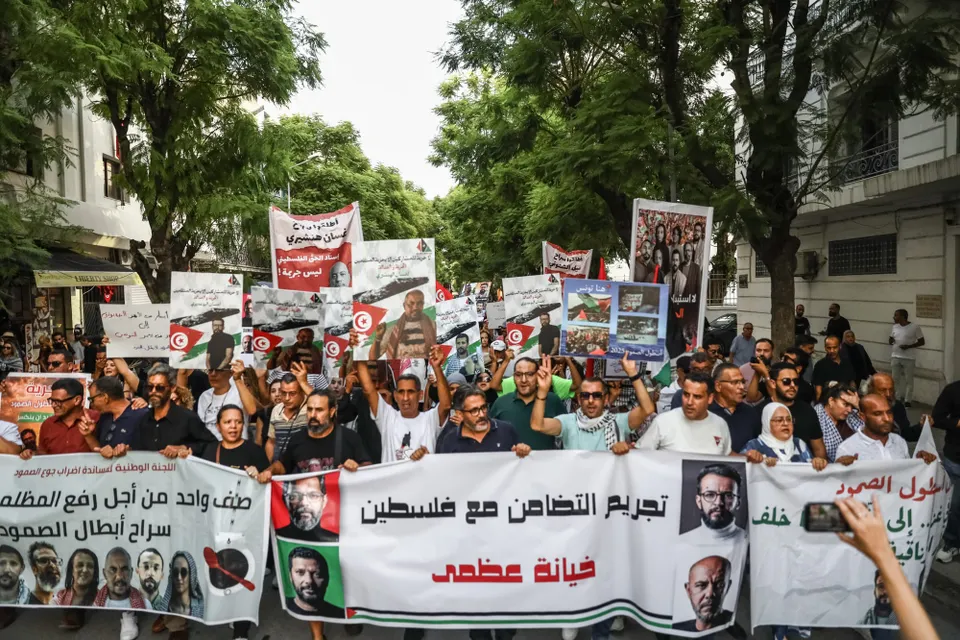
    Demonstrators at the ”National March” in Tunis, Tunisia, on September 19, 2026 | Chedly Ben Ibrahim/NurPhoto/Getty Images

    Wael Naouar has been refusing food since 16 August this year. More than five weeks into his hunger strike, supporters say the Palestinian rights activist imprisoned in Tunis, in a semi-conscious state and on the brink of death: Naour, who is Tunisian, has lost more than 20kg, is struggling to breathe, is fainting repeatedly and suffering from hallucinations. 

    Naouar is not alone, Nabil Channoufi, Ghassan Henchiri and Ghassan Boughdiri — three other activists imprisoned alongside Naouar — have also joined his hunger strike.

    Their alleged crime? 

    Helping organise the 2025 Global Sumud Flotilla, a Palestine solidarity mobilisation in which hundreds of activists from around the world gathered in Tunisia, before setting sail for Gaza in an attempt to break Israel’s illegal siege blockade of the embattled region to provide vital supplies of food and medicine to an embattled population.

    The flotilla — which comprised over 40 ships — never made it to Gaza, but succeeded in refocusing the world’s attention on  the UN-designated genocide perpetrated on the Palestinian people by the Israeli state.

    The story of Naouar’s arrest, his subsequent hunger strike, and the support he and his comrades have received from a wide cross-section of Tunisian society including the Tunisian League for the Defence of Human Rights, the Tunisian General Labour Union and the Tunisian National Bar Association, reveals how the global grassroots movement to demand justice and freedom for Palestinians shows no sign of abating even as many national governments in across the world either chosen silence, or have bowed to pressure from the United States and Israel to crackdown on their own citizens. 

    Around the world, including here in the UK, citizens urging their governments to take action face torture, arrest, prosecution and lengthy prison sentences.

    Earlier this month, Bassem Trifi, president of the Tunisian League for the Defence of Human Rights, visited Naouar in prison with an appeal signed by the Tunisian League for the Defence of Human Rights, the Tunisian General Labour Union and the Tunisian National Bar Association, urging him to stop the hunger strike and preserve his life.

    “His health has deteriorated dramatically and his condition is extremely alarming,” Trifi said at the time, adding that Naouar thanked the organisations and activists supporting him but said his hunger strike would continue until “the injustice imposed upon him and his comrades is lifted.”

    When Solidarity is a Crime

    In Tunisia, the preparations for the 2025 Sumud Flotilla were far from clandestine. Local activists reached out to the relevant Tunisian authorities to seek permission to charter ships and purchase medicines, baby formula and other humanitarian supplies for Gaza, Ghassan Bouazzi, a member of the National Committee for the Defense of the Sumud Flotilla Activists and the Palestinian Cause, told openDemocracy.

    The authorities neither approved nor rejected the application, Bouazzi said, and so the organisers proceeded.

    In September 2025, hundreds of activists descended on Tunisia to prepare the flotilla, organisers spoke to journalists, held public gatherings and coordinated with police and security officials around Sidi Bou Said port, where the boats assembled.

    “The collection of donations, the organisation of the flotilla and, before that, the organisation of a land-based aid convoy… all took place openly and in full view of the Tunisian authorities,” Bouazzi said, adding that the organising headquarters was barely 500 metres from the interior ministry.

    The state did more than simply know about the mobilisation, he continued, “The Tunisian state was, in some sense, a party to the flotilla’s departure, and was fully aware of the entire process through which it was organised.”

    Ships from the global flotilla began departing for Gaza from Italy and Spain in late August 2025, and were joined by vessels from Greece and Tunisia in early September that year. On the night of September 24, several vessels were attacked by drones and the Israeli crackdown swung into full force.

    Back in Tunisia, the mood of the authorities had begun to shift as well.

    In January 2026, Naouar and other organisers in Tunis began publicly discussing preparations for a second flotilla. The following month, organisers submitted an application to the authorities, Bouazzi said. This time, permission was denied.

    Weeks later, the arrests began. 

    The authorities claimed those organising Sumud 2025 had committed fraud, falsification of documents and money laundering. Investigators have since scrutinised the detainees’ bank accounts, assets and financial transactions, as well as those of some relatives, according to Bouazzi. He said that, to his knowledge, the investigation had established no unexplained enrichment or links to money-laundering networks thus far. 

    Seven organisers were initially detained in March. Three have since been released. Naouar, Channoufi, Henchiri and Boughdiri remain in Mornaguia prison.

    Within 48 hours of their arrests, supporters established the National Committee for the Defense of the Sumud Flotilla Activists and the Palestinian Cause. Since then, campaigners have organised repeated protests calling for their release.

    Last week, protesters marched through central Tunis from the headquarters of the Tunisian National Journalists’ Union to Avenue Habib Bourguiba, carrying pictures of the four detainees and calling for an end to the case.

    Then some of the protesters were arrested too.

    From the following night, police detained people who had participated in the demonstration, some from their homes and others from the street. Lawyers said at least 11 had been arrested, while activists put the number at 13 or more. 

    A judge subsequently authorised an additional 48 hours of detention for some of those arrested, whose lawyers said they had been questioned about slogans chanted during the protest. Tunisian authorities had not publicly confirmed the arrests at the time of writing.

    openDemocracy contacted the Tunisian authorities for comment but had received no response by the time of publication.


    Activists such as Bouazzai, have been trying to understand what is driving this recent crackdown.

    “The Tunisian authorities regard any independent movement with significant popular support and mobilisation as a threat to their power,” he said, “even when that movement is devoted to supporting the Palestinian people.”

    Naouar has a history of political organising beyond Palestine solidarity. He was imprisoned as a student under former dictator Zine El Abidine Ben Ali, later became secretary-general of the General Union of Tunisian Students and, shortly before his arrest this year, publicly criticised President Kais Saied.

    Human rights organisations have also raised wider concerns about pressure on Tunisia’s civil society, including the use of financial investigations, lengthy pre-trial detention and prosecutions of activists and NGO workers. Saied’s government has rejected accusations that the judiciary is being used against political opponents and says judicial proceedings are independent.

    That tension is particularly striking in Tunisia, where Palestine has historically commanded broad public support and Saied himself has repeatedly expressed support for the Palestinian cause.

    Bouazzi argues there is a growing gap between that rhetoric and the state’s treatment of independent organising around Palestine.

    He also believes external pressure and the wider geopolitical situation in the region may have played a role in the government’s changing approach, although he did not provide evidence of specific foreign intervention.

    For the movement campaigning outside the prison, the immediate demand remains straightforward: the four organisers should be released.

    “What we ask of our friends and of supporters of the Palestinian people around the world is to shed light on this injustice,” Bouazzi said. “International attention could create embarrassment and pressure on the Tunisian authorities and help secure the release of our detained comrades.”

    Article by Nandini Naira Archer republished from OpenDemocracy under under a Creative Commons Attribution-NonCommercial 4.0 International licence.

    Orcas discuss Donald Trump and the killer apes' concept of democracy. Front Orca warns that Trump is crashing his country's economy and that everything he does he does for the fantastically wealthy.
    Orcas discuss Donald Trump and the killer apes’ concept of democracy. Front Orca warns that Trump is crashing his country’s economy and that everything he does he does for the fantastically wealthy.
    Ed Miliband says that he and the Labour Party are full of shit criminalising people holding signs as terrorists despite anything he says.
    Ed Miliband says that he and the Labour Party are full of shit criminalising people holding signs as terrorists despite anything he says.
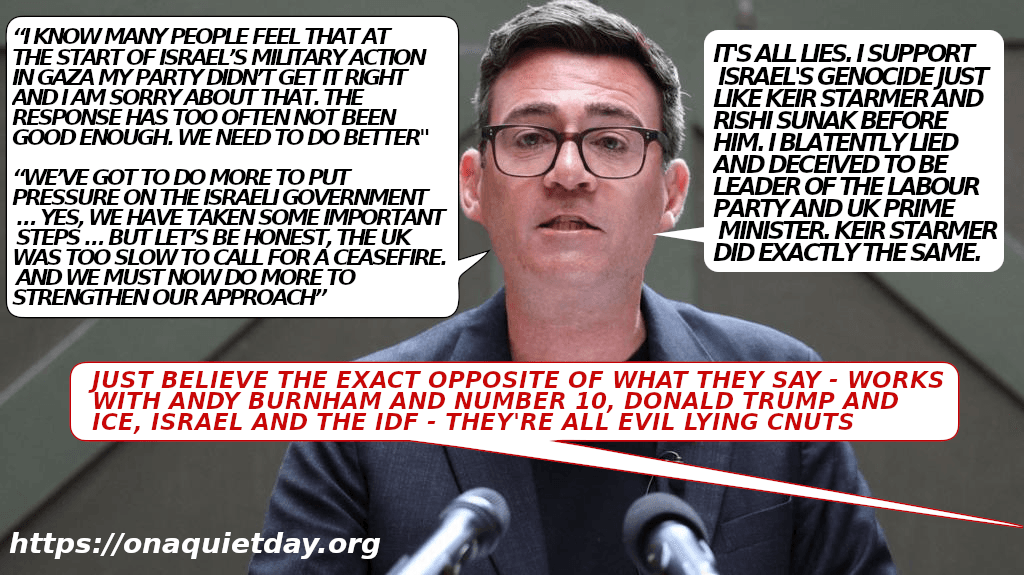
    UK Prime Minister Andy Burnham admits to blatently lying and engaging in deception to become leader of the UK Labour Party and Prime Minister.
    UK Prime Minister Andy Burnham admits to blatently lying and engaging in deception to become leader of the UK Labour Party and Prime Minister.
  • UK police arrest protesters after ban on Palestine Action goes into effect

    Spread the love

    This work by Middle East Monitor is licensed under a Creative Commons Attribution-NonCommercial-ShareAlike 4.0 International License. 

    Police arrest Palestine Action activist during a solidarity protest outside Royal Courts of Justice as co-founder of Palestine Action Huda Ammori takes Home Secretary to High Court over proscription of the group in London, United Kingdom on July 4, 2025. [Tayfun Salci – Anadolu Agency]

    Scores of protesters were arrested in London on Saturday after a ban on the group Palestine Action officially came into effect, Anadolu reports.

    The UK government will, for the first time, legally redefine a non-violent protest group, Palestine Action, as a terrorist organization after a last-minute legal challenge to suspend the group’s ban under anti-terrorism laws failed at a high court on Friday.

    As of this Saturday, membership in, or showing support for, Palestine Action will become a criminal offense in Britain.

    The Metropolitan Police confirmed on Saturday afternoon that officers were responding to a demonstration in Parliament Square and had begun making arrests.

    READ: AOHR UK calls on British Gov’t to sanction GHF officials

    “The group is now proscribed, and expressing support for them is a criminal offense,” the force said in a statement. “Arrests are being made.”

    Officers have arrested more than 20 people on suspicion of offenses under the Terrorism Act 2000.

    It added: “There are a number of events taking place in London this weekend and anyone attending should be aware that officers policing these will act where criminal offenses, including those related to support of proscribed groups or organizations, are committed.”

    MPs overwhelmingly voted in favor of Home Secretary Yvette Cooper’s decision to proscribe the group under the Terrorism Act 2000 on Wednesday. The House of Lords has also approved the move.

    UN experts, civil liberties organizations, cultural figures, and hundreds of lawyers have condemned the ban as “draconian.”

    They argue that it sets a dangerous precedent by conflating protest with terrorism.

    Palestine Action said it is seeking an “urgent appeal to prevent a dystopian nightmare, which criminalizes thousands of people overnight.”

    Another court hearing is scheduled for July 21, when Palestine Action will apply for permission to launch a judicial review in an effort to overturn the order.

    Unless the review is successful, being a member of or inviting support for the group that protests Israeli genocide in Gaza will carry a maximum sentence of 14 years in prison.

    Meanwhile, pro-Palestine activists disrupted the London Pride parade by covering a float in red paint.

    Four protesters from the group Youth Demand targeted a truck belonging to US-based company CISCO, accusing the firm of “genocide” and claiming it has “no place” at the event.

    The incident comes less than 24 hours after the protest group Palestine Action was officially banned and designated a terrorist organization.

    READ: Palestine Action again targets Israeli defense firm in UK amid risk of being placed on terror list

    This work by Middle East Monitor is licensed under a Creative Commons Attribution-NonCommercial-ShareAlike 4.0 International License. 

    Keir "I support Zionism without Qualification" Starmer supporting genocide.
    Keir “I support Zionism without Qualification” Starmer supporting genocide.
    UK Labour Party government ministers Keir Starmer, Angela Rayner and Rachel Reeves explain that they are partners complicit in Israel's Gaza genocide. The UK has provided Israel with arms, military and air force support. They explain that they don't do gas chambers but do do forced marches, starvation, destroy hospitals, mass-murders of journalists and healthcare workers.
    UK Labour Party government ministers Keir Starmer, Angela Rayner and Rachel Reeves explain that they are partners complicit in Israel’s Gaza genocide. The UK has provided Israel with arms, military and air force support. They explain that they don’t do gas chambers but do do forced marches, starvation, destroy hospitals, mass-murders of journalists and healthcare workers.
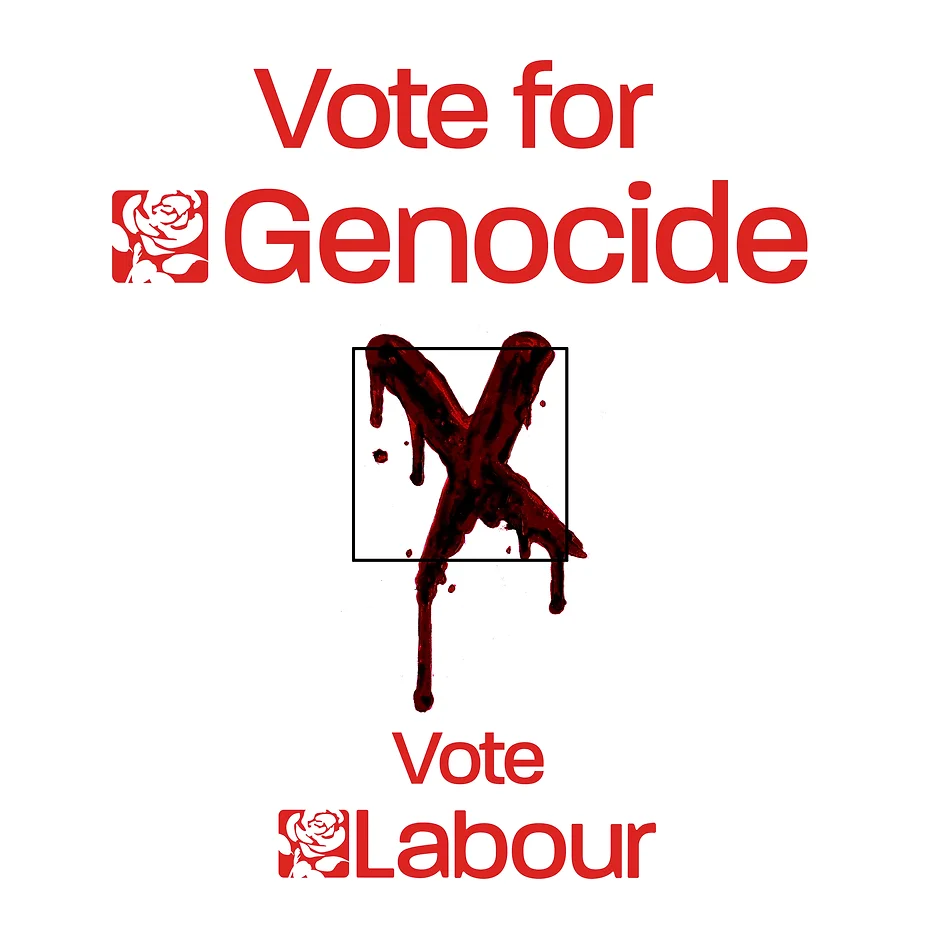
    Vote Labour for Genocide.
    Vote Labour for Genocide.
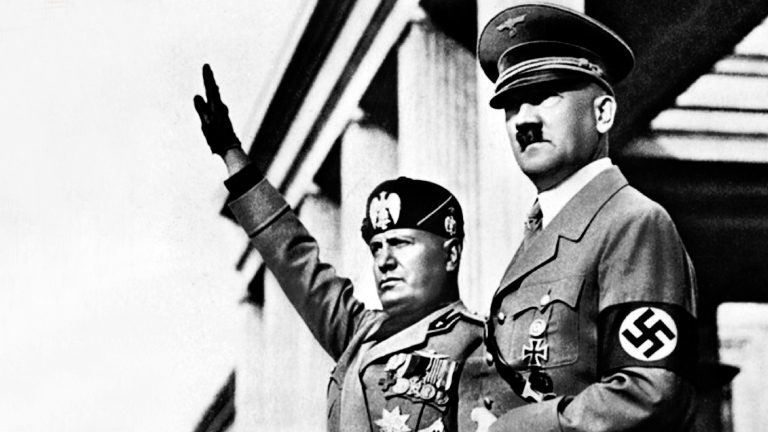
    Image of the original Fascists Mussolini and Hitler.
    The original Fascists Mussolini and Hitler

  • Far-Right Group Sent List of Palestine Defenders to Trump Officials for Deportation

    Spread the love

    Original article by Brett Wilkins republished from Common Dreams under Creative Commons (CC BY-NC-ND 3.0).

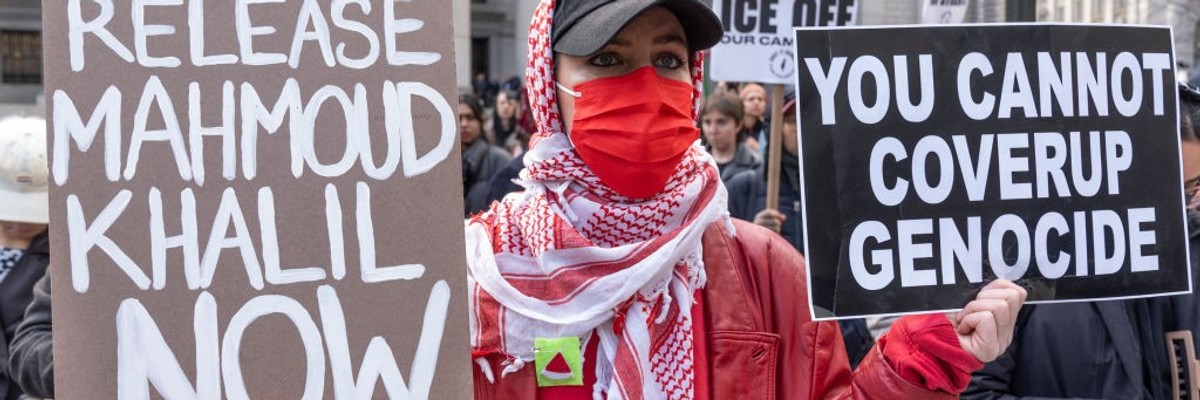
    A protester takes part in a March 12, 2025 demonstration calling for the release of Mahmoud Khalil, at Foley Square in New York City. 
    (Photo: Lev Radin/Pacific Press/LightRocket via Getty Images)

    Betar—which the pro-Israel Anti-Defamation League has blacklisted after comments like “not enough” babies were killed in Gaza—says it provided “thousands of names” for possible arrest and expulsion.

    Betar, the international far-right pro-Israel group that took credit for the Department of Homeland Security’s arrest of former Columbia University graduate student and permanent U.S. resident Mahmoud Khalil for protesting the annihilation of Gaza, claimed this week that it has sent “thousands of names” of Palestine defenders to Trump administration officials for possible deportation.

    “Jihadis have no place in civilized nations,” Betar said on social media Friday following the publication of a Guardian article on the extremist group’s activities.

    Earlier this week, Betar said: “We told you we have been working on deportations and will continue to do so. Expect naturalized citizens to start being picked up within the month. You heard it here first. Those who support jihad and intifada and originate in terrorist states will be sent back to those lands.”

    Betar has been gloating about last week’s arrest of Khalil, the lead negotiator for the group Columbia University Apartheid Divest during the April 2024 Gaza Solidarity Encampment.

    On Thursday, immigration officers arrested another Columbia Gaza protester, Leqaa Kordia—a Palestinian from the illegally occupied West Bank—for allegedly overstaying her expired student visa. Kordia was also arrested last April during one of the Columbia campus protests against the Gaza onslaught.

    On Friday, the Department of Homeland Security (DHS) said that Ranjani Srinivasan, an Indian doctoral student at Columbia whose visa was revoked on March 5 for alleged involvement “in activities supporting” Hamas—the Palestinian resistance group designated as a terrorist organization by the U.S. government—used the Customs and Border Protection’s self-deportation app and, according to media reports, has left the country.

    Khalil and Kordia’s arrests come as the Trump administration targets Columbia and other schools over pro-Palestinian protests under the guise of combating antisemitism, despite the Ivy League university’s violent crackdown on demonstrations and revocation of degrees from some pro-Palestine activists.

    U.S. President Donald Trump, who in January signed an executive order authorizing the deportation of noncitizen students and others who took part in protests against Israel’s war on Gaza, called Khalil’s detention “the first arrest of many to come.”

    The Department of Justice announced Friday that it is investigating whether pro-Palestinian demonstrators at the school violated federal anti-terrorism laws. This followed Thursday’s search of two Columbia dorm rooms by DHS agents and the cancellation earlier this month of $400 million worth of funding and contracts for Columbia because the Trump administration says university officials haven’t done enough to tackle alleged antisemitism on campus.

    On Friday, Betar named Mohsen Mahdawi, a Palestinian studying philosophy at Columbia, as its next target.

    Critics have voiced alarm about Betar’s activities, pointing to the pro-Israel Anti-Defamation League’s recent designation of the organization as a hate group. Founded in 1923 by the early Zionist leader Ze’ev Jabotinsky, Betar has a long history of extremism. Its members—who included former Israeli Prime Ministers Yitzhak Shamir and Menachem Begin—took part in the Zionist terror campaign against Palestinian Arabs and British forces occupying Palestine in the 1940s.

    Today, Betar supports Kahanism—a Jewish supremacist and apartheid movement named after Meir Kahane, an Orthodox rabbi convicted of terrorism before being assassinated in 1990—and is linked to Israeli Prime Minister Benjamin Netanyahu’s Likud Party. The group has called for the ethnic cleansing and Israeli recolonization of Gaza. During Israel’s assault on the coastal enclave, which is the subject of an International Court of Justice genocide case, its account on the social media site X responded to the publication of a list of thousands of Palestinian children killed by Israeli forces by saying: “Not enough. We demand blood in Gaza!”

    Ross Glick, who led the U.S. chapter of Betar until last month, told The Guardian that he has met with bipartisan members of Congress who support the group’s efforts, naming lawmakers including Sens. Ted Cruz (R-Texas) and John Fetterman (D-Pa.). Glick also claimed to have the support of “collaborators” who use artificial intelligence and facial recognition to help identify pro-Palestine activists. Earlier this month, the U.S. State Department said it was launching an AI-powered “catch and revoke” program to cancel the visas of international students deemed supportive of Hamas.

    Betar isn’t alone in aggressively targeting Palestine defenders. The group Canary Mission—which said it is “delighted” about Khalil’s “deserved consequences”—publishes an online database containing personal information about people it deems antisemitic, and this week released a video naming five other international students it says are “linked to campus extremism at Columbia.”

    Shai Davidai, an assistant professor at Columbia who was temporarily banned from campus last year after harassing university employees, and Columbia student David Lederer, have waged what Khalil called “a vicious, coordinated, and dehumanizing doxxing campaign” against him and other activists.

    Meanwhile, opponents of the Trump administration’s crackdown on constitutionally protected protest rights have rallied in defense of Khalil and the First Amendment. Nearly 100 Jewish-led demonstrators were arrested Thursday during a protest in the lobby of Trump Tower in New York City demanding Khalil’s release.

    “We know what happens when an autocratic regime starts taking away our rights and scapegoating and we will not be silent,” said Sonya Meyerson-Knox, the communications director for Jewish Voice for Peace. “Come for one—face us all.”

    Original article by Brett Wilkins republished from Common Dreams under Creative Commons (CC BY-NC-ND 3.0).

    Donald Fuhrump says that Amerikkka doesn't bother with crimes or charges anymore, not being 100% Amerikkkan and opposing his real estate intentions is enough.
    Donald Fuhrump says that Amerikkka doesn’t bother with crimes or charges anymore, not being 100% Amerikkkan and opposing his real estate intentions is enough.
    Elon Musk urges you to be a Fascist like him, says that you can ignore facts and reality then.
    Elon Musk urges you to be a Fascist like him, says that you can ignore facts and reality then.