Cuba Joins ‘Lego Resistance Front’ With Iran-Style Video Decrying Trump Warmongering

Spread the love

Article by Brett Wilkins republished from Common Dreams under Creative Commons (CC BY-NC-ND 3.0).
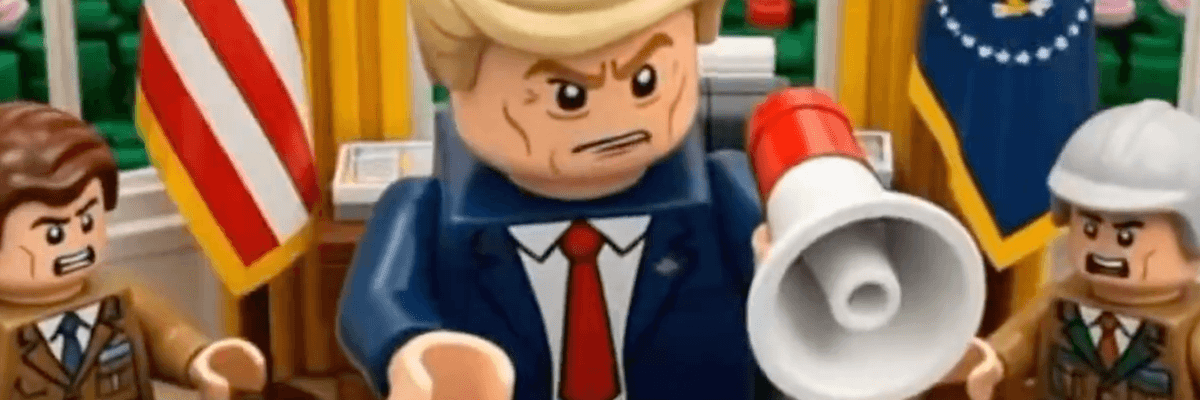
US President Donald Trump is depicted in a Cuba-themed Lego-style video inspired by the viral pro-Iran clip series. (Photo by screen shot/Tere Felipe/X)

Content creator María Teresa Felipe Sosa hailed Cubans as “a people who refuse to submit to the true regime of horror, which the United States represents, as it goes around starting wars throughout the world.”

As the team at Tehran-based Explosive Media keeps churning out viral artificial intelligence-generated Lego-style animated videos condemning the US-Israeli war on Iran, a Cuban version of the clips reacting to President Donald Trump’s threats to attack the island appeared Monday on social media.

First posted by Havana art historian and digital content creator María Teresa Felipe Sosa, the video was shared by users including US investigative journalist Ryan Grim and Explosive Media, which added, “Welcome to the #LRF Cuba,” or Lego Resistance Front.

RECOMMENDED…
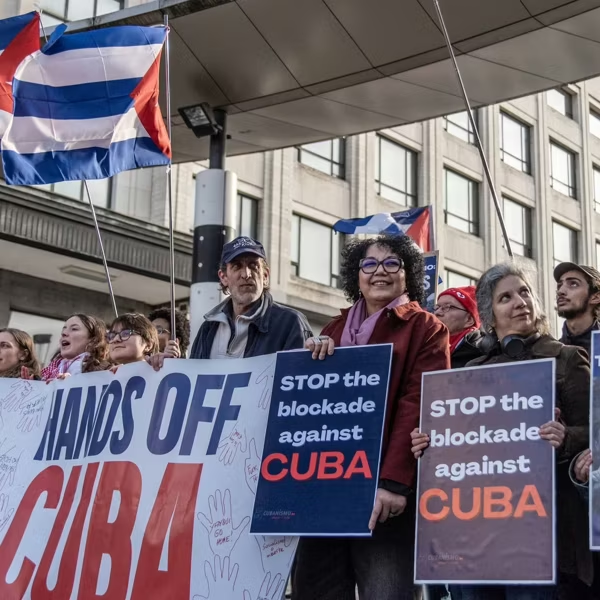
People protest against Trump aggression against Cuba with signs reading "Stop the Blockade Against Cuba"

‘This Is Insane’: Alarm Bells Follow New Report of Looming US Plan to Attack Cuba
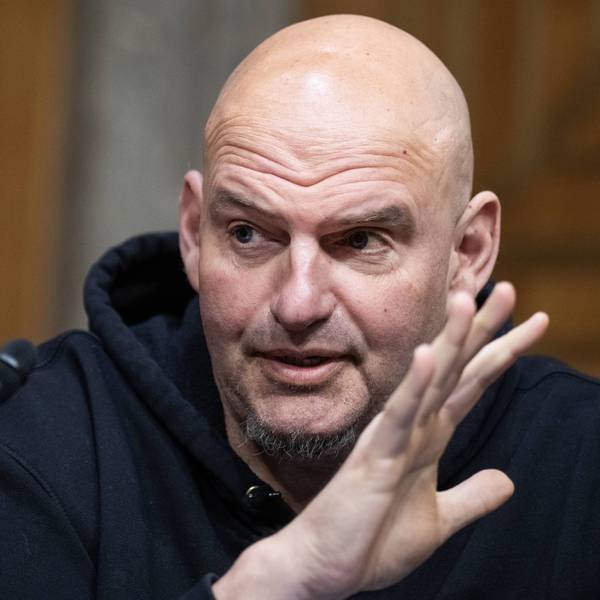
US Sen. John Fetterman in his hoodie in the Senate

Fetterman Helps GOP Senators Sink Democrat Effort to Block Trump War on Cuba

“The threat that Cuba represents to the United States is the dignity and principles of a people who refuse to submit to the true regime of horror, which the United States represents, as it goes around starting wars throughout the world,” Felipe said Tuesday on social media.

According to the video’s lyrics:

They seek to stifle the lifeblood of this land with the talons of empire and the drums of war, from the north they unleash their poisonous breath seeking to seize what belongs to others. But this soil has roots of steel and a people who cannot be bought with money.

They raise walls of hatred and lies while the island, relying on its own strength, breathes amid 60 years of constant hostile siege—yet we continue to march forward with a firm step. There is no threat that can break our faith; the Cuban knows well how to stand tall.

Here dignity has neither price nor master; we are the guardians of our own dream. My people, stand tall, with fists held high against the invader and their dark assault.

There’s no surrender beneath this burning sun, for it’s known that the homeland must be defended. Resist my brother with your head held high for every victory in the battle-hardened struggle, your love is the compass of our people, for you know that the homeland must be defended.

The video comes amid more than 65 years of US-based terrorismassassination attempts, and a tightened economic embargo targeting Cuba, as well as Trump’s threats to attack or “take” the island. Despite extreme hardship caused or exacerbated by these internationally condemned policies, the Cuban people have been resolute in their resistance to US aggression.

With no victory in sight in the US-Israeli war on Iran and the American people increasingly wary of yet another war of choice waged by the self-described “president of peace” who’s now attacked 10 countries over the course of his two terms in office, even some Republican lawmakers are warning Trump against attacking Cuba.

Asked if he would support such an attack, Sen. James Lankford (R-Okla.) told The Hill on Tuesday, “No, I would not.”

“There’s a lot of economic pressure you can put on Cuba that makes a big difference by itself,” the hawkish senator added.

Numerous Democratic lawmakers have consistently opposed any attack on Cuba; however Democratic Sen. John Fetterman (D-Pa.) recently helped sink a Senate war powers resolution aimed at blocking Trump from attacking the country.

More than 6 in 10 Americans surveyed by multiple pollsters in recent months said they oppose a US war on Cuba.

Responding to the renewed US menace under Trump, Felipe recently wrote that “the current threats aren’t anything new, they only confirm a dangerous insistence—that of replacing international law with the law of the strongest.”

“In the face of that, Cuba responds with an uncomfortable and persistent idea—its people does not give up,” she continued. “Cuba is not seeking confrontation. It demands respect. And history, although some prefer to ignore it, has been clear—independence is not negotiated under threat.”

“Once again,” Felipe added, “and against all imperial odds, Cuba will win.”

Article by Brett Wilkins republished from Common Dreams under Creative Commons (CC BY-NC-ND 3.0).
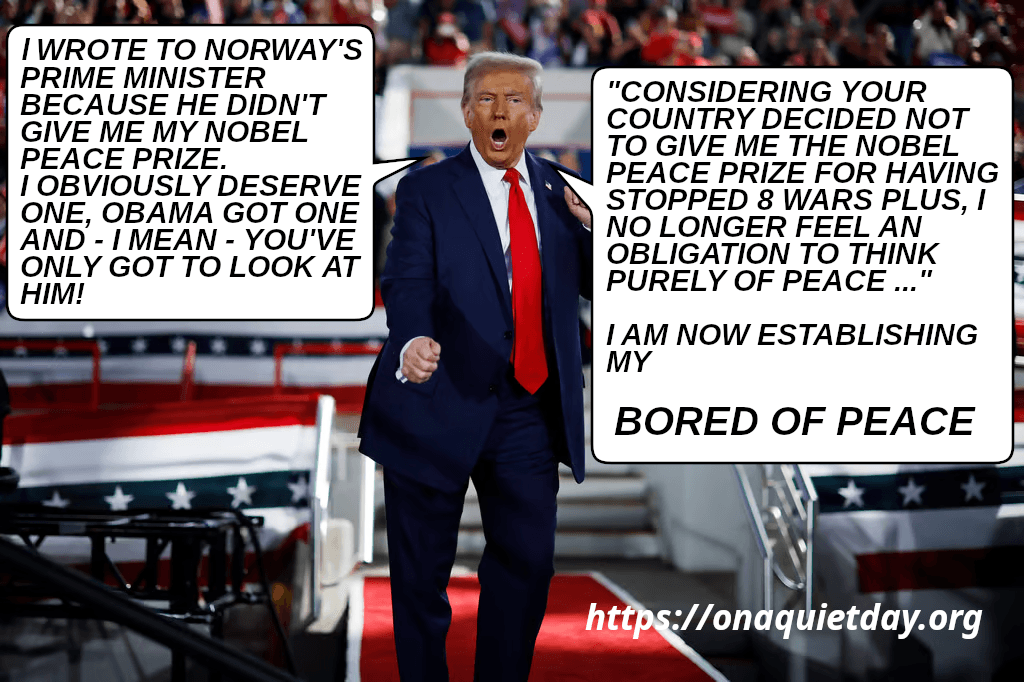
Donald Trump explains why he established his Bored of Peace
Orcas discuss rotting brain, front Orca says disinhibition and swearing are typical and common symptoms
Donald Trump warns against following the Onaquietday.org blog, says that he's heard that she's a witch with a black cat and a dangerous kitchen.
Donald Trump warns against following the Onaquietday.org blog, says that he’s heard that she’s a witch with a black cat and a dangerous kitchen.

Continue ReadingCuba Joins ‘Lego Resistance Front’ With Iran-Style Video Decrying Trump Warmongering

Mainstream media scales up attacks against Maduro ahead of Sunday’s elections

Spread the love

Original article republished from peoples dispatch under a Creative Commons Attribution-ShareAlike 4.0 (CC BY-SA) license.

Closing campaign rally of Nicolás Maduro in Caracas. Photo: Zoe Alexandra

Numerous international media outlets have stepped up attacks against Nicolás Maduro in a seemingly scripted manner with key messages that they seek to establish as the truth

On Sunday, the people of Venezuela will head to the polls to elect their next president. The 21 million eligible voters in Venezuela have the opportunity to pick between 10 candidates from a broad range of political parties and currents. The two projected front runners however, are from completely opposite ends of the spectrum: incumbent President Nicolás Maduro and candidate for the right-wing Unitary Democratic Platform, Edmundo González.

As election day comes closer, and international mainstream media pays more attention to what is happening in the Caribbean country, several dominant patterns have emerged in the discourse and messages of these outlets.

First of all, several media outlets have carried profiles of the leading candidates, and presented a very stark dichotomy. Maduro is authoritarian, González is democratic. Maduro is oppressive, González is free. In these profiles, when talking about Maduro, they will talk about the alleged amount of money and properties that he owns, but when profiling González, no such questions are asked.

When speaking of González, another type of framing is used, namely, that of the chosen one who was able to bring about the unity of an opposition that has historically had enormous difficulties in reaching minimum agreements. In this way, they want to present a worn out, questioned and “possibly” corrupt candidate (Maduro), while on the other hand, they want to show a peaceful, conciliatory, and ethically pristine candidate (Gónzález). This framing also erases the other eight opposition candidates who are running in these elections who also represent important political sectors. This has a very clear political intention, although not explicitly stated.

It goes without saying that there is almost no mention of the ferocious hybrid war which Venezuela has been subjected to for the last decade and how the Maduro government has endured coup attempts, assassination attempts, a near complete blockade on the country’s economy and oil production, and attempted invasions by paramilitary groups. In this situation of an almost constant political and economic siege, Maduro and his party United Socialist Party of Venezuela (PSUV) have not only been able to initiate remarkable economic recovery, but also have forged unity amongst the diverse political progressive tendencies which are under the broad umbrella of Chavismo. During the last several months, the socialist candidate has traveled to dozens of cities and towns across the country to meet with the people, listen to them, and hear their demands of the government and the Bolivarian process. These multitudinous rallies and meetings have received almost no media attention.

Another type of premise that hegemonic media outlets have tried to establish is that of an almost certain electoral fraud if the candidate of the PSUV wins. At the same time they state that if the opposition wins, Maduro will not recognize the results (even though the government has repeatedly publicly stated that it will respect the results, whatever they may be).

That is to say, the media perspective acquires the structure of an informal fallacy called “false dilemma”, in which, according to the hegemonic narrative, either the opposition wins and Maduro ignores the results, or Maduro wins but only through electoral fraud.

For almost a month, these media outlets have also sought to express that the so-called opinion polls (carried out by corporate, right-wing pollsters) give such a wide advantage to González that Maduro will be unable to subtract such difference, implicitly stating that, for almost a month, the election has already been decided. This fatalism also relies on the false premise that election results are absolute and defined several weeks before voting day – completely undermining the people’s will and sovereignty to decide their future.

Furthermore, it is intentionally not said that other polls have put Maduro ahead in terms of voting intentions, thus reinforcing their message that either González wins overwhelmingly or that Maduro carries out electoral fraud. Hence, it is justified, in a somewhat bizarre way, when far-right opposition leaders like María Corina Machado that are backing the candidacy of González, say that the only result they will accept is the victory of their candidate. These figures continue to denounce that Chavismo would only accept a victory of its own. Ironically, only the PSUV has affirmed that it would accept the result, whatever it may be.

This type of Manichean media attitude provokes an evident polarization and increases the tension in a country that already suffered right-wing political violence and tensions after electoral processes.

With all eyes on Venezuela this Sunday, these predetermined media narratives are important to identify and debunk. It will not be the mainstream media outlets like the New York Times, CNN, InfoBae, Voz de América and others that will determine Venezuela’s future, it will be the Venezuelan people.


Original article republished from peoples dispatch under a Creative Commons Attribution-ShareAlike 4.0 (CC BY-SA) license.

Continue ReadingMainstream media scales up attacks against Maduro ahead of Sunday’s elections