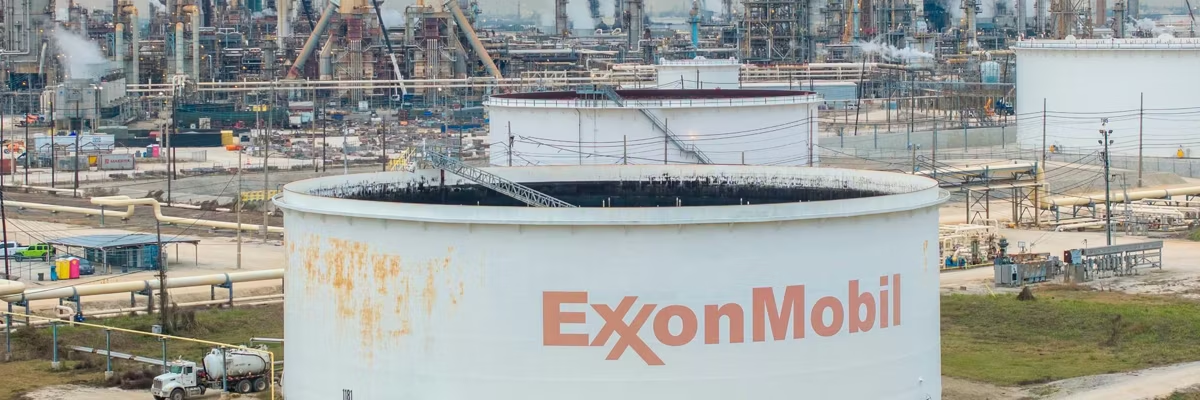
In an aerial view, the ExxonMobil Baytown Refinery is seen on January 13, 2026, in Baytown, Texas. (Photo by Brandon Bell/Getty Images)
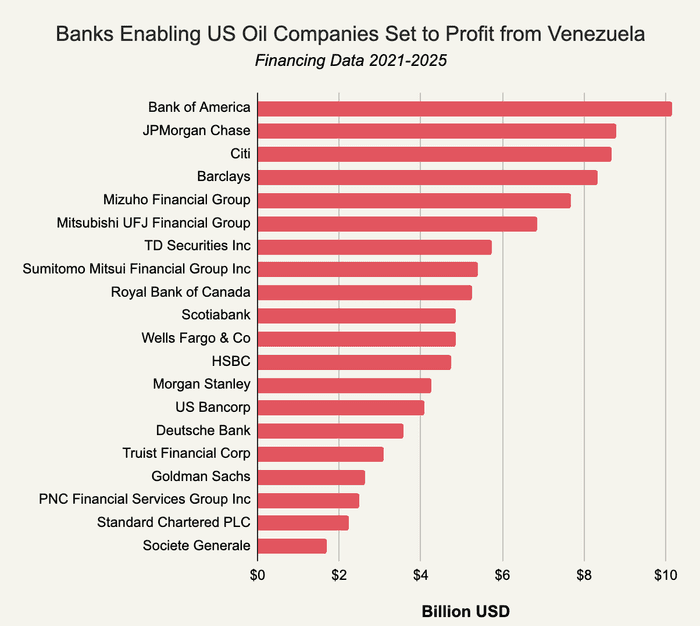
Since 2021, top Wall Street banks have committed more than $124 billion in investments to the nine companies set to profit most from the toppling of Venezuela’s government.
As oil industry giants are being set up to profit from President Donald Trump’s invasion of Venezuela, a new analysis shows the ample backing those companies have received from Wall Street’s top financial institutions.
Last week, Bloombergreported that stock traders and tycoons were “pouncing” after Trump’s kidnapping of President Nicolás Maduro earlier this month, after having pressured the Trump administration to “create a more favorable business environment in Venezuela.”
A dataset compiled by the international environmental advocacy group Stand.earth shows the extent to which these interests are intertwined.
Stand.earth found that since 2021, banks—including JPMorgan Chase, HSBC, TD, RBC, Citigroup, Wells Fargo, and Bank of America—have committed more than $124 billion in investments to the nine companies set to profit most from the toppling of Venezuela’s government.
More than a third of that financing, $42 billion, came in 2025 alone, when Trump launched his aggressive campaign against Venezuela.
Among the companies expected to profit most immediately are refiners like Valero, PBF Energy, Citgo, and Phillips 66, which have large operations on the Gulf Coast that can process the heavy crude Venezuela is known to produce. These four companies have received $41 billion from major banks over the past five years.
Chevron, which also operates many heavy-crude facilities, benefits from being the only US company that operated in Venezuela under the Maduro regime, where it exported more than 140,000 barrels of oil per day last quarter.
At a White House gathering with top oil executives on Friday, the company’s vice chair, Mark Nelson, told Trump the company could double its exports “effective immediately.”
According to Jason Gabelman, an analyst at TD Cowen, the company could increase its annual cash flow by $400 million to $700 million as a result of Trump’s takeover of Venezuelan oil resources.
Chevron was also by far the number-one recipient of investments in 2025, with more than $11 billion in total coming from the banks listed in the report—including $1.78 billion from Barclays, another $1.78 billion from Bank of America, and $1.32 billion from Citigroup.
According to Bloomberg, just weeks before Maduro’s removal, analysts at Citigroup predicted 60% gains on the nation’s more than $60 billion in bonds if he were replaced.
Even ExxonMobil, whose CEO Darren Woods dumped cold water on Trump’s calls to set up operations in Venezuela on Friday, calling the nation “uninvestable,” potentially has something major to gain from Maduro’s overthrow.
Exxon and ConocoPhillips each have outstanding arbitration cases against Venezuela over the government’s 2007 nationalization of oil assets, which could award them $20 billion and $12 billion, respectively.
The report found that in 2025, ExxonMobil and ConocoPhillips received a combined total of more than $12.8 billion in investment from major financial institutions, which vastly exceeded that from previous years.
Data on these staggering investments comes as oil companies face increased scrutiny surrounding possible foreknowledge of Trump’s attack on Venezuela.
Last week, US Senate Democrats launched a formal investigation into “communications between major US oil and oilfield services companies and the Trump administration surrounding last week’s military action in Venezuela and efforts to exploit Venezuelan oil resources.”
Richard Brooks, Stand.earth’s climate finance director, said the role of the financial institutions underwriting those oil companies should not be overlooked either.
“Without financial support from big banks and investors, the likes of Chevron, Exxon, ConocoPhillips, and Valero would not have the power that they do to start wars, overthrow governments, or slow the pace of climate action,” he said. “Banks and investors need to choose if they are on the side of peace, or of warmongering oil companies.”
Elon Musk urges you to be a Fascist like him, says that you can ignore facts and reality then.Donald Fuhrump says that Amerikkka doesn’t bother with crimes or charges anymore, not being 100% Amerikkkan and opposing his real estate intentions is enough.Orcas discuss how Trump was re-elected and him being an obviously insane, xenophobic Fascist.
Original article by Rob Soutar republished from TBIJ under a Creative Commons Attribution-NonCommercial-NoDerivs 3.0 Unported License.
Oil companies’ move to double down on fossil fuels should come as no surprise to anyone – not least its financers
Last week, BP’s CEO Murray Auchincloss said his company had gone “too far, too fast” in its plan to transition away from fossil fuels. BP still says it aims to be a net zero company by 2050 but it will now take a different path to the one it set out in 2021 … doubling down on fossil fuels in the meantime.
Perhaps the move shouldn’t have come as a surprise. After all, BP is a commercial enterprise with a responsibility to deliver returns for its shareholders. And since Russia’s invasion of Ukraine, which led many countries to prioritise energy security over long-term sustainability, oil and gas have remained reliably lucrative.
What’s more, the company made a similar announcement two years ago, saying it would be ramping up its investments in oil and gas.
But if BP had indicated such a significant change in direction so long ago, how did it continue to raise billions from banks that said they’d only do business with “net zero” companies?
Milestone moment?
At the 2021 climate talks in Glasgow, a number of the world’s leading banks made landmark pledges: to slash the footprint of their own operations and, crucially, the emissions of their lending and investment portfolios.
It was hailed as a watershed moment. In theory, the vast stockpiles of money that had supported fossil fuel expansion would now be cut off for companies without net zero ambitions. The same year, the International Energy Agency warned that there must be no new oil and gas projects if the world is to reach net zero by 2050.
The deals illustrate a core problem with the banks’ net zero commitments. A key condition for companies they agreed to do business with was the existence of a “credible” transition plan. But it wasn’t always clear how the banks were assessing that credibility.
Even before Auchincloss’ announcement last week, the world-leading Grantham Research Institute assessed the credibility of oil and gas companies’ transition plans – and found that BP’s fell well short.
That lack of clarity on what was “credible” left the banks with enough wriggle room to maintain relationships with huge fossil fuel companies.
And those relationships have proved profitable. Since May 2021, global banks that have committed to net zero have poured almost $1 trillion into companies pursuing expansion of oil and gas projects that would push the world beyond its survivable limits.
Looking long-term
The policy environment has changed since Glasgow, when both fossil fuel companies and banks launched net zero targets. BP is not the only company of its kind to have “reset” its core business to oil and gas. But critics say that recent moves to boost fossil fuels and ensure quick returns are alarmingly short-sighted.
In the UK, the costs of getting to net zero are cheaper than was anticipated just five years ago, according to a recent report by the Climate Change Committee. And in a low-carbon economy, fossil fuels could nosedive – leaving the oil and gas fields currently in development as “stranded assets” with little value.
But crucially, the banks face considerable risks too. Their previous promises to work only with clients committed to the transition were made for a reason: they were feeling the pressure from climate-conscious investors.
If the banks are found to have broken these promises, they could well be held to account by regulators – not to mention see their credibility shattered in the eyes of their investors.
Reporter: Rob Soutar Deputy editor: Chrissie Giles Editor: Franz Wild Fact checker: Ero Parksakoulaki Production editor: Alex Hess
TBIJ has a number of funders, a full list of which can be found here. None of our funders have any influence over editorial decisions or output.
Original article by Rob Soutar republished from TBIJ under a Creative Commons Attribution-NonCommercial-NoDerivs 3.0 Unported License. Corrected a reference to “oil company’s” in the subheading in this version.
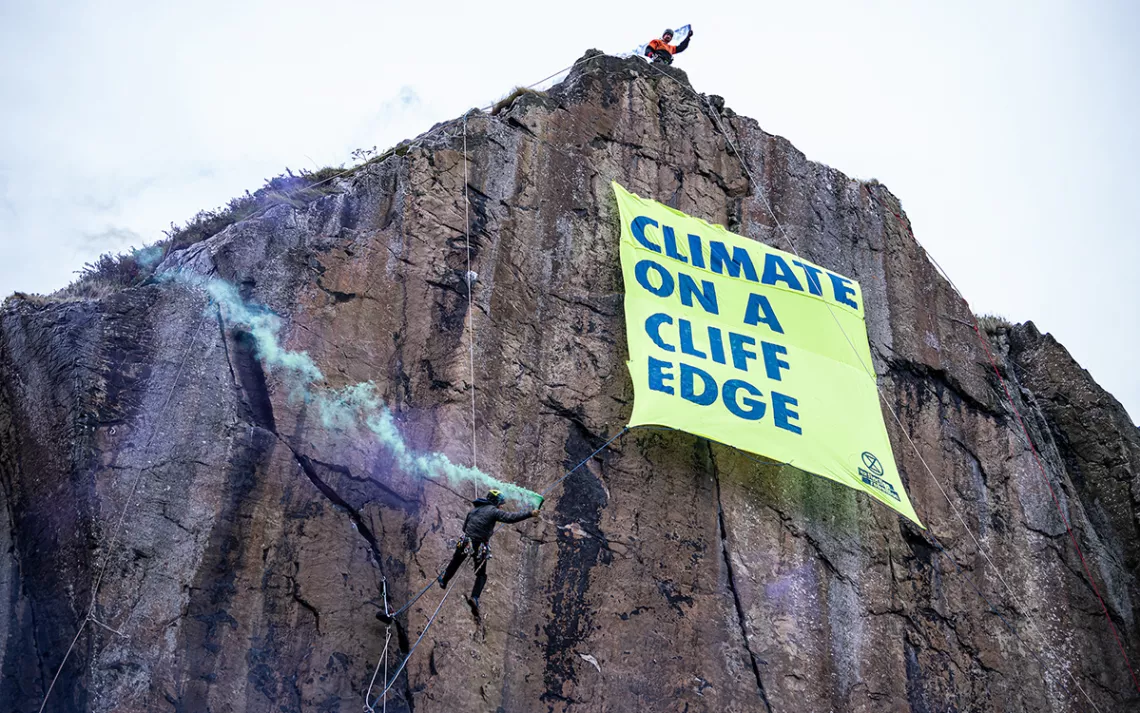
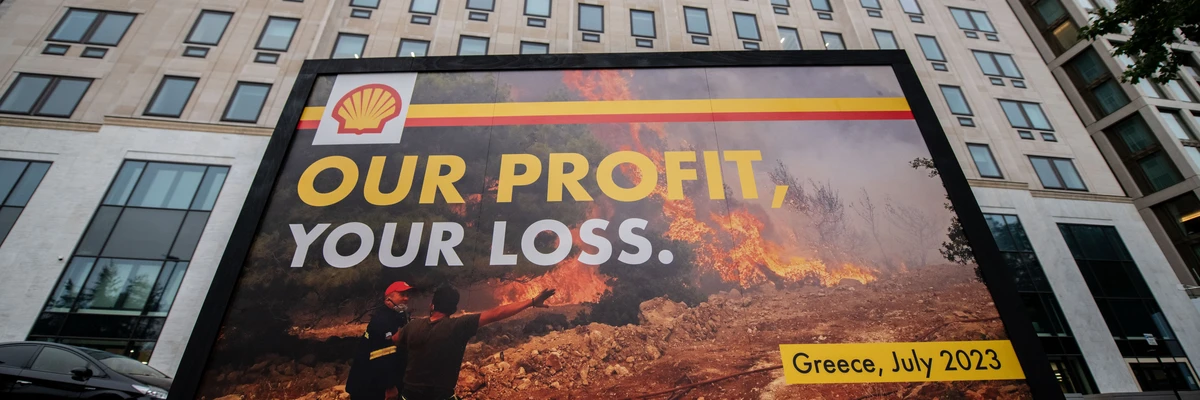
Experienced climbers scale a rock face near the historic Dumbarton castle in Glasgow, releasing a banner that reads “Climate on a Cliff Edge.” One activist, dressed as a globe, symbolically looms near the edge, while another plays the bagpipes on the shores below. | Photo courtesy of Extinction Rebellion and Mark RichardsGreenpeace activists display a billboard during a protest outside Shell headquarters on July 27, 2023 in London. (Photo: Handout/Chris J. Ratcliffe for Greenpeace via Getty Images)Neo-Fascist Climate Science Denier Donald Trump says Burn, Baby, Burn.
RACHEL REEVES’S decision to protect fat cat bankers has lost the public £15 billion — money that could have saved freezing pensioners and hundreds of thousands of children from going hungry, a damning new report found today.
Campaigners for a windfall tax on banking profits slammed the Chancellor after it emerged that Britain’s four biggest banks made a record £45.9bn in profits for 2024.
Positive Money found that the policy, called for by unions and left MPs, would have brought in an additional £14.7bn for the Exchequer this year after Lloyds Bank became the last of the so-called Big Four to announce its £6bn pre-tax profits for last year.
The group calculated that increasing the existing surcharge on bank profits from 3 to 35 per cent, in line with the government’s windfall tax on energy companies, could have raised this sum from Lloyds, HSBC, Barclays and NatWest alone.
This would be enough to cover the cost of scrapping the two-child benefit cap — fives times over.
Keir Starmer, Angela Rayner and Rachel Reeves wear the uniform of the rich and powerful. They have all had clothes bought for them by multi-millionaire Labour donor Lord Alli. CORRECTION: It appears that Rachel Reeves clothing was provided by Juliet Rosenfeld.Keir Starmer says pensioners can freeze to death and poor children can starve and be condemned to failure and misery all their lives.
Bank accused of ‘trying to have it both ways’ with coal policy that allows financing for huge polluters
Barclays helped raise nearly $2bn for companies running highly polluting coal-fired power plants in the US, exposing an “enormous loophole” in its climate policy.
As part of its strategy to reach net zero, the bank has committed to stop financing companies that make more than half their revenues from coal-fired power.
Last year, however, Barclays helped raise $1.7bn for coal-fired power companies that appear to exceed that threshold, the Bureau of Investigative Journalism and ITV News can reveal.
Among these deals were two $400m loans for Monongahela Power, which generates 95% of its electricity from burning coal at two huge plants in West Virginia. The company only sells electricity that it generates itself, suggesting that the vast majority of its revenues are from coal-fired power.
Barclays, however, said its policy only prohibits financing for companies that make more than 50% of revenues specifically from generating coal-fired power; and that TBIJ’s calculations did not account for these companies’ revenues from transmitting and distributing that power.
Barclays was Europe’s biggest lender to the coal power industry last yearAndrea Domeniconi / Alamy
Seth Feaster, an analyst at the Institute for Energy Economics and Financial Analysis (IEEFA) think tank, said: “The bank is trying to have it both ways: a public-facing coal policy that sounds like it will no longer support coal-heavy companies, but the technicality [regarding transmission and distribution revenue] has rendered that policy largely meaningless.
“The bank has created an enormous loophole that appears to allow it to largely continue doing business as usual with coal-friendly utilities.”
Natasha Landell-Mills, head of stewardship at the asset manager Sarasin & Partners, which holds Barclays debt, said the bank’s position appeared to be “somewhat disingenuous”.
“In the end, what matters is that coal-fired power falls in keeping with ensuring a safe climate. As investors, we would expect all related activities that enable coal-fired power to be captured and, if they are not, would hope to see the board urgently address this loophole.” She said this was not just a question of how Barclays is run and its reputation, but that continuing to fund high emitters was also financially risky for long-term investors.
The news comes amid a storm of protest against the bank, which was revealed in May to be Europe’s biggest funder of fossil fuels.
It is also Europe’s biggest lender to the coal power industry, taking part in $75bn worth of deals for companies active in the sector last year.
Bold pledges
Under pressure from its customers and investors, Barclays has made increasingly bold climate promises. It tightened its coal policy in 2022 and said financing the sector not only poses a threat to the planet but could represent a bad lending decision. Yet a number of companies it funded last year appear to be making most of their money from coal-fired power.
In addition to the Monongahela Power deals, Barclays helped raise $400m for Kentucky Utilities, which in 2022 generated almost three quarters of its electricity from burning coal. This suggests more than half its revenues were from coal-fired power.
Barclays also helped raise a $500m loan for Louisville Gas & Electric, which generated 83% of its power from coal in 2022. It makes some revenues from selling gas but calculations based on company and government data suggest its revenue share from coal was more than 50%.
Mill Creek power plant, a coal-fired stations owned by Louisville Gas and ElectricWilliam Alden / Creative Commons
Neither company appears to be transitioning to renewable power and their owner, PPL Corporation, said it expects they will use coal and natural gas as their predominant fuels “for the foreseeable future”.
Monongahela Power is investing millions to keep its two West Virginia plants running until 2035 and 2040, despite scientists warning that developed countries must end power generation from coal by 2030. The company aims to build 50MW of solar generation, but that represents less than 2% of its current coal-fired power capacity.
Barclays told TBIJ the deals complied with its policy “based on publicly disclosed information and our due diligence”. It said its policy does not have a loophole and that its methodology is robust. “An ambition to be net zero by 2050 does not require an immediate exit from financing coal,” the bank said. “Barclays is financing an energy sector in transition, providing finance to meet current energy needs and also financing the scaling of clean energy”.
PPL, which owns utilities in Kentucky, Rhode Island and Pennsylvania, said it had set a clear goal to achieve net-zero carbon emissions by 2050 and was transitioning to a cleaner energy mix across the group. It added that it had received approval from the authorities to retire 600MW of coal-fired power generation in Kentucky by 2027. This, however, represents less than 15% of its remaining coal capacity.
Monongahela Power did not respond to TBIJ’s request for comment.
Deadly coal plants
Coal-fired power plants are responsible for more than 40% of global CO2 emissions from energy. At Cop28 UN climate talks in Dubai last year, all countries agreed that accelerating the transition from coal to renewables was essential in order to avert catastrophic climate change.
Coal is also a major source of toxic air pollution. In the US alone, more than 3,800 people die from soot released by coal-fired power plants every year, according to a report by Sierra Club, a US NGO. While many European banks have distanced themselves from the industry, Barclays has retained strong links with US coal-fired power companies.
The boom in fracked gas and plunging cost of renewables has changed the landscape for power generation in the US. Seth Feaster at IEEFA said: “[Coal-fired power] companies are going to start struggling because they can’t sell their power in competitive environments.
“Investing in coal is very risky because most of [these coal plants] are losing money. They’re not going to be around for very long and if something breaks, they tend to shut down early because they can be very costly to repair.”
Bob Ward from the Grantham Research Institute on Climate Change said: “The coal industry in the United States is failing, it’s on its way out … there’s no excuse for propping up the American coal industry.” He described the distinction Barclays made between the generation, transmission and distribution of electricity from coal in its policy as “semantics”.
“What consumers and investors will be expecting is that Barclays are complying with the spirit of their declarations, and not just a technicality,” Ward said. “If you are generating most of your income from burning coal and then distributing the electricity results, then that’s the coal. That’s the coal industry. You’re damaging the climate. And that is what Barclays said they would stop.”
Last month, the organisers of the Wimbledon tennis championships faced calls to drop Barclays as a sponsor over its ties to fossil fuels and defence companies supplying Israel. Barclays addressed criticism of its defence funding, saying it trades in shares on behalf of clients. “Whilst we provide financial services to these companies, we are not making investments for Barclays.”
Live Nation also dropped the bank as a sponsor for various music festivals – including Download, Latitude and Isle of Wight – after protests from bands and fans.
Steff Wright, chairman of the Gusto Group, said his construction and manufacturing business is moving away from banking with Barclays. “As a company that’s working towards a green future, we need to look at our supply chain and who else is on that journey with us.
“We’d encourage all businesses to move away from them, to put pressure on them to rethink their strategy.”
Reporters: Josephine Moulds Environment editor: Robert Soutar Impact producer: Grace Murray Deputy editors: Chrissie Giles and Katie Mark Editor: Franz Wild Production editor: Alex Hess Fact checker: Somesh Jha
This reporting is funded by the Sunrise Project. None of our funders have any influence over our editorial decisions or output.
The bank has funded the companies behind a controversial pipeline and aggressive oil expansion as part of their commitment to fighting climate change
Barclays has been branded “totally dishonest” by one of its investors for calling tens of billions of dollars for fossil fuel companies “sustainable finance”.
The UK high street bank says it is helping to address climate change by raising $1 trillion in sustainable and transition finance by 2030. This includes sustainability-linked loans and bonds, in which a company agrees to meet certain climate-related targets or else face a higher interest rate.
But these targets can be weak and the penalties for failing to meet them paltry. The company can also use the money raised how it sees fit, meaning supposedly sustainable finance could fund polluting activities.
Andrew Harper of Epworth, an investment manager owned by the Methodist church that invests in Barclays, said: “We’re concerned because the bank is making such a substantial claim and the public thinks the climate emergency is being worked towards being solved. Meanwhile, the problem is getting worse and worse. We think it’s totally dishonest.
“If they are calling the financing of any fossil fuel companies sustainable finance, that to me is greenwash.”
Barclays said: “We are committed to being transparent and report separately on the green finance, sustainable finance and the sustainability-linked finance mobilised towards our $1 trillion target, so stakeholders and investors have a clear understanding of what we are reporting.” It said it set out very clear requirements for energy clients’ targets and transition plans in order to access finance.
‘Deeply problematic’ deals
Barclays helped raise $41bn in sustainability-linked finance for fossil fuel companies last year, according to an analysis by the Bureau of Investigative Journalism of data from LSEG, the financial markets group. The $41bn figure covers the total value of the deals Barclays worked on alongside other banks. Barclays itself counts only the funding it is directly responsible for, which it said was $10.9bn across all sectors last year.
Katharina Lindmeier, responsible investments manager at the publicly owned workplace pension scheme Nest, which also invests in Barclays, said TBIJ’s findings were “very concerning”. She added: “We’ll be raising this research with their management team directly at the next opportunity.
“Regulators are looking closely at the issue of greenwashing and if there is any uncertainty, it’s better to be cautious than to mislead customers. Any loans which help companies expand oil and gas infrastructure should not be classed as sustainable.”
The Financial Conduct Authority, the UK regulator, wrote to banks last year highlighting concerns about this type of loan, including weak incentives, potential conflicts of interest, and low ambition. It said that these may lead to accusations of greenwashing.
Anders Schelde, chief investment officer of AkademikerPension, another Barclays investor, said sustainability-linked finance for oil and gas companies is “in most cases deeply problematic”. He said: “We don’t count sustainability-linked bonds and loans as green investments in our own accounting because we know there are so many problems with them. The penalties are low and the targets often insufficient.”
Last year, Barclays helped raise $3bn worth of sustainability-linked loans and bonds for Enbridge, a company that is dramatically expanding oil and gas infrastructure across North America.
Enbridge is behind the construction of a controversial 1,000-mile pipeline that cuts through Indigenous land in the US to pump tar sands oil. It paid US police to crack down on protesters and has been fined millions of dollars for repeated environmental violations.
Barclays classifies the Enbridge debt as sustainable because the company has set a target to cut emissions from its own operations. In part, it intends to do this by using solar power to pump oil through its pipelines.
“The real source of emissions from a company like Enbridge will be from the oil and gas its pipelines help transport,” said Jeanne Martin from responsible investment charity ShareAction. “We do not need greener pipelines, we need to stop the reckless expansion of the fossil fuel industry.
“If the conditions that a bank sets to provide financing to oil and gas transport companies don’t tackle oil and gas, the bank will be accused of greenwashing.”
Barclays also helped raise a $2.8bn sustainability-linked loan for Harbour Energy, the UK’s largest oil and gas producer. Harbour extracted the equivalent of nearly 70m barrels of oil last year, which if burned would produce the equivalent of eight coal-fired power stations’ annual emissions.
Scientists agree that developing any new oil and gas fields will derail climate targets and push global heating beyond 1.5 degrees – which the UN says will threaten lives, food sources and economies worldwide.
It seems that Harbour is aggressively exploring for new oil and gas as it hopes to extract a further 880 million barrels of reserves in the coming decades. It does not appear from Harbour’s public statements that the company has any plans to shift its focus to renewables.
Yet Barclays’ loan to Harbour Energy is called sustainable because the company has committed to reducing emissions from the process of extracting oil and gas. This, however, takes no account of the vast majority of Harbour’s emissions, which are generated from burning the oil and gas itself.
Enbridge paid US police to crack down on protesters opposing its Line 3 pipeline Nicole Neri/Bloomberg via Getty Images
The notorious oil trader Trafigura also benefited from more than $5.4bn in loans that Barclays called sustainable finance. Counting its supply chain and all the emissions generated by the oil it trades and transports, Trafigura was responsible for more greenhouse gas emissions last year than Spain.
Trafigura’s interest payments are linked to certain sustainability targets, including a pledge to cut emissions – but only from its own operations rather than the burning of the fuels it trades and transports. This accounts for about 1% of the company’s total emissions.
Trafigura said Barclays was one of 54 banks involved in the deal, and said “sustainability-linked loans are an important tool in incentivising reductions in emissions”. It added that its direct emissions were less than 1% of Spain’s. While it reports its indirect emissions, it does not consider all of them “to be within our current sphere of influence”.
Enbridge said it takes climate change seriously and is committed to reducing its greenhouse gas emissions. It said sustainability-linked finance plays an important role in meeting emission-reduction goals and supporting the transition to a lower carbon economy. The company also said that the 1,000-mile Line 3 pipeline had local and tribal approvals and met the strictest environmental standards, and that payments to law enforcement were made and administered via a third party.
Harbour did not respond to a request for comment.
Barclays said: “Sustainability linked loans and bonds are an important sustainable finance tool, incentivising borrowers, particularly in hard to abate sectors, to achieve sustainability objectives over time.”
Net-zero banking
Barclays has committed to cut its emissions – including of the companies it finances – to net zero by 2050. To reach this target, it will have to stop providing money to companies that refuse to shift away from fossil fuels.
Enbridge’s Line 3 project cuts through Indigenous land Tim Evans/Bloomberg via Getty Images
But a report out today shows that the bank’s funding for fossil fuels increased in 2023 from 2022, which troubled shareholders who have been urging it to reduce lending in line with its climate targets. Barclays was Europe’s top funder of the fossil fuel industry last year, according to the report led by the Rainforest Action Network.
Lindmeier, the Nest investment manager, said: “We want to see Barclays immediately reduce its financing to companies behind new fossil fuel expansion. Any delays could leave the company more exposed to bad loans and potentially cost them millions of pounds.”
Laura Hillis from the Church of England pensions board, another Barclays investor, said: “We are looking for banks to produce a clear climate plan and to see the commitments carry through into lending decisions. Our concern is that these fossil fuel financing figures show that is not happening at the pace we’d like.”
Climate-conscious investors have been putting pressure on Barclays to make good on its net-zero pledge and earlier this year the bank committed to stop providing specific project finance for oil and gas expansion and related infrastructure.
However, less than 2% of Barclays’ funding for oil and gas last year fell under the label of “project finance”. Almost all of it comes in the form of general, unrestricted finance for the companies undertaking those projects.
“Barclays’ new oil and gas policy is an important step forward for the bank but it should have gone so much further,” said Martin from ShareAction, which brought together Barclays shareholders to urge the bank to restrict lending to oil and gas companies.
“Ultimately, the bank has kept the right to finance companies that have plans to massively expand the fossil fuel industry with no strings attached, and that’s a real problem.”