Climate change: multi-country media analysis shows scepticism of the basic science is dying out

Spread the love

This article is republished from The Conversation under a Creative Commons license. Read the original article.
 

Frame Stock Footage/Shutterstock

James Painter, University of Oxford

Any regular viewer of BBC’s Question Time could be forgiven for thinking that old-fashioned climate science denialism is alive and kicking. In a recent edition, panellist Julia Hartley-Brewer called the IPCC’s climate models “complete nonsense”, and dismissed the 2022 record UK heatwave and the floods in Pakistan by saying: “It’s called weather.”

But for some time now, researchers have suggested that the balance of arguments propagated by climate sceptics or denialists has shifted from denying or undermining climate science to challenging policy solutions designed to reduce emissions.

For example, computer-assisted methods applied to thousands of contrarian blogs or websites have found that since the year 2000, “evidence scepticism” which argues that climate change is not happening, or is not caused by humans or the effects won’t be too bad, has been on the decline, while “response” or “solutions scepticism” has been on the rise.

In the US media and UK media, there is strong evidence too that the prevalence of these arguments may be shifting. By 2019 much less space was being given to those denying the science in newspaper outlets in Australia, Canada, New Zealand, the UK and the US, except in some right-leaning titles.
tablet showing climate change news article


From denial to delay.
Skorzewiak / shutterstock

But what about television coverage? Recent survey work finds that in most countries, television programmes, including news and documentaries, are by far the most used source of information on climate change compared to online news, print or radio.

In a new study published in Communications Earth & Environment my colleagues and I looked at 30 news programmes on 20 channels in Australia, Brazil, Sweden, the UK and the US which included coverage of a 2021 report by the IPCC on the physical science basis of climate change. Australia, the UK and the US were chosen for their long history of climate scepticism, whereas Brazil and Sweden were included for the more recent arrival of scepticism among key political parties.

These channels included 19 “mainstream” examples such as the BBC, ABC in Australia and NBC in America, and 11 examples from a selection of “right-wing” channels ranging from Fox News, which commands a large audience, to more outliers such as GBTV in the UK, SwebbTV in Sweden, Sky News in Australia and Rede TV! in Brazil.

We then watched and manually coded all 30 programmes (around 220 minutes of content) for examples of the different types of scepticism present, following the broad distinction above between “evidence” and “response/policy” scepticism. But we also distinguished between “general response” scepticism, usually advanced by organised sceptical groups, and “directed” response scepticism, where country-specific economic, social and political obstacles to enacting climate policies were mentioned.

Science scepticism is no longer mainstream

First, we found that on mainstream channels, the presence of science scepticism, science sceptics and general contestation around the IPCC’s report was much less present in our sample than in the coverage of the previous round of IPCC reports in 2013 and 2014, even in countries that have historically had strong traditions of science denial.

Second, response scepticism was in some of the coverage by mainstream channels. But in most cases, these were examples of “directed” scepticism. In contrast, there was more non-specific response scepticism on right-wing channels such as right-wing politician and pro-Brexit campaigner Nigel Farage on GBTV arguing that “whatever we do here [in the UK], it’s China that needs to do far more than us”, or a commentator on Fox News suggesting that “only being able to fly when it is morally justifiable would lead to people having to entirely change their lifestyles”.

Also on right-wing channels, in four countries (Australia, Sweden, the UK and the US) sceptics were combining evidence and response scepticism. For example, Fox News continued its historical record of scepticism by criticising the IPCC report and hosting evidence sceptics, but it also included a wide range of examples of response scepticism (such as the infringement on civil liberties by taking climate action).

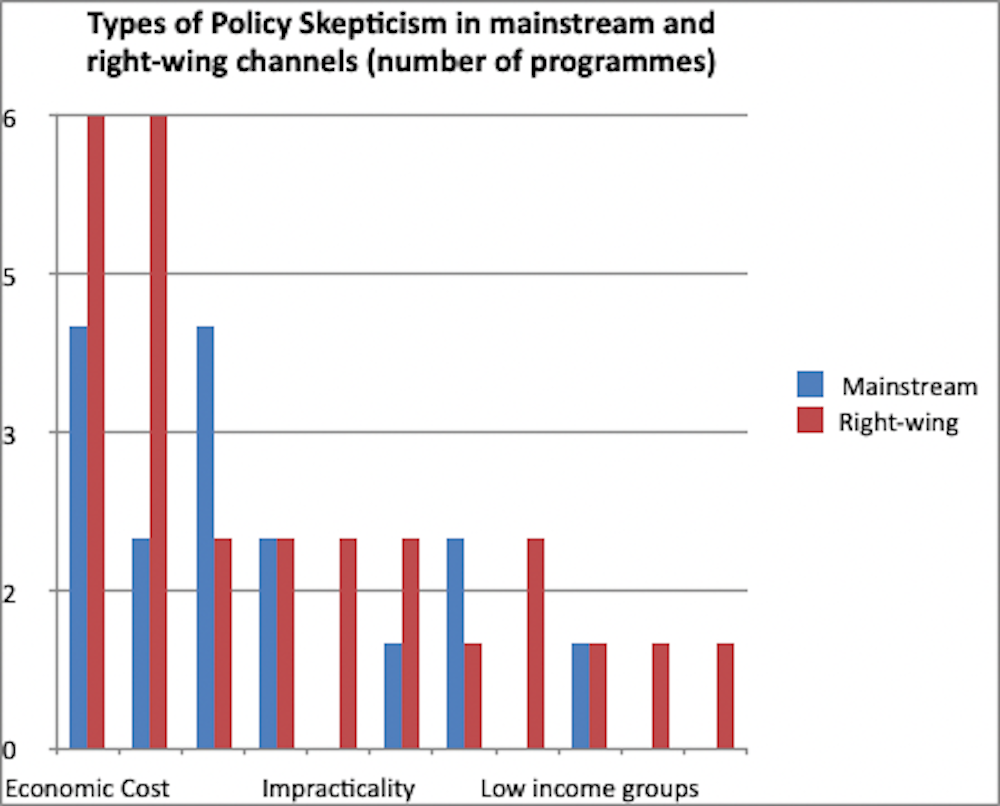
Finally, we looked at the sorts of arguments that were being made, following a useful taxonomy of climate scepticism or obstructionism published in the journal Nature in 2021. We found a wide variety of claims, but the most common concerned the high cost of taking action and “whataboutism” (typically questioning the need to take action when other countries such as China were not doing enough).
Graph showing types of policy scepticism


The most common policy scepticism concerned the economic cost of climate action.
Painter et al / Nature Comms, Author provided

Why does this matter? First, how these arguments play out on television is hugely important because of its dominance as a source of climate information. Second, there is strong evidence that media has a very powerful agenda-setting effect, and in certain contexts, can exert a strong effect on attitudes and behaviour change.

Legitimate policy discussion needs to be carefully distinguished from false claims put out by organised sceptical groups. But for those active in opposing organised scepticism, any definitive shift towards response scepticism across the media, such as vocal opposition to net zero policies, represents an important new challenge to climate action.The Conversation

James Painter, Research Associate, Reuters Institute, University of Oxford

This article is republished from The Conversation under a Creative Commons license. Read the original article.

Continue ReadingClimate change: multi-country media analysis shows scepticism of the basic science is dying out

BBC will not broadcast Attenborough episode over fear of ‘rightwing backlash’

Spread the love

https://www.theguardian.com/media/2023/mar/10/david-attenborough-bbc-wild-isles-episode-rightwing-backlash-fears

Exclusive: Decision to make episode about natural destruction available only on iPlayer angers programme-makers

The BBC has decided not to broadcast an episode of Sir David Attenborough’s flagship new series on British wildlife because of fears its themes of the destruction of nature would risk a backlash from Tory politicians and the rightwing press, the Guardian has been told.

The decision has angered the programme-makers and some insiders at the BBC, who fear the corporation has bowed to pressure from lobbying groups with “dinosaurian ways”.

The BBC strongly denied this was the case and insisted the episode in question was never intended for broadcast.

Caroline Lucas, the Green party MP for Brighton Pavilion, said: “For the BBC to censor of one of the nation’s most informed and trusted voices on the nature and climate emergencies is nothing short of an unforgivable dereliction of its duty to public service broadcasting. This government has taken a wrecking ball to our environment – putting over 1,700 pieces of environmental legislation at risk, setting an air pollution target which is a decade too late, and neglecting the scandal of our sewage-filled waterways – which cannot go unexamined and unchallenged by the public.

Chris Packham, who presents Springwatch on the BBC, also criticised the decision. He told the Guardian: “At this time, in our fight to save the world’s biodiversity, it is irresponsible not to put that at the forefront of wildlife broadcasting.”

https://www.theguardian.com/media/2023/mar/10/david-attenborough-bbc-wild-isles-episode-rightwing-backlash-fears

Continue ReadingBBC will not broadcast Attenborough episode over fear of ‘rightwing backlash’

BBC chairman’s position is ‘untenable’ after MPs finds he made ‘significant errors of judgment’ on Johnson loan

Spread the love

https://morningstaronline.co.uk/article/b/bbc-chairman-position-is-untenable-after-mps-finds-he-made-significant-errors-of-judgment-on-johnson-loan

BBC chairman Richard Sharp’s position is “untenable,” Labour insisted today after MPs found that he had made “significant errors of judgement” when acting as a go-between on a loan for disgraced former prime minister Boris Johnson.

Shadow culture secretary Lucy Powell argued that Mr Sharp’s help, offered when the former Tory donor was applying to the government for the post in early 2021, “throws into serious doubt the impartiality and independence that is so fundamental to trust in the BBC.”

In a highly critical report published today, the digital, culture, media and sport committee, which interviewed Mr Sharp last week, said that he had not supplied the “full facts” when it was considering his suitability for the BBC role.

The former banker’s “failure to disclose his actions constitute a breach of the standards expected of individuals applying for such public appointments,” the cross-party panel of MPs added.

“Mr Sharp should consider the impact his omissions will have on trust in him, the BBC and the public appointments process.”

https://morningstaronline.co.uk/article/b/bbc-chairman-position-is-untenable-after-mps-finds-he-made-significant-errors-of-judgment-on-johnson-loan

Continue ReadingBBC chairman’s position is ‘untenable’ after MPs finds he made ‘significant errors of judgment’ on Johnson loan

Nicola Sturgeon says lack of contact from Liz Truss ‘absurd’

Spread the love

https://www.bbc.co.uk/news/uk-scotland-63175102

Scotland’s first minister has said she has still not had a phone call with Liz Truss more than a month after she became prime minister.

Nicola Sturgeon told the BBC it was “absurd” and “unprecedented” that she had yet to hear from the new PM.

She added: “I don’t know whether that is arrogance, lack of respect or insecurity or whatever it is. It’s not the right way to do government in a grown up way.

“So I hope we will see a change. I’ll do my best to work with Liz Truss as constructively as possible or whoever comes after because we can’t take anything for granted in UK politics these days.”

Continue ReadingNicola Sturgeon says lack of contact from Liz Truss ‘absurd’

Even the sycophancy of an amoral Tory press couldn’t save Boris Johnson

Spread the love

https://www.prospectmagazine.co.uk/politics/even-the-sycophancy-of-an-amoral-tory-press-couldnt-save-boris-johnson

Historians will be baffled by the readiness of Britain’s largest media organisations to lick Johnson’s boots for so long, and will surely look for an explanation. Part of the reason is ideology. Murdoch and the Barclay brothers personally supported the Brexit movement which propelled Johnson to power. 

Another is that Johnson cleverly ensured the major newspaper groups had a vested interest in maintaining him in office. Though lazy and incompetent, Johnson understands the press exceptionally well, and as prime minister managed it skilfully, giving the newspapers everything they wanted in exchange for their support.

This meant allowing media barons to set his agenda. The BBC has long been a target of the press—Murdoch in particular—because it occupies public space which corporate media craves for itself. Johnson’s attacks on the licence fee—and the briefing by allies of his culture secretary, Nadine Dorries, that on her watch “it’s over for the BBC” as we know it—look like gifts to his media backers. So was the appointment of an unqualified Tory donor, former banker Richard Sharp, as chairman of the national broadcaster. The same applies to the proposed Channel 4 sell-off.

Sunday Times Rich List: Frederick Barclay still wealthiest on Channel Islands

Who are the Barclay brothers?

Continue ReadingEven the sycophancy of an amoral Tory press couldn’t save Boris Johnson