Starmer’s hints about the budget suggest UK is set for bleak four years

Spread the love

Original article by Paul Rogers republished from Open Democracy.

https://cdn2.opendemocracy.net/media/images/GettyImages-2159569411.max-760×504.jpg

Introducing a wealth tax would indicate this is a progressive government. But that seems unlikely

Taking as his theme the need to “fix the foundations” after “14 years of rot” under Tory rule, new Labour prime minister Keir Starmer this week delivered a message that should bring discomfort to everyone in the months and perhaps years to come.

Those “14 years of rot” are of no surprise to voters; indeed, they helped ensure a landslide Labour victory in the election in July. But Starmer’s plans to resolve them appear likely to be far harsher than many voters expected.

The chancellor of the Exchequer, Rachel Reeve, has made numerous hints that hard times are ahead. Her October budget will be uncompromising in its commitment to raising revenue to help fill a fiscal hole reckoned to be around £20bn – but much of this money seems likely to be taken from the poorer sections of society, not the rich.

Labour will retain unpopular policies introduced by the Conservatives – the ‘bedroom tax’ and limiting child benefit allowances to the first two children, for example – while introducing its own cost-cutting measures, such as reducing the winter fuel allowances for many pensioners.

These actions contribute to a growing sense that the Starmer government will prove to be decidedly right-of-centre in a country beset with deep divisions of wealth and poverty. Some areas may see an improvement, such as labour rights, but even there, it is a matter of the devil in the detail.

One area where the government does apparently have cash to spash, though, is military spending, which is set to be substantially increased despite the manifest failures in Afghanistan, Iraq and Libya, and the deeply unpopular Israeli wars on Gaza and the West Bank.

Labour’s attitude to Israel is certainly unlikely to change, with the Department for Business and Trade reporting on efforts to strike a new trade deal with the country, saying: “Our teams will be entering negotiating rooms as soon as possible, laser-focused on creating new opportunities for UK firms.” An official from the British Embassy in Israel also recently wrote of the “tremendous opportunity for collaboration between Israeli and British companies”.

A full-scale Strategic Defence Review is also underway, and there are few if any indications that it will start by addressing the grievous failures of the past two decades. If previous experience is anything to go by, it will likely also omit the main challenge to international security: climate breakdown. Without that, the review will not be worth the paper it is written on. Net zero secretary Ed Miliband may be doing his best to maintain the idea of a green transition but the issue would be sidelined by any major increase in government spending.

On the domestic front, less than two months into the new Labour government the contrast between Food Bank Britain and the ludicrous levels of runaway wealth is apparent. It was coincidentally yet powerfully illustrated just four days before Starmer’s pre-budget speech, by a full-page property advertisement from Sotheby’s in the Financial Times.

Of the seven properties on sale, one was a relatively modest three-bedroom apartment in Chelsea, on sale for a mere £5m, while the others included a six-bedroom house in Belgravia offered at £18m and a nine-bedroom/five-bathroom place near Regent’s Park for £20m. Another Regent’s Park number was on sale for £25m million, which at least had 7 bathrooms for the 6 bedrooms. Trumping all was a triplex number in Knightsbridge – £50m with exclusive access to Hans Place Gardens.

While we have to wait for the October budget announcements, we can be reasonably sure that there will be some attempts to raise modest amounts from the wealthier sectors of society, possibly involving changes in capital gains and inheritance taxes. But the best indicator of a changed government would be one willing to bring in wealth taxes, especially those directed at the super-rich.

Onee of Britain’s largest trade unions, Unite, recently proposed a 1% per annum tax on those with net assets of over £4m, which would include property, shares and bank holdings but not mortgaged property. That is estimated to yield £25bn a year but would be bitterly opposed, with the Daily Mail informing us that: “Millionaires are looking to flee the UK in their droves to escape Labour’s tax raids – with a record number of wealthy Britons tipped to leave the country this year.”

As things stand, the budget is expected to include substantial cuts in public spending that could be at least partly avoided by such a wealth tax, and it is worth noting that some European countries such as Switzerland and Spain have already introduced them. At least Britain’s wealthy won’t be fleeing “in their droves” to those countries.

If adopted in October, in even a modest form, a wealth tax would be a reasonable marker for a progressive government. If not, then an opportunity will be missed for placing Labour in a more progressive place in the political spectrum than currently seems at all likely.

Original article by Paul Rogers republished from Open Democracy.
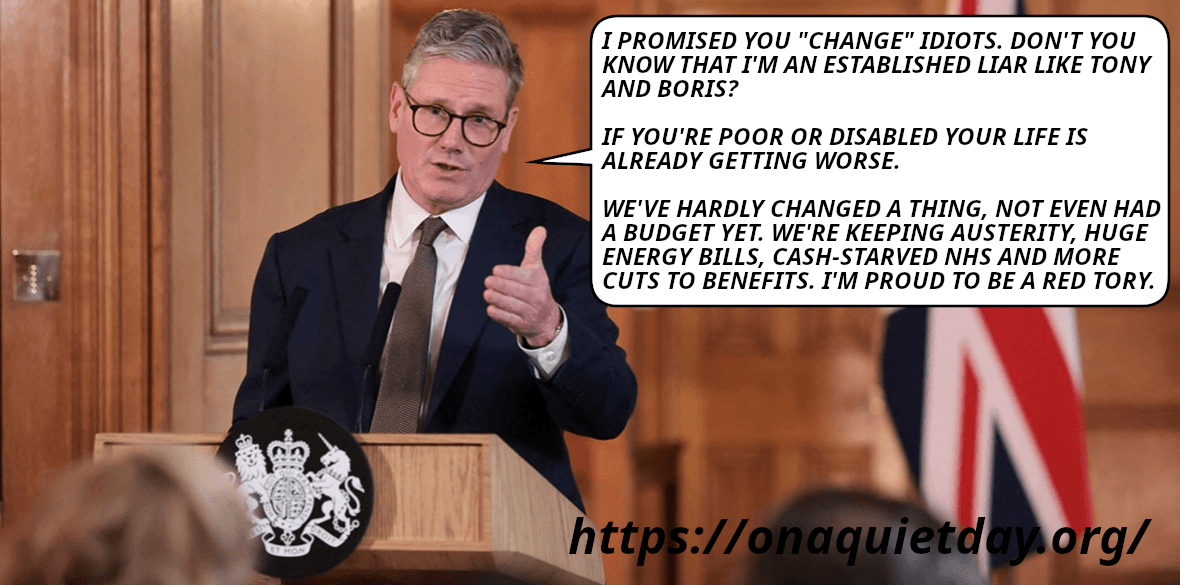
Keir Starmer confirms that he is continuing Tory policies and that he's proud to be a red Tory.
Keir Starmer confirms that he is continuing Tory policies and that he’s proud to be a red Tory.
Keir Starmer says pensioners can freeze to death and poor children can starve and be condemned to failure and misery all their lives.
Continue ReadingStarmer’s hints about the budget suggest UK is set for bleak four years

Wealth distribution / tax avoidance and austerity :: prelude

Spread the love

I originally intended to concentrate on UK wealth distribution and tax evasion. That works well since UK wealth distribution and tax avoidance are inextricably (cannot be detangled) linked. We are (I am?) concerned with reality here and the reality that is becoming increasing clear is that UK wealth distribution is about wealth inequality, tax avoidance but also the austerity agenda.

As a prelude or preamble, a vid by 38degrees about TTIP (the Transatlantic Trade and Investment Partnership). I would urge people to be active in the democratic process because democracy needs active participation. You can join political campaigns like 38degrees or change.org, start a political blog like my own or even be a shouty man or woman ;)

1.50am ed: Apologies, I forgot again. I wonder if there’s a sadistic element to it. The bedroom tax and the withdrawal of tax credits for the most vulnerable is so nasty – is it not also sadistic? Forcing people to leave their homes of many decades and forcing people into more extreme poverty are the issues here.

Continue ReadingWealth distribution / tax avoidance and austerity :: prelude

Appeal against the bedroom tax!

Spread the love

There’s a judgement that says a bedroom is a room furnished as a bedroom or used to sleep in. All bedroom tax decisions can be appealed. Time is running out to appeal.

The Bedroom Tax is Dead here’s why | SPeye Joe (Welfarewrites)

Bedroom Tax – Finally Killed by Plain Old Common-Sense?

The effect of this outbreak of common-sense is that, potentially, any or all of the original Bedroom Tax decisions taking effect last April are wrong – as councils cannot have known the actual situation and were making decisions based on an assumption that the rooms concerned were bedrooms. What’s more, despite the time elapsed since then, these decisions are still appealable – appeals can be accepted up to thirteen months after the date of the original decision. This clearly makes it important to act quickly. Anyone in any doubt about the correctness of their Bedroom Tax decision should write to the local authority decision-maker and seek an appeal in their own individual case. But this must be done soon – it will probably be too late by April.

The implications of this legal development may even go so far as to invalidate all of the decisions. If a room isn’t habitually used as a bedroom, it may fall outwith the normal everyday definition of the word – and therefore beyond the scope of the legislation as it stands. Technically, in order to assess whether a particular room qualifies as a “bedroom”, the local authority would have to go out and inspect it. In practice, this would be a task on a scale made impossible by limitations on resources. But unless a property has been thus assessed, then no decision can properly be made.


Continue ReadingAppeal against the bedroom tax!

Commentary and analysis of recent political events

Spread the love

Number of homeless in England has risen for 3 years in a row, report says

Homelessness has increased for three consecutive years, partly because of housing shortages and cuts to benefits, with an estimated 185,000 people a year now affected in England, a report says.

Research by the Joseph Rowntree Foundation and Crisis found almost one in 10 people experience homelessness at some point in their life, with one in 50 experiencing it in the last five years.

Responding to the report, Emma Reynolds, the shadow housing minister, accused David Cameron of breaking his promises to tackle homelessness and get Britain building.

“Homelessness has risen every year under this government, the number of families with children living in bed and breakfasts is at a 10-year high and house-building is at its lowest in peacetime since the 1920s,” she said.

Leslie Morphy, chief executive of Crisis, urged the government to address a chronic lack of affordable housing and consider the impact of its cuts to housing benefit, such as the bedroom tax, welfare cap and shared accommodation rate.

Image of Accident and emergencyA&E Winter Crisis: Patients Wait 12 Hours

Hundreds of patients are being forced to wait more than four hours to be seen by accident and emergency departments as the winter crisis begins.

It is the first time since April that emergency departments have struggled to hit their four-hour targets as admissions to A&E hit the highest level since data started being collected in November 2010.

According to NHS England figures, 3,678 patients across the country were forced to wait between four and 12 hours for treatment.

Five patients were not seen for more than 12 hours last week – the busiest week of the year with 415,000 people visiting A&E departments.

Waiting times were worst in major A&E wards where just 92.2% of patients were seen within four hours.

Free-Market Ideology: The Destruction of Lives

The over-policing of America

BoJo the bozo: Cycling safety campaigners slam Boris Johnson over lack of helmet and hi-viz 

Idiot Johnson is not the only one setting a poor example. As a cyclist, I advise you to wear a helmet as I was advised by my GP (doctor). If you fall from a bike, you’re falling six feet or so possibly with your head impacting the ground. Even presidents can have a ‘bicycle accident’.

Continue ReadingCommentary and analysis of recent political events