People keep asking why I’m standing in the Clacton by-election, and the answer is simple.
This is no ordinary election. This is me versus The Establishment.
On one side, there’s me: a self-funded independent in a shiny bin, taking on the political machine armed with little more than a manifesto and several kilos of reinforced aluminium.
On the other side, there’s Nigel Farage.
Now, I know what you’re thinking. “Surely Nigel Farage is the anti-establishment candidate?”
Well, he was. Then he spent thirty years becoming the establishment.
When you’ve got billionaire donors, wealthy financiers, television studios, newspaper columns, a party built around your own personality and enough millionaire backers to make a yacht club feel underfunded, you don’t really get to call yourself the outsider any more.
I, meanwhile, remain proudly unsupported by foreign-based billionaires, convicted fraudsters or cryptocurrency tycoons. If anyone has been secretly wiring millions into my campaign account, I can assure you they’ve used the wrong account number.
Nigel says this election is about letting the people decide whether he should be allowed to carry on secretly enriching himself in the shadows and doing whatever Nigel Farage wants Nigel Farage to do. I couldn’t agree more. That’s exactly the sort of thing The Establishment always says.
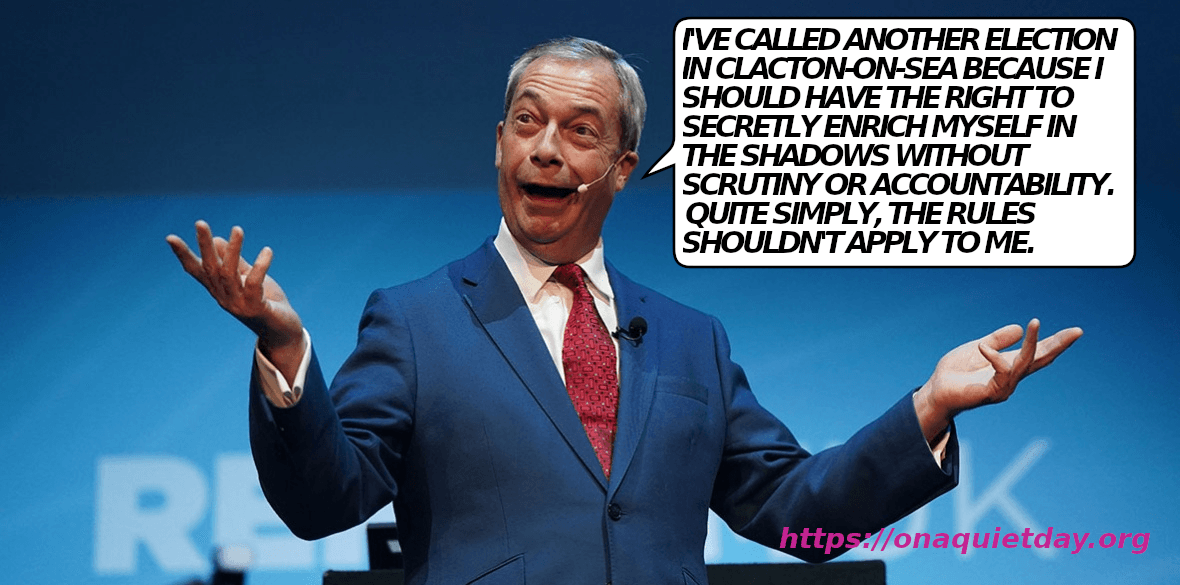
Nigel Farage explains that he’s called another byelection in Clacton-on-Sea because he should be able to secretly enrich himself without scrutiny and accountabilty and that the rules shouldn’t apply to him.
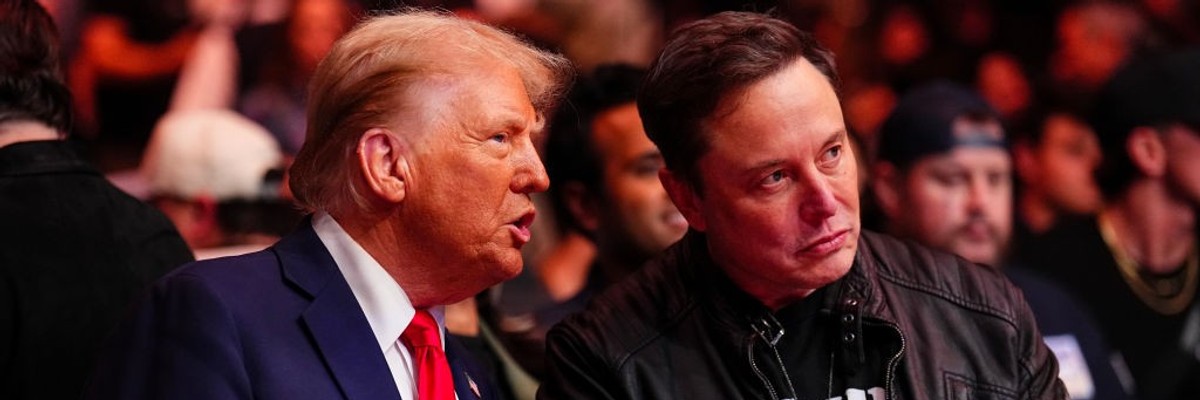
President-elect Donald Trump and Elon Musk talk ringside during the UFC 309 event at Madison Square Garden on November 16, 2024 in New York City. (Photo: Chris Unger/Zuffa LLC)
It appears that Trump has entered into a power-sharing agreement with Musk and several other wealthy individuals including Vivek Ramaswamy, Robert F. Kennedy Jr., and David Sacks.
Democracy decays into oligarchy when a few individuals accumulate most of the political power.
The reelection of Donald Trump has accelerated the decline of the United States into oligarchy. Trump has had billionaire donors for each of his presidential campaigns, but in 2024 the role of these wealthy donors expanded. Donors such as Elon Musk made gigantic contributions to Trump’s campaign; in return for this they are taking an active role in the Trump White House. Perhaps, this time around, Trump turned the oval office into a time-share.
On December 19, Elon Musk led the call for House Republicans to repudiate a continuing resolution they had just negotiated to keep the federal government running through the end of the year. Perhaps Musk’s charter includes coordination with Congress.
When Elon Musk and Vivek Ramaswamy speak of increasing government efficiency, they usually start with services for the unfortunate.
It appears that Trump has entered into a power-sharing agreement with Musk and several other wealthy individuals including Vivek Ramaswamy, Robert F. Kennedy Jr., and David Sacks. However this arrangement works, it’s likely that the Trump administration will cater to billionaires—Sen. Bernie Sanders (I-Vt.) observed that the 13 billionaires chosen by Trump to serve in his administration have a combined wealth of at least $383 billion.
What do these billionaires want? The oligarchs and billionaires want lower taxes and reduced government regulations. Of course, each billionaire has a particular set of interests; for example, David Sacks, Trump’s “AI and crypto czar,” is a venture capitalist with heavy investment in AI and crypto. Sadly. most of the oligarchs are climate-change deniers.
The oligarchs want more wealth. Robert Reich observes:
Since [1980], the median wage of the bottom 90% has stagnated. The share of the nation’s wealth owned by the richest 400 Americans has quadrupled (from less than 1% to 3.5%) while the share owned by the entire bottom half of America has dropped to 1.3%… The richest 1% of Americans now has more wealth than the bottom 90% combined.
The oligarchs share a fiscally conservative agenda. They intend to shrink the size of the federal government. The particulars vary but the oligarchs are not concerned with the size of the defense budget; their cost-cutting focus is on programs that service the poor and disadvantaged—such as Medicaid. When Elon Musk and Vivek Ramaswamy speak of increasing government efficiency, they usually start with services for the unfortunate.
What are the practical consequences of this shift to oligarchy? It’s unsettling to be in a political situation where we do not understand who is in charge at the White House. We don’t know how power-sharing will work. The relationship between Trump and Congress has been fraught. The shift to oligarchy will make this relationship even more difficult.
Will the oligarchs fix the economy? Trump was elected because he promised to fix the economy. Most Americans believed he would drive down inflation; they thought Trump would reduce the cost of food, housing, and household and medical expenses. Since November 5, Trump has given no indication of how he plans to do this. Perhaps he has lost interest.
During the presidential campaign, Trump said his inflation-fighting agenda would rely upon tariffs, but it’s likely that the oligarchs will influence how Trump’s tariff strategy plays out. Musk has huge business interests in China, and it’s unlikely that he would support a tariff policy that would hurt his relationships with the country.
Trump has appointed a “czar” for immigration (Tom Homan), energy (Doug Burgum), and AI & Crypto (Sacks). Trump has not appointed a czar for inflation. With much fanfare, Trump has appointed a commission on “government efficiency;” they’ve already started meeting. Trump has not appointed to a commission to curb inflation.
After January 20, Trump will own inflation and the economy. Trump’s immigration “purge” will drive up the cost of food. Trump’s tariffs will drive up the cost of household expenses.
Trump’s trying to ignore inflation. Or turn it over to an oligarch co-president. Stay tuned.