Original article by Pavan Kulkarni republished from peoples dispatch under Creative Commons Attribution-ShareAlike 4.0 (CC BY-SA) license.
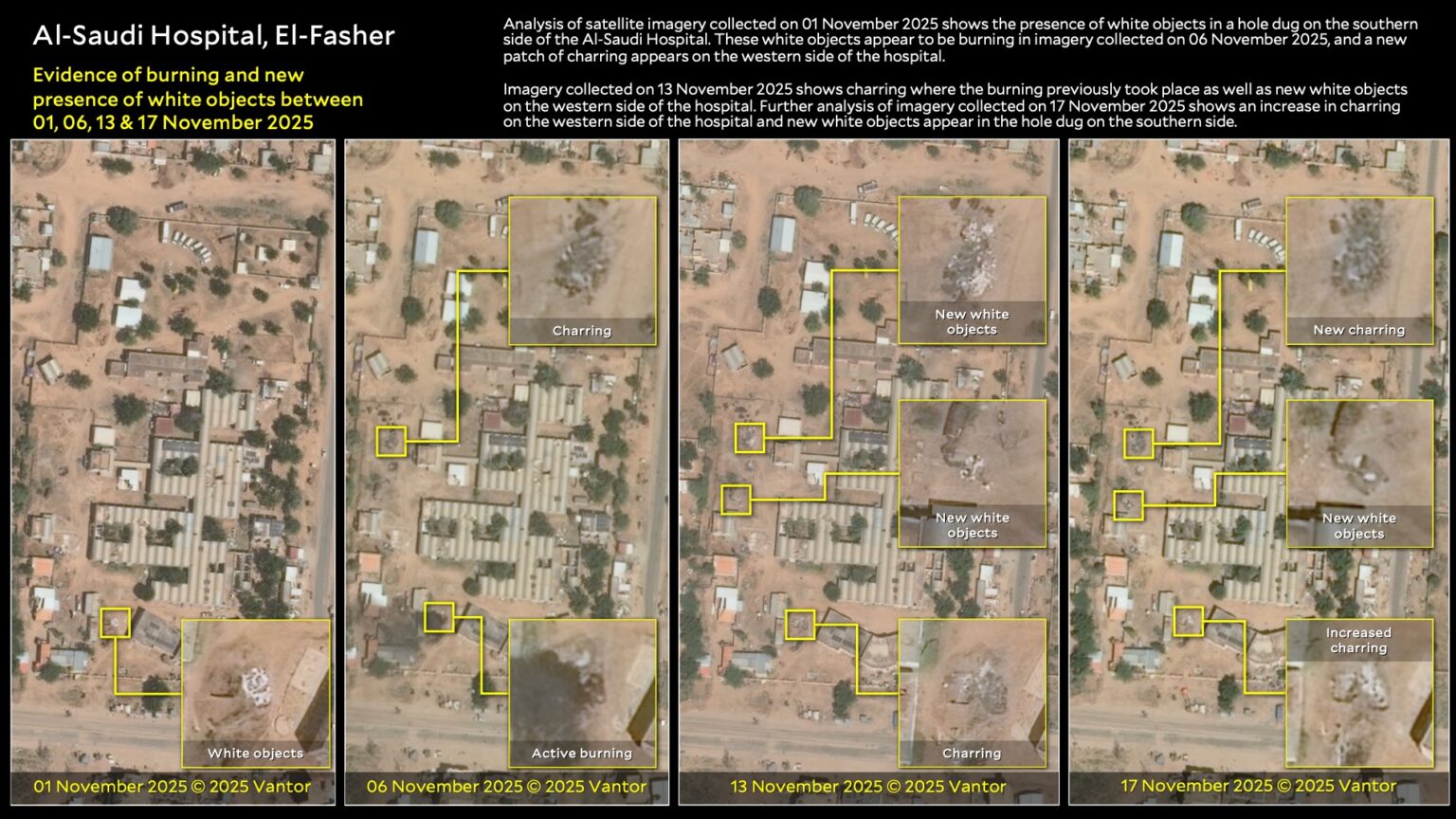
Analyzing satellite images showing “clusters of objects consistent with human remains”, “reddish discoloration consistent with blood”, charred earth and dug up ground consistent with the burning and burial of corpses, Yale HRL assesses that RSF has killed and disposed of people “likely in the tens of thousands”.
Evidence of burning and new presence of white objects collected by satellite imagery in early November. Photo: Yale Humanitarian Research Lab
Sudan’s Rapid Support Forces (RSF) have burnt and buried bodies, likely in the tens of thousands, after massacring civilians while overrunning El Fasher, the last city in Sudan’s western region of Darfur that held out against the paramilitary until late October.
The Yale School of Public Health’s Humanitarian Research Lab (HRL) said in a report published on December 16 that it “assesses to high confidence” that the RSF “engaged in widespread and systematic mass killing” after entering the besieged and starved city on October 26.
Read More: El Fasher’s last stand: “The city has fallen, but its dignity has not”
Satellite images collected over the next few days, until November 1, showed at least 150 “clusters of objects consistent with human remains”. By November 28, 108 of these 150 clusters had changed in size, growing and shrinking over time, while 57 were no longer visible.
“Disturbed earth”, meaning dug up ground, began to appear “at or in close proximity to locations where clusters” that shrunk or disappeared “were identified.” Several “clusters” were also burnt, visible as charred earth in later satellite images.
The ground around 33 of the 108 clusters identified had a “reddish discoloration consistent with blood or other bodily fluids”, shed on a scale large enough to be visible from space.
Read More: A bloodbath visible from space: RSF’s massacres in Sudan’s El Fasher
In the images, 52 body piles were observed in the neighborhood of Daraja Oula, where the remaining civilians in the city had sheltered before being executed by the RSF on a door-to-door killing spree.
Another 83 clusters were seen outside El Fasher, consistent with footage shared on social media by the RSF troops, showing themselves chasing down the fleeing civilians, capturing and executing them. Indications consistent with “mass killings” were also observed at the sites used by the RSF for detention.
The “RSF subsequently engaged in a systematic multi-week campaign to destroy evidence of its mass killings through burial, burning, and removal of human remains on a mass scale,” states the report, adding, “This pattern of body disposal and destruction is ongoing.”
There are no reliable estimates of the death toll in the absence of access to the area. “Over 260,000 civilians, including 130,000 children, have been trapped” in El Fasher “under siege for more than 16 months, cut off from food, water, and healthcare,” UNICEF had reported on October 23, three days before the RSF entered the city after breaching its defenses.
The International Organization for Migration (IOM) had recorded at least 106,387 people displaced by late-November. The remaining civilians, over 150,000 of them, are unaccounted. How many of them have survived is not known, but “HRL assesses that … RSF has systematically killed and disposed of a number of objects consistent with human remains, likely in the tens of thousands.”
In its aftermath, the city appears depopulated. The “pattern of civilian life in El-Fasher seems to have all but ended following RSF’s total control of El-Fasher,” the report added. “The end of civilian pattern of life is evidenced by abnormal vegetation growth in markets, no visible civilian activity at water points, absence of crowds of people in the street, and no evidence of civilian transport.”
Read More: Sudan’s RSF expands control eastward after taking over Darfur
Original article by Pavan Kulkarni republished from peoples dispatch under Creative Commons Attribution-ShareAlike 4.0 (CC BY-SA) license.

