Forget Wealth Tax. We Should Abolish Extreme Wealth Altogether

Spread the love

Original article by C.J. POLYCHRONIOU republished from Common Dreams under Creative Commons (CC BY-NC-ND 3.0). 

“The idea that rich and poor are equal before government in democratic societies is ludicrous,” writes Polychroniou. “As disparities in wealth and income grow, so do the disparities in political influence.” (Photo: flickr/Creative Commons)

Wealth taxation may sound like a good idea, but can it really address, let alone solve, the problem of inequality?

Economic inequality is the scourge of the 21st century. The rich are getting richer and faster than any other time since the onset of neoliberalism, which calls for “free-market” capitalism, regressive taxation, fiscal austerity and the rejection of the social state. They get richer not only when the economy is on an upswing but even amid crises. Billionaires more than doubled their net worth during the pandemic, according to Bloomberg Billionaires Index.

The latest analysis shows that the richest 1 percent gained $42 trillion in new wealth over the past decade, which amounts to “nearly 34 times more than the entire bottom 50 percent of the world’s population.” In the meantime, the very poor and low-income people across the globe, including the U.S., are actually getting poorer. So much for trickle-down economics which was popularized during the 1980s by the Reagan administration’s vast capital gains and income tax cuts and continues to persist to this day in spite of its major flaws. Cutting taxes on the rich not only increases economic inequality but has no effect on economic growth and unemployment.

There must be something very rotten with an economic system that allows individuals to generate obscene amounts of wealth to the point they can hijack the political system and undermine democracy.

However, inequality should not be examined purely from an economic perspective. Over the years, numerous studies have shown that economic inequality influences public attitudes toward democracy by generating political disillusion and low trust in government and other institutions, like Congress. Inequality also undermines social mobility, contributes to political polarization and fuels authoritarianism.

Finally, inequality contributes to climate change. The richest 1 percent is responsible for more carbon emissions than the poorest 66 percent, according to a 2023 report by Oxfam. Of course, while the world’s wealthiest people make a huge contribution to climate change, they are also able to insulate themselves from the worst impacts of global warming.

In sum, the super-rich can be blamed for many of the most serious ills confronting societies in the twentieth-first century. The only consequential question here is this: what can be done about it then?

One of the most frequent responses to the problem of rising inequality is a call for the implementation of a wealth tax. Wealth taxation may sound like a good idea, but can it really address, let alone solve, the problem of inequality? The answer is an unqualified “no.” At least for the world’s advanced economies. Indeed, even if it’s possible to discover all the wealth that the very rich people own (much of which is hidden in companies or put in trusts) and then proceed with an accurate asset valuation, this will have very little impact, if any, on the daily lives of people who try to survive on minimum wages. Wealth taxation alone will have no impact on workers without social protection and no bargaining power at companies. It won’t protect workers at the “gig economy” and part-time workers.

To effectively address economic inequality, we must identify the root cause of the problem, and one simple way to do this is by asking a rather simple question: How does one become superrich? Where does this immense wealth come from? Because as the renowned progressive economist James K. Boyce recently put it “nobody ‘earns’ a billion dollars.

There must be something very rotten with an economic system that allows individuals to generate obscene amounts of wealth to the point they can hijack the political system and undermine democracy. Democracy cannot exist when we have wealth concentrated in the hands of a few. The idea that rich and poor are equal before government in democratic societies is ludicrous. As disparities in wealth and income grow, so do the disparities in political influence.

Take corporations, for example, which exert enormous influence, thanks primarily to campaign donations and lobbying Their actions, which range from opposing labor laws and policies that benefit workers to restricting unionization, exacerbate inequalities at all levels of society and across the globe. Moreover, the surge in billionaire wealth and the surge in “corporate power and monopoly power” form a powerful connection. The very rich are not simply beneficiaries of the existing economic order. They are in control of the working arrangements of the global economic system. Yet despite the enormous power that corporations have on people’s lives and the communities in which they operate, there are very few policies and mechanisms at national or international level to curtail that power.

Of course, we know that billionaires and big corporations pay very little in taxes, but we need much more than wealth and corporate taxation. We need ways to curb the power of big corporations and their drive to maximize shareholder value at the expense of everything else. We should also set a cap on extreme wealth. There is no social value for having billionaires. We should abolish the superrich, perhaps an easier task, politically speaking, than finding ways to tax them. Democratic societies could hold a referendum on whether we should abolish extreme wealth.

In addition, we could create economic arrangements that provide a minimum income to ensure that everyone’s basic needs are met. This can be done either through universal basic income or guaranteed income programs.

Last, but not least, we can challenge the rule of capital by advancing democratic forms of economic governance and economic planning. Participatory economics is one such alternative that would change the economy as we know it since it entails social ownership of production and self-managed workplaces. Worker cooperatives are established is various parts of Europe, particularly in Italy and Spain. The Mondragon Corporation in the Basque region of Spain is owned by its workers and represents the biggest and most successful case of worker cooperatives. Of course, for economic transformation to occur, breaking down hierarchical structures and putting workers in charge of business activities is not enough. What needs to happen is that the values of worker cooperatives spread across the economy and that power is wrested away from the capitalist class.In today’s world, we can tackle economic inequality only by shifting the conversation to its root causes and then coming up with blends of policies that work together to put an end to the driving forces behind inequality. Spending all political capital on something like a wealth tax will only help to prolong the life of an immensely cruel and dangerous economic system. An easier and far more effective way to end plutocracy is through the power of democracy via a binding referendum that calls on citizens to decide whether or not we should abolish altogether extreme wealth.

Original article by C.J. POLYCHRONIOU republished from Common Dreams under Creative Commons (CC BY-NC-ND 3.0). 

Continue ReadingForget Wealth Tax. We Should Abolish Extreme Wealth Altogether

Morning Star: Mass action is the antidote to Labour-Tory policy consensus

Spread the love

https://morningstaronline.co.uk/article/editorial-mass-action-antidote-policy-consensus

Shadow chancellor Rachel Reeves speaking about the economy at the Association of British Insurers in the City of London, May 7, 2024

“LABOUR and the Tories move closer on economy.”

Thus a headline in the Financial Times last week. The FT speaks not just to and for British finance capital, but to capitalists worldwide needing a steer on British and international politics.

Unlike the bought-and-paid-for Tory press, it usually does so without demagogy or partisan point-scoring. Its conclusions are therefore to be taken seriously.

It writes: “Despite being the official opposition, Labour has signally refused to oppose many of [Jeremy] Hunt’s recent economic policies…” including the cuts to National Insurance.

Further: “Hunt set out 110 measures to boost the economy in his 2023 autumn statement and Labour opposed none of them. The same applied to all of the policies announced in the chancellor’s spring budget this year.”

Shadow chancellor Rachel Reeves has also agreed with all Chancellor Hunt’s financial services reforms, has accepted his target of ensuring falling debt as a share of national income within five years, and adopted his corporation tax rate.

The Tories have repaid the compliment up to a point, stealing Labour proposals on taxing non-doms and the North Sea oil and gas industries.

But this convergence is mainly on Tory terms, with Labour dumping any proposal, like its green investment plans, which sit outside the consensus around a new austerity.

For that is what is on offer at the general election. It is a further squeeze on public services and wages to help improve the competitive position of British capitalism.

Reeves and the Labour Party pretend that their approach represents “change” because it offers “stability” after years of Tory chaos.

https://morningstaronline.co.uk/article/editorial-mass-action-antidote-policy-consensus

Continue ReadingMorning Star: Mass action is the antidote to Labour-Tory policy consensus

The heat is on: what we know about why ocean temperatures keep smashing records

Spread the love
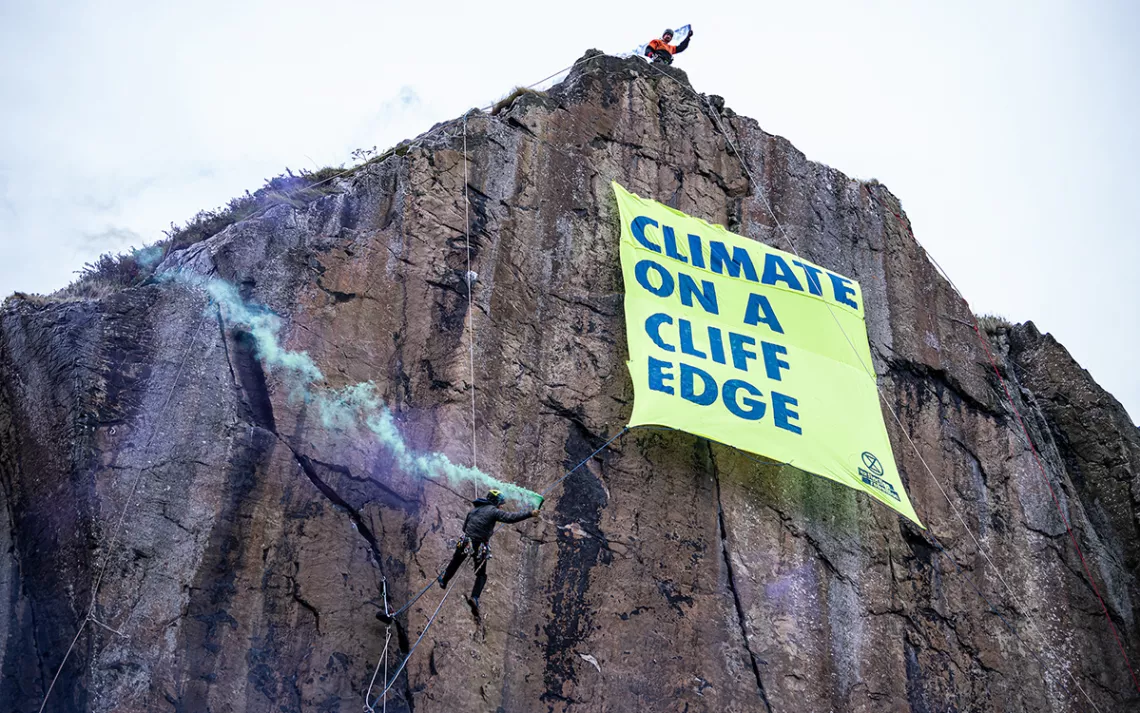
Experienced climbers scale a rock face near the historic Dumbarton castle in Glasgow, releasing a banner that reads “Climate on a Cliff Edge.” One activist, dressed as a globe, symbolically looms near the edge, while another plays the bagpipes on the shores below. | Photo courtesy of Extinction Rebellion and Mark Richards


Alex Sen Gupta, UNSW Sydney; Kathryn Smith, Marine Biological Association; Matthew England, UNSW Sydney; Neil Holbrook, University of Tasmania; Thomas Wernberg, The University of Western Australia, and Zhi Li, UNSW Sydney

Over the last year, our oceans have been hotter than any time ever recorded. Our instrumental record covers the last 150 years. But based on proxy observations, we can say our oceans are now hotter than well before the rise of human civilisation, very likely for at least 100,000 years.

This isn’t wholly unexpected. Ocean temperatures have been steadily rising due to human-caused global warming, which in turn means record hottest years have become increasingly common. The last time ocean temperature records were broken was 2016 and before that it was 2015. The last year we experienced a record cold year was way back at the start of the 20th century.

But what is remarkable about the past year is the huge ongoing spike in global ocean temperature which began in April last year. Last year was hotter than the previous record year by a whopping 0.25°C. In contrast the margins of other previous record years were all less than 0.1°C.

Why? Global warming is the main reason. But it doesn’t explain why the heat spike has been so large. Climate drivers such as El Niño likely play a role, as do the random alignment of certain weather events and possibly the reduction in sulfur emissions from shipping. Researchers around the world are trying to understand what’s going on.

How big is the jump in heat?

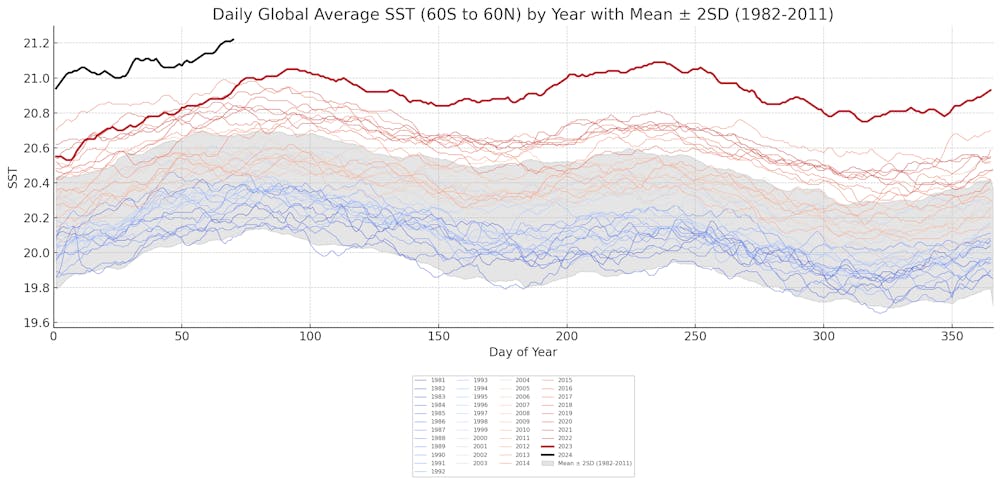
You can see the surge in heat very clearly in the near-global ocean surface temperature data.

dasd
Averaged ocean surface temperatures between 60 degrees south and 60 degrees north of the equator, inspired by ClimateReanalyzer.org. Each coloured line represents the temperature of a single year.
Author provided, CC BY

The trend is clear to see. Earlier years (in blue) are typically cooler than later years (in red), reflecting the relentless march of global warming. But even with this trend, there are outliers. In 2023 and 2024, you can see a huge jump above previous years.

These record temperatures have been widespread, with the oceans of the southern hemisphere, northern hemisphere and the tropics all reaching record temperatures.

What’s behind the surge?

We don’t yet have a complete explanation for this record burst of warming. But it’s likely several factors are involved.

First, and most obvious, is global warming. Year on year the ocean is gaining heat through the enhanced greenhouse effect – indeed over 90% of the heat associated with human-caused global warming has gone into the oceans.

The extra heat pouring into the oceans results in a gradual rise in temperature, with the trend possibly accelerating. But this alone doesn’t explain why we have experienced such a big jump in the last year.

Then there are the natural drivers. The El Niño event developing in June last year has certainly played a substantial role.

El Niño and its partner, La Niña, are opposite ends of a natural oscillation, the El Niño Southern Oscillation, which plays out in the tropical Pacific ocean. This cycle moves heat vertically between the ocean’s deeper waters and the surface. When El Niño arrives, warmer water comes up to the surface. During La Niña, the opposite occurs.

You can see the impact of an El Niño on short term temperature spikes clearly, even against a backdrop of strong long-term warming.

But even climate change and El Niño combined aren’t enough to explain it.

Other natural heat-transferring oscillations, such as the Indian Ocean Dipole or the North Atlantic Oscillation, may play a role.

It may also be that our successful efforts to cut aerosol pollution from the dirty fuel shipping relies on has had an unwanted side effect: more warming. With less reflective aerosols in the atmosphere, more of the Sun’s energy can reach the surface.

But there’s probably also a level of random chance. Chaotic weather systems over the ocean can reduce cloud cover, which can let in more solar radiation. Or these weather systems could weaken winds, reducing cooling evaporation.

Why is this important?

To us, a warmer ocean might feel pleasant. But the extra heat manifests underwater as an unprecedented series of major marine heatwaves. The ocean’s organisms are picky about their preferred temperature range. If the heat spikes too much and for too long, they have to move or die.

Marine heatwaves can lead to mass death or mass migration for marine mammals, seabirds, fish and invertebrates. They can cause vital kelp forests and seagrass meadows to die, leaving the animals depending on them without shelter or food. And they can disrupt species important for fisheries and tourism.

This year’s heat stress has caused widespread coral bleaching around the world. Bleaching has been seen on reefs in the Caribbean, Florida, Egypt, and the Great Barrier Reef.

In the cooler waters of Tasmania, extraordinary conservation efforts have been put in place to try and protect endangered fish species such as the red handfish from the heat, while in the Canary Islands, small scale commercial fisheries have popped up for species not normally found there.

Last year, Peru’s anchovy fishery – the country’s largest – was closed for long periods, leading to export losses estimated at A$2.1 billion.

What’s going to happen next?

Given the record temperatures stem from a combination of human-induced climate change and natural sources, it’s very likely ocean temperatures will drop back to more “normal” temperatures. Normal now is, of course, much warmer than in previous decades.

In the next few months, forecasts suggest we have a fair chance of heading into another La Niña.

If this eventuates, we might see slightly cooler temperatures than the new normal, but it’s still too early to know for sure.

One thing is certain though. As we struggle to rein in greenhouse gas emissions, the steady march of global warming will keep adding more heat to the oceans. And another spike in global ocean warming won’t be too far away.The Conversation

Alex Sen Gupta, Senior Lecturer, School of Biological, Earth and Environmental Sciences, UNSW Sydney; Kathryn Smith, Postdoctoral Research Scientist, Marine Biological Association; Matthew England, Scientia Professor and Deputy Director of the ARC Australian Centre for Excellence in Antarctic Science (ACEAS), UNSW Sydney; Neil Holbrook, Professor, University of Tasmania; Thomas Wernberg, Professor, The University of Western Australia, and Zhi Li, Postdoctoral researcher, Centre for Marine Science & Innovation, UNSW Sydney

This article is republished from The Conversation under a Creative Commons license. Read the original article.

Continue ReadingThe heat is on: what we know about why ocean temperatures keep smashing records

Talking about a Revolution podcast with Roger Hallam 1 May 2024 7pm BST (GMT +1)

Spread the love
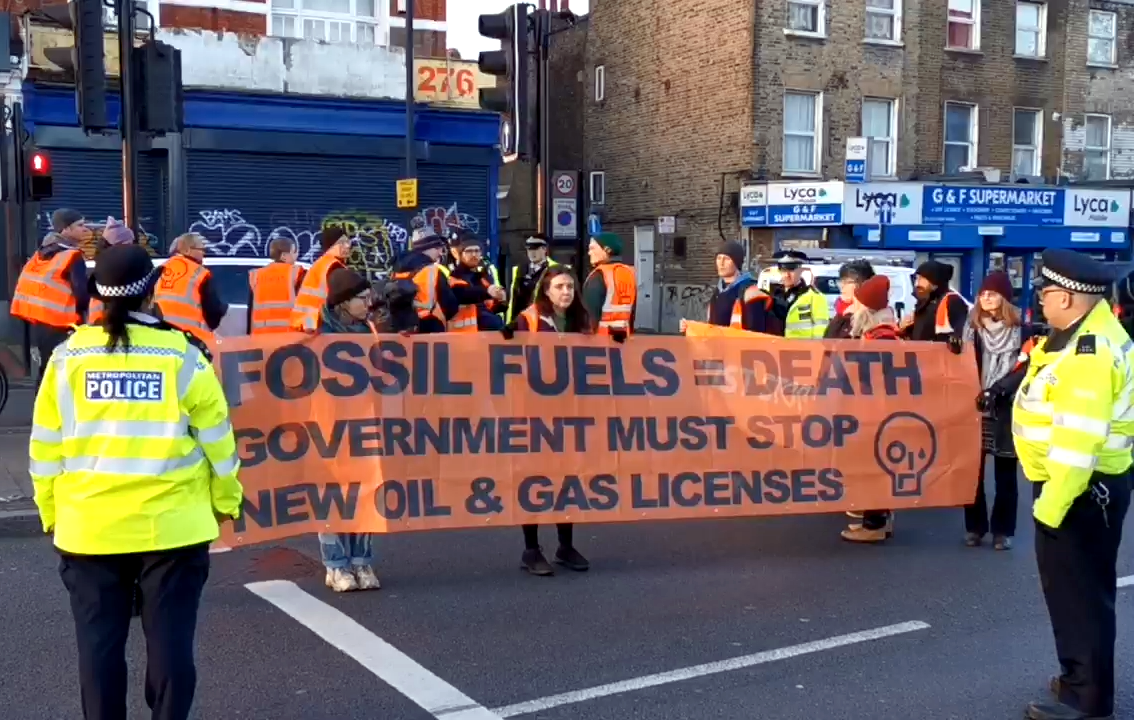
Just Stop Oil protesting in London 6 December 2022.
Just Stop Oil protesting in London 6 December 2022. Roger Hallam was instrumental is founding Just Stop Oil.

I am very pleased to announce an audio podcast featuring renowned climate activist Roger Hallam and myself on 1 May 2024 at 7pm BST (GMT +1).

The podcast is titled ‘Talking about a Revolution’ and to include addressing the following themes: What is a revolution – historically and in the 21st century?, that revolution means exiting the system and being in resistance to it, why that is necessary as we face social/eco collapse and concrete pathways to action at the present moment. 

I have research to do as preparation. Roger has many videos on youtube, I’m finding many of them long and long-winded. The podcast is likely to last at least 30 minutes. Roger has a reputation for sometimes being abrasive and I have been known to call a cnut a cnut so it is probably wise to accept that there may be some profanities. Further audio podcasts may follow.

Roger Hallam’s blog.

Roger Hallam’s wikipedia entry.

Continue ReadingTalking about a Revolution podcast with Roger Hallam 1 May 2024 7pm BST (GMT +1)

Morning Star: Sewage at the boat race: it’s well over time we take water back into public hands

Spread the love

Many articles from the Morning Star featured today. https://morningstaronline.co.uk/article/editorial-take-water-back-public-hands

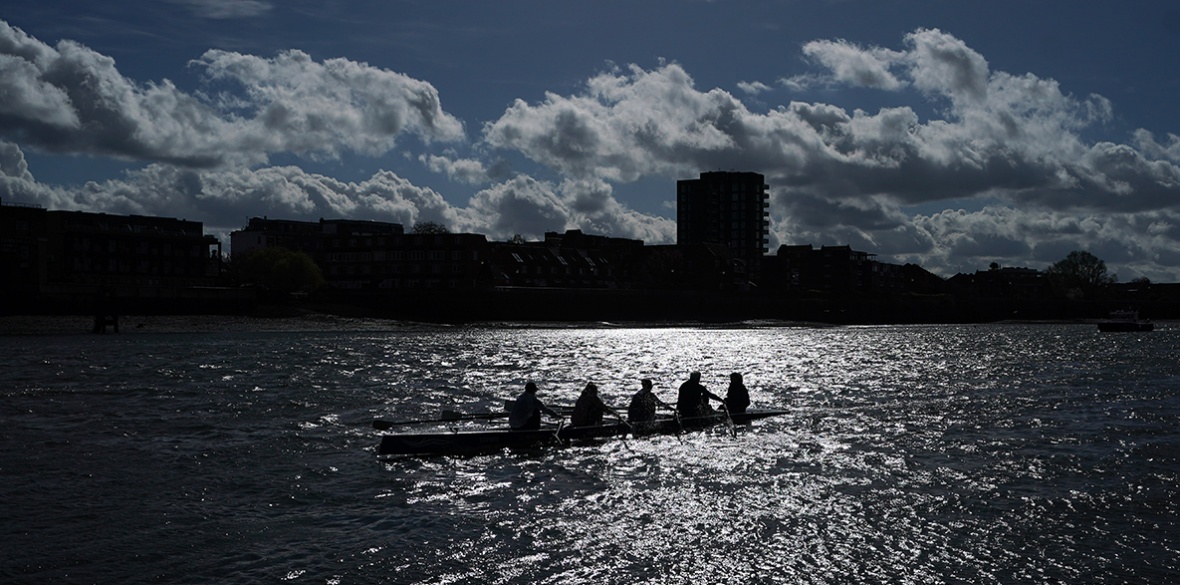
A rowing boat on the River Thames Putney, London, March 27, 2024

THE crisis of capitalism is running out of your taps and pouring into our rivers. Britain’s water industry is lurching towards calamity, poisoned by the priorities of profit and abetted by politicians in the pocket of the privateers.

The largest water company in the country, Thames Water, appears to be on the edge of insolvency after its investors refused to pump in cash essential to the company’s survival — apparently because the reluctance of regulator Ofwat to authorise even steeper increases in bills to households made it an unattractive bet.

And alarm was spread about the annual Oxford-Cambridge boat race on Saturday having to row through the sewage-ridden Thames, with doubts being cast on maintaining the tradition of throwing the cox of the winning crew in the river on health and safety grounds.

Now there are calls for the government to declare a national emergency as discharges of raw sewage into rivers and seas across Britain reach a record high.

These are the fruits of the handing over of the most basic resource to the tender mercies of monopoly capital. The sewage in the rivers is one side of the coin, the riches sitting in shareholders’ bank accounts is the other.

Nationalisation may be forced on the government in the case of Thames Water. But state control can only work in a context of planning, investment and a role for both workers’ and consumer interests.

That was Labour Party policy until Keir Starmer abandoned it. It is time the labour movement demanded its reinstatement.

Many articles from the Morning Star featured today. https://morningstaronline.co.uk/article/editorial-take-water-back-public-hands

Continue ReadingMorning Star: Sewage at the boat race: it’s well over time we take water back into public hands