Alarm caused by posts of Alex Karp, tech firm’s CEO, championing US military dominance and of AI weapons
The US spy tech company Palantir published a manifesto extolling the benefits of American power and implying some cultures are inferior to others – in what MPs have called “a parody of a RoboCop film” and “the ramblings of a supervillain”.
“Some cultures have produced vital advances; others remain dysfunctional and regressive,” wrote Palantir in a 22-point post on X over the weekend, which also called for an end to the “postwar neutering” of Germany and Japan.
The post exhorted the US to reinstate a military draft, saying that “free and democratic societies” need “hard power” in order to prevail.
It also predicted a future dominated by autonomous weapons: “The question is not whether A.I. weapons will be built; it is who will build them and for what purpose. Our adversaries will not pause to indulge in theatrical debates about the merits of developing technologies with critical military and national security applications. They will proceed.”
…
It led to criticism from several MPs, who said that it raised yet more questions about the UK’s portfolio of contracts with the company. Palantir has built up more than £500m in contracts in Britain, including a £330m contract with the NHS, as well as deals with the police and Ministry of Defence. These deals have come in for increasing criticism.
“Palantir’s manifesto, which embraces AI state surveillance of citizens along with national service in the USA, is either a parody of a RoboCop film, or a disturbing narcissistic rant from an arrogant organisation,” said Martin Wrigley, a Liberal Democrat MP who is a member of the commons science and technology select committee.
“Either way it shows that the company’s ethos is entirely unsuited to working on UK government projects involving citizens’ most sensitive private data.”
Despite claiming a commitment to sustainability, the world’s largest investment fund continues to invest heavily in fossil fuels through its “green” funds — prompting accusations of greenwashing.
In the first quarter of 2025, BlackRock invested $3 billion in fossil-fuel companies through its funds that are defined as sustainable. Credit: Christopher Michel/Flickr (CC BY-NC-ND 2.0)
Claim to be verified: BlackRock offers its global clients sustainable investment products, which allegedly exclude fossil fuels.
Context: In the first quarter of 2025 only, the world’s largest asset manager invested US$3 billion in fossil-fuel companies through its funds defined as sustainable. BlackRock promotes them with language that is potentially misleading and likely to leave unwary investors believing that such products exclude fossil fuels.
In 2016, Larry Fink, CEO of investment firm BlackRock, had no doubts about the importance of environmental, social, and governance (ESG): “Over the long term, ESG issues – ranging from climate change to diversity to board effectiveness – have real and quantifiable financial impacts”, he wrote in a letter on corporate governance in 2016.
The CEO of the world’s largest asset-management company has since changed his mind: “The reason I backed away from using the term ESG is that it means something different to everyone. It’s so undefined that it’s become unmentionable”, Fink said in 2023, as a guest on the Wall Street Journal podcast “Free Expression”. In the same podcast, he added: “If you want to invest in hydrocarbons, we will select the best hydrocarbon companies in the world for you. If you want to invest in a more decarbonized portfolio, we’re going to try to find the best economic portfolio that will achieve your financial goal.”
BlackRock manages US$11.6 trillion of investments. The firm has drastically changed its ESG and sustainable-investing policies in recent years. In its 2020 letter to clients, BlackRock used the term “ESG” 26 times and made a bold assertion: “We believe that sustainability must become our new standard for investing.” It also pledged to launch a product “that allows clients to invest in companies with the highest ESG scores, using our most extensive exclusion criteria, including one for fossil fuels.”
These commitments were widely covered in the international media. In January 2020, the specialist magazine UK Investor headlined: “BlackRock to focus on ESG and climate change in 2020”. CNBC wrote: “BlackRock, a $7 trillion asset manager, puts climate change at the heart of its investment strategy for 2021.” The specialist publication ESG Today asked: “BlackRock is betting everything on sustainability: Why is this important?”
Glossary
The European Regulation on sustainability-related disclosures in the financial services sector (known as SFDR) introduces two categories of green investments: those that merely promote “environmental and/or social characteristics” (Article 8), known in the jargon as “light green”, and those that must be properly “sustainable” (Article 9), known as “dark green”. In both cases, certain additional details must be provided to the consumer/investor, namely: (1) information about how these characteristics are met and (2) if a benchmark is indicated, an explanation of how that benchmark is consistent with the advertised characteristics.
While asset managers can independently define the criteria by which they consider a fund to promote “environmental and/or social characteristics”, “Article 9” funds must meet more stringent criteria regarding renewable energy, greenhouse gas emissions, etc. However, by exploiting semantic ambiguities, some managers still choose to sell funds that do not fall under Article 9 but rather under Article 8, while nonetheless labelling them as “sustainable and responsible” (i.e. dark green) investments.
To stay with the gambling theme, was BlackRock bluffing? In its 2025 letter, there is no reference to sustainability, ESG, or the Paris Climate Agreement. The company has left Net Zero Asset Managers, a global initiative launched in 2020 to promote net-zero 2050 projects. Following the departure of other major players such as JP Morgan, Net Zero Asset Managers has suspended its activities.
Yet, notwithstanding the ESG labels, the climate promises, and the pledges of “sustainability”, BlackRock continues to offer products that funnel money to the hydrocarbons giants.
BlackRock’s “sustainable” investments in fossil fuels
From 2023 to 2025, BlackRock invested an annual average of US$2.3 billion in the fossil-fuel majors through its ESG funds. The supposedly “green” funds we initially identified are those that make reference to the EU Sustainable Finance Regulation (SFDR), which came into force in 2021. Articles 8 and 9 of the SFDR concern the promotion of “environmental or social” objectives and “sustainable investments”, respectively.https://datawrapper.dwcdn.net/zNmlR/2/
In markets where sustainable finance is not regulated, BlackRock promotes funds that are entirely outside the SFDR definitions as “ESG”, “sustainable” and (energy) “transition”. These amounted to US$1.8 billion in the first quarter of 2025. The fact that sustainable finance is almost wholly unregulated in countries such as the United States allows BlackRock to use notably audacious names for products which continue to channel money to Big Oil. Examples include “iShares ESG Aware”, “iShares Global Clean Energy”, and “BlackRock Sustainable Advantage”.https://datawrapper.dwcdn.net/02UAz/4/
A US investor might thus be sold a BlackRock “Carbon Transition Readiness” fund that has funnelled more than ten million dollars to fossil giants including BP, Equinor, Shell, Eni, and TotalEnergies. The “Climate Conscious and Transition” fund, meanwhile, has pumped US$65 million into Chevron, ConocoPhillips, EOG, Exxon, and Occidental Petroleum.
Among the so-called “carbon majors” in which BlackRock invests through its supposedly green funds are many of the same names: TotalEnergies, Shell, Equinor, Chevron, Eni, and Repsol. All are heavy emitters of greenhouse gases responsible for global warming. None, as we showed in the previous article in this series, is currently on track with its Paris Agreement targets.https://datawrapper.dwcdn.net/lRahP/4/
BlackRock appears to be disrespecting its own criteria
Contrary to Larry Fink’s statements in the Wall Street Journal podcast, our fact-checking reveals that over 20 funds classified as Article 8 or 9 (the “green” fund categories under EU regulations) have stakes in the oil giants. This despite the fact that their prospectuses contain commitments on ESG or decarbonisations, and may even openly renounce fossil-fuel investments.
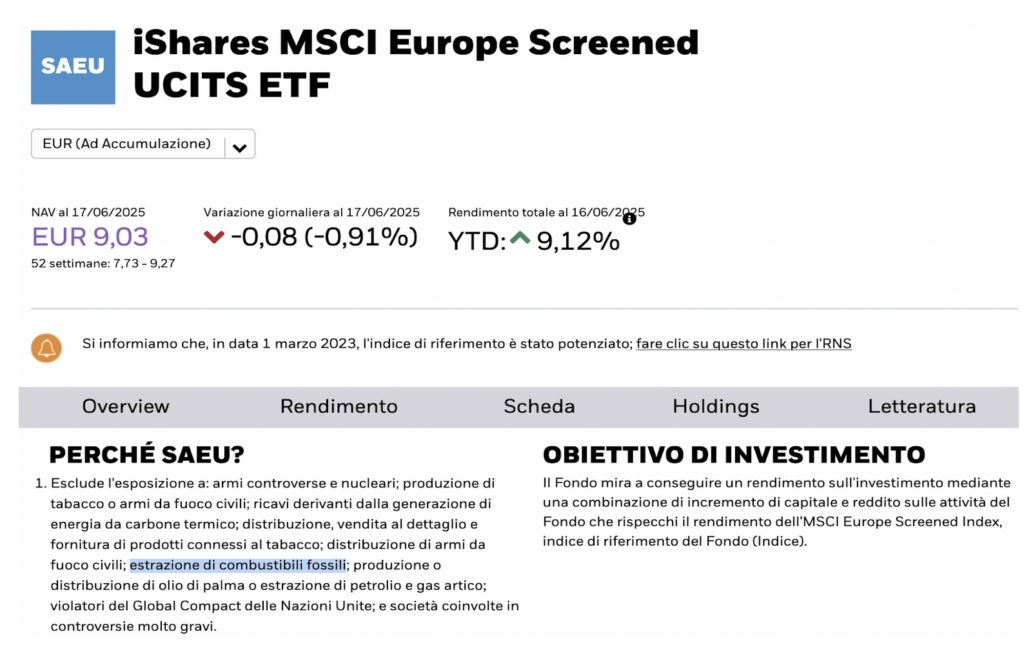
For example, the iShares MSCI Europe Screened UCITS ETF (exchange-traded fund) explicitly states in the first lines of its description that it excludes exposure to “fossil-fuel extraction”. A BlackRock client who is not sufficiently versed in interpreting such claims might therefore reasonably expect companies such as Shell, TotalEnergies, and Eni to be excluded.
Screenshot of the prospectus for the iShares MSCI Europe Screened UCITS ETF: BlackRock states that it excludes “fossil-fuel extraction” from its investments. | Source: iShares.com
A closer look at the fund’s sustainability information shows that it is passively managed and follows the MSCI Europe Screened Index, aiming to promote environmental and social standards. This means the fund uses MSCI’s own rules for excluding certain companies — MSCI being one of the largest global financial firms.
To understand what these exclusion rules are, investors must go to MSCI’s website and read the ESG (Environmental, Social and Governance) methodology behind the index. While it initially appears that oil and gas are excluded, the detailed rules reveal otherwise. The index doesn’t exclude all fossil fuel companies. Instead, it only leaves out those earning more than 5% of their revenue from specific controversial sources: coal, unconventional oil and gas (like fracking or tar sands), palm oil, Arctic drilling, or companies that violate the UN Global Compact’s voluntary sustainability principles.
In short, the index allows most fossil fuel companies unless they cross certain thresholds. That’s why BlackRock, which uses this index, can claim in its prospectus to exclude fossil fuel extraction — but then clarify in other documents that it relies on MSCI’s criteria. In fact, BlackRock refers readers to MSCI’s methodology page for details — but that page leads to a 404 error.
This index, like many others we examined, claims to exclude companies involved in hydrocarbon extraction. However, it later clarifies that the exclusion applies only to “unconventional” projects, such as tar sands and Arctic drilling.
Despite this, many of the companies the funds invest in are still involved in these very activities. A detailed look at the rules and factsheets shows that there is often flexibility under vague categories like “other investments.” This loophole allows the funds to legally maintain their “sustainable” label, even while investing in companies that contradict it.
In its sustainability report, meanwhile, BlackRock makes a confusing claim that might raise eyebrows among the more attentive clients: “This Fund promotes environmental or social characteristics, but does not aim to invest sustainably.” The statement seems to conflict with the very description of the investment, which talks of “a meaningful approach” to sustainable investing.
To further protect itself, BlackRock makes clear that any sustainability conditions “do not change a fund’s investment objective or limit its investment universe, and there is no indication that a fund will adopt investment strategies focused on ESG factors, impact, or exclusion criteria”. BlackRock thus effectively contradicts its own promise to exclude fossil fuels.
In the first quarter of 2025, such nominally “green” funds held fossil-fuel assets worth more than US$1 billion.
Screenshot: MSCI Europe Screened Index fossil-fuel exclusion criteria. | Source: MSCI
Reviewing our findings, Nicolas Koch, from the NGO Sustainable Finance Observatory, comments: “We cannot expect customers to read all the information, and it is likely that most of them will be easily misled by statements that certain activities are completely excluded, when in fact they are not. However, the SFDR represents a major victory in terms of transparency in this regard. It should provide the necessary information to intermediaries, such as financial advisors, who could easily exclude this fund thanks to the SFDR.”https://datawrapper.dwcdn.net/F5AuF/5/
In its “green” funds that specifically claim to exclude hydrocarbons from their portfolios, BlackRock holds fossil-fuel investments worth a total of US$850 million. The first lines of their prospectuses, in addition to mentioning the exclusion criteria, state that the investments are designed to reduce carbon impacts.
In August 2024, the European Securities and Markets Authority (ESMA) introduced stricter rules on the use of sustainability-related terms in fund names. These rules prohibit funds with significant fossil fuel holdings from using labels like “green,” “ESG,” or “sustainable.” The regulation took effect on 21 May 2025.
Before that date, the iShares MSCI Europe Screened UCITS ETF included “ESG” in its name, despite holding US$177 million in fossil fuel companies. As of now, it still holds around US$156 million in firms like Shell, TotalEnergies, Eni, Equinor, EQT, Aker, and OMV. Yet, the fund claims it is designed for investors who want to “exclude controversial sectors and reduce carbon intensity.”
In the first quarter of 2025, the iShares MSCI EMU ESG Enhanced CTB UCITS ETF fund invested US$160 million in fossil-fuel assets. It carries the CTB label, referring to the Carbon Transition Benchmark, meaning that it should promote decarbonisation standards. According to the new guidelines of the ESMA, BlackRock is required to demonstrate in its sustainability reporting how its investments are “on a clear and measurable path towards social or environmental transition”.
In its sustainability disclosures, BlackRock states that it doesn’t practise “engagement” with companies. The term refers to the interaction between asset managers and companies in which they hold equity stakes through “green” funds, where the aim is to positively influence their ESG and climate policies. According to a report by the European Commission’s sustainable-finance platform, such engagement can have positive impacts on companies, and this should be measured and shared with clients. BlackRock has chosen a different path. According to its disclosures, it “does not directly engage with companies, focusing instead on the quality of ESG data (it is committed to engaging directly with data and index providers to ensure better analysis and stability of ESG metrics)”.
“This is not a good way to generate impact and offer a more decarbonised investment portfolio”, says Sustainable Finance Observatory’s Nicolas Koch. NGO ShareAction’s latest report reveals that BlackRock has reduced its support for ESG resolutions at shareholder meetings to almost zero percent, and its commitment to sustainability is not sufficient to be considered credible. “Therefore, for any impact-oriented retail investor who has purchased iShares ESG ETFs in the past or is considering purchasing them in the future, there is a clear recommendation: avoid these products and move toward funds that engage in credible dialogue with companies”, concludes Koch.
To date, none of the carbon majors, including those in which BlackRock’s green funds invest, appear to have energy-transition plans consistent with international climate goals
Robert Clarke, an expert at Client Earth, a nonprofit legal and environmental organisation, makes a similar point:
“There is a huge question mark over impact claims. This is another category of potential ‘transition-washing’. Many funds have been rebranded from ‘ESG’ or ‘sustainable’ to ‘transition funds’, highlighting a subset of them that focus on transition strategies. But the problem here is: what happens if a fund is labeled a transition fund but the investments are not consistent? An example of this, in our view, is continued investment in the expansion of fossil fuels, which is simply incompatible with the transition.”
To date, none of the carbon majors, including those in which BlackRock’s green funds invest, appear to have energy-transition plans consistent with international climate goals. In fact, many seem to have watered down their climate strategies over the past year, as reported in a Carbon Tracker report published in April 2025.
Specialists agree that engagement with companies and voting at shareholder meetings are the most effective mechanisms for ensuring that “sustainable” investments have an impact. A recent report by the Sustainable Finance Observatory shows that 51 percent of European investors want their investments to have an impact.
We asked ESMA whether it considers BlackRock’s statements on sustainability to be contradictory. “The supervisory authority of the related fund will have to determine whether it intends to investigate whether the disclosure may be unclear, incorrect, or misleading to investors”, a spokesperson said.
“BlackRock operates in one of the most highly regulated industries in the world, and our funds, their prospectuses, and their supporting documents, adhere to all applicable regulations,” a spokesperson for the bank told Voxeurop. He added: “For our sustainable range, this includes those governing sustainable investing. iShares ETF holdings are published daily to provide investors with full transparency into where their investments go, and our leading sustainable fund range offers a spectrum of exposures allowing our clients to choose how to meet their own individual investment goals.”
BlackRock accused of greenwashing by Client Earth
The obvious incompatibility between the names of “sustainable” funds and their Big Carbon investments was tackled head on by the environmental group Client Earth in October 2024.
The organisation filed a legal complaint with the French financial supervisory authority, the AMF, challenging BlackRock’s labelling of certain consumer-oriented funds as “sustainable”. It singled out products such as the BSF Systematic Sustainable Global Equity Fund, pointing out that such funds had channelled €1 billion to the fossil-fuel sector.
In its action, Client Earth argued that such labels mislead consumers and may violate EU regulations. “There are rules that require communications to be fair, clear, and not misleading”, said Robert Clarke. “It should be the responsibility of the regulatory authorities [of the country] where the funds are marketed to take action to combat greenwashing, not only in fund names but also in prospectuses, in order to protect their investment sector. At present, national authorities are failing to take action.” In the wake of the complaint, BlackRock has changed the names or exclusion criteria of several of its funds.
Lynn Perry, Chief Executive of the children’s charity Barnardo’s, says: ‘The Spring Statement today offered little hope to the 4.3m children and their families who are living in poverty. In fact, the welfare changes announced today will make things even worse, putting an extra 50,000 children into relative poverty. These children face devastating impacts on their health, well-being and life opportunities long into adulthood.
‘While we welcome the investment to recruit 400 new foster carers, much more action is urgently needed to achieve the government’s ambition to create the healthiest generation of children. Planned freezes to universal credit will add to the worry facing families already struggling to make ends meet. Looking ahead to the Spending Review, we urge the government to prioritise investment in lifting children out of poverty – an investment in children is an investment in the country’s future.’
…
Dr Sarah Hughes, CEO of mental health charity Mind, adds: ‘The extra cuts to benefits announced today are devastating and will push more people into a mental health crisis.
‘It’s a political choice to try fixing the public finances by cutting the incomes of disabled people, including people with mental health problems. Benefits are a lifeline for so many people. Cuts will push people into poverty. This is policy making by numbers with little recognition of the impact on real people’s lives.
Slain health CEO Brian Thompson’s tenure was marked by skyrocketing prior authorization denials, leading to increased profits
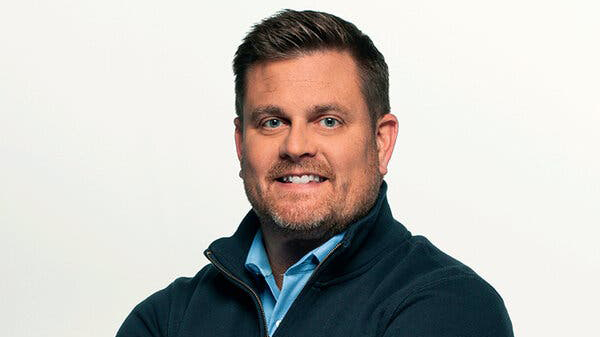
Brian Thompson, slain CEO of UnitedHealthcare, was responsible for skyrocketing prior authorization denials (Photo: UnitedHealthcare)
The assassination of UnitedHealthcare CEO Brian Thompson on December 4 has sparked a reaction that few may have suspected. The perpetrator has received an outpouring of popular support, and a profound debate on the brutality of the US for-profit healthcare system has been sparked, with many accusing healthcare corporations of reaping their profits directly from human misery.
Thompson was shot and killed while heading to an investors meeting in Midtown Manhattan on December 4. Police have arrested 26-year-old Luigi Mangione in connection with the crime, who quickly has become a working class hero in the eyes of many in the US public, especially after his alleged manifesto revealed that he was motivated by outrage towards healthcare corporations. “A reminder: the US has the #1 most expensive healthcare system in the world, yet we rank roughly #42 in life expectancy,” reads the alleged manifesto, which law enforcement claim to have found in his backpack. “It is not an issue of awareness at this point, but clearly power games at play. Evidently I am the first to face it with such brutal honesty.”
The reactions to Thompson’s death show that this outrage is echoed by the US public. UnitedHealthcare had to remove a Facebook post mourning Thompson after it received over 42,000 laughing reactions. Comments on social media regarding Thompson’s death made insurance-related quips including “unfortunately my condolences are out-of-network,” and “thoughts and deductibles to the family.”
Health beyond the for-profit system
People in the US are increasingly demanding alternatives to the present for-profit healthcare system. A Gallup poll taken shortly before Thompson’s assassination shows that the highest percentage of US adults in over a decade believe it is the government’s responsibility to ensure that people have healthcare coverage—62%, as opposed to 36% who insist it is not the government’s responsibility. Gallup data also indicates that most in the US have a negative view of the healthcare industry.
Data for Progress polling indicates that people across the political spectrum support policies that make healthcare more equitable, with 75% of both Democrat, Republican, and independent voters opposing allowing insurers to deny coverage or charge more based on pre-existing conditions. Also across party lines, 70% of voters oppose stopping Medicare (US public insurance) from being able to negotiate lower costs for drug prices.
The unpopularity of the healthcare insurance industry becomes obvious when one examines how exactly insurance companies wield their power over the healthcare system to extract profits from working people.
Cost cutting through denial of service
Shortly before Thompson’s killing, another insurance corporation, Anthem Blue Cross Blue Shield, announced that it would not pay for the complete duration of anesthesia for surgical procedures. This move was denounced by the American Society of Anesthesiologists (ASA). “This is just the latest in a long line of appalling behavior by commercial health insurers looking to drive their profits up at the expense of patients and physicians providing essential care,” said Dr. Donald E. Arnold of ASA. “It’s a cynical money grab by Anthem, designed to take advantage of the commitment anesthesiologists make thousands of times each day to provide their patients with expert, complete and safe anesthesia care. This egregious policy breaks the trust between Anthem and its policyholders who expect their health insurer to pay physicians for the entirety of the care they need.”
Following Thompson’s assassination and the subsequent outrage over the state of the healthcare industry, Anthem walked back this decision, with a company spokesperson stating that “there has been significant widespread misinformation about an update to our anesthesia policy. As a result, we have decided to not proceed with this policy change.”
Regardless of Anthem’s flip-flopping, the corporation was willing to cut anesthesia for patients mid-surgery simply to cut costs. This is only one example of how health insurance companies are able to reap their enormous profits from policies which maximize human misery.
Under the current privatized healthcare system in the US, working people and their employers pay hundreds of billions of dollars to private insurance companies in the hopes of receiving adequate coverage when most needed. Insurance companies, which under a capitalist system exist only to make a profit, not to actually provide coverage, do whatever they can do to deny coverage to patients in their hour of need—enabling them to pocket the billions they receive from people in the US and increase their revenue.
Companies such as UHC, which is the nation’s largest health insurer with over 15% of the market share, cut costs by denying coverage to patients, including through a process called prior authorization, a process which insurance companies utilize to determine if they will cover a prescribed procedure, service, or medication. Prior to Thompson’s tenure as UHC CEO, which began in 2021, the rate of prior authorization denials was 8%. By 2022, the rate of denial had skyrocketed to 22.7%. According to personal finance platform ValuePenguin, UHC denies Medicare and non-Medicare insurance claims at a rate that is double the rate of the national average.
UHC’s prior authorization denials increased so sharply that they prompted an investigation by media outlet ProPublica as well as the US Senate. ProPublica found that UHC had culled therapy expenses by using an algorithm to restrict mental healthcare coverage. A report by the Senate Permanent Subcommittee on Investigations found that UHC used artificial intelligence to deny claims at an increasing rate. In November of 2023, UHC was hit by a class action lawsuit filed by the families of two former UHC beneficiaries, which alleged that the company had illegally denied “elderly patients care owed to them under Medicare Advantage Plans” by utilizing an AI algorithm with a 90% error rate.
“The elderly are prematurely kicked out of care facilities nationwide or forced to deplete family savings to continue receiving necessary medical care, all because [UHC’s] AI model ‘disagrees’ with their real live doctors’ determinations,” said the complaint.
These sharp increases in claim denials served a particular purpose: under Thompson’s leadership, UHC profits increased from USD 12 billion in 2021 to USD 16 billion in 2023. UnitedHealthcare Group, of which UHC is a part, is now the largest health insurance company is the US, with an annual revenue of over USD 189 billion.
Hey @UHC. Completed a hysterectomy yesterday afternoon, discharged her home in the evening (saving @UHC and everyone some money). Discharge medications included 12 Vicodin. (retail cost $30). Vicodin DENIED pending prior authorization. Patient in pain all night. Way to go.
As health insurance companies extract their enormous profits from those left without coverage, some are seeking to propose and organize alternatives to the for-profit healthcare system. Progressive demands for Medicare for All, a single-payer healthcare program in which the costs of essential healthcare for all US residents are covered under a public health plan that would replace almost all other existing public and private health plans, have reignited following Thompson’s assassination. Organizations such as Physicians for a National Health Program have advocated for such a policy. As PNHP outlines, under a single-payer program, “over $500 billion in administrative savings would be realized by replacing today’s inefficient, profit-oriented, multiple insurance payers with a single streamlined, nonprofit, public payer.”
“There is no justification for violence,” said California Representative Ro Khanna, who supports the policy. “But the outpouring afterwards has not surprised me.
Zeynep Tufekci (New York Times, 12/6/24) “can’t think of any other incident when a murder in this country has been so openly celebrated.”
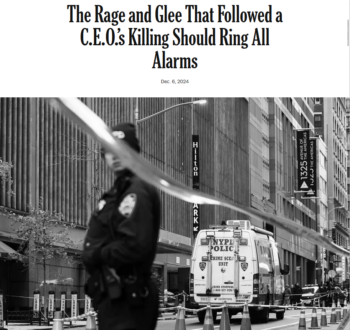
The early morning murder of UnitedHealthcare CEO Brian Thompson was met on social media with a “torrent of hate” for health insurance executives (New York Times, 12/5/24). Memes mocking the insurance companies and their callous disregard for human life abound on various platforms (AFP, 12/6/24).
Internet users are declaring that the man police believe to be the shooter, 26-year-old Luigi Mangione, is certifiably hot (Rolling Stone, 12/9/24; KFOX, 12/10/24). A lookalike contest for the shooter was held in lower Manhattan (New York Times, 12/7/24).
If so many people are unsympathetic at best in response to such a killing, that might be a reason to revisit why health insurance companies are so loathed. The rage “was shocking to many, but it crossed communities all along the political spectrum, and took hold in countless divergent cultural clusters,” the New YorkTimes (12/6/24) noted. Mangione was reportedly found with an anti-insurance manifesto that stated “these parasites had it coming” (Newsweek, 12/9/24), echoing a resentment largely felt by a lot of Americans, and targeted fury at UnitedHealthcare specifically.
UnitedHealthcare has always stood out for exceptionally high rate of claims denial generally in the industry (Boston Globe, 12/5/24; Forbes, 12/5/24). For example, a Senate committee found that “UnitedHealthcare’s prior authorization denial rate for post-acute care jumped from 10.9% in 2020 to 22.7% in 2022” (WNYW, 12/7/24).
The Times (12/5/24) reported that the Senate committee found that “three major companies—UnitedHealthcare, Humana and CVS, which owns Aetna—were intentionally denying claims” related to falls and strokes in order to boost profits. UnitedHealthcare “denied requests for such nursing stays three times more often than it did for other services.”
Increasing dissatisfaction
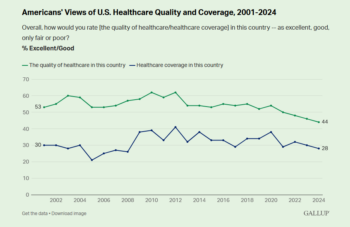
The perception of the quality of US healthcare has been on the decline since 2012 (Gallup, 12/6/24).
On top of that, Americans generally believe their insurance-centered system is a mess. Gallup (12/6/24) reported that “Americans’ positive rating of the quality of healthcare in the US is now at its lowest point in Gallup’s trend dating back to 2001.”
It continued:
The current 44% of US adults who say the quality of healthcare is excellent (11%) or good (33%) is down by a total of 10 percentage points since 2020 after steadily eroding each year. Between 2001 and 2020, majorities ranging from 52% to 62% rated US healthcare quality positively; now, 54% say it is only fair (38%) or poor (16%).
As has been the case throughout the 24-year trend, Americans rate healthcare coverage in the US even more negatively than they rate quality. Just 28% say coverage is excellent or good, four points lower than the average since 2001 and well below the 41% high point in 2012.
Most Americans are unsatisfied with the healthcare system, say the health insurance system is confusing and opaque, and many have skipped or delayed care because of a bad experience or the lack of timely appointments. A small, but not insignificant number, of Americans believe they have had a negative health outcome as result of their experiences within the healthcare system.
When this inefficient system doesn’t literally kill Americans, it can still kill them financially. “Almost a third of all working adults in the United States are carrying some kind of medical debt—that’s about 15% of all US households,” Marketplace (3/27/24) reported. It added: “This debt is also the leading cause of bankruptcies in the country.”
Many news outlets’ pontificators, however, were incensed that anyone would voice frustration with health insurance when an industry CEO has fallen.
‘Not the time to offer criticism’
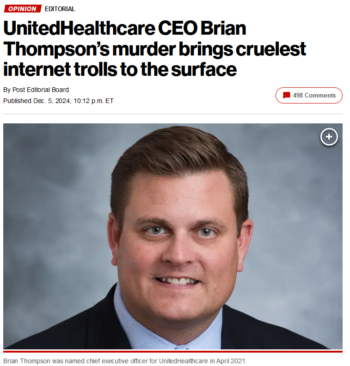
After Brian Thompson’s killing, the New York Post (12/5/24) condemned those on social media who “swooned over his killer, speculated on his motives, and wondered if Timothée Chalamet would play him in the movie.”
Responding to the memes and the jokes, many of which were more about the unjust health insurance system than support for vigilante murder, the New York Post editorial board (12/5/24) asked:
Do the jokes point to a society that has become so desensitized by the coarseness of online discussion, so disassociated from kindness, that a baying mob cheers a man’s murder and cries out for more?
And upon Mangione’s arrest, the Post (12/9/24) complained that on social media, “tasteless trolls showered praise on the Ivy League grad.” The Post (12/11/24) also fretted about fake “Wanted” posters for insurance company executives that the paper considered a “a fear-mongering social media stunt to incite hysteria,” adding that the “murder has also spawned a stream of merchandise sympathetic towards the 26-year-old being sold by online retailers, forcing Amazon to pull them from its website.”
Fox News (12/6/24) quoted one of its own contributors, Joe Concha, saying, “I think this encapsulates the far left’s worldview: If you run a company that isn’t to their liking, you deserve to die.” The network (12/7/24) praised Democratic Sen. John Fetterman of Pennsylvania for “tearing into” a New York article (12/7/24) that the outlet characterized as saying “resentment over denied insurance claims made…Thompson’s murder inevitable.”
The dismay was felt in other corners of right-wing media. At the Free Press (12/5/24), the brainchild of anti-woke crusader Bari Weiss, Kat Rosenfield wrote:
The people celebrating Brian Thompson’s murder by turning him into an avatar for everything wrong with the American healthcare system remind me of nothing so much as Hollywood screenwriters, cunningly manipulating an audience into cheering on unforgivable acts of fictional violence.
This is not the time to offer your criticisms of the health-insurance industry. And there is never a time to believe that corporate executives are, by their very nature, evil people who deserve to be killed. Yet that is what you’ll see if you go on social media right now and look at comments on news stories about this assassination.
Yet all of these outlets at the same time have run support for Daniel Penny, the man recently acquitted for killing a Black homeless man on the New York City subway (National Review, 6/17/23; Free Press, 10/20/24; New York Post, 12/4/24; Fox News, 12/6/24). These outlets likewise expressed support for Kyle Rittenhouse after he gunned down Black Lives Matter protesters (National Review, 11/19/21; Free Press, 11/17/21; New York Post, 11/19/21; Fox News cited by Media Matters, 11/11/21), and for George Zimmerman when he shot Trayvon Martin (National Review, 6/22/20; New York Post, 7/15/13; Fox News, 7/18/12). In other words, it’s fine to defend vigilantes when they kill unarmed Black people or anti-racist activists, but when a CEO’s life is taken, we must solemnly stay silent on the reasons why such a person might be targeted or why bystanders might not be crying.
Piers Morgan (New York Post, 12/10/24) made this clear when he said “I cheered when I heard” Penny’s acquittal, and felt “shocked and saddened when I saw the footage” of the Thompson shooting. “Those two reactions would surely be the correct and appropriate ones for anyone with an ounce of fairness and humanity in their heart,” he said—because Thompson was “a non-violent, non-threatening, non-criminal man in the street,” whereas Penny’s victim was “a dangerous, mentally ill, homeless man.”
Blame it on Medicare
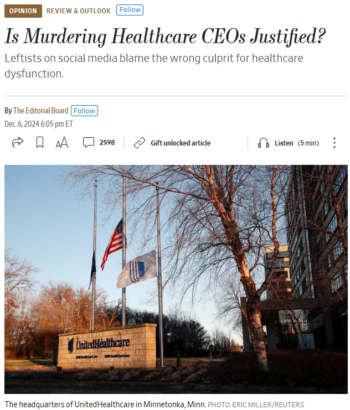
The Wall Street Journal (12/6/24) made the absurd claim that a medical system based on private insurance is better than any other kind of healthcare system.
It was the Wall Street Journal, the more erudite of Murdoch’s media properties, that really addressed the question of why people might hate health insurance companies. The anger was misdirected, the editorial board (12/6/24) said. Rather, we should look to federally funded healthcare if we want to get mad: “Medicare and Medicaid, two government programs, cover about 36% of Americans,” the paper observed; because they “pay doctors and hospitals below the cost of providing care…many providers won’t see Medicaid patients, resulting in delayed care.”
It’s an odd argument, given that people who receive Medicaid report being happier with their health insurance than people who get it through their employers or pay for it themselves—and people with Medicare are the happiest of all (KFF, 6/15/23). If the federal programs are underpaying healthcare providers, the obvious solution would be to increase funding for them—an initiative the Journal would be unlikely to support.
The board (Journal, 10/10/24) later dismissed critiques of the health insurance industry and passed off Mangione as a “disturbed individual” radicalized by the Internet and said it is “a dreadful sign of the times that Mr. Mangione is being celebrated.”
Journal editorial board member Allysia Finley (12/8/24) followed up by placing the blame on the Affordable Care Act (aka “Obamacare”). “Having insurance doesn’t change people’s behavior,” she wrote, but does “cause them to use more care.” The situation, she said, “has gotten worse since Obamacare expanded eligibility” for Medicaid. This portrait of US patients overusing healthcare like sweet-toothed children let loose in a candy store is belied by (among other things) the fact that Americans live 4.7 fewer years than the average of comparable countries (KFF, 1/30/24).
The Journal editorial went on to complain that “some providers prescribe treatments and tests that may be medically unnecessary,” and so “insurers have tried to clamp down on such abuse by requiring prior authorization.” While this “can result in delayed care that is medically necessary…it’s also how insurers control costs.”
In reality, doctors are complaining that insurance bureaucrats are impeding their ability to deliver needed healthcare because of this cost-slashing system (Forbes, 3/13/23). The American Medical Association found “94% of doctors say prior authorization leads to delays in patient care” (Chief Medical Executive, 3/14/23); “one in three doctors (33%) say prior authorization has led to serious adverse events with their patients.”
Journal editorialists appear to believe that doctors are jauntily giving away expensive blood pressure medicine and signing up patients for brain surgery for no particular reason, and the only thing that can stop this carnival of care is some bureaucrat who is trained to say “no.” The reality is that the private insurance system “saves insurance companies money by reflexively denying medical care that has been determined necessary by a physician,” as pediatrician William E. Bennett Jr. (Washington Post, 10/22/19) wrote. This is why people are so unsympathetic to Thompson, who was paid an estimated $10 million annually for imposing medical austerity on patients and providers (PBS, 12/7/24).
Pity the insurance giants
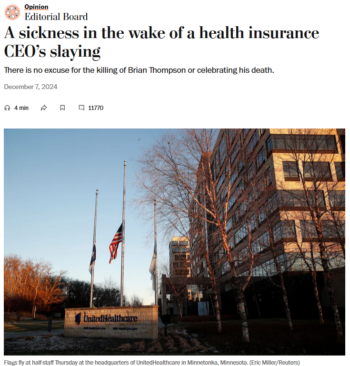
The Washington Post (12/7/24) criticized those who tried to use Thompson’s killing “as an occasion for policy debate about claim denial rates by health insurance companies.” (Note that both the Post and the Wall Street Journal used the same photo of flags at half-mast.)
Right-wing media weren’t the only engaging in scolding. At the Jeff Bezos–owned Washington Post, the editorial board (12/7/24) criticized those “who excuse or celebrate the killing,” as well as those “who do not countenance the killing itself” but “have nevertheless tried to treat it as an occasion for policy debate about claim denial rates by health insurance companies, an admittedly legitimate issue.” The Post added that debate was “fine in principle, but we’re skeptical that this particular moment lends itself to nuanced discussion of a complicated, and heavily regulated, industry.”
The editors nevertheless spent a lengthy paragraph explaining to readers that “controlling healthcare costs requires difficult trade-offs,” and that “even the most generous state-run health systems in other countries also have to face” these trade-offs. The editorial attempted to summon sympathy for
insurers, whose profits are capped by federal law, [and] must contend with consumer demand for ready access to high-priced specialists and prescription drugs—and, at the same time, premiums low enough that people can afford coverage.
Note that insurance company profits are “capped” by requiring them to spend at least 80% of premiums on claims, a percentage known as their loss ratio—but those claims can be paid to providers that are owned by the insurers themselves, “a loophole that makes loss ratio requirements meaningless” (Physicians for a National Healthcare Program, 7/16/21). United Healthcare has been particularly aggressive at this, which is part of the reason its “capped” profits soared to $22.4 billion in 2023.
As for the Post’s assertion that insurance providers should keep “premiums low enough that people can afford coverage,” KFF (10/9/24) found that “Family premiums for employer-sponsored health insurance rose 7% this year to reach an average of $25,572 annually, marking the “second year in a row that premiums are up 7%.” The Center for American Progress (11/29/22) found that employer sponsored insurance “premiums have risen above the rate of inflation and have outpaced wage growth” over the course of a decade. “Escalating grocery bills and car prices have cooled, but price relief for Americans does not extend to health care,” USA Today (10/9/24) reported.
The Post added that all this talk about how Americans are being tortured by the insurance system should wait until next year, “when Congress is to consider whether to keep temporary Obamacare enhancements that have boosted enrollment.”
It is easy to see the material interests of the Washington Post‘s owner at work. Jeff Bezos’ Amazon does not run a health insurance company, but it is fully entrenched in the for-profit medical system. It offers a health insurance marketplace through AmazonFlex, acquired the healthcare provider One Medical last year (NPR, 11/12/23; Forbes, 4/5/24), and offers a pharmacy and other health services.
As one of the world’s richest people, Bezos might have another reason to be worried about people cheering on the murder of CEOs: Amazon is often hated for its monopoly-like grip on online retail (FTC, 9/26/23), as well as charges of price-gouging (Seattle Times, 8/14/24) and union-busting (Guardian, 4/3/24).
‘Last or near last’
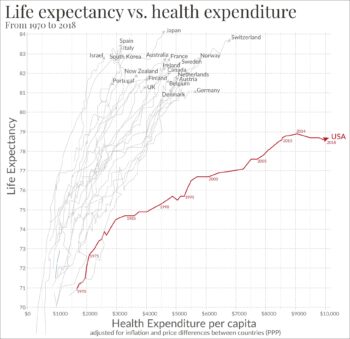
The failure of the US healthcare system in one chart: life expectancy plotted against healthcare spending.
The Washington Post‘s line about the comparable ills of “generous state-run health systems” echoed a similar argument from the Wall Street Journal‘s editorial, which concluded:
Government healthcare is a recipe for more care delays and denials. Witness the fiasco in the United Kingdom, where the Labour government reports that more than 120,000 people died in 2022 while on the National Health Service’s waitlist for treatment. To adapt a famous Winston Churchill phrase, private insurance is the worst form of healthcare, except for all others.
The statement that the British or European health systems are worse for people than the US private insurer–dominated system is simply false. Just months ago, the Commonwealth Fund (NBC, 9/19/24) found that the United States
ranks as the worst performer among 10 developed nations in critical areas of healthcare, including preventing deaths, access (mainly because of high cost) and guaranteeing quality treatment for everyone.
The US “ranked last or near last in every category except one,” precisely because
the complex labyrinth of hospital bills, insurance disputes and out-of-pocket requirements that patients and doctors are forced to navigate put the US second to last in administrative efficiency.
The Commonwealth Fund (CNN, 1/31/23) also found that
the United States spends more on healthcare than any other high-income country, but still has the lowest life expectancy at birth and the highest rate of people with multiple chronic diseases.
Healthcare providers in Mexico and Costa Rica are huge draws for Americans in need of care who can’t make it through America’s Kafkaesque system (NPR, 3/8/23). Spain and Portugal are attracting American retirees, and good low-cost health care is one incentive (Travel + Leisure, 6/20/24).
Retreat to the castle
Apparently the CEOs that Fox News (11/13/24) is so concerned about don’t qualify as “professional elites.”
While the Washington Post’s position clearly falls in line with its material allegiance to a system where its owner sits at the apex, the positions from Murdoch are more interesting. As the Democratic Party has lost support among the working class (NPR, 11/14/24; USA Today, 11/30/24), Murdoch’s outlets have touted Donald Trump and the Republican Party as alternatives for working-class voters.
Murdoch and other purveyors of Republican propaganda have promoted the idea that Democrats serve only financial elites and Hollywood producers, and that protectionist policies under Trump will help US workers (New York Post, 7/16/24; Fox News, 11/13/24). Republicans were able to woo voters by complaining about the high price of gasoline and groceries under the Biden administration (CNBC, 8/7/24).
Now Murdoch outlets are fully retreating into their elite castle and telling the rabble to stop complaining about the lack of access to healthcare. The Republicans and their news outlets have worked hard to recharacterize themselves as something more populist, but the Thompson killing has brought back the old narrative that they are, proudly, the champions of the 1 Percent.
FAIR’s work is sustained by our generous contributors, who allow us to remain independent. Donate today to be a part of this important mission.