A Palestinian boy protests outside the illegal settlement of Modiin Illit. (Photo: Majdi Mohammed / Alamy)
Exclusive: Six British charities appear to funnel donations to Israeli settlements in the occupied West Bank
Six registered British charities are openly fundraising for activities and infrastructure in illegal Israeli settlements, a Declassified investigation has found.
Two of the charities explicitly state in their publicly available filings with the Charity Commission that they are supporting specific settlements in the occupied West Bank. Others feature illegal settlements in their names.
Altogether, they appear to have sent more than £1.7 million to recipients in settlements over the past three years, although the figure could be much higher.
The findings raise further questions about the quality of the commission’s oversight following recent reports, including several by Declassified, which have revealed the role UK charities play in facilitating the flow of money to settlement-supporting organisations.
“The government and regulators have been far too slow to confront the systematic issue of UK charitable funds supporting settlements,” said Shaima Dallali, legal researcher from the International Centre of Justice for Palestinians (ICJP).
…
The ICJP has already filed a formal complaint with the Commission and the Metropolitan Police about one of the charities flagged by Declassified and is reviewing the others.
Dallali said there are “legitimate questions” about how charities were able to operate “without apparent regulatory intervention”.
This work by Middle East Monitor is licensed under a Creative Commons Attribution-NonCommercial-ShareAlike 4.0 International License.
Pro-Palestinian demonstrators march past Big Ben as they march from Embankment Station during the 28th protest held since October 7, 2023, calling for an end to UK arms sales to Israel and condemning Israel’s attacks on Gaza as well as crackdowns on Palestinian solidarity in the UK on July 29, 2025 in London, United Kingdom. [Behlül Çetinkaya – Anadolu Agency]
Legal Action for Peace, an organisation of lawyers and human rights advocates who challenge anti-Muslim hatred and anti-Arab discrimination, has written to the Charity Commission to raise serious concerns over its discriminatory conduct during its investigation into the Abdullah Quilliam Society.
LAFP’s complaint follows two letters sent to the Charity from the Commission on 15 July and 5 August 2025 regarding statements made by Ajmal Masroor criticising Israel which the Commission deemed to be “divisive and inflammatory” a position the LAFP strongly refutes, citing several international legal precedents, human rights reports, and United Nations findings that support such descriptions of Israel as being an ‘apartheid,’ ‘racist’ and ‘settler-colonial’ state.
Concerns over discrimination and free speech
In its letter, LAFP alleges that the Commission’s inquiry has disproportionately targeted the Abdullah Quilliam Society, a Muslim organisation, for commentary relating to the State of Israel. The organisation argues that similar commentary by other high-profile human rights organisations—such as Amnesty International—did not lead to equivalent regulatory action, raising questions of unequal treatment and possible discrimination under the Equality Act 2010.
LAFP also raised significant concerns over the Charity Commission’s apparent attempts to regulate or censure speech critical of Israel, arguing that doing so constitutes interference with the lawful exercise of free expression under Article 10 of the Human Rights Act 1998. The letter warns against the misuse of public resources to police political discourse—particularly where such speech is supported by documented international human rights violations.
LAFP’s Miriam Khan stated “During the past 22 months of Israeli onslaught on the Palestinians both in Gaza and the West Bank, the forced starvation and the Genocide, we are witnessing the Charity Commission’s misguided attempt to regulate speech criticising Israel whilst using public money. It is our view that the Commission has significantly overstepped its regulatory powers in its attempt to censure speech relating to a foreign state.
LAFP have written to the Commission demanding that it explains its legal rationale for considering speech that is critical of Israel as a regulatory breach and to also explain the disparity in its treatment of Muslim charities compared to others.”
Legal Action for Peace concluded the letter by urging the Commission to provide assurances that any ongoing inquiry into the Abdullah Quilliam Society will be free from bias or discriminatory intent. LAFP stated in their letter “We will not hesitate to take legal action where we consider the Muslim community, including its institutions, are being unfairly targeted in contravention of the law.”
Genocide denier and Current UK Prime Minister Keir Starmer is quoted that he supports Zionism without qualification. He also confirms that UK air force support has been essential in Israel’s mass-murdering genocide. Includes URLs https://www.declassifieduk.org/keir-starmers-100-spy-flights-over-gaza-in-support-of-israel/ and https://youtu.be/O74hZCKKdpAUK Labour Party government Keir Starmer, Angela Rayner and Rachel Reeves explain that they are participants and complicit in Israel’s Gaza genocide providing Israel with army and air force support. They explain that they don’t do gas chambers but do do forced marches, starvation, destroy hospitals, mass-murders of journalists and healthcare workers.Vote Labour for Genocide.
A DeSmog collage. The Institute of Economic Affairs has its headquarters on Lord North Street, Westminster. Credit: Des Blenkinsopp(CC BY-SA 2.0)
The regulator has opened a case against the Tufton Street group.
The Institute of Economic Affairs (IEA) pressure group, which campaigns against clean energy policies, is being investigated by the charities regulator.
The Good Law Project (GLP), a legal advocacy group, yesterday announced that it had been successful in forcing the Charity Commission to open a “regulatory compliance case” against the IEA.
A Charity Commission spokesperson told DeSmog: “We can confirm that, following an internal review, we have opened a regulatory compliance case to assess potential regulatory concerns about the Institute for Economic Affairs.
“Our case will examine the trustees’ management of perceptions of potential political bias, perceptions of a potential lack of transparency around funding, and perceptions that the charity may have pre-determined policy positions which would not be in keeping with its charitable purposes to advance education.”
The IEA is registered as a charity, and the regulator states that “political activity must not become the reason for the charity’s existence.”
In 2018, Greenpeace’s investigative journalism unit Unearthed revealed that the IEA had received funding from oil major BP every year since 1967. In response to the story, an IEA spokeswoman said: “It is surely uncontroversial that the IEA’s principles coincide with the interests of our donors.”
The IEA also received a £21,000 grant from U.S. oil major ExxonMobil in 2005.
However, the IEA does not publicly declare its donors, and it’s not known if the pressure group has received funding from BP or ExxonMobil in more recent years.
The IEA has extensive influence in politics and the media. It was pivotal to Liz Truss’s short-lived premiership as prime minister, and has boasted of its access to Conservative ministers and MPs.
The IEA is a prominent supporter of the continued and extended use of fossil fuels. The group has advocated for the ban to be lifted on fracking for shale gas, calling it the “moral and economic choice”. The IEA has also said that a ban on new North Sea oil and gas licences would be “madness”, has criticised the windfall tax imposed by the UK on fossil fuel firms, and said that the previous government’s commitment to “max out” the UK’s oil and gas reserves was a “welcome step”.
The IEA is part of the Tufton Street network – a cluster of libertarian think tanks and pressure groups that are in favour of more fossil fuel extraction and are opposed to state-led climate action. These groups are characterised by a lack of transparency over their sources of funding.
The Charity Commission initially rejected the GLP’s complaint about the IEA, which was lodged in March 2024 and backed by MPs from the Green Party, Liberal Democrats, and the Scottish National Party. The Charity Commission rejected the complaint after just 12 days.
However, after the GLP threatened formal legal action against the Charity Commission for failing to properly consider the evidence against the IEA, it has agreed to open a compliance case.
“We welcome this screeching u-turn from the Charity Commission who raced to clear the IEA last year,” said Good Law Project’s executive director Jolyon Maugham.
“It shouldn’t have taken the threat of legal action to force the regulator to do its job. The IEA’s activities are the polar opposite of public benefit and we’re now urging the Charity Commission to go further in its investigation.”
However, it’s unclear what action, if any, will be taken against the IEA if the regulator finds it in breach of charity rules. A previous case brought against the Global Warming Policy Foundation (GWPF) – the UK’s leading climate science denial group – didn’t lead to any meaningful sanctions against the Tufton Street group.
The GLP accused the GWPF of breaching charity law by spending hundreds of thousands of pounds on one-sided research attacking climate science, and by funding the lobbying activities of its campaign arm Net Zero Watch. However, the Charity Commission asked the GWPF to make only minor changes to its ownership structure and output.
An IEA spokesperson said: “We have received a letter from the Charity Commission and will be responding to them thoroughly in due course.”
The Institute of Economic Affairs has its headquarters on Lord North Street, Westminster. Credit: Des Blenkinsopp (CC BY-SA 2.0)
A senior figure at the influential Institute of Economic Affairs (IEA) think tank contributed to a new documentary that spread numerous myths about climate change.
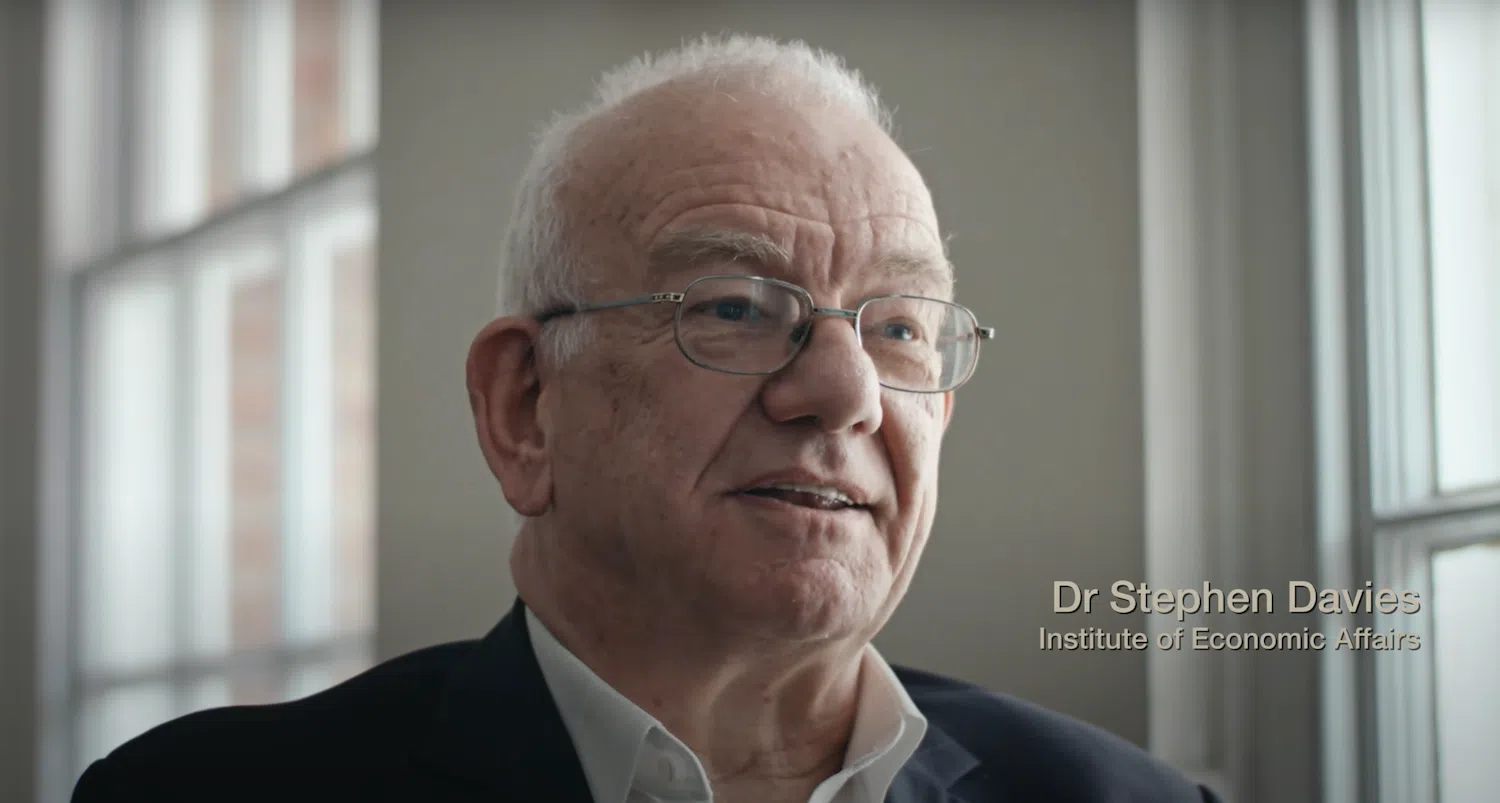
Stephen Davies, an academic who has worked in educational outreach roles at the IEA since 2010, appeared several times in Climate The Movie: The Cold Truth – a new film directed by climate science denier Martin Durkin.
In the documentary, Davies claims that climate activists want to impose an “austere” life on ordinary people. “Behind all the talk about a climate emergency, climate crisis” is “an animus and hostility towards” working-class people, “their lifestyle, their beliefs and a desire to change it by force if necessary,” he says.
According to the website Skeptical Science, which debunks climate misinformation, Climate The Movie contains more than two dozen myths about climate change. The film suggests that we shouldn’t be worried about greenhouse gas emissions, because plants need carbon dioxide. “We’re in a CO2 famine,” one interviewee claims.
The UN’s Intergovernmental Panel on Climate Change (IPCC), the world’s foremost climate science body, has stated that carbon dioxide “is responsible for most of global warming” since the late 19th century, which has increased the “severity and frequency of weather and climate extremes, like heat waves, heavy rains, and drought”.
Climate The Movie producer Thomas Nelson told DeSmog that “I see the misguided fight against carbon dioxide as being as crazy as fighting against oxygen or water vapour, and I think scaring innocent children about this is deeply evil”.
The IEA said that “Steve firmly believes that climate change is happening and carbon emissions are having an impact. His view that climate policy imposes costs, particularly on working-class communities, is entirely mainstream. IEA publications and spokespeople have supported action on climate change, including carbon pricing.”
A screenshot of Stephen Davies of the Institute of Economic Affairs in Climate The Movie: The Cold Truth. Credit: Climate The Movie / YouTube
In 2018, Greenpeace’s investigative journalism unit Unearthed revealed that the IEA had received funding from oil major BP every year since 1967. In response to the story, an IEA spokeswoman said: “It is surely uncontroversial that the IEA’s principles coincide with the interests of our donors.”
The IEA also received a £21,000 grant from U.S. oil major ExxonMobil in 2005.
The IEA has extensive influence in politics and the media. It was pivotal to Liz Truss’s short-lived premiership as prime minister, and has boasted of its access to Conservative ministers and MPs. During the year ending March 2023, the IEA appeared in the media on 5,265 occasions, a figure 43 percent higher than its previous peak in 2019.
The group has also received donations from a number of philanthropic trusts accused of channelling funds from the fossil fuel industry and helping to support climate science denial groups. The IEA is a member of the Atlas Network – an international collaboration of “extreme” free market groups that have been accused of promoting the interests of fossil fuel companies and other large corporations.
It’s not known if the IEA has received funding from BP since 2018.
The IEA is a prominent supporter of the continued and extended use of fossil fuels. The group has advocated for the ban to be lifted on fracking for shale gas, calling it the “moral and economic choice”. The IEA has also said that a ban on new North Sea oil and gas would be “madness”, has criticised the windfall tax imposed on North Sea oil and gas firms, and said that the government’s commitment to “max out” the UK’s fossil fuel reserves is a “welcome step”.
The IEA is part of the Tufton Street network – a cluster of libertarian think tanks and pressure groups that are in favour of more fossil fuel extraction and are opposed to state-led climate action. These groups are characterised by a lack of transparency over their sources of funding. The IEA does not publicly declare the names of its donors.
“From Brexit to Trussonomics, the IEA has consistently peddled and promoted destructive and damaging policies,” Green Party MP Caroline Lucas told DeSmog. “Yet perhaps nothing will prove more dangerous long term than the stream of climate denialism and calls to delay action that have been pouring out of Tufton Street for many years.
“Clearly the IEA is now ramping up its climate culture war and the Conservative Party has been following suit. The cross-party consensus on climate action we used to have in Parliament is under strain like never before.”
The IEA and Stephen Davies were approached for comment.
Climate The Movie
During the documentary, Davies suggests that action to reduce greenhouse gas emissions is being used to limit the freedom of individuals. He claims that climate activists want to impose “a much more austere simple kind of lifestyle” on people “in which the consumption choices of the great bulk of the population are controlled or even prohibited.”
Davies adds that: “What you have here is a classic example of class hypocrisy and self-interest masquerading as public spirited concern. You could take these kinds of green socialist more seriously if they lived off grid, they cut their own consumption down to the minimum, they never flew. Instead you get constant talk about how human consumption is destroying the planet but the people making all this talk show absolutely no signs of reducing their own.”
The documentary also features an interview with Benny Peiser, the director of the Global Warming Policy Foundation (GWPF) – the UK’s leading climate science denial group. Peiser has previously claimed that it would be “extraordinary anyone should think there is a climate crisis”, while the GWPF has expressed the view that carbon dioxide has been mischaracterised as pollution, when in fact it is a “benefit to the planet”.
The film was favourably reviewed by commentator Toby Young in The Spectator magazine, who described it as “a phenomenon”. Young has previously said that he’s sceptical about the idea of human-caused climate change.
The IPCC has stated it is “unequivocal that human influence has warmed the atmosphere, ocean and land”, while scientists at NASA have found that the last 10 years were the hottest on record. Earth’s average surface temperature in 2023 was the warmest since records began in 1880.
The IPCC has also warned that false and misleading information “undermines climate science and disregards risk and urgency” of climate action.
The documentary also features Claire Fox, a member of the House of Lords who was nominated for a peerage by former prime minister Boris Johnson in 2020.
Fox used the documentary to claim that, by tackling climate change, people will be forced to pay more “to simply live the lives that they were leading”.
She suggests that supporters of climate action are trying to “take away what we consider to be not luxuries but necessities.”
The UK’s Climate Change Committee, which advises the government on measures to achieve net zero emissions by 2050, estimates that the combined policies will cost less than one percent of the country’s national output.
The Office for Budget Responsibility, the UK’s independent economic forecaster, has also said that “the costs of failing to get climate change under control would be much larger than those of bringing emissions down to net zero”.
Claire Fox and the GWPF were approached for comment.
A Charitable Cause?
The IEA is a registered charity, meaning that it receives generous tax breaks.
The group justifies this charitable status partly on the basis of its educational outreach programme, which aims to “equip tomorrow’s leaders with a deep understanding of free market economics”.
The IEA claims that: “Our aim is to change the climate of opinion in the long term and our work with students is a key part of this.”
In the year ending March 2023, the group claimed to have engaged with 3,500 students and 1,200 teachers via its seminars, internships and summer schools.
Formerly the IEA’s head of education and now a senior education fellow, Davies is a senior member of the group’s outreach programme. He is the first person listed in the IEA’s student speakers brochure, which advertises the IEA staff members who are available to speak at schools or universities.
The brochure also lists the IEA’s chief operating officer Andy Mayer, who has said that the government should “get rid of” its target of achieving net zero emissions by 2050, which he called a “very hard left, socialist, central-planning model”.
The non-profit Good Law Project recently made a complaint to the Charity Commission about the IEA, claiming that the libertarian group had breached charity rules. Namely, the Good Law Project claims that the IEA is in breach of rules stating that charities must avoid presenting “biased and selective information in support of a preconceived point of view”.
The Charity Commission rejected this complaint, stating that: “We have assessed the concerns raised and have not identified concerns that the charity is acting outside of its objects or the Commission’s published guidance.”
Good Law Project campaigns manager Hannah Greer told DeSmog: “It won’t be a surprise to anyone that the IEA is cementing its role as a major mouthpiece for climate change scepticism. It’s a huge scandal that the IEA is still allowed to peddle fringe views under the guise of being an ‘educational charity’ while benefiting from taxpayer subsidies.
“This has been allowed to happen because we have seen alarming and unambiguous regulatory failure from the Charity Commission – who have been presented with evidence of how the IEA is flouting charity law, but have chosen to look the other way.”