This work by Middle East Monitor is licensed under a Creative Commons Attribution-NonCommercial-ShareAlike 4.0 International License.
Colombian President, Gustavo Petro, speaks as United Nations Security Council visits Bogota, Colombia on February 8, 2024. [Juancho Torres – Anadolu Agency]
Colombian President Gustavo Petro has said that the question of “who will hold Israel accountable for its crimes” should start with Germany, stressing that Germany’s “guilt complex towards the Jews because of the Holocaust” continues to paralyse its decisions.
In an interview with Al Jazeera Mubasher, President Petro said that while Israel “is a state with a government,” it “has committed genocide and is repeating what the Nazis once did to the Jews — but this time against the Palestinians.”
He called on Germany and Europe to take action, as well as democratic people in the United States — particularly the youth — noting that “American capital is trying to silence them.”
The president added that Germans “are paralysed by fear of their past and its burden.” He pointed out that the Nuremberg Trials, which later evolved into the international justice system represented by the International Court of Justice and the International Criminal Court, are now “under attack from the United States.”
President Petro noted that most countries have ratified the courts’ conventions “despite their current inability to act,” adding, “I trust that the Israeli people, especially the youth — who are currently ruled by a Nazi government that oppresses Christians and Arabs alike — will rise up.”
He went on to say that the International Criminal Court had issued an arrest warrant for Benjamin Netanyahu and his former defence minister, but that US President Donald Trump and other states have ignored it.
President Petro concluded by saying that “the chosen people are not Israel or the United States; the chosen people are those who choose humanity.”
This work by Middle East Monitor is licensed under a Creative Commons Attribution-NonCommercial-ShareAlike 4.0 International License.
Genocide denier and Current UK Prime Minister Keir Starmer is quoted that he supports Zionism without qualification. He also confirms that UK air force support has been essential in Israel’s mass-murdering genocide. Includes URLs https://www.declassifieduk.org/keir-starmers-100-spy-flights-over-gaza-in-support-of-israel/ and https://youtu.be/O74hZCKKdpAKeir Starmer objects to criticism of the IDF. He asks how could anyone object to them starving people to death, forced marches like the Nazis did, bombing Gaza’s hospitals and universities, mass-murdering journalists, healthworkers and starving people queuing for food, killing and raping prisoners and murdering children. He calls for people to stop obstructing his genocide for Israel.Orcas discuss Genocide-supporting and complicit Zionists. Donald Trump, Keith Starmer, David Lammy, Rachel Reeves, Angela Rayner and Wes Streeting are acknowledged as evil genocide-complicit and supporting cnuts.
This work by Middle East Monitor is licensed under a Creative Commons Attribution-NonCommercial-ShareAlike 4.0 International License.
Gustavo Petro, Colombia’s president, during the United Nations General Assembly (UNGA) in New York, US, on Tuesday, Sept. 23, 2025. [Photographer: Michael Nagle/Bloomberg via Getty Images]
In one of the most daring and controversial political interventions to echo through the halls of the United Nations in decades, Colombian President Gustavo Petro, in his address to the UN General Assembly on 23 September 2025, called for the creation of an international army that transcends the traditional balance of power and whose first mission would be the liberation of Palestine from Israeli occupation and the cessation of the ongoing genocide in Gaza.
The speech drew widespread global attention, opening the door to a complex debate on the future of the international order, the limits of international law, and the possibility of a fundamental transformation toward a new architecture of international relations that moves beyond bipolarity and the centrality of U.S. power.
Petro: The end of words and the beginning of action
In his speech, President Gustavo Petro sharply criticised the current international order, asserting that a world dominated by a single power and complicit in genocide cannot credibly claim to defend democracy or human rights. He emphasised that statements and declarations are no longer sufficient amid the mass killings in Gaza, calling for the creation of an international armed force composed of states that reject genocide, tasked with protecting threatened populations and enforcing international justice. Petro declared: “We need a strong army of nations that do not accept genocide… We must gather weapons and armies. We must liberate Palestine.”
Invoking Simón Bolívar, he added: “We are tired of words… It is time for the sword of liberty or death.”
In later remarks posted on X (formerly Twitter), Petro announced plans to submit a draft resolution to the UN General Assembly to establish a “global army for justice,” with its first mission focused on liberating Palestine,” marking a dramatic call for action over [sic]
Petro’s proposal marks a significant shift in international political discourse. Since the UN’s founding in 1945, international forces have primarily focused on post-conflict peacekeeping, operating under limited mandates and with Security Council approval. Petro, however, envisions a force designed not to maintain the status quo but to actively change it, intervening militarily to prevent genocide and end occupation. This transition from neutrality to action challenges core principles of international law, including state sovereignty and non-intervention, while contesting the Security Council’s monopoly, particularly its five permanent members, over the authorised use of force. Petro suggested that such a force could be established through the General Assembly, referencing the 1950 “Uniting for Peace” resolution, when the Assembly bypassed a deadlocked Security Council to authorize military intervention in Korea, setting a precedent for acting when conventional mechanisms fail.
Enormous political and legal obstacles
Despite Petro’s bold proposal, formidable obstacles make its near-term realization highly unlikely. The UN’s legal framework restricts the use of force to the Security Council, where the US holds veto power and would never allow the creation of a force that could act against Israel, its key Middle Eastern ally. Geopolitical realities also hinder the formation of a global coalition outside the Western security umbrella. Even countries critical of Israeli policies, including EU members and Global South states, may resist joining a force that risks direct confrontation with Israel or the U.S Additionally, there is a significant lack of collective political will: while smaller and medium-sized states often use strong rhetoric, turning such words into military action demands a consensus that is currently absent. Past struggles to reform the Security Council or establish war crimes tribunals underscore how difficult it is to translate ambitious ideas into action within today’s entrenched power structures.
The significance and timing of Petro’s speech
Despite significant practical obstacles, Petro’s speech carries profound symbolic and political weight in shaping global discourse on Palestine and the international order. He reframes the Palestinian issue from a mere “conflict” to an act of “genocide,” shifting the debate from political negotiation to one centered on liberation and international justice. His references to “Bolívar’s sword” and an “army of justice” seek to place Palestine at the core of a broader struggle against double standards and for global legitimacy.
Moreover, Petro’s call sparks renewed debate on reforming the United Nations. Beyond advocating for a force dedicated to Palestine, he highlights the failure of the current system to prevent genocides in Rwanda, Syria, Myanmar, and now Gaza. The proposed army thus symbolizes a deeper demand for rebuilding the international order on fairer, more pluralistic foundations.
Finally, the speech underscores a shift within the Global South. From Colombia to South Africa and Brazil, states on the geopolitical periphery are increasingly using the UN stage to challenge the Global North’s dominance and redefine concepts of legitimacy. Petro’s message aligns with this momentum, adding new strategic depth to the Palestinian cause within emerging international alliances.
President Petro’s speech comes at a critical moment, as Gaza endures one of the most brutal Israeli military campaigns since the Nakba. UN agencies and human rights organizations, including OCHA, Oxfam, and Human Rights Watch, report the killing of tens of thousands of civilians and the widespread destruction of vital infrastructure, including hospitals, schools, and relief centers. The UN has also documented the deaths of hundreds of humanitarian workers, in what international organizations describe as the largest targeting of the humanitarian sector in modern conflict.
In this context, Petro’s speech becomes more than a theoretical proposal, it is a cry against a world that remains silent in the face of genocide. His call to form an “army of justice” is, at its core, an expression of the failure of the international system to fulfill its most fundamental duty: protecting civilians and enforcing international law.
And while the idea may be unattainable at present, it exposes the glaring gap between the UN’s rhetoric and its reality, opening the door to rethinking the mechanisms of collective international action.
Conclusion
President Petro’s project to form an international army to liberate Palestine may seem, in the realpolitik balance, a utopian dream difficult to achieve amid current power dynamics. Yet, in the realm of symbolic and strategic politics, it reflects a profound shift in how international justice, Palestine, and the global order itself are conceived.
The speech will not change the world tomorrow, but it could mark a turning point in a longer trajectory toward reshaping international institutions so that they are capable of confronting genocide and injustice. And just as Simón Bolívar’s words once ignited the liberation of entire continents, President Petro’s speech may, even if only in the long run, be the spark that drives the world to contemplate a global army for justice, one whose first mission would begin in Gaza, if Gaza, as we know it, still exists.
The views expressed in this article belong to the author and do not necessarily reflect the editorial policy of Middle East Monitor.
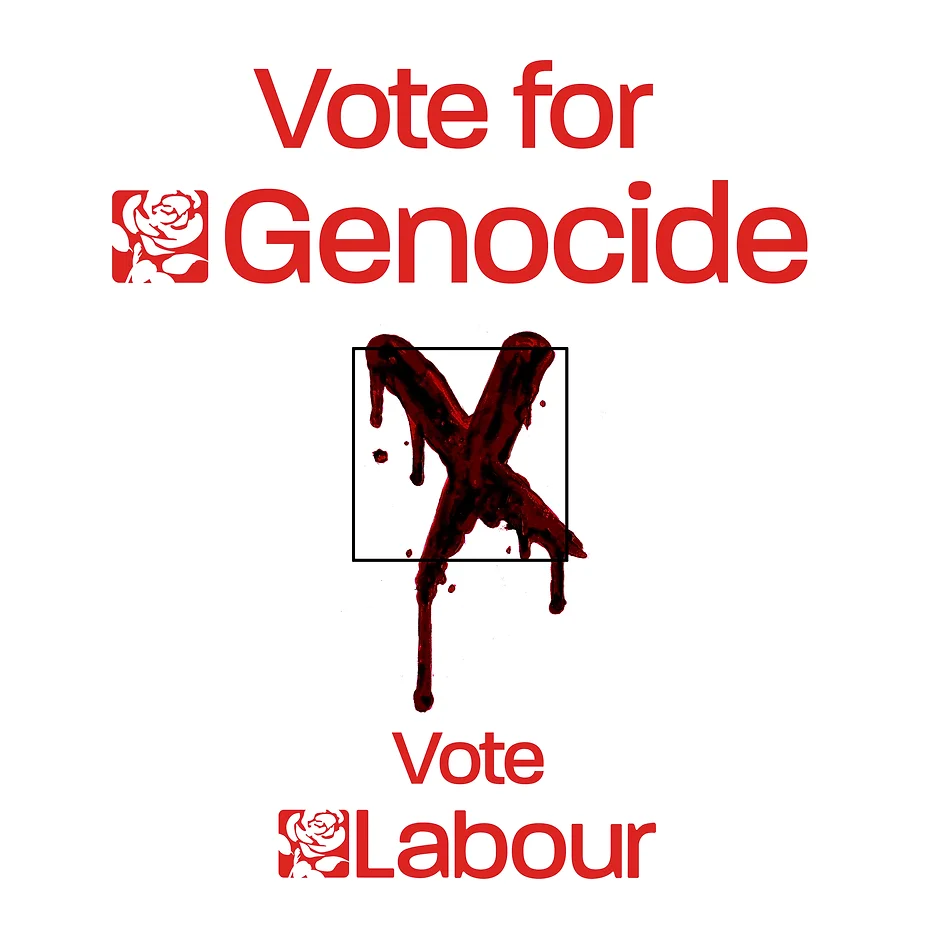
Genocide denier and Current UK Prime Minister Keir Starmer is quoted that he supports Zionism without qualification. He also confirms that UK air force support has been essential in Israel’s mass-murdering genocide. Includes URLs https://www.declassifieduk.org/keir-starmers-100-spy-flights-over-gaza-in-support-of-israel/ and https://youtu.be/O74hZCKKdpAKeir Starmer objects to criticism of the IDF. He asks how could anyone object to them starving people to death, forced marches like the Nazis did, bombing Gaza’s hospitals and universities, mass-murdering journalists, healthworkers and starving people queuing for food, killing and raping prisoners and murdering children. He calls for people to stop obstructing his genocide for Israel.Vote Labour for Genocide.
Relatives carry the body of 13-year-old Seraje Ebrahim, killed in an Israeli strike on a drinking water distribution point, for burial outside Al-Awda Hospital in Nuseirat, central Gaza Strip, July 13, 2025
Over 30 nations to gather in Colombia to bring a halt to the genocide in Gaza
MORE than 30 nations gather in Bogota, Colombia tomorrow [today] for an “Emergency Conference” to bring a halt to the Israeli genocide against the Palestinians in Gaza.
UN special rapporteur Francesca Albanese, who is attending the conference, said the gathering “will go down as the moment in history that states finally stood up to do the right thing.”
The conference is called by The Hague Group which was set up in January this year.
Jointly convened by Colombia and South Africa, The Hague Group’s co-chairs, the conference brings together 32 states including Brazil, China, Cuba, Indonesia, Ireland, Mexico, Nicaragua, Pakistan, Spain, Turkey and Venezuela.
Colombian President Gustavo Petro described the conference as an opportunity “to move from condemnation to collective action.”
Ahead of the conference Colombia’s Vice Foreign Minister Mauricio Jaramillo Jassir said: “The Palestinian genocide threatens our entire multilateral system.”
…
Article continues, discussing
US imposed sanctions on UN Special Rapporteur Fransesca Albanese who is attending the Bogota conference.
Attempts in UK Parliament by the standing group on atrocity crimes “to create a clearer legal obligation on the British government to prevent genocides, and to determine if one is occurring rather than leaving such judgements to international courts.”
South Africa’s case against Israel at the International Court of Justice alleging violations of the Genocide Convention by Israel.
United Nations general assembly voting to take action on “Israel’s policies and practices in the Occupied Palestinian Territory” with a 12-month deadline to deliver concrete obligations — investigations, prosecutions, sanctions, asset freezes, and cessation of imports and arms.
Former Israeli prime ministers Yair Lapid and Ehud Olmert describing plans to create a “humanitarian city” in southern Gaza as amounting to interning Palestinians in a “concentration camp.”
Increasing numbers of Palestinians getting killed by Israeli forces.
More than 58,000 killed and 138,520 wounded, according to Gaza’s Health Ministry.
Genocide denier and Current UK Prime Minister Keir Starmer is quoted that he supports Zionism without qualification. He also confirms that UK air force support has been essential in Israel’s mass-murdering genocide. Includes URLs https://www.declassifieduk.org/keir-starmers-100-spy-flights-over-gaza-in-support-of-israel/ and https://youtu.be/O74hZCKKdpAKeir Starmer objects to criticism of the IDF. He asks how could anyone obect to them starving people to death, forced marches like the Nazis did, bombing Gaza’s hospitals and universities,mass-murdering journalists, healthworkers and starving people queuing for food, killing and raping prisoners and murdering children. He calls for people to stop obstructing his genocide for Israel.UK Labour Party government ministers Keir Starmer, Angela Rayner and Rachel Reeves explain that they are partners complicit in Israel’s Gaza genocide. The UK has provided Israel with arms, military and air force support. They explain that they don’t do gas chambers but do do forced marches, starvation, destroy hospitals, mass-murders of journalists and healthcare workers.



 Relatives carry the body of 13-year-old Seraje Ebrahim, killed in an Israeli strike on a drinking water distribution point, for burial outside Al-Awda Hospital in Nuseirat, central Gaza Strip, July 13, 2025