‘Climate Arsonists’: 8 Major Oil Companies Fail to Align With Paris Agreement

Spread the love

Original article by OLIVIA ROSANE republished from Common Dreams under Creative Commons (CC BY-NC-ND 3.0).
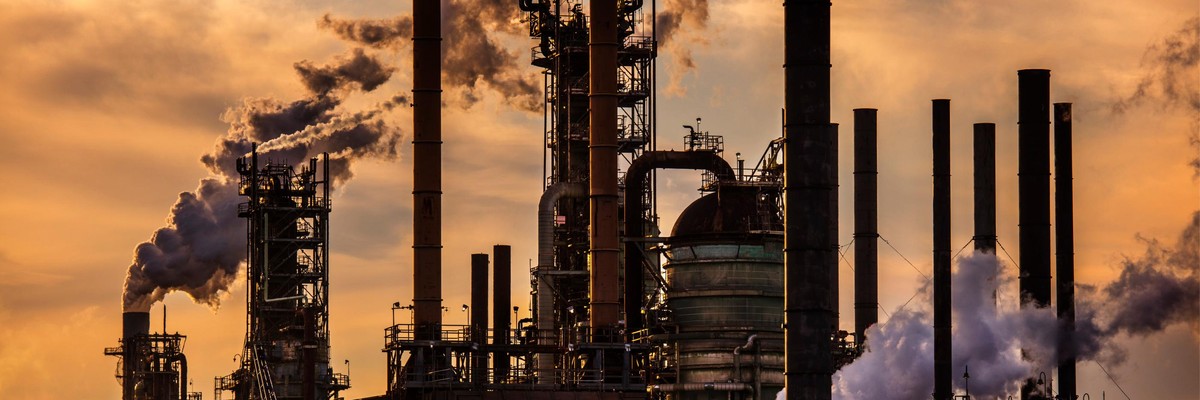
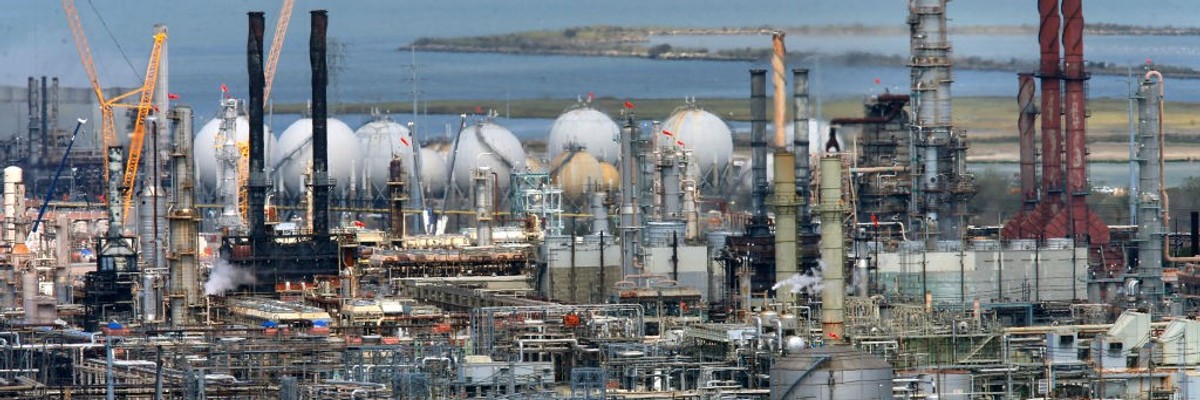
An ExxonMobil oil refinery is pictured in Baton Rouge, Louisiana. (Photo: Barry Lewis/InPictures via Getty Images)

“We cannot trust fossil fuel corporations to do anything but line the pockets of their CEOs and investors at the cost of our climate and communities,” one campaigner said.

The eight largest U.S. and Europe-based oil and gas producing companies are failing to align their plans with the Paris agreement goal of limiting global heating to 1.5°C above preindustrial levels and avoiding ever more catastrophic climate impacts.

Oil Change International’s Big Oil Reality Check report, released Tuesday, concludes that the plans of BP, Chevron, ConocoPhillips, Eni, Equinor, ExxonMobil, Shell, and TotalEnergies would actually put the world on track for more than 2.4°C of warming and burn through nearly one-third of the global carbon budget for hitting the 1.5°C target.

“It’s clearer than ever that oil and gas companies—the climate arsonists fueling climate chaos—cannot be trusted to put out the fire,” David Tong, report author and global industry campaign manager at Oil Change Internationalsaid in a statement. “There is no evidence that big oil and gas companies are acting seriously to be part of the energy transition.”

The Big Oil Reality Check report reveals that oil and gas corporations are more interested in looking like they are acting on climate change than actually acting on climate change.”

For its fourth annual Big Oil Reality Check, Oil Change International judged the oil companies’ climate plans and pledges against a set of minimum standards for alignment with the Paris agreement. The standards were divided into three main categories: ambition, integrity, and people-centered transitions.

Under ambition, the companies were assessed on whether they had plans to stop oil and gas exploration, stop approving new extraction projects, decrease production every year through 2030, and stop extraction on a certain date while outlining a long-term plan to end production.

Under integrity, the companies were assessed on whether their emissions-reduction plans included their entire supply chain, whether they relied on carbon capture or offsets, whether their methane-reduction plans were really in line with climate goals, and whether they lobbied or advertised against climate action.

For people-centered transitions, they were assessed on whether they had just transition plans for employees and members of frontline communities and whether they respected human rights overall and the rights of Indigenous peoples, including to free, prior, or informed consent to any fossil fuel activities.

The companies were then rated from “fully aligned” to “grossly insufficient” for how well their plans complied with the Paris goals within the assessment’s framework, but all eight companies scored “insufficient” or “grossly insufficient” for a majority of the criteria.

Only one company—Eni—scored above “insufficient” in any category, earning a ranking of “partially aligned” for having greenhouse gas-reduction plans that included its supply chains. The three U.S.-based companies—Chevron, ConocoPhillips, and ExxonMobil—scored “grossly insufficient” for all 10 criteria.

“American fossil fuel corporations are the worst of the worst,” Oil Change International’s U.S. program manager Allie Rosenbluth said. “Chevron, ExxonMobil, and ConocoPhillips perpetuate harm in frontline communities not only across the U.S. but worldwide.”

Oil Change found that six out of the eight companies have official plans to increase oil and gas production. The only two that did not were BP and Shell; however, these companies employ a misleading strategy. They compensate for new oil and gas projects by selling off polluting assets. While the emissions from the sold operations no longer count toward company emissions, they still count toward the planet’s total. This practice is out of line with the GHG Protocol on corporate emissions accounting and may violate the United Nations Guiding Principles on Business and Human Rights.

Four of the companies assessed in the report—BP, Shell, Exxon, and Chevron—were also the subject of a recent U.S. House investigation and Senate hearing detailing how the fossil fuel industry playbook has shifted from outright denial of climate science to greenwashing its activities by presenting itself as part of the solution to the climate crisis while its day-to-day operations continue to raise global temperatures.

“The efforts of climate and social movements have forced oil and gas companies to acknowledge that fossil fuels are dirty and dangerous, leading to a variety of climate pledges and ‘plans,'” said Oil Change campaigner Myriam Douo. The Big Oil Reality Check report reveals that oil and gas corporations are more interested in looking like they are acting on climate change than actually acting on climate change.”

“They spend billions on smoke and mirrors to try to fool us into believing they have solutions for a livable planet when, in reality, they are perpetuating harm to the climate and local communities while trying to suck every last ounce of profit out of their dirty fossil fuel business,” Douo concluded.

All told, Rystand energy data suggests that the combined production of the eight companies will be 17% by 2030 than they were last year.

“Such an increase in production on a global scale would put the world on a path towards global heating well beyond 2°C, locking in destruction of vulnerable communities and ecosystems,” the report authors wrote.

The report finds that all of the companies intend to rely on unproven carbon capture technology or offsets schemes to meet their claimed emission-reduction goals and have continued to spend money on lobbying against climate action and greenwashing their own activities since the agreement in Paris.

Further, no company has plans consistent with ensuring a just transition or protecting human rights. In one recent and urgent example, ExxonMobil, Chevron, TotalEnergies, BP, Shell, and Eni all continue to provide Israel with crude oil despite “the Israeli military’s ongoing assault on Palestinian civilians, ecosystems, and infrastructure in Gaza and mounting evidence of war crimes,” a March Oil Change investigation found.

The report comes nearly half a year after world leaders agreed to contribute to “transitioning away from fossil fuels” at the COP28 U.N. climate change conference in Dubai. In light of its conclusions, Oil Change called on governments to take action to further a just transition:

  1. Stop permitting or approving new fossil fuel projects or infrastructure;
  2. Set a Paris-aligned date for phasing out fossil fuel production;
  3. End subsidies and financing for fossil fuels and false solutions like carbon capture;
  4. Use tax policy to incentivize against investing in fossil fuels;
  5. Craft a just transition, including by making polluters pay for cleanup and reparations; and
  6. Passing laws to protect human rights and Indigenous rights and giving communities a legal mechanism to seek redress from corporate polluters.

Oil Change also argued that governments in the Global North should hold companies headquartered within their borders accountable for harm abroad and put money into funds to enable the Global South to transition to renewable energy, adapt to climate change, and pay for inevitable loss and damage.

“This year’s Big Oil Reality Check makes it clearer than ever—we cannot trust fossil fuel corporations to do anything but line the pockets of their CEOs and investors at the cost of our climate and communities,” Rosenbluth said. “People around the world are rising up to end the era of fossil fuels and build a just energy system that puts climate and communities first.”

Original article by OLIVIA ROSANE republished from Common Dreams under Creative Commons (CC BY-NC-ND 3.0).

Continue Reading‘Climate Arsonists’: 8 Major Oil Companies Fail to Align With Paris Agreement

Dozens of Climate Activists Arrested at Citibank Headquarters in New York City During Earth Week

Spread the love

https://insideclimatenews.org/news/25042024/citibank-headquarters-new-york-climate-activists-arrested/

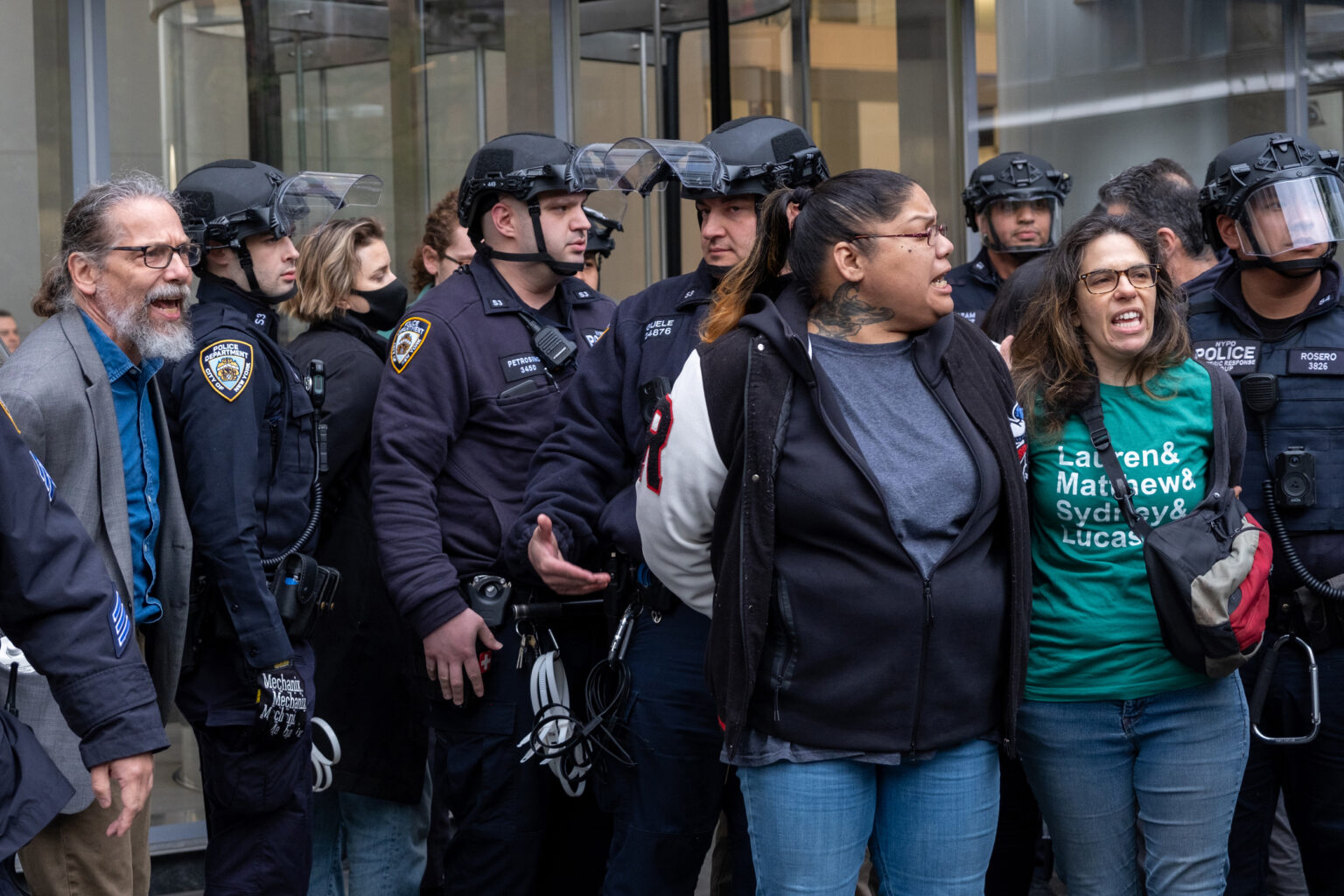
During a demonstration at Citibank’s headquarters in Manhattan on Wednesday, 33 protesters were taken into custody, including Rachel Rivera (center), a board member with New York Communities for Change. Credit: Keerti Gopal/Inside Climate News

Campaigners pressuring Citibank say they see the bank as potentially movable on its funding of fossil fuels, citing the company’s commitments to sustainability.

NEW YORK—Climate demonstrators blocked entrances to Citibank’s headquarters in Manhattan at the start of the workday on Wednesday and Thursday, part of a series of Earth Week actions pressuring the bank to end its financing of fossil fuels. On both mornings, it took the New York Police Department less than 10 minutes to start making arrests.

Climate activists, citing Citibank as the second largest financier of fossil fuels in the world, are engaged in a multi-year campaign to pressure the bank to stop financing oil, gas and coal projects. The week’s protests follow a mock environmental justice hearing at a New York church on Monday, where advocates spoke about the health harms and human rights violations of Citibank-financed fossil fuel projects in Peru, Canada and domestically. The New York demonstration was timed alongside actions in Seoul, South Korea, Melbourne, Australia, Jakarta, Indonesia, Belfast, Northern Ireland, and Dallas that also targeted Citibank’s financing of coal, oil, natural gas and military projects.

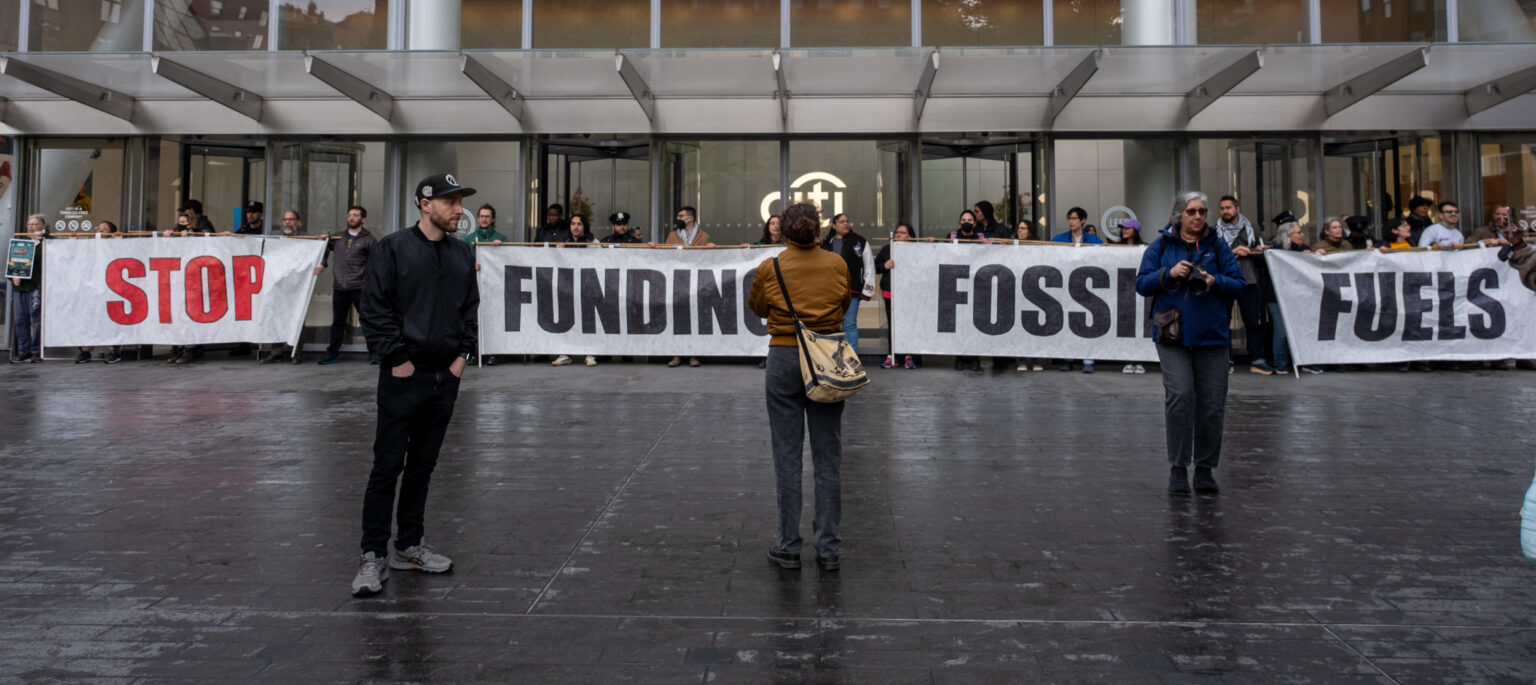
At about 8:15 Wednesday morning, activists holding four large white banners that together read “Stop Funding Fossil Fuels” blocked the main entrance to Citibank’s headquarters while smaller groups of demonstrators stood outside other entrances to the building. Police began taking protesters into custody at 8:30 and arrested approximately 33 activists for disorderly conduct at Wednesday’s protest, according to activists and the office of NYPD’s deputy commissioner of public information. 

Protesters barricaded the main entrance to Citibank’s headquarters in Manhattan on Wednesday morning. Credit: Keerti Gopal/Inside Climate News

Campaigners have said that, since 2016, Citibank has provided $332 billion in fossil fuel financing, and calculate that the bank has given $1.85 billion in financing to oil and gas operations in the Amazon since 2009 and $1.78 billion in financing to ConocoPhillips, the company behind the contentious Willow Project. 

https://insideclimatenews.org/news/25042024/citibank-headquarters-new-york-climate-activists-arrested/

Continue ReadingDozens of Climate Activists Arrested at Citibank Headquarters in New York City During Earth Week

Chicago Joins ‘Historic Wave of Lawsuits’ Against Big Oil

Spread the love

Original article by BRETT WILKINS republiahed from Common Dreams under Creative Commons (CC BY-NC-ND 3.0).

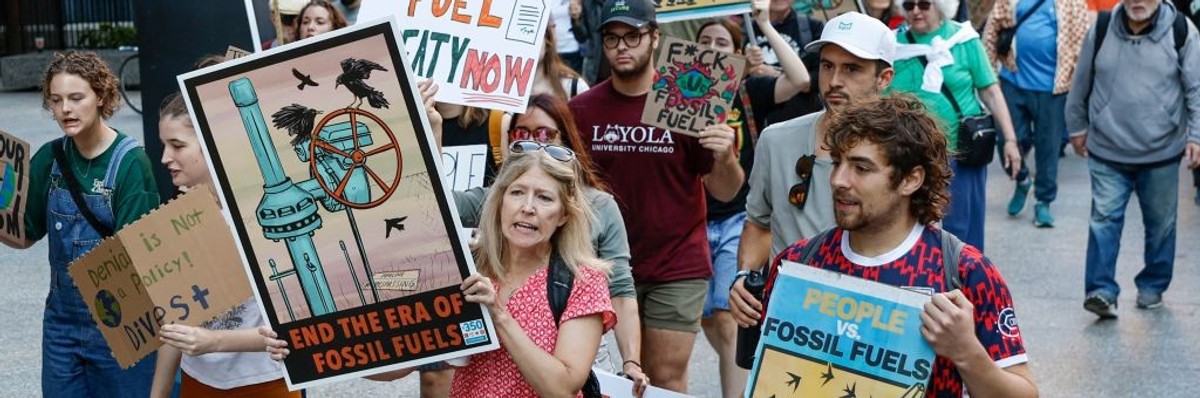
Environmental activists march during the Global Climate Strike in downtown Chicago, Illinois, on September 15, 2023.  (Photo: Kamil Krzaczynski/AFP via Getty Images)

The city alleges the industry “funded, conceived, planned, and carried out a sustained and widespread campaign of denial and disinformation about the existence of climate change and their products’ contribution to it.”

Chicago on Tuesday joined the growing list of U.S. cities and states suing Big Oil for lying to the public about how burning fossil fuels causes and exacerbates the climate emergency.

The administration of Chicago Mayor Brandon Johnson, a progressive Democrat, filed a lawsuit in Cook County Circuit Court against ExxonMobil, Chevron, BP, Shell, ConocoPhillips, Phillips 66, and the industry lobby American Petroleum Institute, which “funded, conceived, planned, and carried out a sustained and widespread campaign of denial and disinformation about the existence of climate change and their products’ contribution to it.”

“The climate change impacts that Chicago has faced and will continue to face—including more frequent and intense storms, flooding, droughts, extreme heat events, and shoreline erosion—are felt throughout every part of the city and disproportionately in low-income communities,” the suit contends.

In a statement, Johnson said that “there is no justice without accountability.”

“From the unprecedented poor air quality that we experienced last summer to the basement floodings that our residents on the West Side experienced, the consequences of this crisis are severe, as are the costs of surviving them,” he added. “That is why we are seeking to hold these defendants accountable.”

Climate campaigners welcomed the lawsuit.

“Big Oil has lied to the American people for decades about the catastrophic climate risks of their products, and now Chicago and communities across the country are rightfully insisting they pay for the damage they’ve caused,” Center for Climate Integrity president Richard Wiles said in a statement.

“With Chicago, the nation’s third largest city, joining the fray, there is no doubt that we are witnessing a historic wave of lawsuits that could finally hold Big Oil accountable for the climate crisis they knowingly caused,” he added.

Chicago joins eight U.S. states plus the District of Columbia and numerous municipalities across the country that have sued to hold Big Oil accountable for deceiving the public about its role in the climate emergency.

“To date, eight federal appeals courts and dozens of federal district courts have unanimously ruled against the fossil fuel industry’s arguments to prevent these lawsuits from moving forward in state courts,” noted the Center for Climate Integrity. “In 2023, the U.S. Justice Department added its support for the communities. The U.S. Supreme Court has denied Big Oil petitions to consider the industry’s appeals of those lower court rulings three separate times, most recently in January.”

Angela Tovar, Chicago’s chief sustainability officer, told the Chicago Sun-Times that “the fossil fuel industry should be able to pay for the damage they’ve caused.”

“We have to see accountability for the climate crisis,” she added.

Original article by BRETT WILKINS republiahed from Common Dreams under Creative Commons (CC BY-NC-ND 3.0).

Continue ReadingChicago Joins ‘Historic Wave of Lawsuits’ Against Big Oil

Tribes Sue Six Oil Giants for Climate Deception

Spread the love

Original article by JULIA CONLEY republished from Common Dreams under Creative Commons (CC BY-NC-ND 3.0).

A Chevron refinery in Richmond, California is seen on September 12, 2017.  (Photo: Michael Macor/The San Francisco Chronicle via Getty Images)

“These oil companies knew their products were dangerous, yet they did nothing to mitigate those dangers or warn any of us about them, for decades,” said the chairwoman of the Shoalwater Bay Indian Tribe.

Two Indigenous tribes in Washington state said Wednesday that they intend to force several oil giants “to help pay for the high costs of surviving the catastrophe caused by the climate crisis,” as they filed lawsuits in the state’s largest trial court.

The Makah Indian Tribe and Shoalwater Bay Indian Tribe filed two separate complaints in King County Superior Court against ExxonMobil, Shell, Chevron, BP, ConocoPhillips, and Phillips 66, saying the defendants must be held “accountable for their deceptive and unfair conduct, and pay for the damage their deceptive conduct has caused and will cause for decades to come.”

The lawsuits—among dozens filed against Big Oil since 2017—detail the extent to which the companies have long known that their fossil fuel extraction would drive planetary heating and the resulting sea-level rise, extreme weather, public health crises, and other impacts of the climate crisis, which now costs the U.S. roughly $150 billion per year just in damages from hurricanes and other weather disasters.

“We are seeing the effects of the climate crisis on our people, our land, and our resources. The costs and consequences to us are overwhelming,” said Timothy Greene Sr., chairman of the Makah Tribal Council. “We intend to hold these companies accountable for hiding the truth about climate change and the effects of burning fossil fuels.”

“We are facing hundreds of millions of dollars in costs to relocate our community to higher ground and protect our people, our property, and our heritage. These companies need to be held accountable for that.”

Newly uncovered documents revealed earlier this year that scientists at Shell warned executives of the climate impact of the company’s products in the 1980s, and an analysis published in Science in January showed that 63-83% of the global warming projections documented by Exxon scientists between 1977 and 2003 were accurate.

“These oil companies knew their products were dangerous, yet they did nothing to mitigate those dangers or warn any of us about them, for decades,” said Charlene Nelson, chairwoman of the Shoalwater Bay tribe. “Now we are facing hundreds of millions of dollars in costs to relocate our community to higher ground and protect our people, our property, and our heritage. These companies need to be held accountable for that.”

The tribes said in their complaints that they are “particularly vulnerable” to rising sea levels because their reservations are adjacent to the Pacific Ocean, and they have already incurred “significant costs” as they try to mitigate its risk by preparing to build and move housing and government buildings to higher ground.

The tribes accused the companies of creating a “public nuisance” and violating Washington’s Products Liability Act by misrepresenting and intentionally concealing the risks involved in their fossil fuel extraction activities. They asked the court for jury trials and requested that the court order the companies to fund “an abatement fund to be managed by the tribe[s] to remediate and adapt [their] Reservation lands, natural resources, and infrastructure.”

Original article by JULIA CONLEY republished from Common Dreams under Creative Commons (CC BY-NC-ND 3.0).

Continue ReadingTribes Sue Six Oil Giants for Climate Deception

Most US Voters Agree: Make Big Oil Pay for Climate Damage

Spread the love

Original article by BRETT WILKINS at Common Dreams shared under Creative Commons (CC BY-NC-ND 3.0).

Two-thirds of U.S. voters surveyed by Data for Progress support making fossil fuel companies pay for the damage their products cause to the climate.  (Photo: rmitsch/Getty Images)

“Voters resoundingly endorse fossil fuel companies contributing their fair share to address a crisis they helped manufacture and still refuse to help fix,” said one campaigner.

As yet another United Nations Climate Change Conference winds down without a meaningful agreement on phasing out fossil fuels, polling released Tuesday by Data for Progress revealed strong bipartisan support among U.S. voters for legislation forcing oil and gas companies to pay for their role in fueling the planetary emergency.

The survey of 1,279 U.S. voters, conducted November 3-6, found that around two-thirds of all likely voters support such legislation, a +40-point net margin. Among Democrats, support for the proposed bill is 88%, while 61% of Independent and 46% of Republicans either strongly or somewhat back the proposal.

“In a resounding call for accountability, two-thirds of the American people support legislation demanding industry titans like Exxon and Shell shoulder their fair share of the climate damages inflicted by fossil fuels.”

Asked if they were more or less likely to support elected officials who prioritize making Big Oil pay for its climate pollution, 64% of overall respondents, 89% of Democrats, and 58% of Independents answered “more likely.” Republicans were the only group whose members were less likely to back officials who would make oil and gas companies pay for their pollution.

“In a resounding call for accountability, two-thirds of the American people support legislation demanding industry titans like Exxon and Shell shoulder their fair share of the climate damages inflicted by fossil fuels,” Fossil Free Media communications director Cassidy DiPaola said in a statement.

“With COP spotlighting the towering price tag of climate change, voters resoundingly endorse fossil fuel companies contributing their fair share to address a crisis they helped manufacture and still refuse to help fix,” she added, referencing the U.N. summit.

The poll follows the September launch of the “Make Polluters Pay” campaign, a public relations blitz meant to drum up public support for suing fossil fuel corporations—which knew that their products caused climate change decades before publicly saying so.

That month, California joined dozens of states and municipalities that have targeted fossil fuel giants in court,suing five fossil fuel giants—ExxonMobil, Shell, BP, ConocoPhillips, and Chevron—over their decadeslong effort to deceive the public about their products’ role in fueling global heating.

The new survey’s findings also came as so-called “loss and damage”—the harm caused by anthropogenic climate change—features prominently at COP28. However, climate campaigners were once again disappointed as the United States and other top polluters failed to make meaningful contributions to the fund.

The rich nations most responsible for the climate catastrophe pledged just $700 million between them, the equivalent of under 0.2% of the irreversible losses Global South countries suffer each year during the worsening planetary crisis. The United States pledged a paltry $17.5 million.

“Every year, we travel across oceans to come to these negotiations and we continue to get only drops of ambition,” Drue Slatter, a Fijian climate campaigner attending COP28, wrote in an opinion piece published Tuesday by Common Dreams.

“Facing the catastrophic effects of extreme weather at home and watching the slow progress of the negotiations, it was hard not to be pessimistic before we even arrived at COP28,” Slatter added. “But the point is that we can’t afford not to be here, we can’t afford to stop fighting because what’s at stake is our very survival.”

Original article by BRETT WILKINS at Common Dreams shared under Creative Commons (CC BY-NC-ND 3.0).

Continue ReadingMost US Voters Agree: Make Big Oil Pay for Climate Damage