Israeli Prime Minister Benjamin Netanyahu attends his trial on corruption charges at the district court in Tel Aviv, Israel, April 21, 2025
THE head of Israel’s internal security service has accused Prime Minister Benjamin Netanyahu of trying to exploit the agency for political and personal gain by making numerous improper demands.
In a submission to the Supreme Court om Monday, Shin Bet chief Ronen Bar wrote that he had refused a request from Mr Netanyahu to identify anti-government protesters and put their financial backers under surveillance.
Mr Bar added he had been told to obey Mr Netanyahu, not the courts, in the event of a constitutional crisis. He also said there had been unsuccessful attempts to force him to sign a document making it nearly impossible for the prime minister to testify in his corruption trial due to security concerns. Mr Netanyahu’s office dismissed Mr Bar’s affidavit as “full of lies.”
The Trump administration maintains that it can send people to overseas concentration camps with impunity because “activist judges do not have the jurisdiction to seize control of the president’s authority to conduct foreign policy” (BBC, 4/11/25).
As the Trump administration openly defies court orders to return a man wrongfully deported to a notorious mega-prison in El Salvador, some American outlets are underplaying the significance of this constitutional crisis.
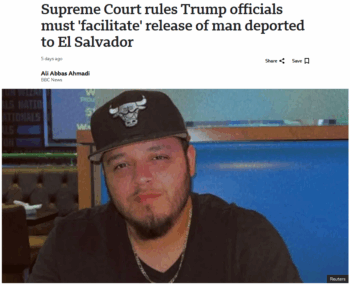
In a unanimous decision the Supreme Court “declined to block a lower court’s order to ‘facilitate’ bringing back Kilmar Ábrego García,” a Salvadoran who had legal protections in the United States and was wrongfully sent to El Salvador’s Terrorism Confinement Center, or CECOT (BBC, 4/11/25).
The White House is not complying (Democracy Docket, 4/14/25). “The federal courts have no authority to direct the executive branch to conduct foreign relations in a particular way, or engage with a foreign sovereign in a given manner,” Trump’s Justice Department insists (CNN, 4/15/25). Fox News (4/16/25) said of Attorney General Pam Bondi: “Bondi Defiant, Says Ábrego García Will Stay in El Salvador ‘End of the Story.’”
In an X post (4/15/25) filled with unproven assertions that skirt the question of due process and extraordinary rendition, Vice President J.D. Vance said, “The entire American media and left-wing industrial complex has decided the most important issue today is that the Trump admin deported an MS-13 gang member (and illegal alien).” (Are we supposed to believe that the six conservatives on the Supreme Court, three of whom were appointed by Trump, are a part of the “left-wing industrial complex?”)
The complete disregard to constitutional protections of due process and to court orders should send alarm bells throughout American society. The MAGA movement condones sending unconvicted migrants to a foreign hellhole largely on grounds that they are not US citizens, and thus don’t have a right to constitutional due process. But the administration has floated the idea of doing the same thing to “homegrown” undesirables as well (Al Jazeera, 4/15/25).
‘An uncertain end’
The New York Times (4/15/25) goes out on a limb and declares that the president defying the Supreme Court is “a path with an uncertain end.”
The case is quite obviously not about the extremity or unpopularity of President Donald Trump’s policies, but a breaking point at which the executive branch has left the democratic confines of the Constitution, as many journalists and scholars have warned about. But the case is not necessarily being portrayed that way in the establishment press.
In an article about the Trump administration’s record of resisting court orders, a New York Times subhead (4/15/25) read, “Scholars say that the Trump administration is now flirting with lawless defiance of court orders, a path with an uncertain end.” In an article about “What to Know About the Mistaken Deportation of a Maryland Man to El Salvador” (4/14/25), reporter Alan Feuer described the Supreme Court’s upholding the order to “facilitate” the return of Ábrego García as “complicated and rather ambiguous” rather than a “clear victory for the administration.”
At the Washington Post (4/14/25), law professor Stuart Banner wrote an opinion piece saying that fears of a constitutional crisis were overblown, noting that while Trump is “famous for his contemptuous remarks about judges…tension between the president and the Supreme Court is centuries old.” Thus, he said, there are incentives in both branches to “not to let conflict ripen into public defiance.”
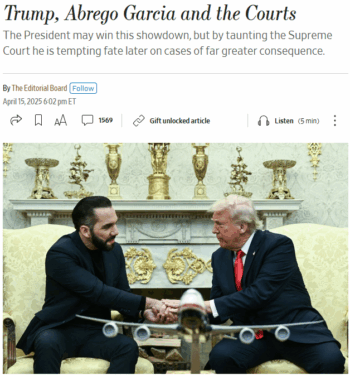
The Wall Street Journal (4/15/25) presents the prospect of the White House defying a Supreme Court order as a “showdown” that Trump might “win.”
The Wall Street Journal editorial board (4/15/25) said:
Mr. Trump would be wise to settle all of this by quietly asking Mr. Bukele to return Mr. Ábrego García, who has a family in the US. But the president may be bloody-minded enough that he wants to show the judiciary who’s boss. If this case does become a judicial showdown, Mr. Trump may assert his Article II powers not to return Mr. Ábrego García, and the Supreme Court will be reluctant to disagree.
But Mr. Trump would be smarter to play the long game. He has many, much bigger issues than the fate of one man that will come before the Supreme Court. By taunting the judiciary in this manner, he is inviting a rebuke on cases that carry far greater stakes.
These articles display a naivete about the current moment. The Trump administration and its allies have flatly declared that they believe a judicial check on the executive authority wrongly places constitutional restraints on Trump’s desires (New York Times, 3/19/25; Guardian, 3/22/25).
House Speaker Mike Johnson, responding to court rulings that went against MAGA desires, “warned that Congress’ authority over the federal judiciary includes the power to eliminate entire district courts,” Reuters (3/25/25) reported. The House also approved legislation, along party lines, that “limits the authority of federal district judges to issue nationwide orders, as Republicans react to several court rulings against the Trump administration” (AP, 4/9/25).
In other words, Trump’s defiance of the courts is part of a broader campaign to assert that the Constitution simply should not be an impediment to his rule. That’s not a liberal versus conservative debate about national policy, but a declaration that the United States will no longer operate as a constitutional republic.
‘Constitutional crisis is here’
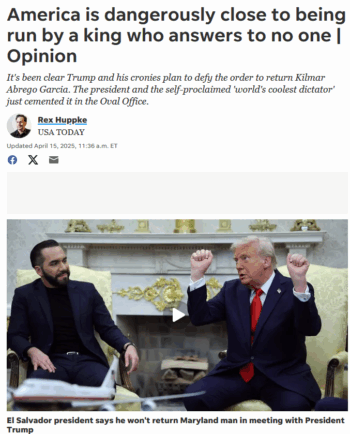
“Think long and hard about what it means to have a president who gleefully ignores the courts,” urges Rex Huppke (USA Today, 4/15/25). “It’s time to stand up and shout ‘Hell no!’ right freakin’ now, and not a moment later.”
Pieces like the ones at the Journal, Times and Post give readers the sense that this affair is just another quirk of the American system of checks and balances, when, in fact, history could look back and declare this the moment when the Constitution became a dead letter.
Other outlets, however, appeared to appreciate the gravity of the situation. “America Is Dangerously Close to Being Run by a King Who Answers to No One” was the headline of Rex Huppke column at USA Today (4/15/25). “The Constitutional Crisis Is Here” was the headline of a recent piece by Adam Serwer at the Atlantic (4/14/25).
This case will roil on, and both the judicial system (Reuters, 4/15/25) and congressmembers (NBC News, 4/16/25) are taking action. There’s still time for the papers to treat this case with the urgency that it deserves.
FAIR’s work is sustained by our generous contributors, who allow us to remain independent. Donate today to be a part of this important mission.
Donald Fuhrump says that Amerikkka doesn’t bother with crimes or charges anymore, not being 100% Amerikkkan and opposing his real estate intentions is enough.Elon Musk urges you to be a Fascist like him, says that you can ignore facts and reality then.
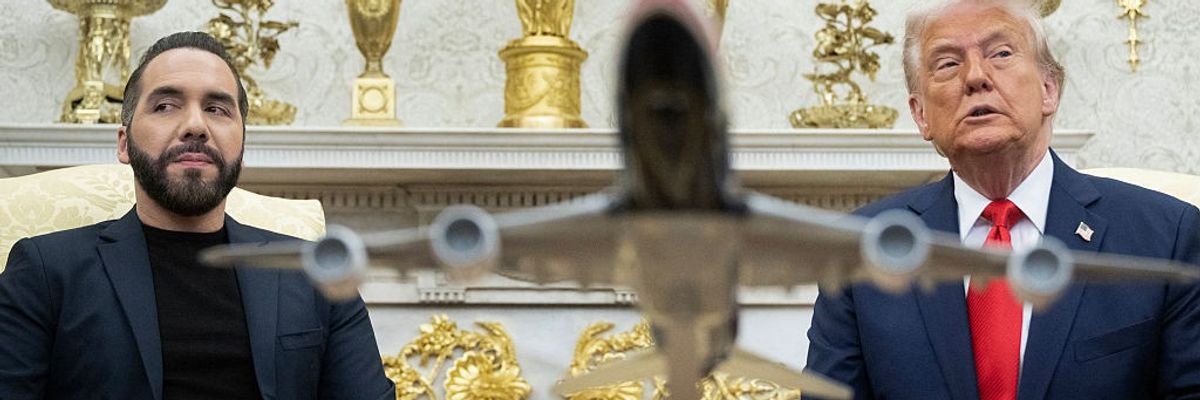
U.S. President Donald Trump participates in a bilateral meeting with El Salvador’s President Nayib Bukele in the Oval Office of the WHite House in Washington, D.C. on April 14, 2025. (Photo: Brendan Smialowski/AFP via Getty Images)
Refusals to comply with Supreme Court decisions equal a constitutional crisis.
I was at an event last week where a prominent GOP pollster who often appears on CNN was discussing the details of U.S. President Donald Trump’s political profile as we approach the 100-day mark of his administration. The back and forth was interesting to me and my fellow political nerds. However, during the presentation, my inner voice sounded like Independent Vermont Sen. Bernie Sanders: “This is not normal.”
Unfortunately, far too many political insiders are acting as if Trump is a normal if a little eccentric president. They think that they can negotiate with him on issues and influence his staff to move him in their direction. No matter what Trump does, they see it as just a negotiating tactic.
April 14, 2025 should go down in American history as the day when Trump’s steps in the direction of authoritarianism made it clear to all that this is not a normal presidency. After Monday’s events, there can be no more debate about what Trump is and where he is taking America.
Let’s break down what happened. In a meeting with President Nayib Bukele of El Salvador, President Trump openly defied a 9-0 Supreme Court decision that said that Kilmar Abrego Garcia, a Maryland resident wrongly deported to El Salvador, must be returned to the United States. As The New York Times put it:
The meeting in the Oval Office on Monday was a blunt example of Mr. Trump’s defiance of the courts. The president and his top White House officials said the decision over Mr. Abrego Garcia, a 29-year-old father of three, would have to be made by [El Salvador President] Mr. Bukele.
If this was not enough, President Trump went on to outline plans for sending American citizens convicted of crimes to El Salvador. More from The New York Times:
President Trump just said he was open to sending American citizens convicted of violent crimes to President Bukele’s prison in El Salvador. Trump had a similar response when Bukele first offered to jail convicted American criminals in February.
“I’m all for it,” Trump said, adding that his attorney general was studying whether the idea was legally feasible. “If it’s a homegrown criminal, I have no problem, no,” he said, adding: “I’m talking about violent people. I’m talking about really bad people.”
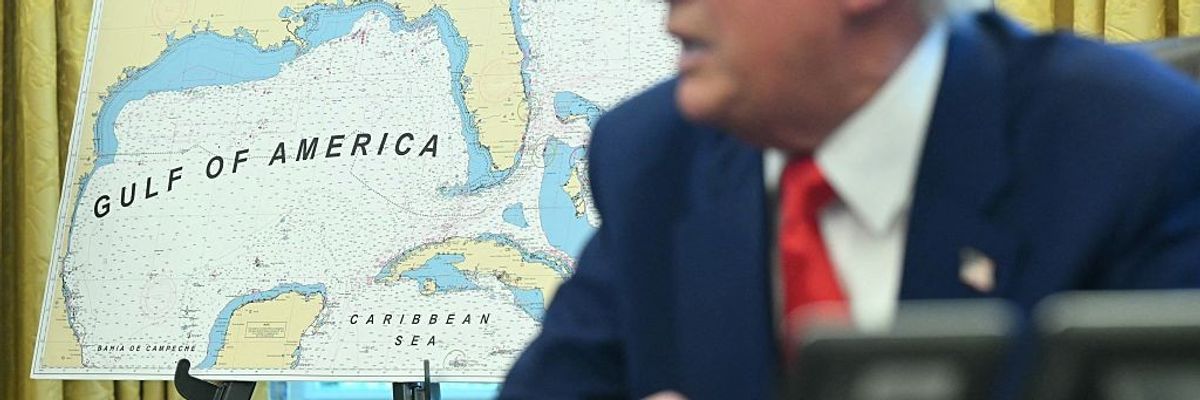
Another sign that we are in a constitutional crisis happened just outside the Oval Office on Monday. President Trump had barred The Associated Press from covering certain White House events because they had refused to use his preferred nomenclature for what the White House refers to as the “Gulf of America.” Last week, a federal judge ordered the White House to restore AP access to White House events. The federal judge who ruled in this case was Trevor McFadden, a Trump appointee. In his decision, McFadden wrote that:
No, the Court simply holds that under the First Amendment, if the Government opens its doors to some journalists—be it to the Oval Office, the East Room, or elsewhere—it cannot then shut those doors to other journalists because of their viewpoints… The Constitution requires no less.
On Monday, the White House blocked the AP reporter from attending the Oval Office press conference with President Trump and Bukele. Again, Trump failed to obey a court order.
Now, barring a reporter from the Oval Office may not seem to be a big deal. However, it is the government telling the media what it can report on. Plus, the courts ruled directly in the AP’s favor. The lines are clearly drawn here.
President Trump in the Oval Office on Monday openly defied decisions of the judicial branch. One was a 9-0 ruling of the Supreme Court and the other ruling was by a federal judge he appointed. As a nation, we are clearly in a constitutional crisis. This is not something theoretical or something that might happen sometime in the future. The crisis is at hand. The fabric of the American republic is being torn in two.
What we need is bold opposition from Democratic leaders in the House and Senate. If the current leadership is unwillingly to respond, they need to step aside. The first action that each of us can take to protect the American experiment is to stop pretending that Trump is a normal president.
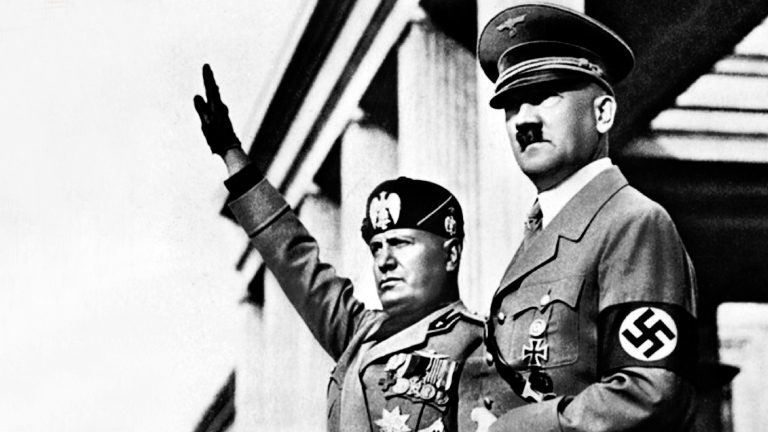
Neo-Fascist Climate Science Denier Donald Trump says Burn, Baby, Burn.Elon Musk urges you to be a Fascist like him, says that you can ignore facts and reality then.Image of the original Fascists Mussolini and Hitler
US President Donald Trump speaks after signing an executive order in the Oval Office of the White House on April 9, 2025. 9Photo by Saul Loeb / AFP via Getty Images)
“Is it a constitutional crisis yet?” asked one journalist.
Despite a federal court ruling last week, journalists with the Associated Press were blocked from reporting on several White House events on Monday, leading to fresh accusations that President Donald Trump is openly violating court orders as well as core constitutional protections, in this case freedom of speech and the press.
“Our journalists were blocked from the Oval Office today,” said Lauren Easton, an AP spokesperson, following a press event with Trump and El Salvador President Nayib Bukele. “We expect the White House to restore AP’s participation in the pool as of today, as provided in the injunction order.”
A pair of AP photographers were later allowed to attend an event on the South Lawn, but a print journalist was barred from entry.
According to the AP:
Last week’s federal court decision forbidding the Trump administration from punishing the AP for refusing to rename the Gulf of Mexico was to take effect Monday. The administration is appealing the decision and arguing with the news outlet over whether it needs to change anything until those appeals are exhausted.
The U.S. Court of Appeals for the D.C. circuit set a Thursday hearing on Trump’s request that any changes be delayed while case is reviewed. The AP is fighting for more access as soon as possible.
“Is it a constitutional crisis yet?” asked Missouri-based journalist Steve Lambson in response to the latest developments.
“More contemptuous behavior by this administration,” added attorney Bernadette Foley. “What will the courts do about it? What will GOP do?”
In the federal court ruling last week, the presiding judge wrote that access to presidential events “must be reasonable and not viewpoint-based,” though the White House has been clear the decision was a punitive response to editorial decisions by AP with which it disagreed.
“While the AP does not have a constitutional right to enter the Oval Office,” the judge said, “it does have a right to not be excluded because of its viewpoint. … All the AP wants, and all it gets, is a level playing field.”
Neo-Fascist Climate Science Denier Donald Trump says Burn, Baby, Burn.Elon Musk urges you to be a Fascist like him, says that you can ignore facts and reality then.The original Fascists Mussolini and Hitler
As the 19th-century French political philosopher, Alexis de Tocqueville, memorably observed, Americans have a tendency to fight their political battles in court. Barely two months into his presidency, Donald Trump is demonstrating increasing frustration as trade unions, civil rights organisations and states attorneys general challenge the implementation of his policies with lawsuits alleging presidential overreach that undermines the constitutional separation of powers.
More than 130 lawsuits are now pending. As a result, federal courts have put on hold key policies of the Trump administration and Trump lawyers have lodged emergency petitions invoking Supreme Court intervention.
First to face court check was the federal funding freeze order. This was swiftly followed by court rulings against the birthright citizenship order. This controversial measure would withdraw citizenship for children born in the United States to undocumented or non-citizen parents who are in the country legally but temporarily.
Sign up to receive our weekly World Affairs Briefing newsletter from The Conversation UK. Every Thursday we’ll bring you expert analysis of the big stories in international relations.
Donald Trump decrees forbidden terms denying sexual diversity. Image added by https://onaquietday.org
This was blocked for the very fundamental grounds that this has not been authorised by Congress and is not within the scope of the presidential power. Whether Doge can even exist without Congressional authority is also in contention.
The president’s increasing anger with the courts erupted on March 18. The US president launched an astonishing personal attack on a US federal judge who ruled against the summary deportation of alleged members of the Venezuelan Tren de Aragua gang and ordered the administration to turn around the plane carrying them that had already taken off.
The US president calls for a judge to be impeached. TruthSocial.
Trump’s call for Judge James Boasberg to be impeached prompted a rare intervention from Supreme Court chief justice John Roberts. Roberts condemned the impeachment call in a statement that did not name the president but was clearly intended as a rebuke and a reminder of the constitutional boundaries that guarantee the role of the judiciary as the equal third branch of government.
Unrepentant, Trump doubled down the next day on TruthSocial calling Judge Boasberg a “Radical Left Lunatic Judge” who wanted “to assume the role of president”. His charge was then echoed by White House press secretary Karoline Leavitt who accused the judiciary generally of attempting to paralyse the administration’s programme, usurp the power of the president and undermine the will of the American people.
White House press secretary Karoline Leavitt on Judge James Boasberg.
Despite Judge Boasberg’s order, the plane carrying the Venezuelans did not turn back. The administration has denied wrongdoing and Judge Boasberg has yet to impose any penalty.
This was not the first occasion that the administration has appeared to openly defy court orders. The previous week Dr Raiza Alawieh, a Brown University professor with an American visa was deported despite an order from a federal judge in Boston requiring that the court be given advance notice before the government attempted to remove her.
All eyes on the Supreme Court
All these cases are likely to go to the US Supreme Court. As its name suggests, this is the highest level of the judiciary in the US. It has the final say on what the US constitution means and authorises. At issue will be the scope of the presidential power – and the outcome is uncertain.
It’s important to bear in mind that the court now has a six-to-three majority of conservative justices – three of whom were Trump nominees. We also need to be aware that this court, in a previous ruling, considerably extended the scope of presidential immunity to cover all official “core acts” so that, whatever the outcome, the president himself is unlikely to attract personal liability.
But we do know that the Supreme Court’s ruling on a constitutional issue is final – and that all government officials at federal and state level will be required to respect it. The fear now is that the administration may go ahead regardless in which case we will find ourselves in unknown constitutional territory.
To find parallels we could go back to the desegregation era of the middle of the 20th century and specifically to Little Rock in Arkansas where the then governor, Orval Faubus, called out the national guard to prevent the court-ordered desegregation of the local high school.
The ensuing crisis ended when the then president, Dwight D. Eisenhower, sent in federal troops to enforce the court order. The US Supreme Court unanimously declared that its interpretations of what the constitution required were the supreme law of the land, which bound the governor and the state legislature.
The chief justice of that era, Earl Warren, later regarded this ruling (Cooper v Aaron) as the most important of his time on the Supreme Court – more important even than the actual desegregation decision itself (Brown v Board of Education).
It is clear that the judicial branch depends upon the executive to put its orders into effect and demonstrate respect for the rule of law and the separation of powers. But we now see a president who demonstrates open hostility to judges whom he considers have opposed him. His administration has also begun to vindictively target with punitive blocking orders the big law firms who assisted in the prosecutions brought against him before he took office.
Does a constitutional crisis loom? How all this plays out remains to be seen.

 Israeli Prime Minister Benjamin Netanyahu attends his trial on corruption charges at the district court in Tel Aviv, Israel, April 21, 2025