Actuaries and Scientists Warn Climate Shocks Risk ‘Planetary Insolvency’

Spread the love

Original article by Jessica Corbett republished from Common Dreams under Creative Commons (CC BY-NC-ND 3.0). Published Jan 16, 2025
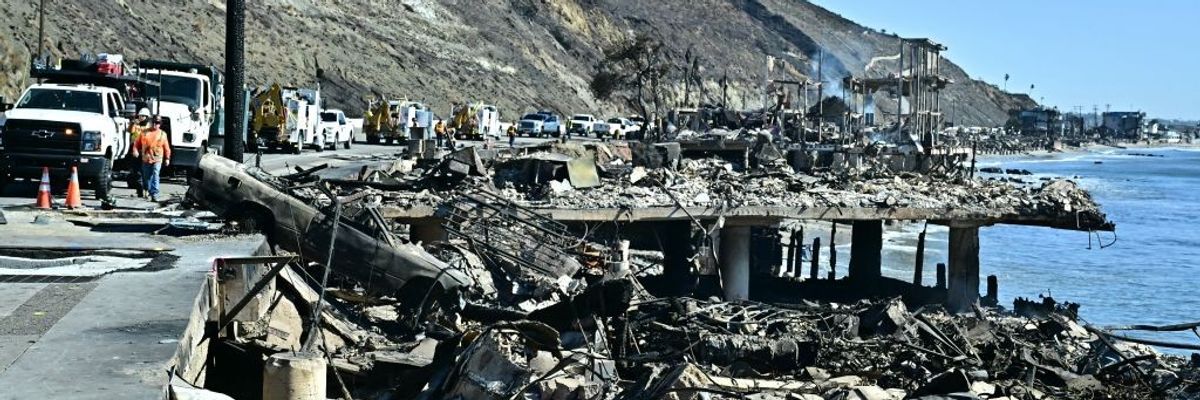
Gas company employees work in Malibu, California, after the Palisades Fire destroyed beach homes on January 12, 2025. (Photo: Frederic J. Brown/AFP via Getty Images)

A new report “shows a 50% GDP contraction between 2070 and 2090 unless an alternative course is chartered,” said the lead author.

U.K. actuaries and University of Exeter climate scientists on Thursday warned that “the risk of planetary insolvency looms unless we act decisively” and urged policymakers to “implement realistic and effective approaches to global risk management.”

Actuaries have developed techniques that “underpin the functioning of the global pension market with $55 trillion of assets, and the global insurance market, collecting $8 trillion of premiums annually, to help us manage risk,” Tim Lenton, University of Exeter’s climate change and Earth system science chair, noted in the foreword of a report released Thursday.

Planetary Solvency—Finding Our Balance With Nature is the fourth report for which the Institute and Faculty of Actuaries (IFoA) has collaborated with climate scientists. In financial terms, solvency is the ability of people or companies to pay their long-term debts. Co-authors of one of the previous publications coined the phrase planetary solvency, “setting out the idea that financial risk management techniques could be adapted to help society manage climate change and other risks.”

Three IFoA leaders—Kalpana Shah, Paul Sweeting, and Kartina Tahir Thomson—explained in their introduction to the latest report how “planetary solvency applies these techniques to the Earth system,” writing:

The essentials that support our society and economy all flow from the Earth system, commodities such as food, water, energy, and raw materials. The Earth system regulates the climate and provides a breathable atmosphere, it is the foundation that underpins our society and economy. Planetary solvency assesses the Earth system’s ability to continue supporting us, informed by planetary boundaries, tipping points in the Earth system, and other scientific discoveries to assess risks to this foundation—and thus to our society and the economy.

Our illustrative assessment of planetary solvency in this report shows a more fundamental, policy-led change of direction is required. Our current market-led approach to mitigating climate and nature risks is not delivering. There is an increasing risk of severe societal disruption (planetary insolvency), as our economic system drives further global warming and nature degradation.

“Impacts are already severe with unprecedented fires, floods, heatwaves, storms, and droughts,” the document points out, emphasizing that human activity—particularly burning fossil fuels—drives climate change and biodiversity loss. “If unchecked they could become catastrophic, including loss of capacity to grow major staple crops, multimeter sea-level rise, altered climate patterns, and a further acceleration of global warming.”

The report was released as wildfires ravage California and shortly after scientific bodies around the world concluded that 2024 was the hottest year on record and the first in which the average global temperature exceeded a key goal of the Paris agreement: 1.5°C above preindustrial levels. In the United States, experts identified 27 disasters with losses exceeding $1 billion.

“We risk triggering tipping points such as Greenland ice sheet melt, coral reef loss, Amazon forest dieback, and major ocean current disruption,” the new publication warns, adding that “tipping points can trigger each other,” and if multiple are triggered, “there may be a point of no return, after which it may be impossible to stabilize the climate.”

Food system shocks and more frequent and devastating disasters increase the risk of mass mortality for humanity—including due to hunger and infectious diseases—along with mass migration and conflict, the report highlights.

“Climate change risk assessment methodologies understate economic impact, as they often exclude many of the most severe risks that are expected and do not recognize there is a risk of ruin,” the document stresses. “They are precisely wrong, rather than being roughly right.”

Specifically, lead author and IFoA council member Sandy Trust said in a statement, “widely used but deeply flawed assessments of the economic impact of climate change show a negligible impact” on gross domestic product (GDP).

However, Trust continued, “the risk-led methodology, set out in the report, shows a 50% GDP contraction between 2070 and 2090 unless an alternative course is chartered.”

To mitigate the risk of planetary insolvency, the co-authors called on policymakers around the world to implement independent, annual assessments; set limits and thresholds that respect the planet’s boundaries; enhance governance structures to support planetary solvency; and “enhance policymaker understanding of ecological interdependencies, tipping points, and systemic risks so they understand why these changes are needed.”

They also underscored the need to limit global warming and avoid triggering tipping points with actions such as accelerating decarbonization, removing greenhouse gases from the atmosphere, restoring damaged ecosystems, and building resilience.

“You can’t have an economy without a society, and a society needs somewhere to live,” said Trust. “Nature is our foundation… Threats to the stability of this foundation are risks to future human prosperity which we must take action to avoid.”

Original article by Jessica Corbett republished from Common Dreams under Creative Commons (CC BY-NC-ND 3.0).

Orcas discuss Donald Trump and the killer apes' concept of democracy. Front Orca warns that Trump is crashing his country's economy and that everything he does he does for the fantastically wealthy.
Orcas discuss Donald Trump and the killer apes’ concept of democracy. Front Orca warns that Trump is crashing his country’s economy and that everything he does he does for the fantastically wealthy.
Neo-Fascist Climate Science Denier Donald Trump says Burn, Baby, Burn.
Elon Musk urges you to be a Fascist like him, says that you can ignore facts and reality then.

Continue ReadingActuaries and Scientists Warn Climate Shocks Risk ‘Planetary Insolvency’

Guest post: What 1.5C overshoot would mean for climate impacts and adaptation

Spread the love

Original article by multiple authors republished from Carbon Brief under a CC license

With average global temperatures set to see another record high this year, the chances of holding warming to no more than 1.5C continue to dwindle.

Keeping warming below 1.5C by the end of the century – in line with the long-term goal of the Paris Agreement – now likely involves “overshooting” 1.5C and then bringing temperatures back down later by removing carbon dioxide (CO2) from the atmosphere. 

(What this means for “net-negative” emissions is covered in a previous guest post.)

This raises a number of unknowns in terms of what overshoot means for the impacts of climate change on the planet, people and ecosystems. 

For example, even if global temperatures can be brought back down again by the end of the century, will the impacts of climate change also reduce? Will coral reefs be able to recover or will glaciers reform? What will it mean for the world’s coastlines, food production and endangered species?

For the past three years, we have been working on a Horizon Europe-funded project called PROVIDE to dive deeper into what overshoot really looks like for countries, regions and cities. 

This data is available on the Climate Risk Dashboard – a tool to help people see how climate change will affect them and how it depends on the actions taken today.

Until carbon emissions are reduced to net-zero, the world will not stop warming. Delay will result in ever more intense climate impacts – and increase the risk of crossing irreversible thresholds. 

Urban heat stress under overshoot

One of the clearest and most acute impacts of climate change is on extreme heatwaves. Our findings suggest that, were global average temperatures to decline, extreme heat events in most locations will also decrease, on average. 

But achieving a new balance in local climates would be a slow process, influenced by ongoing climate system adjustments for decades – if not centuries – to come.

Reversing climate change would most probably take several decades, even if overshoot is limited to a few tenths of a degree. This implies that the climate risks that generations alive today will be exposed to are largely determined by collective actions today. 

We can illustrate these differences for the risks of extreme heat stress for the Indian city of Chennai, one of 140 cities for which we modelled urban heat stress risks at 100-metre spatial resolution.  

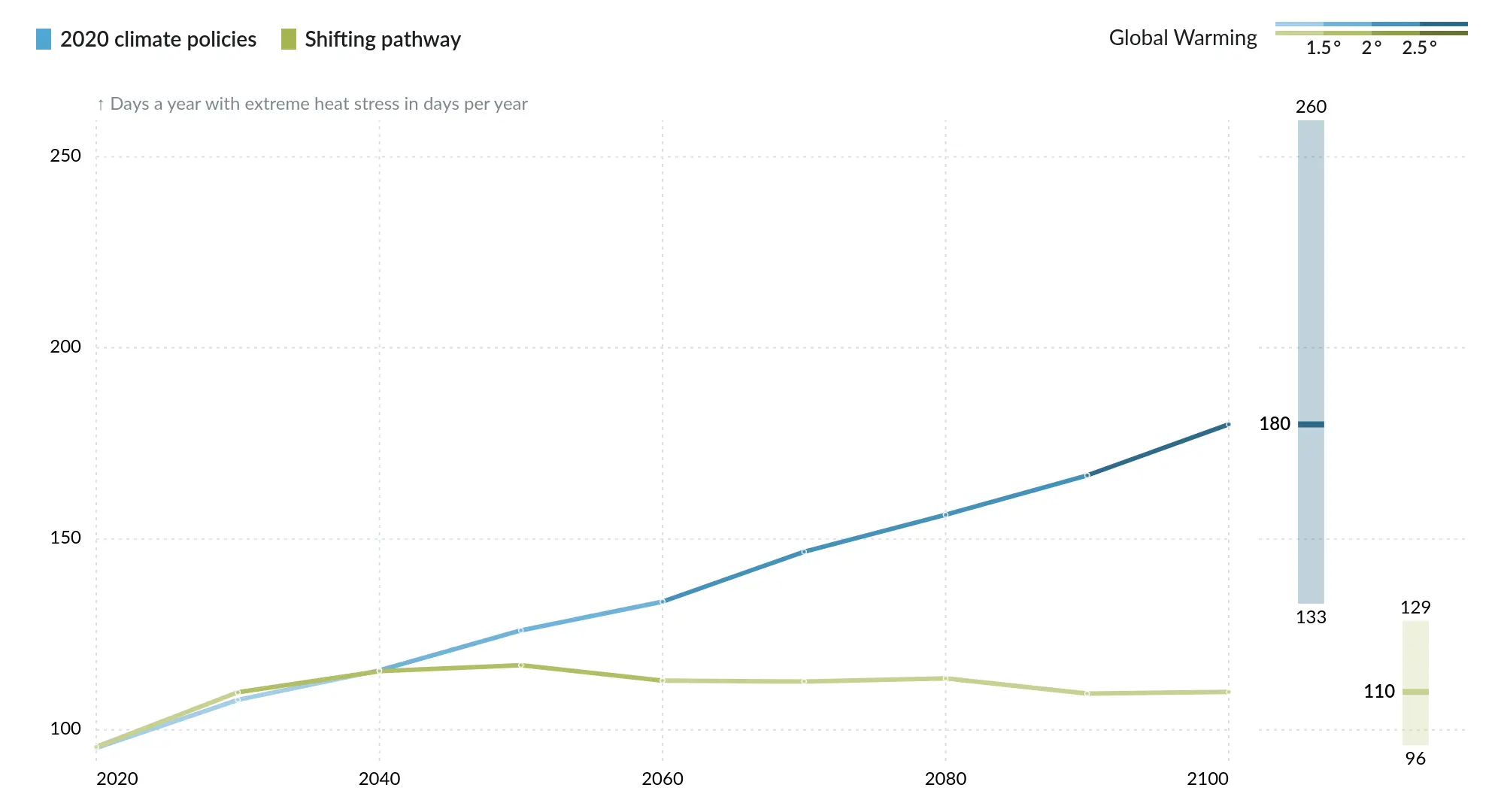
The chart below shows the projected annual number of days of extreme heat stress in Chennai – defined as days where wet-bulb globe temperature (WBGT) goes over 31C. (WBGT is a metric that combines air temperature, humidity and exposure to direct sunlight.)

This level of heat stress approaches the limits of human survivability (without adaptation) – for example, physical outdoor labour is almost impossible under these conditions.

Under current 2020 climate policies, leading to a best estimate of about 3C of warming in 2100, extreme heat days increase pretty much unchecked. By the end of the century, around half of the days (180) per year would experience extreme heat stress conditions (or even higher). 

In contrast, in a 1.5C low-overshoot scenario (the IPCC Shifting Pathway), the number of extreme heat stress days would peak mid-century at around 120 days , before declining again to around 110 days by 2100 as global average temperature decreases from just above 1.5C to around 1.3C. This is a modest decline in extreme heat risk, yet a profound difference from a 3C world. 

Projected days a year with extreme heat stress in Chennai from 2020 to 2100
Projected days a year with extreme heat stress in Chennai from 2020 to 2100 under the climate policies of 2020 (blue) and 1.5C low-overshoot scenario called “IPCC Shifting Pathway” (green). Source: PROVIDE Dashboard

Irreversible consequences from overshoot

There are many other impacts of climate change that will be irreversible – for centuries to millennia – at peak temperatures, let alone if society is able to bring warming back down.

Coral reef lossglacier losssea level rise and the loss of many species and ecosystems all fall into this category.

Yet, a lot of these losses can still be avoided by stringent mitigation. For example, our multi-scenario framework allows us to explore glacier futures showing unavoidable, or “locked-in”, risks even under the lowest emission scenario we have explored, and compare them with the avoidable risks through stringent mitigation. 

Below, we provide an example for glacier volume projections for Peru, where glaciers serve as an essential freshwater resource during the extremely dry season of June to September. Due to past warming, glacier loss will continue over the coming decades. Under a current policy scenario (blue dots), 50% of the glacier volume might be lost as early as 2050.

Yet this does not need to happen. In fact, stringent mitigation pathways (green dots) are still possible that give a four-in-five chance of preserving 50% of today’s glacier ice in Peru, avoiding the worst and helping to maintain some of their vital uses.

Chart illustrating risks of losing 50% of 2020 glacier volume for Peru today and in 2030, 2050 and 2100
Chart illustrating risks of losing 50% of 2020 glacier volume for Peru today and in 2030, 2050 and 2100, under the climate policies of 2020 (blue) and 1.5C low-overshoot scenario called “IPCC Shifting Pathway” (green). Shading highlights the avoidable risk. Source: PROVIDE Dashboard.

Overshoot risks for the biosphere

Climate change represents a major threat to biodiversity globally. We modelled species at risk from local extinction for about 135,000 terrestrial fungi, plants, invertebrates and vertebrates based on the Wallace Initiative

Under the assumption that the 1950-2000 reference climate was suitable for the species at question, we model the proportion of species for which the local climate becomes unsuitable under ongoing climate change. 

In the chart below, we illustrate the risks to species in one of the countries with the world’s richest terrestrial biodiversity, Brazil. Under the current policy scenario (blue dots), the likelihood of 50% of species being at risk of local extinction rises to 74% by 2100. Yet, our analysis shows that this likelihood can still be avoided almost entirely by stringent mitigation (green dots). 

Chart showing the likelihood of 50% of Brazilian species being at risk of local extinction today and in 2030, 2050 and 2100
Chart showing the likelihood of 50% of Brazilian species being at risk of local extinction today and in 2030, 2050 and 2100, under the climate policies of 2020 (blue) and 1.5C low-overshoot scenario called “IPCC Shifting Pathway” (green). Shading highlights the avoidable risk. Source: PROVIDE Dashboard.

It is important to highlight that species loss does depend on a range of factors – of which climate suitability is only one. Yet there is a range of other human-caused stressors to biodiversity loss and a complex interdependencies of species and food webs in particular in the most biodiverse ecosystems implies the risk of knock-on effects and ecosystem tipping points

We also note that our results do not necessarily imply global species extinction and do not allow us to quantify if and how species survival under different overshoot trajectories would emerge. 

Overshoot will stress adaptation planning

Overshoot outcomes matter for climate risk assessments. Yet, in contrast with the prominence of overshoot pathways in the climate mitigation literature, their implications for adaptation planning have not been widely explored.

Overshoot would increase the threat of climate change that society needs to adapt to – and make that adaptation more difficult. Some options may become unavailable due to limits of adaptation

Also, timescales matter. Reversing an overshoot will take decades. Even assuming reversibility of climate hazards in the future as temperatures come down, this might only matter for adaptation decisions that involve a planning horizon of 50 years or more.

This is illustrated in the chart below, from our recent Nature study. This shows a stylised trajectory of warming (top chart) with overshoot (red bars) and how it compares to planning horizons for some example adaptation options (green bars), the lifetime of those measures (blue bars) and the intergenerational equity they involve (bottom chart).

The possibility of reversing long-term impacts in the future does not reduce the urgent need to act now on closing the wide gap in current adaptation efforts.

Figure showing stylised temporal evolution of a reversible climate impact driver
Figure showing: a) stylised temporal evolution of a reversible climate impact driver under a peak and decline scenario. Dashed lines indicate a low and high overshoot outcome with median timescales of global temperature reversibility typically in line with those from the IPCC AR6 database; and b) stylised illustration of adaptation-relevant timescales starting in 2030, including different planning horizons for adaptation planning (green bars) and lifetimes of individual adaptation measures (blue), and the effect of applying discounting (reflecting societal preferences towards intergenerational equity) to future damages and adaptation benefits. Source: Schleussner et al. (2024)

Limit peak warming and aim for long-term decline

While our results clearly underscore the importance of limiting peak warming to as low as possible, there are also very good arguments for aiming for a long-term global temperature decline, irrespective of the peak warming level. 

For a wide range of time-lagged climate impacts, such as ice sheet, peatland and permafrost loss, as well as large-scale irreversible tipping points, achieving temperature decline well below 1.5C is key to limiting long-term risks from global warming. 

Overshoot is clearly not an alternative way to achieve a similar climate outcome. Effectively limiting climate risks requires restricting peak warming as low and as close to 1.5C as possible – and then aim for long-term decline to reduce the climate impact legacy of human-caused emissions.

This guest post is by:

Dr Carl-Friedrich Schleussner leads the integrated climate impact group at the International Institute for Applied Systems Analysis (IIASA) and is a scientific advisor at Climate Analytics, Berlin.

Prof Rachel Warren, professor of global change and environmental biology at the University of East Anglia.

Dr Fabien Maussion, associate professor in glaciology at the School of Geographical Sciences, University of Bristol, UK.

Dr Niels Souverijns, urban climatologist at VITO Belgium and guest professor at KU Leuven.

Dr Quentin Lejeune, a climate scientist who has led the development of the PROVIDE Climate Risk Dashboard at Climate Analytics.

Original article by multiple authors republished from Carbon Brief under a CC license

Continue ReadingGuest post: What 1.5C overshoot would mean for climate impacts and adaptation