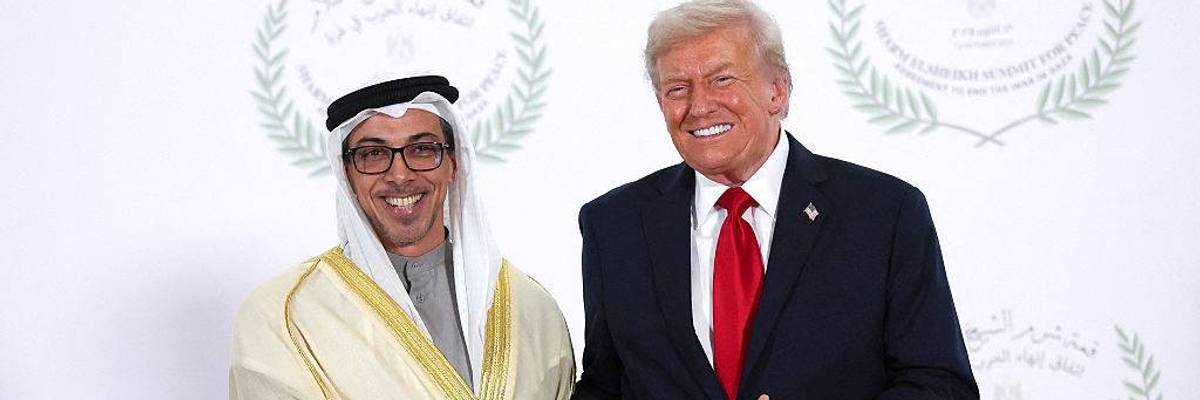
President Donald Trump and Sheikh Mansour bin Zayed Al Nahyan, UAE Vice President and Deputy Prime Minister, shake hands on October 13, 2025 in Sharm El-Sheikh, Egypt. (Photo by Suzanne Plunkett, Pool / Getty Images)
According to the Journal’s sources, lieutenants of Abu Dhabi royal Sheikh Tahnoon bin Zayed Al Nahyan signed a deal in early 2025 to buy a 49% stake in World Liberty Financial, the startup founded by members of the Trump family and the family of Trump Middle East envoy Steve Witkoff.
Documents reviewed by the Journal showed that the buyers in the deal agreed to “pay half up front, steering $187 million to Trump family entities,” while “at least $31 million was also slated to flow to entities affiliated with” the Witkoff family.
Weeks after green lighting the investment into the Trump crypto venture, Tahnoon met directly with President Donald Trump and Witkoff in the White House, where he reportedly expressed interest in working with the US on AI-related technology.
Two months after this, the Journal noted, “the administration committed to give the tiny Gulf monarchy access to around 500,000 of the most advanced AI chips a year—enough to build one of the world’s biggest AI data center clusters.”
Tahnoon in the past had tried to get US officials to give the UAE access to the chips, but was rebuffed on concerns that the cutting-edge technology could be passed along to top US geopolitical rival China, wrote the Journal.
Many observers expressed shock at the Journal’s report, with some critics saying that it showed Trump and his associates were engaging in a criminal bribery scheme.
“This was a bribe,” wrote Melanie D’Arrigo, executive director of the Campaign for New York Health, in a social media post. “UAE royals gave the Trump family $500 million, and Trump, in his presidential capacity, gave them access to tightly guarded American AI chips. The most powerful person on the planet, also happens to be the most shamelessly corrupt.”
Jesse Eisinger, reporter and editor at ProPublica, argued that the Abu Dhabi investment into the Trump cypto firm “should rank among the greatest US scandals ever.”
Democratic strategist David Axelrod also said that the scope of the Trump crypto investment scandal was historic in nature.
“In any other time or presidency, this story… would be an earthquake of a scandal,” he wrote. “The size, scope and implications of it are unprecedented and mind-boggling.”
Tommy Vietor, co-host of “Pod Save America,” struggled to wrap his head around the scale of corruption on display.
“How do you add up the cost of corruption this massive?” he wondered. “It’s not just that Trump is selling advanced AI tech to the highest bidder, national security be damned. Its that he’s tapped that doofus Steve Witkoff as an international emissary so his son Zach Witkoff can mop up bribes.”
Former Rep. Tom Malinkowski (D-NJ) warned the Trump and his associates that they could wind up paying a severe price for their deal with the UAE.
“If a future administration finds that such payments to the Trump family were acts of corruption,” he wrote, “these people could be sanctioned under the Global Magnitsky Act, and the assets in the US could potentially be frozen.”
Elon Musk urges you to be a Fascist like him, says that you can ignore facts and reality then.Donald Fuhrump says that Amerikkka doesn’t bother with crimes or charges anymore, not being 100% Amerikkkan and opposing his real estate intentions is enough.Orcas discuss how Trump was re-elected and him being an obviously insane, xenophobic Fascist.
“The swamp has never been so fetid,” wrote New York Times columnist Nick Kristof.
As millions of Americans face down devastating cuts to their healthcare and food assistance, President Donald Trump and his family personally enriched themselves to the tune of at least $1.4 billion during his first year back in office, according to an analysis published by the New York Timeseditorial board on Tuesday, the one-year anniversary of his second inauguration.
This unprecedented profiteering, which already amounts to 16,822 times the median US household income according to the Times, is almost certainly an undercount, as many sources of the president and his family’s wealth remain hidden from public view.
“President Trump has never been a man to ask what he can do for his country. In his second term, as in his first, he is instead testing the limits of what his country can do for him,” the board wrote. “He has poured his energy and creativity into the exploitation of the presidency—into finding out just how much money people, corporations, and other nations are willing to put into his pockets in hopes of bending the power of the government to the service of their interests.”
Relying on a series of previous analyses from other news organizations, the Times notes several of Trump’s key streams of income.
As has been widely documented, most comprehensively byReuters in October, by far Trump’s largest source of income has been his family’s investment in cryptocurrencies, which has generated at least $867 million in new wealth for the family. Other investigations suggest the true number could be several billion when accounting for unreported assets and gains that have not yet been realized.
“People who hope to influence federal policy, including foreigners, can buy his family’s coins, effectively transferring money to the Trumps, and the deals are often secret,” the Timesboard wrote.
The swamp has never been so fetid. President Trump has greedily raked in $1.4 billion (an underestimate) in the last year, often from those seeking favor. E.g. He accepts a Qatari jet and promises US forces will protect Qatar. The corruption is staggering: www.nytimes.com/interactive/…
It noted one particularly brazen transaction earlier this year, when an investment company owned by a member of the United Arab Emirates’ (UAE) ruling family dumped $2 billion into the Trump family’s crypto startup World Liberty Financial, just two weeks before the White House announced that the UAE would be given access to hundreds of thousands of the world’s most advanced computer chips.
Inking real-estate deals has been another tool nations have used to buy influence with Trump. The Times cites a report from the watchdog group Citizens for Responsibility and Ethics (CREW), showing that the Trump Organization and its partners were planning at least 22 “Trump-branded projects around the globe” over the course of his presidency, including through hotels and golf courses in India, Oman, Saudi Arabia, the UAE, Indonesia, and other nations eager to be in the US government’s good graces.
In all, since his reelection, the Times calculated that Trump has reaped at least $23 million from licensing his name overseas, at times culminating in the appearance of blatant pay-for-play. In one instance, “the administration agreed to lower its threatened tariffs on Vietnam about a month after a Trump Organization project broke ground on a $1.5 billion golf complex outside of Hanoi. Vietnamese officials ignored their own laws to fast-track the project.”
Another CREW analysis from July found that Trump visits his own properties roughly “every other day”—much more frequently than in his previous term—and that many foreign government officials have traveled to these sites to curry favor with the president.
CREW is tracking Trump’s conflicts of interest tied to his real estate empire, including:-Visits to Trump properties-Events held at Trump properties-Promotion of Trump business interests The pattern is clear: it’s all happening more this time around.
Trump also infamously accepted a $400 million jet, described as a “flying palace,” from the Qatari government. He plans to use the plane as Air Force One during his presidency and transfer it to his presidential library after leaving office. Shortly after receiving the jet, he pledged to “protect” Qatar and announced lucrative new military and economic partnerships with the country.
Elsewhere, Amazon spent $40 million on a documentary about First Lady Melania Trump, $28 million of which will be given directly to the first lady, which the Times said is far more than has been paid for similar projects. The company’s CEO, Jeff Bezos, has critically lobbied the administration for favorable treatment regarding antitrust and defense contracts, and has seen his own wealth soar by nearly $9 billion over the past year.
But Trump’s income from media and tech companies has more commonly arrived in the form of shakedowns. He has made an estimated $90.5 million from settlements from X (formerly Twitter), ABC News, Meta, YouTube, and Paramount since his reelection, none of which, the Times argues, “were justified on the merits.”
“Mr. Trump’s hunger for wealth is brazen,” the editorial board wrote. “Throughout the nation’s history, presidents of both parties have taken care to avoid even the appearance of profiting from public service. This president gleefully squeezes American corporations, flaunts gifts from foreign governments, and celebrates the rapid growth of his own fortune.”
The report of Trump’s looting of the presidency comes as roughly 1.3 million Americans are expected to lose health insurance coverage in 2026 due to Republican cuts to Medicaid and other assistance programs, while more than 20 million are expected to pay higher insurance premiums after the GOP allowed Affordable Care Act subsidies to expire last year. Roughly 1.5 million have already dropped their health coverage this year, according to a report last week from CNBC.
Meanwhile, about 4 million low-income people—including 1 million children—are expected to see their access to food assistance either substantially reduced or totally lost in the coming years due to Republican cuts to the Supplemental Nutrition Assistance Program.
While “Drain the Swamp” has remained one of Trump’s signature phrases, portraying the president as a crusader against endemic corruption in Washington, Times columnist Nick Kristof wrote, in the wake of his paper’s new report, that under Trump’s watch, “the swamp has never been so fetid.”
Elon Musk urges you to be a Fascist like him, says that you can ignore facts and reality then.Donald Fuhrump says that Amerikkka doesn’t bother with crimes or charges anymore, not being 100% Amerikkkan and opposing his real estate intentions is enough.Orcas discuss how Trump was re-elected and him being an obviously insane, xenophobic Fascist.
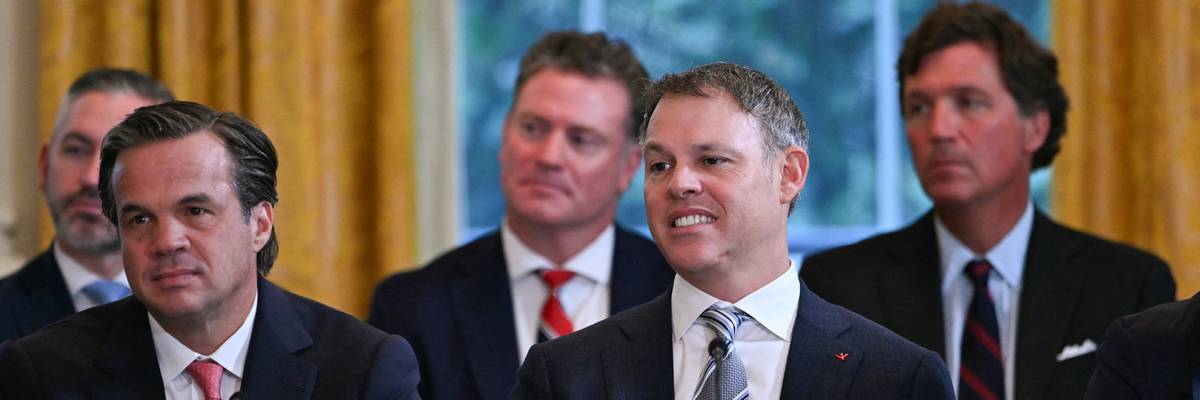
John Addison, front right, energy trader for Vitol, attends a meeting with oil company executives hosted by US President Donald Trump in the East Room of the White House on January 9, 2026. (Photo by Brendan Smialowski/AFP via Getty Images)
“Trump took Venezuela’s oil at gunpoint, and gave it to one of his biggest campaign donors,” wrote one US senator.
The first US sale of Venezuelan oil since the Trump administration illegally attacked the South American country earlier this month went to the company of a trader who donated millions to President Donald Trump’s 2024 campaign.
The roughly $250 million sale of Venezuelan crude went to Vitol, a Geneva-based energy and commodity trading firm whose US arm is headquartered in Houston. The Financial Timesreported late last week that John Addison, a senior trader at Vitol, was involved in his company’s efforts to secure the deal.
Addison, who attended a recent White House meeting with other top oil executives, donated $6 million total to Trump’s 2024 presidential campaign via several super PACs, including $5 million to MAGA Inc.
“Addison pledged to Trump at the [White House] event that Vitol would attain the best price possible for Venezuelan oil for the US, ‘so that the influence you have over the Venezuelans will ensure that you get what you want,’” according to the Financial Times.
US Sen. Chris Murphy (D-Conn.), noted on social media that Vitol has a “criminal history of bribing foreign governments” and called the Venezuelan oil deal “fundamentally corrupt.”
“Trump took Venezuela’s oil at gunpoint, and gave it to one of his biggest campaign donors,” Murphy wrote. “Vitol had to buy access to Trump because under normal circumstances, they wouldn’t be able to get a deal like this.”
Vitol is one of a number of corporations positioned to reap windfall profits from the Trump administration’s assault on Venezuela, abduction of its president, and efforts to seize and indefinitely control the country’s vast oil reserves.
Hedge fund billionaire Paul Singer’s firm Elliott Investment Management has for years been in the process of acquiring distressed Venezuelan-owned assets in the US and is on the cusp of owning them. After clearing final regulatory and legal approval, the firm can use them to make a considerable profit turning newly available Venezuelan oil into gasoline. The company that would be acquired by an Elliott affiliate is Citgo, the Houston-based refining firm owned by Venezuela’s state oil company Petróleos de Venezuela (PDVSA). Citgo owns refineries in Illinois, Louisiana and Texas that are well-positioned to profit off the millions of barrels of Venezuelan oil that Trump says will be steered to US refineries because it is a particularly heavy blend of crude that is difficult to process. Only certain refineries, like those run by Citgo, are equipped to handle it.
Proceeds from the US sale of Venezuelan oil are being stashed in Qatar—an arrangement that critics said opens the door to additional corruption.
“After illegally and unconstitutionally striking Venezuela, Trump is now selling Venezuelan oil through a campaign donor, and funneling the proceeds to an offshore account in Qatar—creating a potential slush fund with no accountability, oversight, or guardrails for Trump and his allies,” US Sen. Cory Booker (D-NJ) wrote late Sunday. “His continued abuse of power doesn’t serve the Venezuelan people or the American people—and it certainly doesn’t lower costs for Americans.”
“This outrage,” Booker added, “is yet another example of his unchecked corruption as he again ignores laws and enriches his friends, donors, and himself.”
Elon Musk urges you to be a Fascist like him, says that you can ignore facts and reality then.Donald Fuhrump says that Amerikkka doesn’t bother with crimes or charges anymore, not being 100% Amerikkkan and opposing his real estate intentions is enough.Orcas discuss how Trump was re-elected and him being an obviously insane, xenophobic Fascist.
Presidential candidate Fernando Dias da Costa of the Party for Social Renewal (PRS) in a pre-election meeting. Photo: JAAC / Facebook
Claiming to be under arrest, President Embaló has left the country while his opponents remain in custody after a military coup a day ahead of the announcement of the final results
The military coup in Guinea-Bissau on November 26 was not directed against the outgoing president, Umaro Sissoco Embaló, but orchestrated by him to thwart the return to constitutional order, opposition parties and members of the dissolved parliament allege.
Claiming to be arrested by the coup leaders – while still communicating with the French media – Embaló flew to neighboring Senegal the following day. His opponents, on the other hand, are still held in military custody.
The coup came on the heels of the long-delayed elections on Sunday, November 23. Both domestic and international observers had reportedly agreed that Embaló was voted out of the presidency.
“Why would anyone do a coup against a losing candidate?” asked Imani Umoja, Central Committee member of the African Party for the Independence of Guinea and Cape Verde (PAIGC).
Having led the country’s liberation struggle against Portuguese colonialism under the leadership of the Marxist revolutionary Amilcar Cabral, PAIGC is the country’s largest party. Its presidential candidate, Domingos Simões Pereira, Embaló’s main opponent, was barred from contesting the election by the Supreme Court, whose legitimate president had been replaced in 2023 by militias of the presidential guard under Embaló’s command.
“We had three options. One was to boycott the election,” which would have only handed over power to Embaló for the second term without a fight, Umoja told Peoples Dispatch. “Or we could have taken the streets in protest, but that is what the regime wanted. They would have killed us and postponed the election,” further extending his rule that had already continued beyond his term.
“So we decided to back one of the candidates approved to contest. Dias was our natural choice,” because he is the head of the Party for Social Renewal (PRS) – a splinter from the PAIGC. “There is no great ideological difference between us,” he added, explaining the split was over tactical differences, overcoming which the two parties had often collaborated on broader struggles.
Although the leadership of the PRS identified the party as “social-democratic” as opposed to PAIGC’s “socialist” identification, the rank-and-file of both parties are Cabralists.
“So we were able to reach an agreement that once Dias becomes the president, he would reverse all the unconstitutional decrees by Embaló.”
An unconstitutional regime
Swearing himself in as the country’s president at a hotel guarded by soldiers in February 2020 after a disputed election against the PAIGC leader Pereira, who was barred from contesting this time, Embaló had the president of the Supreme Court replaced, practically at gunpoint, in November 2023. Then, in December that year, he unconstitutionally dissolved the parliament, where the PAIGC had the majority, justifying the action by citing a coup attempt he had allegedly staged himself.
Removing the ministers constitutionally chosen by this parliament, he replaced them with a so-called “Government of Presidential Initiative.”
Thus, grabbing all power and dismantling democratic structures, Embaló has allegedly been signing away in secret valuable natural resources and lucrative infrastructure projects to France and the neighboring West African states under its neocolonial yoke.
A reversal of this neocolonial penetration was set to begin under Dias’s presidency, starting with the restoration of the dissolved parliament, the National People’s Assembly, dominated by the PAIGC and presided by its leader and barred candidate, Pereira.
According to the vote count from each region published by the Regional Electoral Councils, Embaló bagged around 43% of the votes, while Dias had won with about 53%, said Umoja.
A staged coup
However, one day before the National Electoral Council was set to publish the final results, summing up the nationwide count and the votes from the diaspora, gunfire erupted near the presidential palace.
“But there was no fighting. Soldiers were shooting in the air,” said Umoja. Embaló then told the French media that he had been removed from power in a coup led by a group of soldiers who had put him under arrest. “It was all staged. The coup was not against Embaló, but Dias… the president-elect.”
Opening fire near the National Election Council, “another group of armed people from the Ministry of Interior, accompanied by some soldiers, barged into its office and seized the phones of all the workers there, including the representatives of the candidates,” he added.
“A group of heavily armed militias associated with the Presidential Palace” also “invaded the campaign headquarters of the presidential candidate [Dias],” said Ruth Monteiro, Director of the Office of the President of the National People’s Assembly, namely Pereira.
Pereira was arrested with Dias’s National Representative, Octávio Lopes, and several others, Monteiro added. Dias himself managed to escape arrest “through a back door,” he later said in a video message.
Shutting down the radio, the officers who carried out the coup read out a statement on television, declaring themselves in charge, christening their junta as the “High Military Command for the Restoration of Order.”
Announcing the closure of borders, they ordered the suspension of the electoral process “until further notice”, ostensibly to thwart the “capture of Guinean democracy” by “narcotraffickers”.
Labeling this as “a self-coup orchestrated by Umaru Sissoko Embaló, who was overwhelmingly defeated at the polls,” the West Africa People’s Organization said: “The very clear aim is to prevent the electoral body from announcing results that are unfavorable to this well-known agent of the neo-colonial system.”
On November 27, when General Horta Nta Na Man swore in as transitional president for one year, the junta announced that it “strictly prohibits any demonstration, march, strike or action that disrupts peace and stability.”
Protests
“We cannot fold our hands while our leadership is imprisoned unjustly. When our leader and candidate was barred from contesting, we chose to avoid” a confrontation by not taking to the streets, backing another candidate instead. “But now we have run out of options. We have to protest.”
The Amílcar Cabral African Youth (JAAC) posted videos of protest marches in some neighborhoods around the Ministry of Interior. Large-scale protests are at high risk at the moment in Guinea-Bissau. A large section of “our leadership is still in hiding,” Umoja added.
However, the diaspora is mobilizing. In Dakar, the capital of Senegal, progressive Senegalese activists protested alongside the diaspora outside the Guinea-Bissau embassy against hosting Embaló in the country. “Dictators are not wanted anywhere!” Umoja remarked.
JAAC Portugal and Firkidja di Pubis, an organization of Guinean students and workers abroad, protested in Lisbon, capital of their former colony, outside the Community of Portuguese Language Countries (CPLP), chaired by Embaló.
“The CPLP and the so-called international community” is complicit with Embaló, who “orchestrated a fake coup d’état with the sole purpose of derailing the electoral process in which the people had defeated his dictatorship,” Firkidja di Pubis accused. Protesters demanded the “completion of the electoral process in which the people chose Fernando Dias da Costa as their President.”
Should the junta not pay heed, Umoja warns, “Embaló’s followers in the military are only those who are paid” for their loyalty, but the bulk of the rank-and-file soldiers are unpaid.
The PAIGC denounced on Saturday, November 29, that a group of masked and armed men raided their headquarters, attacking party leaders and those present. In statements released, the party alleges that the objective of the raid was to plant weapons in the office to later serve as evidence against them. The party called on the international community to “follow these events closely and support all of the efforts to preserve democratic legality.” The party has also called for authorities to release Pereira and all others arrested amid the coup plot.
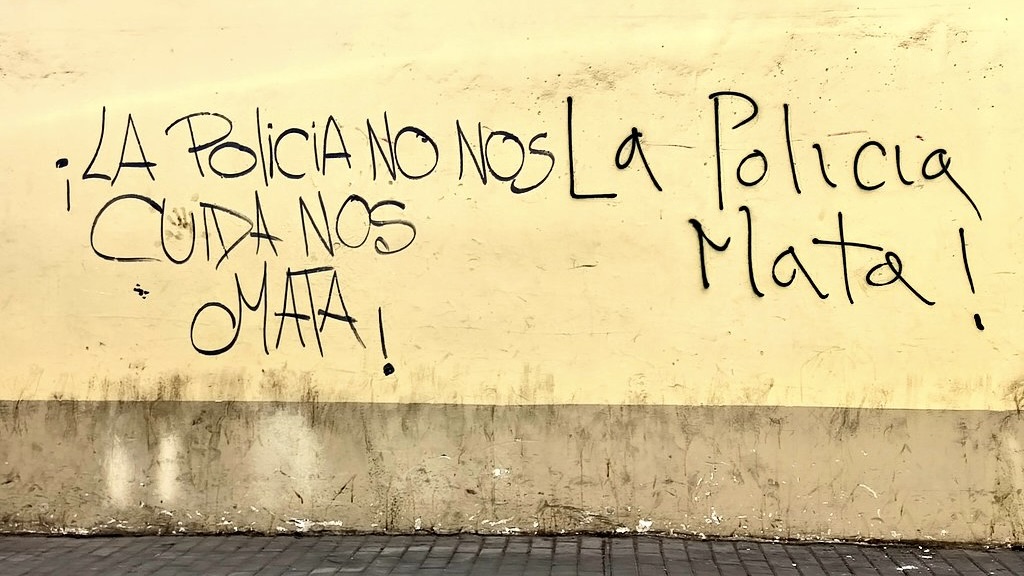
Graffiti in Lima condemning police repression of protests. Photo via Joxe Carlos / X
Protesters are demanding an end to the government with the highest disapproval rating on the entire continent. Boluarte, however, says she will not resign.
Another massive mobilization took place on October 4 in Lima, Peru’s capital, against the government of Dina Boluarte. With this mobilization, it has now been three weeks in a row that thousands of Peruvians have taken to the streets to demand an end to the proposed pension reform, corruption, insecurity, and police abuse.
But, as several analysts have pointed out, the protests are no longer focused solely on specific issues, but on raising the demand for an end to the Boluarte government. Boluarte took office after the overthrow of then-President Pedro Castillo, and led to the deaths of more than 60 Peruvians following massive protests between 2022 and 2023.
Protests in Lima
On Saturday, October 4, the streets of downtown Lima were once again filled with cries against the government and the national congress. The demonstrations were attended by young people, university students, workers, transport workers, and various collectives who denounced the Peruvian state structure as corrupt due to the presence of political and economic mafias. The General Confederation of Workers of Peru (CGTP) also joined the demonstration.
However, journalist Ricardo Rodríguez argues that perhaps the most important aspect of the protests is not the repression, but rather the ability of Peruvians to mobilize in the face of a government that refuses to step aside: “It’s not just about bullets, tear gas, or arrests. What those in power fear – and are already beginning to feel – is that these young people are not just taking to the streets: they know, they understand, they articulate. They organize in a decentralized manner; they mobilize without waiting for permission; they use social media not as a showcase but as a tool for coordination; they demand not crumbs, but real change.
Rodríguez also pointed out that there is a spirit of rejection not only of the current government, but of a system that offers no opportunities for growth for Peruvians, felt most strongly among young people: “Many reject the economic model that offers them precariousness, miserable wages, and old age without decent pensions. The proposed reform is not the only cause: it is the trigger for accumulated resentment against decades of broken promises and state neglect.”
Transport workers’ strike
In addition to the demonstrations on Saturday, October 4, several dozen transport companies in Peru staged protests against the government of Dina Boluarte on October 7.
Their main demand is that the government take action to stop the growing wave of insecurity and extortion suffered by transport workers at the hands of organized crime groups. Attacks on transport workers have caused the deaths of 47 drivers.
At various points in Lima, transport workers stopped work and gathered in the streets to demand a change in the state’s security policy, even blocking roads to make themselves heard.
France 24 correspondent Francisco Zacarías reported that there were clashes between protesters and police. He also stated that President Boluarte “downplayed” the transport strike and said that the protests “will not solve the problem,” which has further provoked the transport unions.
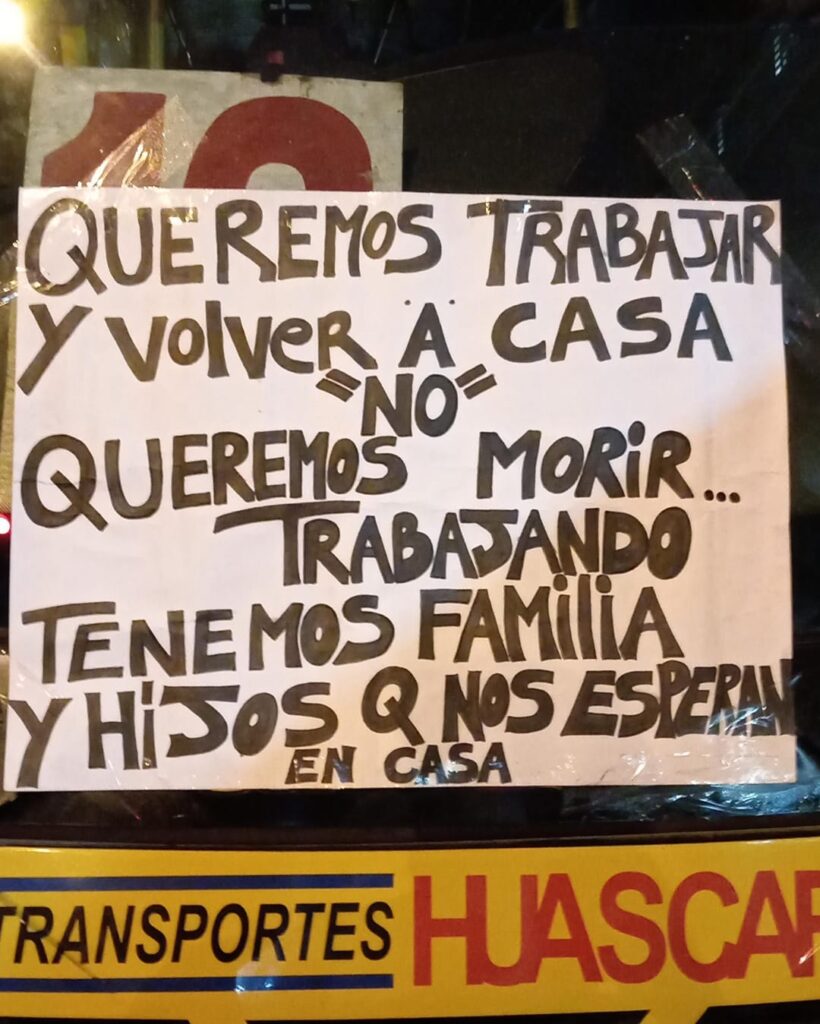
Sign on a bus reads “We want to work and return home. We do NOT want to die working. We have family and children that wait for us at home.” Photo via X
Almost total rejection of the Boluarte government and Congress
Currently, Peru’s Congress has one of the lowest approval ratings among the country’s various state institutions, reaching almost total rejection. Not far behind, President Boluarte has a 96% disapproval rating, according to an IPSOS poll.
In this regard, IPSOS CEO Alfredo Torres stated: “This is something that has never been seen before in history, nor has it been seen in other countries. A poor approval rating for any president is 20% in favor and 80% against, but a 96% disapproval rating is extremely high. It is absolute rejection, absolute distrust. People no longer expect anything. It is also outrageous that scandals continue to emerge and nothing happens.”
“I will not resign,” says Boluarte
Faced with periodic protests and a huge crisis of legitimacy, President Boluarte stated that she has no intention of leaving power before the 2026 elections. According to Boluarte, Peru has become a prime destination for foreign investment, so her administration is more than justified.
“If those small-time leaders believe that with riots, violence, hatred, and the desire to impose an anarchic world, they are going to change the history of Peru … We are seeing other countries that have done the same and have failed governments,” Boluarte said.
However, Boluarte will still have to endure protests that seem to be increasing in frequency in line with the disapproval of her mandate.