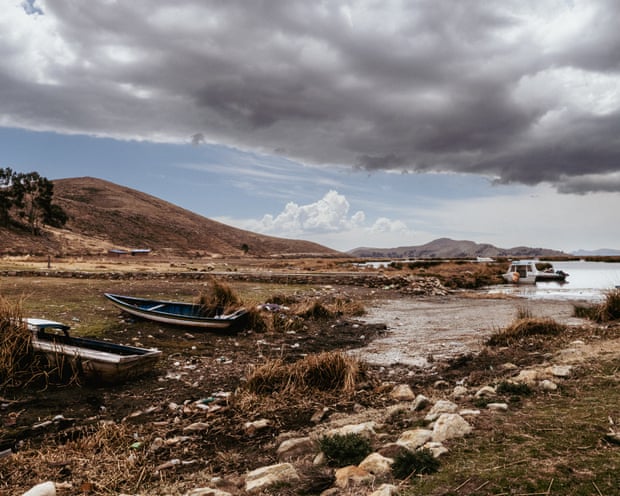
Lake Titicaca in South America. Its water levels are receding, partly due to shifts in rainfall caused by Amazon deforestation. Photograph: Benjamin Swift/The Guardian
It took an FOI request to bring this national security assessment to light. For ‘doomsayers’ like us, it is the ultimate vindication
…
When the report at last appeared, thanks to an FoI request lodged by the Green Alliance, The Times reported that it had been significantly “abridged”, I expect by the same goons. Some of its starkest conclusions had been omitted. Even so, the assessment – believed to have been compiled by the joint intelligence committee (on which the heads of MI5, MI6 and GCHQ sit) – is not exactly reassuring.
It echoes warnings some of us have made for years, only to be dismissed as nutters, doomsayers and extremists. It tells us that “ecosystem degradation is occurring across all regions. Every critical ecosystem is on a pathway to collapse (irreversible loss of function beyond repair).” This presents a threat to “UK national security and prosperity”. It says “the world is already experiencing impacts including crop failures, intensified natural disasters and infectious disease outbreaks. Threats will increase with degradation and intensify with collapse.” The results will include geopolitical and economic instability, increased conflict and competition for resources. “It is unlikely the UK would be able to maintain food security if ecosystem collapse drives geopolitical competition for food.” It also warns that “conflict and military escalation will become more likely, both within and between states, as groups compete for arable land and food and water resources”.
…
But what was cut from the report is, according to The Times, even graver, including a warning that the shrinkage of glaciers in the Himalayas, causing declining river flow, would “almost certainly escalate tensions” between China, India and Pakistan, leading to the possibility of nuclear war. Again, some of us have been trying to persuade governments to focus on this threat with little success.
…
The report, notably shorter than most of its kind, gives every appearance of having been hastily and crudely truncated.
…
I know this government exists only to disappoint us. But its environmental failures are even more striking than its failures on other issues. When the ruling party compares unfavourably with the one that brought us Boris Johnson and Liz Truss, it’s worse than a betrayal. It’s a threat to our survival.
dizzy: It was difficult to select extracts from this article, suggest that you read the original.
Nigel Farage urges you to ignore facts and reality and be a climate science denier like him and his Deputy Richard Tice. He says that Reform UK has received £Millions and £Millions from the fossil fuel industry to promote climate denial and destroy the planet.Donald Trump urges you to be a Climate Science denier like him. He says that he makes millions and millions for destroying the planet, Burn, Baby, Burn and Flood, Baby, Flood.Elon Musk urges you to be a Fascist like him, says that you can ignore facts and reality then.
Children born in 2020 will face “unprecedented exposure” to extreme weather events, including heatwaves, droughts and wildfires, even if warming is limited to 1.5C above pre-industrial temperatures.
That is according to a new study, published in Nature, which calculates the number of unprecedented extreme events that people born in different decades and countries might live through.
Using a case study focused on Brussels, the researchers find that people born in 2020 will experience an “unprecedented” 11 heatwaves in their lifetime – even if global warming is limited to 1.5C by the end of the century.
In contrast, in a pre-industrial climate, a person living in the Belgian capital would likely experience just three such heatwaves, according to the study.
More than half of children born in 2020 – around 62 million people – will experience “unprecedented lifetime exposure” to heatwaves, even if warming is limited to 1.5C, the study finds.
However, this number nearly doubles to 111 million under a scenario where warming hits 3.5C.
The study also analyses crop failures, river floods, tropical cyclones, wildfires and droughts.
The research “helps the climate community build new narratives that better clarify the impacts [of climate change] on younger generations and vulnerable populations”, one expert who was not involved in the study tells Carbon Brief.
Intergenerational justice
As the planet warms, extreme weather events such as heatwaves, floods and droughts are becoming more intense, more frequent and lasting longer.
A popular 2021 study found that children born in the 21st century will be exposed to more extreme weather events in their lifetimes than their parents and grandparents.
The paper found that in a scenario of 3C of warming above pre-industrial levels, a child who turns six in 2020 will experience twice as many wildfires and tropical cyclones, three times more river floods, four times more crop failures, five times more droughts and 36 times more heatwaves over their lifetime than a six-year-old living in a pre-industrial climate.
The authors also found a “particularly strong increase” in children’s future exposure to extremes in the Middle East and North Africa.
The lead author of the study – Prof Wim Thiery from Vrije Universiteit Brussel – told Carbon Brief at the time that today’s youth will live “an unprecedented life”, in which they will “face conditions which older generations have never experienced”.
Four years later, Dr Luke Grant – a researcher in Thiery’s team – has led a new study building on the ideas of the 2021 paper.
Grant tells Carbon Brief that rather than counting the number of extreme events that an individual might experience, his new study counts the number of people that reach an “unprecedented state” of exposure to extremes.
Prof Kaveh Madani is the director of the UN University Institute for Water, Environment and Health and was not involved in the study. He tells Carbon Brief that the paper “helps the climate community build new narratives that better clarify the impacts [of climate change] on younger generations and vulnerable populations”.
The authors define “exposure” as the number of extreme events that a person experiences in their lifetime, relative to the number they would have experienced in a pre-industrial climate.
“Unprecedented lifetime exposure” is defined as exposure so high that it has only a one-in-10,000 chance of happening in a world without any greenhouse gas emissions.
‘Unprecedented lifetime exposure’
The authors present a case study of extreme heat in Brussels, Belgium, to explain their method.
They define a heatwave as a three-day extreme heat event, which reaches average temperatures that would be expected once per century in a pre-industrial climate.
Using models from the Inter-Sectoral Impact Model Intercomparison Project (ISIMIP), the authors calculate heatwave frequency in a world without climate change. They also assess scenarios in which warming is limited to 1.5C, 2.5C and 3.5C by the end of the century.
They combine this data with demographic information, including how many people are born in the country each year and their average life expectancy, using data from sources including the ISIMIP database and UN population estimates and projections.
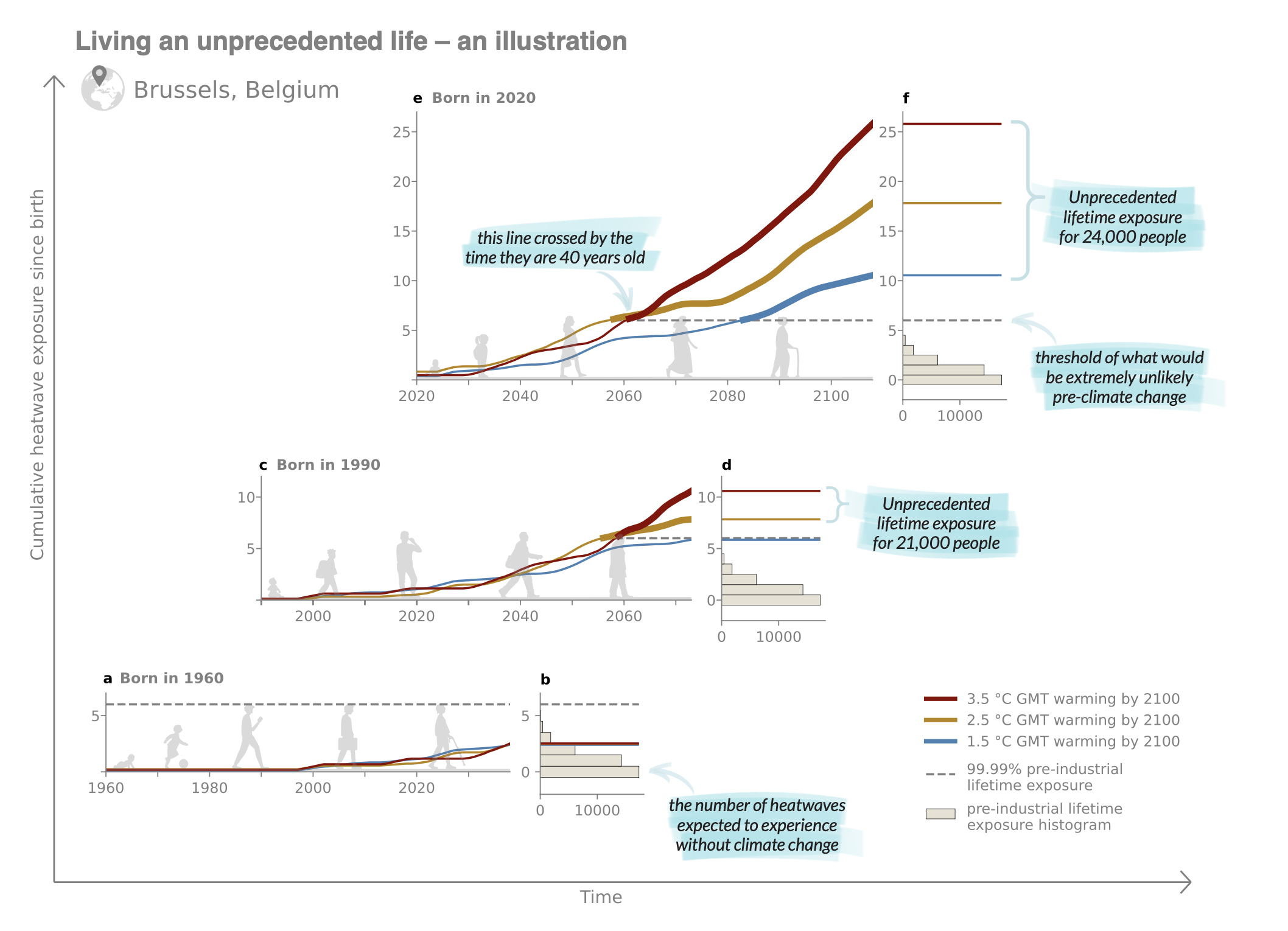
In a world without climate change, the study finds that a person born in 1960 in Brussels would have a one-in-10,000 chance of experiencing six of the pre-defined heatwaves in their lifetime. Any member of this “birth cohort” who experiences more than six heatwaves in their lifetime has therefore faced “unprecedented lifetime exposure” to extreme heat, according to the study.
The authors find that a person born in Brussels in 1960 is likely to experience three heatwaves on average during their lives under all of the three future warming pathways– meaning that they are unlikely to face “unprecedented lifetime exposure” to heat.
By contrast, the researchers find that many younger age cohorts will experience unprecedented heatwave exposure. For many younger age cohorts, lifetime exposure to heatwaves is greater for higher warming pathways.
For example, people born in Brussels in 2020 will experience 11 heatwaves in their lifetime if global warming is limited to 1.5C by the end of the century. If warming rises to 2.5C or 3.5C, they could experience 18 or 26 heatwaves, respectively.
The graphic below shows heat exposure since birth in Brussels for three “birth cohorts” of 1960 (bottom row), 1990 (middle row) and 2020 (top row). It presents three future scenarios, in which warming is limited to 1.5C (blue), 2.5C (yellow) and 3.5C (red) by 2100. The dotted line shows the threshold for an “unprecedented” lifetime exposure to extreme heat.
Lifetime exposure to unprecedented heat for people born in Brussels in 1960 (bottom row), 1990 (middle row) and 2020 (top row), under scenarios that limit warming to 1.5C (blue), 2.5C (yellow) and 3.5C (red) by the year 2100. The dotted line shows the threshold for an “unprecedented” lifetime exposure to extreme heat. Source: Grant et al (2025).
Heat exposure
The authors repeat their analysis across the Earth’s entire land surface, by dividing it into grid cells and using location-specific temperature and demographic data.
Of the 81 million people born in 1960, they find that 13 million are likely to face unprecedented exposure to heatwaves in their lifetimes. They add that for this age cohort, lifetime exposure to unprecedented extremes does not vary depending on the warming scenario.
However, 21st century warming has a significant effect on exposure for younger generations. Under a 1.5C warming pathway, 52% of people born in 2020 will face unprecedented exposure to heatwaves. This rises to 92% under a 3.5C warming scenario.
The study adds:
“This implies that 111 million children born in 2020 will live an unprecedented life in terms of heatwave exposure in a world that warms to 3.5C versus 62 million in a 1.5C pathway.”
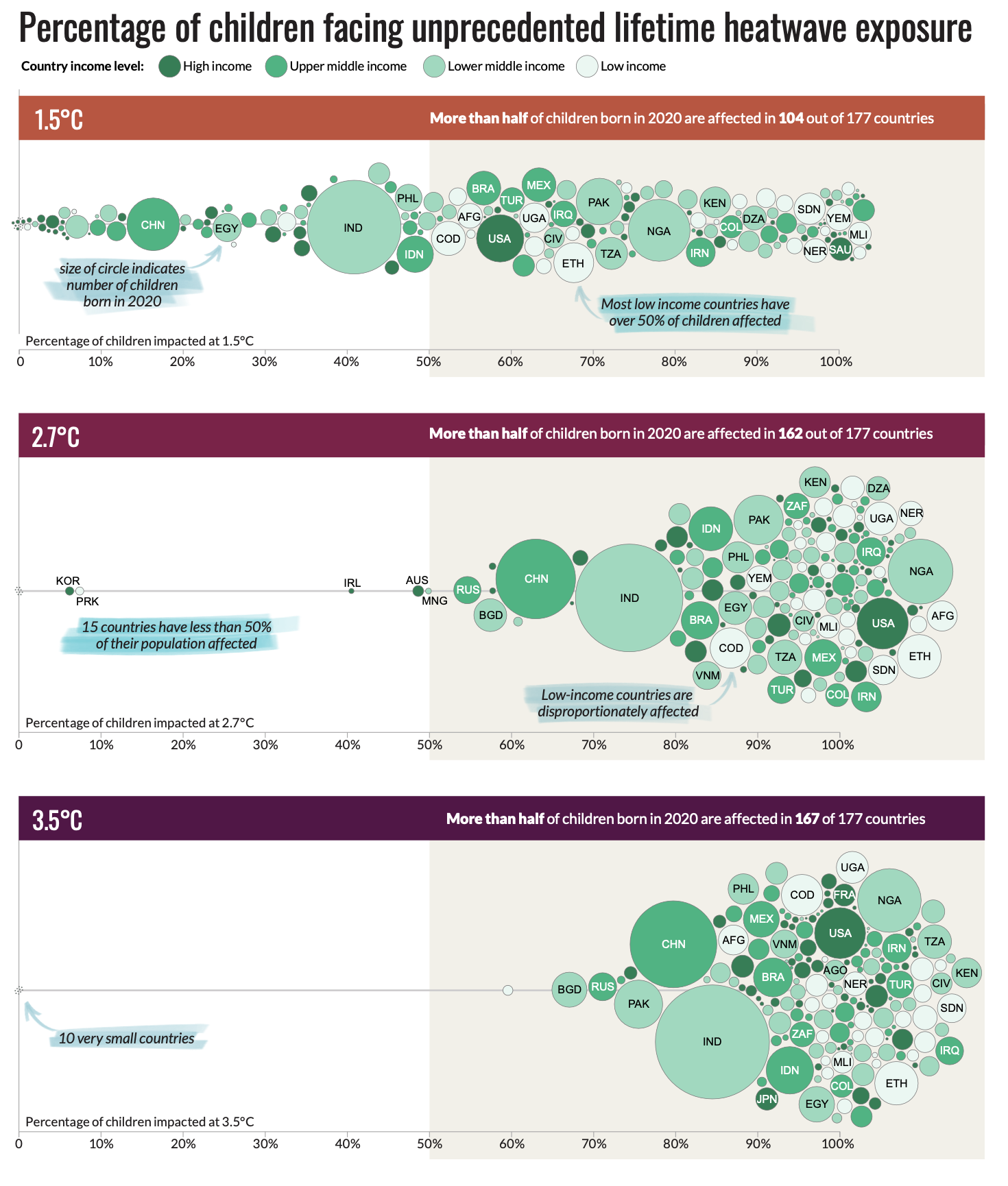
The charity Save the Children has published a report which unpacks the findings of the study. The graphic below, from the report, shows the percentage of people from different countries born in 2020 who will face unprecedented lifetime exposure to heatwaves under the 1.5C (top), 2.5C (middle) and 3.5C (bottom) warming scenarios.
Each circle shows a country, indicated by its three-letter countries code. The size of the circle indicates the number of people in the country. Darker circles indicate higher-income countries.
Circles on the right hand side of the graphic indicate that more than half of the country’s 2020 cohort will be exposed to unprecedented heatwaves in their lifetime.
The percentage of people born in 2020 who will face unprecedented lifetime exposure to heatwaves under the 1.5C (top), 2.5C (middle) and 3.5C (bottom) warming scenarios. Each circle indicates a country, indicated by its three-letter countries code. The size of the circle indicates the number of people in the country. Darker circles indicate higher-income countries. Source: Save the Children
“The evidence is now inescapable that heatwaves impact every community around the world,” Dr Luke Harrington, a senior lecturer in environmental science at the University of Waikato, who was not involved in the study, tells Carbon Brief. He adds:
“This paper offers the clearest view that climate change is verifiably unfair: those who have done the least to contribute to rising global temperatures will experience the most extreme impacts.”
From floods to fires
The authors apply the same method to five other climate extremes – crop failure, wildfires, droughts, floods and tropical cyclones.
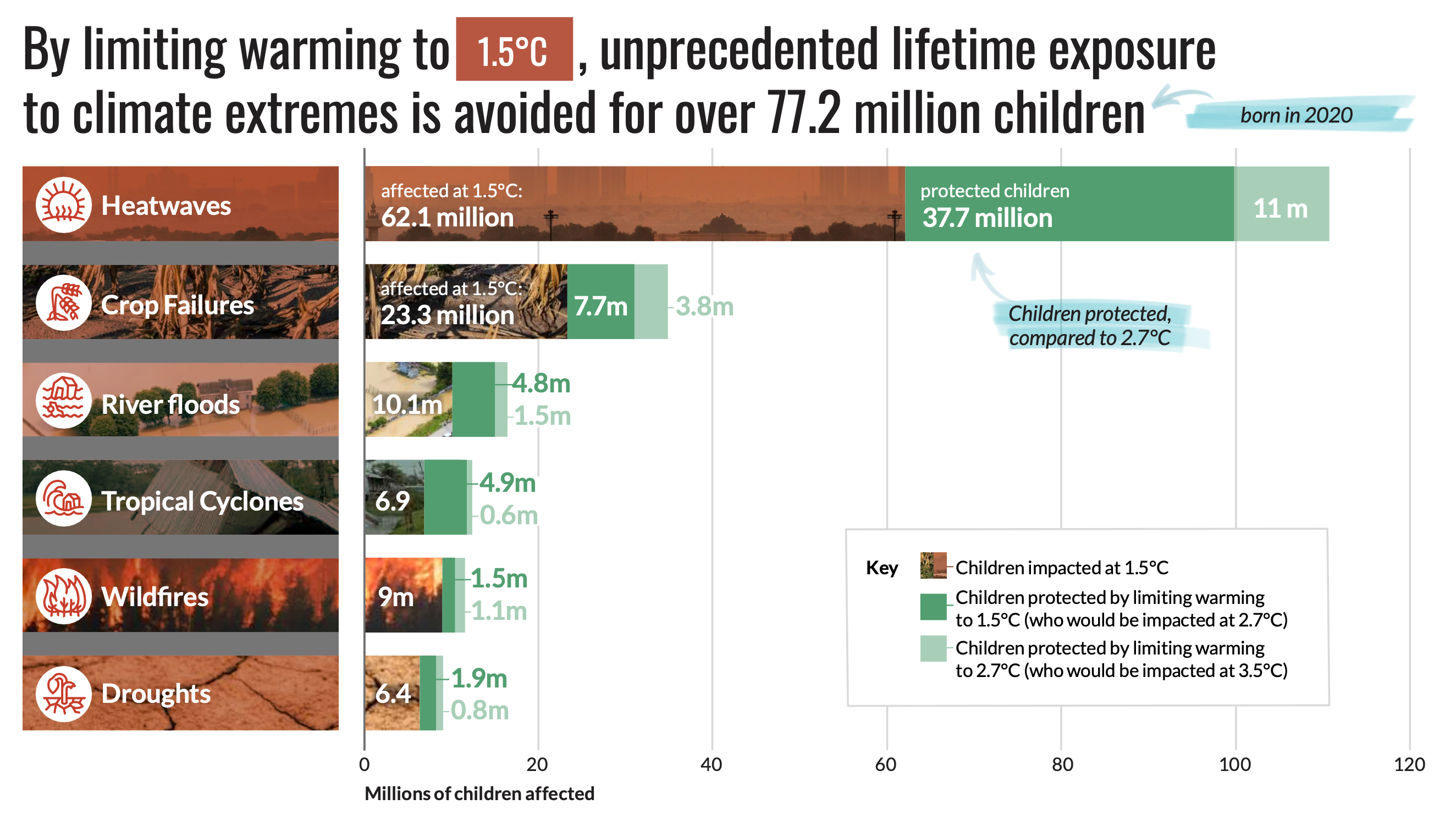
The graphic below shows the key findings. The coloured portion of the bar shows the number of people born in 2020 who will face unprecedented exposure to each extreme under a 1.5C warming pathway. The dark green and light green bars show the additional exposure under 2.7C and 3.5C warming.
Number of people born in 2020 who will face “unprecedented lifetime exposure” to heatwaves, crop failures, river floods, tropical cyclones, wildfires and droughts under 1.5C 2.7C and 3.5C warming. Source: Save the Children
The authors find that unprecedented lifetime exposure to heatwaves will affect the most people, with 62 million people born in 2020 likely to face unprecedented exposure to heat in their lifetimes if warming is limited to 1.5C.
This is followed by crop failures and river floods, which will impact 23 million and 10 million people from the 2020 birth cohort under the 1.5C warming pathway, respectively.
Lead author Grant tells Carbon Brief that he is “most confident” about his heatwave findings because temperature is a “basic” metric for climate models to “get right”.
Meanwhile, extremes such as crop failure depend on a range of factors including soil moisture, land-atmosphere interactions and rainfall, which can make it harder for the models to accurately capture changes, Grant explains.
Vulnerability
The authors also assess how “socioeconomic vulnerability” affects their findings using a global deprivation index – a tool which measures the level of disadvantage and hardship experienced by individuals or communities in a particular geographic area.
The authors use the index to identify the 20% most and least vulnerable people in each age cohort. They find that the most vulnerable groups are overwhelmingly from African countries.
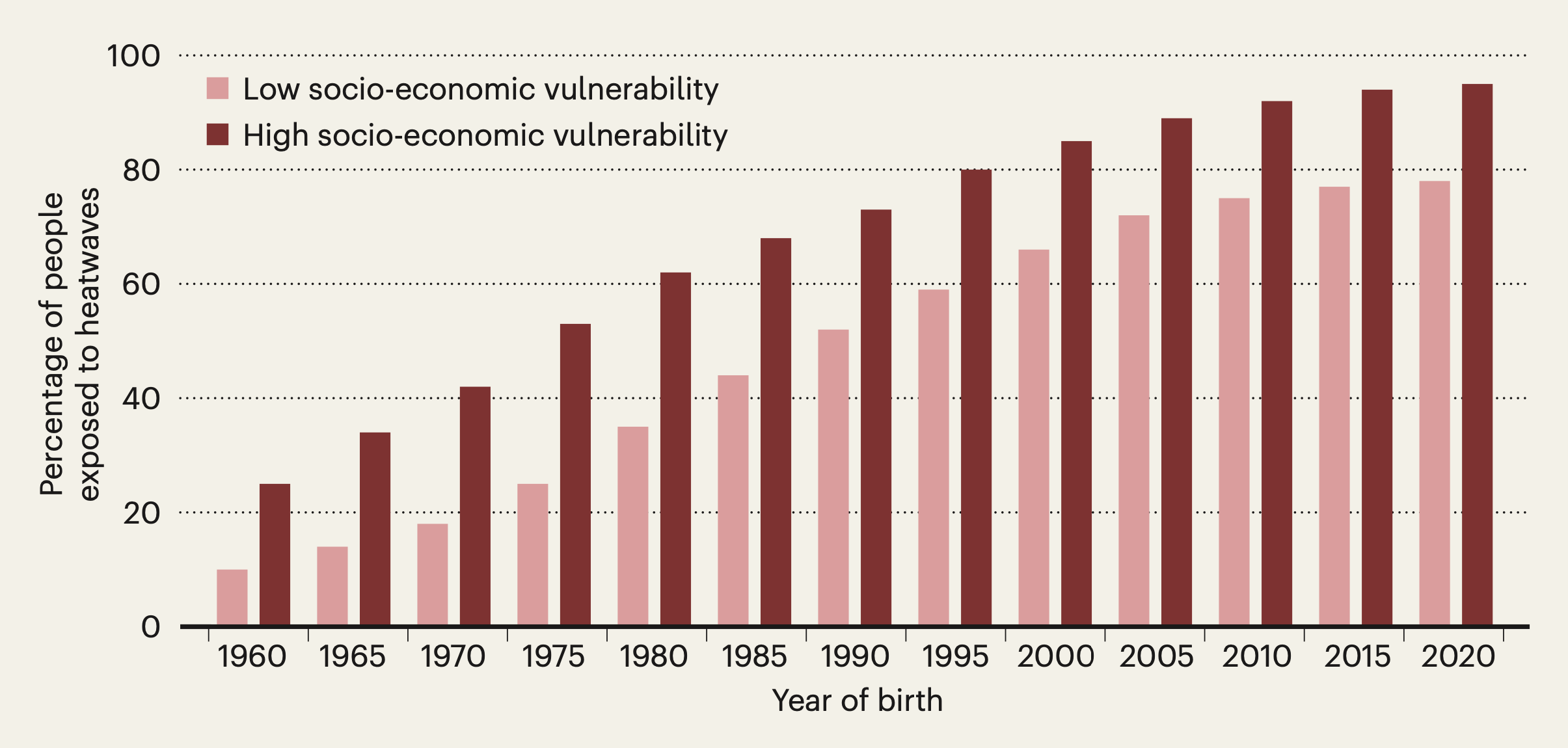
The authors also conclude that “socioeconomically vulnerable people have a consistently higher chance of facing unprecedented lifetime heatwave exposure compared to the least vulnerable members of their generation”.
The graph below, taken from a news and views article about the study, shows the percentage of high vulnerability (red) and low vulnerability (pink) people in each age cohort who would be exposed to unprecedented heat, under a 2.7C warming scenario.
The percentage of high vulnerability (red) and low vulnerability (pink) people in each age cohort who would be exposed to unprecedented heat, under a 2.7C warming scenario. Source: Gualdi and Muttarak (2025).
Dr Marina Romanello, a research fellow at the University College London and research director of the Lancet Countdown on Health and Climate Change who was not involved in the study, tells Carbon Brief that the paper “is an important addition to the scientific literature, showing how our delays in tackling climate change are putting the future of our children at risk”.
She adds:
“The authors have used well-established models to project future health threats, framing them around what matters the most: the wellbeing, health and survival of present and future generations.”
Grant, L. et al. (2025) Global emergence of unprecedented lifetime exposure to climate extremes, Nature, doi:10.1038/s41586-025-08907-1
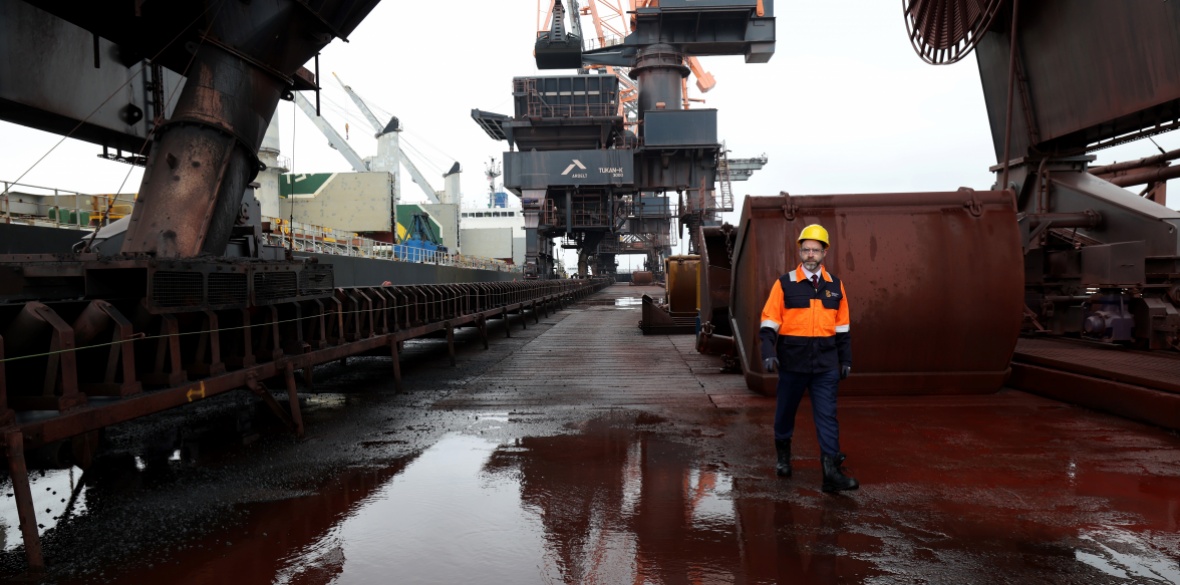
Business Secretary Jonathan Reynolds arrives as coking coal is unloaded at Immingham Port, northern England, as he visits the site in Lincolnshire to view raw materials destined for British Steel at Scunthorpe, being off-loaded, April 15, 2025
THE CRISIS at Scunthorpe steelworks, rightly if belatedly being addressed in the immediate term by state intervention, is the consequence of privatising critical national infrastructure so decisions on its future rest on the profit-and-loss calculations of private companies.
Right-wing media and parliamentarians, who are pro-privatisation and pro-war, want to avoid this conclusion. So we are seeing a propaganda campaign to blame it on other causes, each of which advances the right’s agenda.
One is that it is the result of pursuing “net zero” policies aimed at reducing greenhouse gas emissions. In fact, a planned and publicly directed green transition is essential to Britain’s industrial future: it is leaving it to the market which places jobs and industry at risk.
Turning our backs on the climate crisis cannot be an option as extreme weather events and crop failures grow more serious with each passing year. Labour should face pressure not to drop its already much reduced climate commitments, but to invest in measures that directly help people — restoring its original ambitious plans to insulate 19 million homes in a decade, cutting emissions and lowering household energy bills, for example — to stop the climate-denialist right claiming green policies lower living standards.
The other is to turn Jingye’s record at British Steel into a “security risk” because the company is Chinese, scaremongering over other Chinese investments in Britain and calling for trade decoupling in line with the new cold war being pushed from Washington.
Here, socialists must take a clear position that distinguishes our opposition to any company not accountable to the British people controlling assets of strategic importance from a China-bashing narrative that raises international tensions and risks advancing the US-led war drive.
That doesn’t mean defending the behaviour of a firm like Jingye, which seemed designed to force the closure of the Scunthorpe blast furnaces and whose negotiations with government involved demanding huge sums of money while offering little in return.
But it does mean identifying the parallels between its conduct and, say, that of the Indian conglomerate Tata, which has also taken hundreds of millions in public money while refusing to save the blast furnaces at Port Talbot, a move set to cost thousands of jobs. The common factor is not the country of origin, but the lack of democratic accountability of companies not owned by the British public.