Original article by Stephen Prager republished from Common Dreams under Creative Commons (CC BY-NC-ND 3.0).
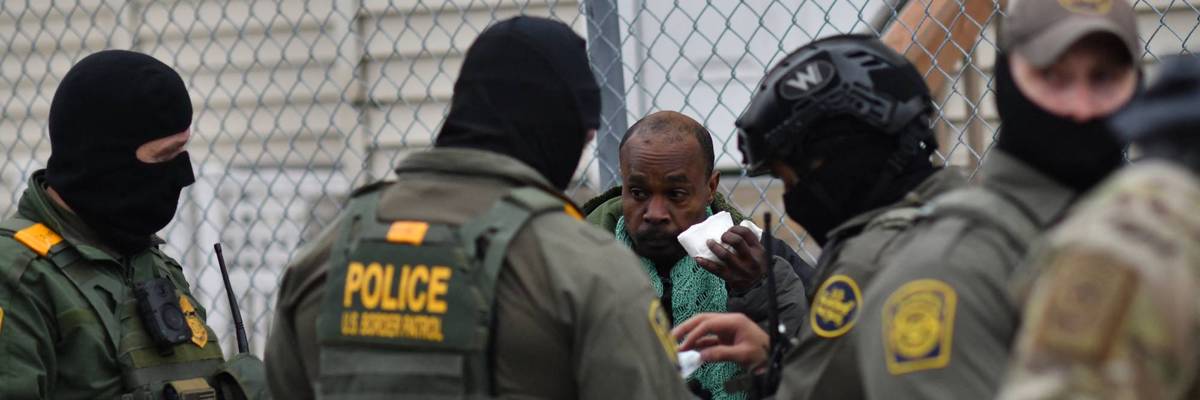
A new database of sworn affidavits filed by the ACLU shows masked agents detaining citizens based on race without warrants, ignoring IDs, and pointing weapons at them.
Federal agents deployed to Minnesota by the Trump administration are systematically violating the rights of US citizens and lawful residents, according to more than two dozen sworn affidavits made available this week as part of a class action lawsuit against the Department of Homeland Security.
The suit was filed last month by the ACLU of Minnesota and partnered law firms, which said that as part of President Donald Trump’s Operation Metro Surge, “masked federal agents in the thousands are violently stopping and arresting countless Minnesotans based on nothing more than their race and perceived ethnicity, irrespective of their citizenship or immigration status, or their personal circumstances.”
RECOMMENDED…
Trump Vows ‘Reckoning and Retribution is Coming’ to Minnesota as ICE Brutality Mounts
Trump’s DHS Sued to End Lawless Stops and Arrests in Minnesota
The case was launched by three plaintiffs, which include 20-year-old Mubashir Khalif Hussein, a Somali-born US citizen whose brutal arrest and detention was caught on video in December. He was placed into a headlock by masked agents and brought to an ICE office, where he said he was left in shackles for an hour and a half before being released miles from his home in the freezing cold.
The plaintiffs called it just one example of a “startling pattern of abuse spearheaded by the Department of Homeland Security (DHS) that is fundamentally altering civic life in the Twin Cities and the state of Minnesota.”
On Thursday, the online legal policy journal Just Security published a searchable database of the 29 sworn declarations filed so far as part of the case. Nearly all of them were filed by US citizens, while a few others were permanent legal residents or had pending legal status.
The statements detail numerous allegations that agents violated their basic constitutional rights, including by detaining them without showing a warrant; targeting Somali and Latino individuals based on their appearances; ignoring identifying documents that could prove their legal residency or citizenship; restraining them violently; and pointing weapons at them during searches.
Last year, the Supreme Court sided with the Trump administration’s claim that when deciding whether to stop someone as part of “roving patrols,” agents had the right to consider certain factors, including “the type of work one does,” a person’s use of Spanish or accented English, or their “apparent race or ethnicity.”
While critics described it as an invitation to blatant and unconstitutional racial profiling and invasions of privacy, Justice Brett Kavanaugh wrote in a concurring opinion that the practice should not prove burdensome to those legally in the US: “If the person is a US citizen or otherwise lawfully in the United States, that individual will be free to go after the brief encounter,” he said.
Ryan Goodman, a law professor at New York University and the co-editor-in-chief of Just Security,said that the “sworn affidavits show how, on the ground, this is simply not how ICE operates.”
“They did not identify themselves, and they did not present a warrant. They just opened my car door and started yanking me out of the car. I kept saying over and over that I was a US citizen.”
One 33-year-old Latino citizen who was born in the US was driving to Menards on January 10 when he suddenly found himself boxed in by two cars at a stoplight. Before he knew it, he said agents were banging aggressively on his windows and one had started pointing a gun at him. When he put his vehicle in park, he said the doors opened automatically.
“When the doors unlocked, the agents did not ask me anything, they did not identify themselves, and they did not present a warrant. They just opened my car door and started yanking me out of the car,” he said. “I kept saying over and over that I was a US citizen.”
“Once they did get my seatbelt off and finally [pulled] me out of the car, they threw me to the ground and pinned me,” he continued. “They were pulling on my arms so tight to put on the handcuffs. They ripped my jacket, and it was torn up. My wallet fell on the ground. I was still repeating that I am a US citizen. I repeated it over and over. They never asked for or looked at my identification.”
The agents hauled the man into their car and began driving him around and interrogating him for about 20 minutes. He said the first question they asked him was his name.
“It seemed if they were going to violently arrest me before even looking at my identification, that they should have known who I was,” the victim said.
Agents eventually realized they’d been searching for another person with the same name and birthdate. They drove their captive behind a warehouse, where nobody could see, and released him. But another agent had taken his car from the intersection. An agent said he’d only give it back if the agent could scan his face, which he did.
“I felt traumatized. My arm hurt, I had bruises from the handcuffs. They were so tight that half of my hand was numb for a few days. I guess it stopped the circulation to my hands while I was handcuffed. I had cuts on my face and hands,” the victim said. “Since this happened to me, I have to pass through that spot every time I drive to work. I keep going back to it and reliving it in my mind.”
According to the database, at least five other US citizens, lawful residents, or legal asylum seekers also claimed in court that they’d had weapons pointed at them by agents during their stops.
Two other US citizens and one lawful permanent resident detailed being subject to physical force during stops.
One 53-year-old Somali man, a US citizen since 2008, said he was physically grabbed and dragged from his car, handcuffed, and pinned against the vehicle by masked agents.
“One officer pressed his knee into my back,” he said. When I screamed out in pain, another officer put his elbow into my neck, and one of the officers yelled at me, ‘Shut the fuck up, son of a bitch!’ One of the officers responded, ‘Why don’t you go back to your country?’“
“I believe that I was stopped solely because of the color of my skin and our appearance, including wearing a hijab.”
One 22-year-old Somali-American citizen who was born in Minnesota said that on January 21, five agents hopped out of their car with multiple guns drawn as she was on her way to work.
She said they demanded to see proof of her citizenship, but rejected her valid ID, claiming it was fake. They demanded to see her passport, which US citizens are not required to carry under US law. The agents told her they did not believe she was a US citizen because of her “accent.”
“I believe that I was stopped solely because of the color of my skin and our appearance, including wearing a hijab,” she said. “It was clear that the ICE agents did not know who I was when they stopped me. I had not violated any traffic laws, and the vehicle I was driving was registered to my mother, who is a United States citizen.”
It’s one of at least five cases in the database in which agents dismissed proof of a citizen or legal resident’s status.
There have also been many other documented instances, including some caught on video, in which agents have detained a citizen or legal resident or refused to let them go because they believed the person’s “accent” did not sound American.
All 29 of those who filed affidavits in the case have alleged unconstitutional racial profiling.
One 25-year-old Somali man, a US citizen born in Atlanta, said a group of masked agents accosted him and his mother while he was shoveling snow.
He said they were joined by a pair of unmasked men who appeared to be livestreaming and helped the agents to box him in. He later identified one of them as a right-wing YouTube influencer named Ben Bergquam.
Even though the vast majority of Somalis living in the US are citizens, he said the agents and the streamers were laughing and referring to him and his mother as “illegal aliens.”
“I was unsure if I was going to be seriously injured or killed.”
At least 12 people in the lawsuit have filed sworn testimony stating that agents forced them to stop while they were driving.
In one case, a Hispanic US citizen said that after following him for a few blocks, agents put on their lights and “rammed” his car off the road.
“An agent came up to my window, asking if I was a citizen. I was furious. I told them I was a citizen and they damaged my car,” he said. “Instead of apologizing, they demanded that I produce documents to prove I was a US citizen. I was too angry. I told them again that I was a US citizen and I didn’t have to prove it to them.”
He said the episode lasted 45-60 minutes, with agents repeatedly demanding his ID, name, and place of birth. Eventually, he says, they confirmed his citizenship by taking photos and videos of him and scanning his license plate.
He said agents told him they would pay for the damages to his car, but that they drove away without providing any insurance information.
“Even though I am a United States citizen and I was carrying proof of my citizenship with me, ICE agents didn’t believe me,” he said. “I felt intense fear and shock. I was unsure if I was going to be seriously injured or killed.”
The affidavits were filed as part of the case Hussen v. Noem, which claims that agents have violated Minnesotans’ rights to equal protection and against unreasonable searches and seizures. A hearing is scheduled to take place later this month.
“The government can’t stop and arrest people based on the color of their skin, or arrest people with no probable cause,” said Kate Huddleston, senior staff attorney with the ACLU’s Immigrants’ Rights Project. “These kinds of police-state tactics are contrary to the basic principles of liberty and equality that remain a bedrock of our legal system and our country.”
Original article by Stephen Prager republished from Common Dreams under Creative Commons (CC BY-NC-ND 3.0).