Amid Soaring Temps, Heat-Related Deaths Have More Than Doubled Since 1999

Spread the love

Original article by Jessica Corbett republished from Common Dreams under a CC licence.
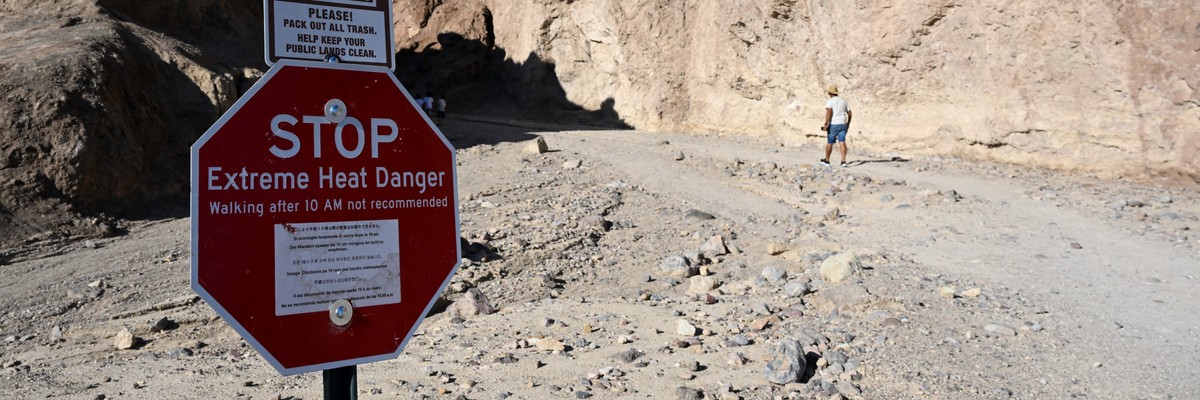
A sign says, “Stop: Extreme Heat Danger,” at the Golden Canyon Trailhead in Death Valley, California on July 9, 2023.
 (Photo: Tayfun Coskun/Anadolu Agency via Getty Images)

“It is likely that continued increases in average temperatures, the number of ‘hot days,’ and the frequency and intensity of heatwaves could be playing a role,” said one researcher.

As 55 million people in the U.S. Midwest faced heat alerts on Monday, research published in the peer-reviewed Journal of the American Medical Association showed that heat-related deaths in the country rose 117% between 1999 and 2023.

“The current trajectory that we’re on, in terms of warming and the change in the climate, is starting to actually show up in increased deaths,” lead author Jeffrey Howard, an associate professor of public health at the University of Texas at San Antonio, told USA Today. “That’s something that we hadn’t had measured before.”

Using a U.S. Centers for Disease Control and Prevention platform, Howard and co-authors from Pennsylvania State University and the Uniformed Services University of the Health Sciences analyzed all deaths from those 25 years coded for “hyperthermia of newborn,” “effects of heat and light,” or “exposure to excessive natural heat” as either a contributing or underlying cause of death.

They found 21,518 deaths for the full period, with 1,069 in 1999. The lowest annual figure was in 2004 (311) and the highest was in 2023 (2,325). Last year was the hottest on record globally and scientists are already warning that this year is expected to continue that trend.

“As temperatures continue to rise because of climate change, the recent increasing trend is likely to continue.”

Last year broke the record that was set in 2016—a year that’s also significant in the new study: “The number of heat-related deaths… showed year-to-year variability, with spikes in 2006 and 2011, before showing steady increases after 2016.”

Howard told CBS News that “it is likely that continued increases in average temperatures, the number of ‘hot days,’ and the frequency and intensity of heatwaves could be playing a role” in the rise since 2016.

“There is also a social and behavioral component as well,” he added, “including differences in access to air conditioning, outdoor work, the number of unhoused individuals, and things like that.”

The researcher noted that Arizona, California, Nevada, and Texas had the highest heat-related deaths—which he said is “not terribly surprising because we know that these are some of the hottest regions in the country, but it does reinforce that the risk varies regionally.”

The paper warns that “as temperatures continue to rise because of climate change, the recent increasing trend is likely to continue. Local authorities in high-risk areas should consider investing in the expansion of access to hydration centers and public cooling centers or other buildings with air conditioning.”

The authors also acknowledged limitations of their research—including “the potential for misclassification of causes of death, leading to possible underestimation of heat-related mortality rates; potential bias from increasing awareness over time; and lack of data for vulnerable subgroups”—meaning the true death toll could be higher.

A legal memo published in June by the watchdog Public Citizen detailed how local or state prosecutors could bring criminal charges against oil and gas companies for deaths from extreme heat made more likely by the fossil fuel-driven climate emergency.

“These victims deserve justice no less than the victims of street-level homicides,” said Aaron Regunberg, senior policy counsel for the group. “And this memo shows that prosecutors have a path to secure that justice, if they choose to pursue it.”

Original article by Jessica Corbett republished from Common Dreams under a CC licence.

Continue ReadingAmid Soaring Temps, Heat-Related Deaths Have More Than Doubled Since 1999

Fossil Fuel Industry Propaganda Blamed as Record Heat Scorches Planet

Spread the love

Original article by JESSICA CORBETT republished from Common Dreams under Creative Commons (CC BY-NC-ND 3.0). 

Civilians flee a forest fire that broke out close to residential areas at Cesmealti in Urla district of Izmir, Turkey on July 31, 2024. (Photo: Mahmut Serdar Alakus/Anadolu via Getty Images)

“We need to tackle the root cause and get serious about reducing record levels of greenhouse gas emissions,” said the head of the World Meteorological Organization.

As scientists around the world on Thursday released new data about recent record-smashing heat, one United Nations adviser placed blame for the lack of ambitious climate action on the fossil fuel industry’s decadeslong disinformation efforts.

“There is this prevailing narrative—and a lot of it is being pushed by the fossil fuel industry and their enablers—that climate action is too difficult, it’s too expensive,” Selwin Hart, a special adviser to the U.N. Secretary-General António Guterres and assistant secretary-general of the Climate Action Team, told The Guardian‘s Fiona Harvey.

“It is absolutely critical that leaders, and all of us, push back and explain to people the value of climate action, but also the consequences of climate inaction,” said Hart, former executive director of the Caribbean at the Inter-American Development Bank and Barbados’ ambassador to the United States and the Organization of American States.

Investigations by academicsjournalists, and lawmakers as well as ongoing legal battles have exposed how Big Oil not only has heated and polluted the planet but also knew about the devastating impacts of fossil fuels decades ago and opted to spread lies so shareholders could make massive profits—which they continue to rake in today.

“Climate appears to be dropping down the list of priorities of leaders,” Hart said, pointing to polling that shows people around the world want a rapid transition to clean energy. “But we really need leaders now to deliver maximum ambition. And we need maximum cooperation. Unfortunately, we are not seeing that at the moment.”

According to The Guardian:

[Hart] warned that the consequences of inaction were being felt in rich countries as well as poor. In the U.S., many thousands of people are finding it increasingly impossible to insure their homes, as extreme weather worsens. “This is directly due to the climate crisis, and directly due to the use of fossil fuels,” he said. “Ordinary people are having to pay the price of a climate crisis while the fossil fuel industry continues to reap excess profits and still receives massive government subsidies.”

Yet the world has never been better equipped to tackle climate breakdown, Hart added. “Renewables are the cheapest they’ve ever been, the pace of the energy transition is accelerating,” he said.

Hart’s comments came as the European Union’s Copernicus Climate Change Service (C3S) announced that last month “was the second-warmest July globally in our data record, with an average ERA5 surface air temperature of 16.91ºC,” or 62.44ºF.

From June 2023 to June 2024, each month was the hottest on record, according to C3S. Samantha Burgess, the agency’s deputy director, noted that now, “the streak of record-breaking months has come to an end, but only by a whisker.”

“Globally, July 2024 was almost as warm as July 2023, the hottest month on record,” Burgess stressed. “July 2024 saw the two hottest days on record. The overall context hasn’t changed, our climate continues to warm. The devastating effects of climate change started well before 2023 and will continue until global greenhouse gas emissions reach net-zero.”

The U.N.’s World Meteorological Organization (WMO) said Thursday that the new C3S data “underlines the urgency of the Call to Action on Extreme Heat” issued by Guterres last month, shortly after July 22 became the hottest day ever recorded.

“Widespread, intense, and extended heatwaves have hit every continent in the past year,” said WMO Secretary-General Celeste Saulo in a statement. “At least 10 countries have recorded daily temperatures of more than 50ºC in more than one location. This is becoming too hot to handle.”

Saulo highlighted that “Death Valley in California registered a record average monthly temperature of 42.5ºC (108.5ºF)—possibly a new record observed for anywhere in the world. Even the remote frozen ice sheets of Antarctica have been feeling the heat.”

“The WMO community is committed to responding to the U.N. secretary-general’s Call to Action with better heat-health early warnings and action plans,” she pledged. “Recent estimates produced by WMO and the World Health Organization indicate that the global scale-up of heat-health warning systems for 57 countries alone has the potential to save an estimated 98,000 lives per year. This is one of the priorities of the Early Warnings for All initiative.”

“Climate adaptation alone is not enough,” she added. “We need to tackle the root cause and get serious about reducing record levels of greenhouse gas emissions.”

C3S wasn’t alone in releasing new data on Thursday; the U.S. National Oceanic and Atmospheric Administration (NOAA) also shared some key points for the country’s climate in July, with the full report set to be released on Tuesday.

NOAA’s top takeaways were:

  • The average temperature of the contiguous U.S. in July was 75.7ºF, 2.1ºF above average, ranking 11th warmest in the 130-year record.
  • The Park Fire is the fourth-largest wildfire in California history as of August 6; beginning on July 24, it burned approximately 401,000 acres and destroyed over 560 structures.
  • On July 15, a derecho that spawned 32 tornadoes broke the Chicago-area record for most tornadoes in a day.
  • On July 1, Beryl became the earliest Category 5 hurricane and the second Category 5 on record during the month of July in the Atlantic Ocean.
  • Alaska had its wettest July on record.
  • Four new billion-dollar weather and climate disasters were confirmed in July. The year-to-date total currently stands at 19 disasters.

Other major events in July included California’s Thompson Fire, which forced over 13,000 people to evacuate, and Washington, D.C. enduring 101ºF on July 17, tying a record for the longest streak of temperatures above 100ºF. NOAA also found that “for the January-July period, the average contiguous U.S. temperature was 54.5ºF, 3.2ºF above average, ranking second-warmest on record.”

Original article by JESSICA CORBETT republished from Common Dreams under Creative Commons (CC BY-NC-ND 3.0). 

Continue ReadingFossil Fuel Industry Propaganda Blamed as Record Heat Scorches Planet