Bangladesh’s Supreme Court scraps most of government job quota amidst widespread protests and violence

Spread the love

Original article by Abdul Rahman republished from peoples dispatch under a Creative Commons Attribution-ShareAlike 4.0 (CC BY-SA) license.
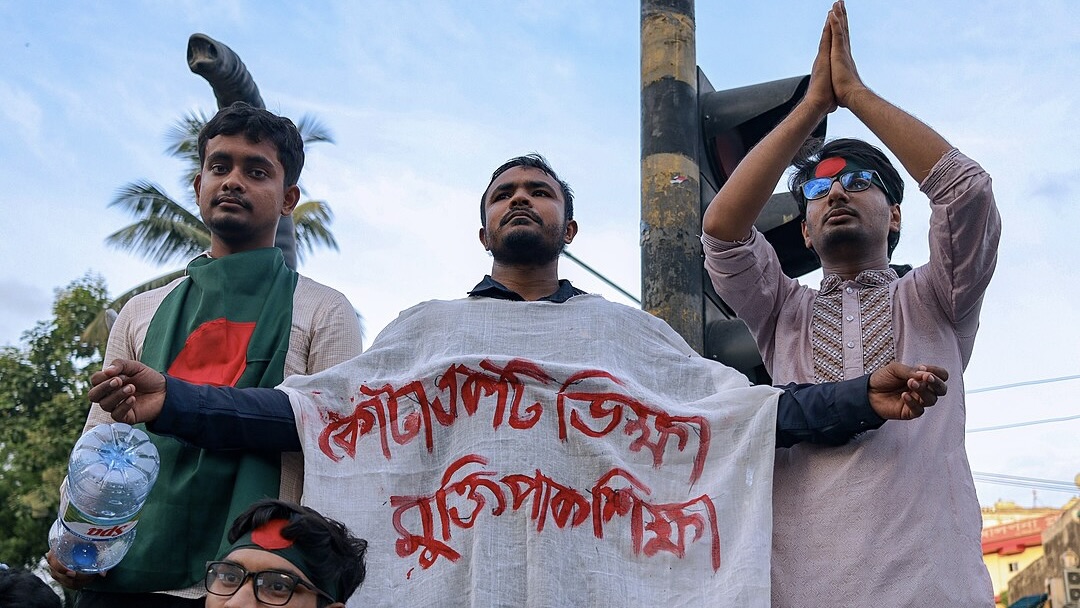
Quota reform protesters in Bangladesh. Photo: Rownak Shahriar Ruhan/ Wikimedia commons

Amidst widespread violence across the country over the controversial quota in government jobs, Bangladesh’s Supreme Court issued a crucial verdict on Sunday, July 21 scaling back the quotas drastically.

As per the verdict, 93% government jobs would be based on merit and the overall quota would be reduced to 7% from the current 56%. Descendants of ‘freedom fighters’ who currently have 30% of posts reserved for them would now only get 5% reservation. The remaining 2% of reserved jobs would be allotted to candidates belonging to sexual and ethnic minorities in the country and the physically disabled.

According to various reports, around 140 people, including a large number of students, were killed in the violent clashes last week between security forces and students who have been opposing the high quota. The protests remained by and large peaceful, until last Monday July 15 when they turned violent after an alleged attack carried out by pro-government students backed by the country’s security forces.

Most of the deaths have been reported from the capital Dhaka where protesters clashed with the security forces and attacked metro rail stations and even a jail in nearby Narsingdi. However, several other parts of the country were also affected by the violence.

Despite the Supreme Court judgment on Sunday, some of the student leaders declared they will continue their protests. According to an Al Jazeera report, protesters are now demanding the resignation of home minister Asaduzzaman Khan, holding him responsible for the violence and killing of people. They are also demanding release of all people arrested during last week’s protests. Some others have called the Supreme Court verdict vague and wanted more clarity on it before calling off the protests, Reuters reported.

The ruling Awami League has however stated that the otherwise “legitimate protests” by students have been “hijacked” by the opposition Bangladesh Nationalist Party (BNP) and some extremist groups in the country. It alleged that those opposition parties who could not win through popular elections have been looking for an opportunity to destabilize the Hasina government which won its fourth consecutive term earlier this year in January. BNP had boycotted the elections.

Following the Supreme Court judgment Attorney General A. M. Amin Uddin expressed hope that “normalcy will return” and “people with ulterior motives will stop instigating people,” Reuters reported.

Violent escalation

On Tuesday, a day after the violence broke out, the government led by Sheikh Hasina of the Awami League ordered shutting down of all universities, colleges, and high schools in the country for an indefinite period.

Later on Friday, the government called in the army and imposed a curfew with shoot-on-sight orders following the spread of violence all across the country. Internet and other communication services were also suspended.

In the meanwhile, protesters rejected the government’s offer of talks regarding their demands and continued to mobilize large-scale demonstrations against the quota system.

The government in response had called on protesters to wait for the Supreme Court judgment before further steps could be taken to address their concerns.

Protesters alleged that the government was reluctant to ban the quota as it benefited the members of the ruling party and its supporters. However, the government had argued that the quota was an acknowledgment of the sacrifices made by people during the freedom struggle.

Quota controversy

The Awami League was at the forefront of Bangladesh’s war of liberation in 1971 against Pakistan in which hundreds of thousands of people were killed by Pakistan’s army and local collaborators known as Razakars. The quota in government jobs was first constituted by Hasina’s father Sheikh Mujibur Rahman immediately after he became the first prime minister of independent Bangladesh as a way to recognize the sacrifices made by the people.

Due to rising unemployment among the country’s youth and crisis in the economy, these quotas became increasingly unpopular. After a student protest in 2018, the Hasina government issued a circular scrapping the quota system for recruitment to 1st and second class jobs. However, in June this year, a High Court order annulled the 2018 circular, thus making the quotas effective again. This verdict was what sparked the latest round of large scale student protests which turned violent last week. On Sunday, the Supreme Court called the High Court’s judgment illegal.

The verdict on Sunday however, also scrapped the 10% quota each for women and people from underdeveloped districts and the 5% quota for religious minorities in government jobs.

Progressive sections in the country including the Workers Party of Bangladesh (BWP) and the Communist Party of Bangladesh (CPB) had earlier demanded that these “progressive” quotas for women and minorities be protected and that a process be initiated to fulfill other legitimate demands of reforms.

Original article by Abdul Rahman republished from peoples dispatch under a Creative Commons Attribution-ShareAlike 4.0 (CC BY-SA) license.
Continue ReadingBangladesh’s Supreme Court scraps most of government job quota amidst widespread protests and violence

Youth Lead Global Strike Demanding ‘Climate Justice Now’

Spread the love

Original article by OLIVIA ROSANE republished from Common Dreams  under Creative Commons (CC BY-NC-ND 3.0).

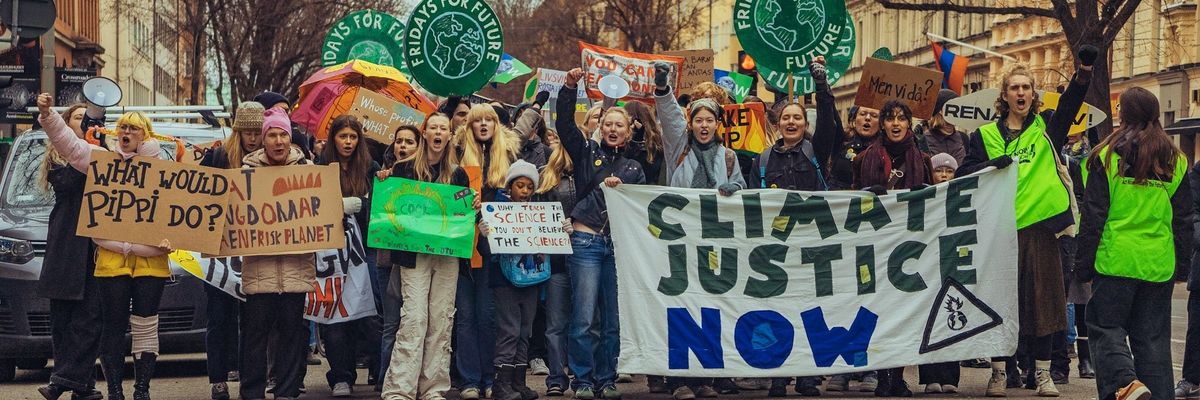
Climate strikers march in Stockholm, Sweden, on April 19, 2024.  (Photo: Albin Haglund via Greta Thunberg/X)

“We are many people and youths who want to express our frustration over what decision-makers are doing right now: They don’t care about our future and aren’t doing anything to stop the climate crisis,” one young activist said.

Ahead of Earth Day, young people around the world are participating in a global strike on Friday to demand “climate justice now.”

In Sweden, Greta Thunberg joined hundreds of other demonstrators for a march in Stockholm; in Kenya, participants demanded that their government join the Fossil Fuel Non-Proliferation Treaty; and in the U.S., youth activists are kicking off more than 200 Earth Day protests directed at pressing President Joe Biden to declare a climate emergency.

“We’re gathered here to fight, once again, for climate justice,” Thunberg told Agence France-Presse at the Stockholm protest, which drew around 500 people. “It’s now been more than five and a half years that we’ve been doing the same thing, organizing big global strikes for the climate and gathering people, youths from the entire world.”

“I lost my home to climate change. Now I’m fighting so that others don’t lose their homes.”

The first global youth climate strike, which grew out of Thunberg’s Fridays for Future school strikes, took place on March 15, 2019. Since then, both emissions and temperatures have continued to rise, with 2023 blowing past the record for hottest year. Yet, according to Climate Action Tracker, no country has policies in place that are compatible with limiting global heating to 1.5°C above preindustrial levels.

“We are many people and youths who want to express our frustration over what decision-makers are doing right now: They don’t care about our future and aren’t doing anything to stop the climate crisis,” Karla Alfaro Gripe, an 18-year-old participant at the Stockholm march, told AFP.

The global strikes are taking place under the umbrella of Friday’s for Future, which has three main demands: 1. limit temperature rise to 1.5°C, 2. ensure climate justice and equity, and 3. listen to the most accurate, up-to-date science.

“Fight with us for a world worth living in,” the group wrote on their website, next to a link inviting visitors to find actions in their countries.

Participants shared videos and images of their actions on social media.

European strikers also gathered in LondonDublin, and Madrid.

In Asia, Save Future Bangladesh founder Nayon Sorkar posted a video from the Meghna River on Bangladesh’s Bola Island, where erosion destroyed his family’s home when he was three years old.

“I lost my home to climate change,” Sorkar wrote. “Now I’m fighting so that others don’t lose their homes.”

Also in Bangladesh, larger crowds rallied in Dhaka, SylhetFeni, and Bandarban for climate action.

“Young climate activists in Bandarban demand a shift to renewable energy and away from fossil fuels,” said Sajjad Hossain, the divisional coordinator for Youthnet for Climate Justice Bangladesh. “We voiced urgency for sustainable energy strategies and climate justice. Let’s hold governments accountable for a just transition!”

In Kenya, young people struck specifically to demand that the government sign on to the Fossil Fuel Non-Proliferation Treaty.

“As a member of the Lake Victoria community, the importance of the treaty in our climate strikes cannot be overstated,” Rahmina Paullette, founder of Kisumu Environmental Champions and a coordinator for Fridays for Future Africa, said in a statement. “By advocating for its implementation, we address the triple threat of climate change, plastic pollution, and environmental injustice facing our nation.”

“Halting fossil fuel expansion not only safeguards crucial ecosystems but also combats the unjust impacts of environmental degradation, ensuring a more equitable and sustainable future for our community and the wider Kenyan society,” Paullette said.

In the U.S., Fridays for Future NYC planned for what they expected to be the largest New York City climate protest since September 2023’s March to End Fossil Fuels. The action will begin at Foley Square at 2:00 pm Eastern Time, at which point more than 1,000 students and organizers are expected to walk across the Brooklyn Bridge to rally in front of Borough Hall.

The strike “is part of a national escalation of youth-led actions in more than 200 cities and college campuses around the country, all calling on President Biden to listen to our generation and young voters, stop expanding fossil fuels, and declare a climate emergency that meaningfully addresses fossil fuels, creating millions of good paying union jobs, and preparing us for climate disasters in the process,” Fridays for Future NYC said in a statement.

The coalition behind the climate emergency drive, which also includes the Sunrise Movement, Fridays for Future USA, and Campus Climate Network, got encouraging news on Wednesday when Bloomberg reported that the White House had reopened internal discussions into potentially declaring a climate emergency.

“We’re staring down another summer of floods, fires, hurricanes, and extreme heat,” Sunrise executive director Aru Shiney-Ajay said in a statement. “Biden must do what right Republicans in Congress are unwilling to do: Stand up to oil and gas CEOs, create green union jobs, and prepare us for climate disasters. Biden must declare a climate emergency and use every tool at his disposal to tackle the climate crisis and prepare our communities to weather the storm. If Biden wants to be taken seriously by young people, he needs to deliver on climate change.”

The coalition is planning events leading up to Monday including dozens of Earth Day teach-ins beginning Friday to encourage members of Congress to pressure Biden on a climate emergency and Reclaim Earth Day mobilizations on more than 100 college and university campuses to demand that schools divest from and cut ties with the fossil fuel industry.

Original article by OLIVIA ROSANE republished from Common Dreams  under Creative Commons (CC BY-NC-ND 3.0).

Continue ReadingYouth Lead Global Strike Demanding ‘Climate Justice Now’