World Leaders Failed Us, But We Have the Power to End the Era of Fossil Fuels

Spread the love

Original article by RABBI JACOB SIEGEL republished from Common Dreams under Creative Commons (CC BY-NC-ND 3.0). 
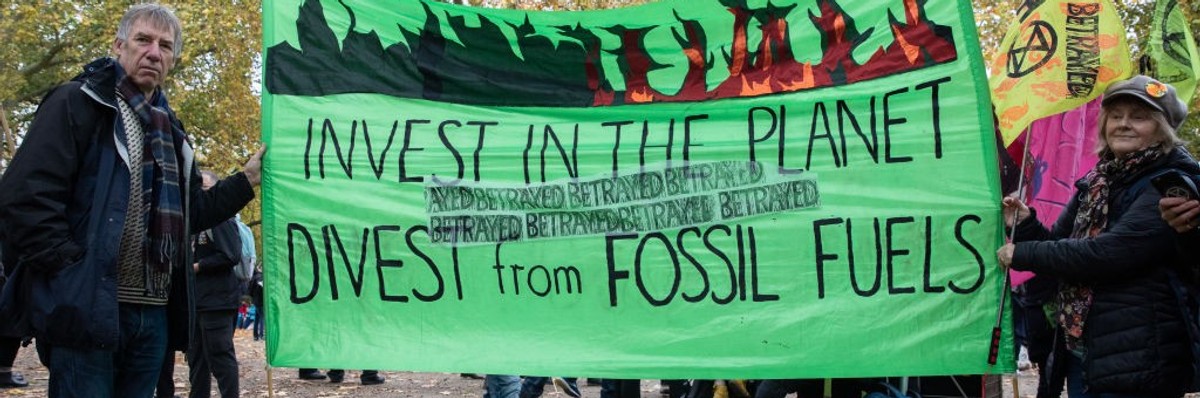
Extinction Rebellion climate activists hold a banner in Lincoln’s Inn Fields before a march on November 13, 2021 in London, United Kingdom.  (Photo by Mark Kerrison/In Pictures via Getty Images)

Over 1,600 institutions, including hundreds of faith-based organizations, have now joined the fight to move money away from polluting fossil fuels and toward clean energy solutions—yours should be next.

Last month saw an historic, albeit altogether insufficient, step forward to avoid climate catastrophe.

At the annual global UN-backed climate change conference in Dubai, known as COP28, countries for the first time unanimously acknowledged the necessity of “transitioning away from fossil fuels”: coal, oil, and gas. While short of an endorsement of a full fossil fuel phaseout—what scientists tell us is needed to avert the worst impacts of the climate crisis—it is a milestone, decades in the making.

Yet even this tepid sign of progress faced pushback from fossil fuel executives and the politicians who do their bidding.

The story of COP28 is one of the power and perniciousness of the fossil fuel industry. The CEO of the United Arab Emirates’ oil company (the 12th largest in the world) served as conference chair, and industry lobbyists outnumbered delegates from nearly every country. The final text is full of industry-friendly loopholes, giving fossil fuel corporations leeway to continue to profit off dirty energy.

Trying to address the climate crisis while expanding drilling, mining, and fracking operations is like offering chemotherapy to a lung cancer patient while handing them pack after pack of Marlboro Reds.

It’s clear we are at the end of the fossil fuel era. Solar and wind energy are the cheapest forms of energy to build.

Like tobacco companies before them, fossil fuel corporations have known for years (with shocking accuracy) about the science: their products, when used as directed, would harm the health of the planet and cause widespread devastation. But the industry has time and again blocked significant action or sought to delay it through false promises. They did so again at COP28.

As the future is at stake, it falls to the rest of us to take urgent action. Indeed, civil society institutions are not waiting. Last week marked a major achievement: 1600 institutions across the world representing more than $40 trillion (with a “T”) have now pledged to move money away from fossil fuels and toward clean energy.

Finance represents a critical lever for climate action. Fossil fuel corporations rely on an open spigot of funds – project finance through underwriting and loans from major banks, plus investment capital and approval for continued fossil fuel expansion from investors, including the world’s largest firms, BlackRock and Vanguard.

When investors move their money en masse, fossil fuel corporations face reputational and brand risk that can have knock-on effects, including lower credit ratings and challenges with securing financing for projects and operations. Crucially, doing so also erodes fossil fuel corporations’ social license to expand their operations.

The 1600 institutions that have committed to move their money include groups like the National Academy of Medicine, because profiting from burning fossil fuels violates the medical ethic of “first, do no harm.” They include universities like Brandeis, rooted in Jewish history, experience, and values, whose students and administration recognize the climate crisis as an existential threat to their future.

It’s clear we are at the end of the fossil fuel era. Solar and wind energy are the cheapest forms of energy to build. The market itself is acting on this imperative. Fossil fuels as a sector have performed worse financially over the past decade than the rest of the market. Over the last 30 years, they have shrunk from a quarter of the market to around 5%. According to a recent report, six public pensions could be $21 billion richer if they had ditched investments in coal, oil, and gas a decade ago.

As the future is at stake, it falls to the rest of us to take urgent action.

Faith-based institutions, representing more than a third of the commitments, are at the forefront of this movement for change. As Pope Francis has encouraged, we “must listen to science and institute a rapid and equitable transition to end the era of fossil fuel.”

One year ago, my organization, Dayenu: A Jewish Call to Climate Action, released a report about the investment capital of major Jewish institutions. The report found that these institutions had a substantial opportunity to move more than $3 billion in capital out of fossil fuels and into clean energy, and offered a roadmap to achieve this goal. Since last year, the climate crisis has grown more urgent, and so has the power of our faith and moral voice.

Faith groups are leading. They are making prudent, long-term decisions that will protect their communities. Join us before it is too late.

Original article by RABBI JACOB SIEGEL republished from Common Dreams under Creative Commons (CC BY-NC-ND 3.0). 

Continue ReadingWorld Leaders Failed Us, But We Have the Power to End the Era of Fossil Fuels

Cambridge University reportedly could drop Barclays in favour of greener bank

Spread the love
Emmanuel College Canterbury University. Image by Cmglee, CC BY-SA 3.0 , via Wikimedia Commons

https://www.theguardian.com/education/2023/dec/16/cambridge-university-reportedly-could-drop-barclays-in-favour-of-greener-bank

UK lender is a major European funder of oil and gas projects and university has said it does not want to back fossil fuel expansion

Cambridge University could cut ties with Barclays after more than 200 years over the bank’s refusal to stop financing new oil and gas projects, according to the Financial Times.

It reported that Cambridge is looking for an institution with robust climate policies to manage “several hundred million pounds” in cash and money market funds – a mandate expected to cover more than £200m in assets and generate about £10m in fees a year.

The university said it was “exploring opportunities to find financial products that do not finance fossil fuel expansion” as part of its “net zero engagement strategy with the banking sector”.

Though Barclays has provided financing to the university for centuries, the bank was also the top European funder of fossil fuels between 2016 and 2022, according to a report by the Rainforest Action Network.

https://www.theguardian.com/education/2023/dec/16/cambridge-university-reportedly-could-drop-barclays-in-favour-of-greener-bank

Continue ReadingCambridge University reportedly could drop Barclays in favour of greener bank

Public Pension Funds Have Lost Billions on Their Fossil Fuel Investments: New Analysis

Spread the love

Orifginal article by Dana Drugmand republished from DeSmog

Six major US retirement funds would be worth a combined $21 billion more today if they had divested a decade ago, University of Waterloo researchers find.

US public pension funds would be worth billions more if they divested from fossil fuels, researchers have found. Credit: Climate Clock

For U.S. public pension funds, divesting from oil, coal, and gas would result in overall higher financial value.

That is the key takeaway from a new study examining the past decade’s portfolio performance for several of the largest public pension funds in the country. The analysis by researchers at the University of Waterloo, published today in partnership with the organization Stand.earth, has found that the total cumulative value of six major U.S. public pension funds would have been about 13 percent higher had they divested from fossil fuel holdings ten years ago – equivalent to around $21 million in earnings.

Using Bloomberg Terminal data, the researchers looked at the actual portfolio performance between December 31, 2012 and December 31, 2022 of six funds: the Alaska Permanent Fund Corporation, California Public Employees’ Retirement System, California State Teachers’ Retirement System, New York State Teachers’ Retirement System, Oregon Public Employees’ Retirement Fund, and the State of Wisconsin Investment Board.

Then they analyzed how the funds would have done over the same time period if the fossil fuel investments had been divested, and their value spread evenly among the remaining holdings.

The analysis found that while the total actual value of the six funds was $402.8 billion at the end of 2022, they would have been worth $424.6 without the fossil fuel holdings. 

“Financially it doesn’t make sense to stay invested [in fossil fuels],” Olaf Weber, a University of Waterloo sustainable finance professor and co-author of the study, told DeSmog.

He said the findings are consistent with other similar studies, such as a 2019 analysis which found that California and Colorado’s public pension funds would have been a combined $19 billion richer had they divested from fossil fuel holdings in 2009.

Although major fossil fuel companies have reported record profits over the past year, this growing body of research suggests that it has not significantly boosted the value of pension funds that remain invested in these companies. 

Experts have pointed out that in addition to the great volatility of the fossil fuel industry’s value,  the sector appears to be bound for long-term, perhaps even permanent, decline.

“Today the oil and gas sector is in a pitched battle for last place in the stock market,” said Tom Sanzillo, director of financial analysis at the Institute for Energy Economics and Financial Analysis, during an April webinar timed to the release of a report calling for major hospital systems to divest from the industry. 

While the fossil fuel sector commanded about 28 percent of the stock market in 1980, it now accounts for about 5 percent or less of the market, Sanzillo said during the event.

Oil and gas sector profits “are unsustainable,” he said, “and their future is on shaky ground.”

Fossil Fuel Divestment ‘a Win-Win Situation’

One often-used argument for staying invested in fossil fuels is that it allows investors to try influencing companies through shareholder engagement. The problem with this argument is that shareholder engagement has not been very effective at compelling big polluters to take serious climate action. 

“The results show there is not really an effect of engagement because if [investors] put pressure on the fossil fuel companies to reduce production, it will have a negative impact on the share price as well,” Weber said. “So that’s kind of a conflict.”  

Weber and his colleagues also looked at the greenhouse gas emissions associated with the public equity investments of eight U.S. pension funds: the same six plus the Colorado Public Employees’ Retirement Association and the Alaska Retirement Management Board. They found that if the funds had divested from fossil fuel holdings ten years ago, their cumulative carbon spew would have been about 16.6 percent or nearly 280 million tons lower  – the equivalent of the annual energy use of 35 million homes.  

“[Fossil fuel] divestments are able to create a win-win situation with higher financial returns and lower carbon footprints,” the researchers concluded.

Orifginal article by Dana Drugmand republished from DeSmog

Continue ReadingPublic Pension Funds Have Lost Billions on Their Fossil Fuel Investments: New Analysis