Netanyahu seeks to prolong Gaza war until elections: Israel’s ex-defense minister

Spread the love

This work by Middle East Monitor is licensed under a Creative Commons Attribution-NonCommercial-ShareAlike 4.0 International License

Israel’s Prime Minister Benjamin Netanyahu gives a statement during a visit to the site of the Weizmann Institute of Science, which was hit by an Iranian missile barrage, in the central city of Rehovot on June 20, 2025. [Jack GUEZ / POOL / AFP/ Getty Images]

Former Israeli Defense Minister Avigdor Lieberman accused Prime Minister Benjamin Netanyahu on Sunday of seeking to prolong the Gaza war until elections, Anadolu reports.

Lieberman, leader of the right-wing Yisrael Beiteinu Party, said internal pressure will be directed at Netanyahu after the hostages taken by Hamas in October 2023 are returned and the war ends.

“Netanyahu wants to prolong the war until the elections,” Lieberman told Israel’s public broadcaster KAN.

The former minister did not specify whether he meant elections after Netanyahu’s term ends in December 2026 or early polls that might take place at the end of 2025 or the beginning of 2026.

“It is not possible to eliminate Hamas without first returning all the hostages (in Gaza) at once,” he added.

Indirect negotiations started on July 6 in the Qatari capital, Doha, to reach an agreement that includes a ceasefire and a prisoner exchange between Hamas and Israel.

A source close to Hamas told Anadolu that the group received updated maps from mediators showing areas across Gaza still under Israeli control and began internal consultations to evaluate the maps.

The Israeli army has killed nearly 59,000 Palestinians in the Gaza Strip since October 2023, most of them women and children. The relentless bombardment has destroyed the enclave, making it uninhabitable.

Last November, the International Criminal Court issued arrest warrants for Netanyahu and his former Defense Minister Yoav Gallant for war crimes and crimes against humanity in Gaza.

Israel also faces a genocide case at the International Court of Justice for its war on the enclave.

READ: Gaza is starving and the world looks away

This work by Middle East Monitor is licensed under a Creative Commons Attribution-NonCommercial-ShareAlike 4.0 International License

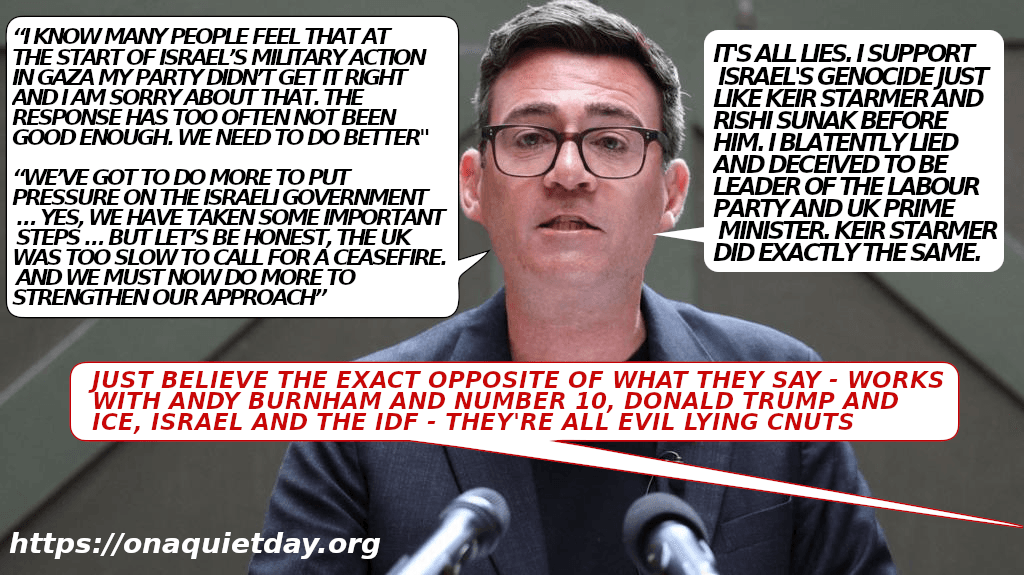
UK Labour Party government ministers Keir Starmer, Angela Rayner and Rachel Reeves explain that they are partners complicit in Israel's Gaza genocide. The UK has provided Israel with arms, military and air force support. They explain that they don't do gas chambers but do do forced marches, starvation, destroy hospitals, mass-murders of journalists and healthcare workers.
UK Labour Party government ministers Keir Starmer, Angela Rayner and Rachel Reeves explain that they are partners complicit in Israel’s Gaza genocide. The UK has provided Israel with arms, military and air force support. They explain that they don’t do gas chambers but do do forced marches, starvation, destroy hospitals, mass-murders of journalists and healthcare workers.
Continue ReadingNetanyahu seeks to prolong Gaza war until elections: Israel’s ex-defense minister

WaPo Says Not to Worry About Climate Disruption’s Disastrous Costs: 

Spread the love

Original article by Julie Hollar republished from FAIR under a Creative Commons Attribution-NonCommercial-NoDerivs 3.0 Unported License.

Reassuring report based on long-debunked climate contrarian

The Washington Post (10/24/24) claims that “the rise in billion-dollar disasters, while alarming, is not so much an indicator of climate change as a reflection of societal growth and risky development.”

As the country begins to vote in an election that will be hugely consequential for the climate crisis, the central task of news outlets’ climate beats should be informing potential voters of those consequences. Instead, the Washington Post‘s “Climate Lab” seems to be working hard to cast doubt on whether climate change is really causing weather disasters to be more expensive.

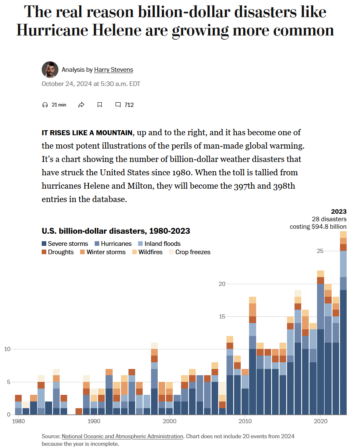
In a lengthy piece (10/24/24) headlined “The Real Reason Billion-Dollar Disasters Like Hurricane Helene Are Growing More Common,” Post Climate Lab columnist Harry Stevens highlighted a NOAA chart depicting a notable increase in billion-dollar weather disasters hitting the US that he says is widely used by government reports and officials “to help make the case for climate policies.” But, in fact, Stevens tells readers:

The truth lies elsewhere: Over time, migration to hazard-prone areas has increased, putting more people and property in harm’s way. Disasters are more expensive because there is more to destroy.

The takeaway is clear: The (Democratic) government is lying to you about the supposedly devastating impacts of climate change.

Distorting with cherry-picked data

The problem is, it’s Stevens’ story that’s doing the misleading. It relies heavily on the work of one source, Roger Pielke Jr., a longtime climate contrarian beloved by climate denial right-wingers, who cherry-picks data to distort the truth.

What’s worse, from a media critic’s perspective, is that it’s not even a new story; it’s been debunked multiple times over the years. Pielke—a political scientist, not a climate scientist, which Stevens never makes clear—has been promoting this tale since 1998, when he first published a journal article that purported to show that, as Stevens describes, “after adjusting damage to account for the growth in people and property, the trend [of increasing economic costs from weather disasters] disappears.”

A review of Roger Pielke’s book The Climate Fix in the journal Science (11/26/10) accused him of writing “a diatribe against the IPCC and other scientists that is based on highly selective and distorted figures and his own studies.”

When Pielke published the argument in his 2010 book, the journal Science (11/26/10) published a withering response, describing the chapter as “a diatribe against the IPCC and other scientists that is based on highly selective and distorted figures and his own studies.” It detailed the multiple methodological problems with Pielke’s argument:

He makes “corrections” for some things (notably, more people putting themselves in harm’s way) but not others. Some adjustments, such as for hurricane losses for the early 20th century, in which the dollar value goes up several hundred–fold, are highly flawed. But he then uses this record to suggest that the resulting absence of trends in damage costs represents the lack of evidence of a climate component. His record fails to consider all tropical storms and instead focuses only on the rare land-falling ones, which cause highly variable damage depending on where they hit. He completely ignores the benefits from improvements in hurricane warning times, changes in building codes, and other factors that have been important in reducing losses. Nor does he give any consideration to our understanding of the physics of hurricanes and evidence for changes such as the 2005 season, which broke records in so many ways.

Similarly, in discussing floods, Pielke fails to acknowledge that many governing bodies (especially local councils) and government agencies (such as the US Army Corps of Engineers) have tackled the mission of preventing floods by building infrastructure. Thus even though heavy rains have increased disproportionately in many places around the world (thereby increasing the risk of floods), the inundations may have been avoided. In developing countries, however, such flooding has been realized, as seen for instance this year in Pakistan, China and India. Other tenuous claims abound, and Pielke cherry-picks points to fit his arguments.

That year, climate expert Joe Romm (Climate Progress2/28/10) called Pielke “the single most disputed and debunked person in the entire realm of people who publish regularly on disasters and climate change.”

Debunked a decade ago

In response to Pielke, climate scientist Kerry Emanuel (5383/31/14) pointed out that it’s not necessarily appropriate to normalize damages by gross domestic product (GDP) if the intent is to detect an underlying climate trend,” since “GDP increase does not translate in any obvious way to damage increase,” as “wealthier countries can better afford to build stronger structures and to protect assets.”

Pielke peddled the story in 538 (3/19/14) four years later—and lost his briefly held job as a contributor for it, after the scientific community spoke out against it in droves, as not being supported by the evidence.

The backlash led 538 to give MIT climate scientist Kerry Emanuel (3/31/14) a column to rebut Pielke, in which she explained that while it’s of course true that “changing demographics” have impacted the economic costs of weather disasters, Pielke’s data didn’t support his assertion “that climate change has played no role in the observed increase in damages.” She pointed to the same kinds of methodological flaws that Science did, noting that her own research with Yale economist Robert Mendelsohn projected that through the year 2100, “global hurricane damage will about double owing to demographic trends, and double again because of climate change.”

That all happened ten years ago. So why is Pielke’s same old ax-grinding getting a platform at the Washington Post shortly before Election Day?

Stevens does tell readers—quite far down in the article—that Pielke has “clashed with other scientists, journalists and government officials” over his research—though Stevens doesn’t give any details about those clashes, or about Pielke’s reputation among climate scientists more generally.

Stevens also briefly notes that Pielke was recently hired by the American Enterprise Institute, which Stevens characterizes as “center-right,” but more helpfully might have characterized as “taking millions from ExxonMobil since 1998.” But in the same paragraph, Stevens also takes pains to point out that Pielke says he’s planning to vote for Harris, as if to burnish Pielke’s climate-believer bonafides.

Pielke agrees with Pielke

Roger Pielke “agrees with studies that agree with Pielke” (Environmental Hazards10/12/20).

Stevens tells Post readers that the science is firmly on Pielke’s side:

Similar studies have failed to find global warming’s fingerprint in economic damage from hurricanes, floods, tornadoes and crop losses. Of 53 peer-reviewed studies that assess economic damage from weather events, 52 could not attribute damage trends to global warming, according to Pielke’s 2020 review of the literature, the most recent and comprehensive.

You’ll notice Stevens just used Pielke’s own review to bolster Pielke’s argument. But the journal that published that review (Environmental Hazards8/5/20) immediately followed up with the publication of a critique (10/12/20) from researchers who came to the opposite conclusion in their study on US hurricanes. They explained that there are “fundamental shortcomings in this literature,” which comes from a disaster research “field that is currently dominated by a small group of authors” who mostly use the same methodology—adjusting historical economic losses based strictly on “growth in wealth and population”—that Pielke does.

The authors, who wrote a study that actually accounted for this problem and did find that economic losses from hurricanes increased over time after accounting for increases in wealth and population, point out that Pielke dismissed their study and two others that didn’t agree with his own results essentially because they didn’t come to the same conclusions. As the authors of the critique write drily: “Pielke agrees with studies that agree with Pielke.”

A phony ‘consensus’

Stevens includes in his article an obligatory line that experts say

disputing whether global warming’s influence can be found in the disaster data is not the same as questioning whether climate change is real or whether society should switch from fossil fuels.

He also adds that

​​many scientists say that global warming has intensified hurricanes, wildfires, droughts and other extreme weather, which must be leading to greater economic losses.

Note that he frames it as only “many,” and suggests they are only using (faulty, simplistic) logic, not science. But of course, climate change is intensifying extreme weather, as even Stevens has reported as fact recently (in the link he provides in that passage). In contrast, Stevens writes that

the consensus among disaster researchers is that the rise in billion-dollar disasters, while alarming, is not so much an indicator of climate change as a reflection of societal growth and risky development.

But in fact, as mentioned above, there’s not consensus even among disaster researchers (who are primarily economists). And the “many scientists” who disagree with Pielke aren’t the scientists the Post chooses to focus on. While Stevens quotes a number of different experts, including some who disagree with Pielke, they are not given anywhere near the space—or credence—Pielke and his arguments are. (Pielke’s name appears 15 times across the article and its captions.)

When he does get around to quoting some of the scientists, like MIT’s Emanuel, whose research shows that extreme weather events are intensifying, Stevens presents the conflicting conclusions as a back-and-forth of claims and counterclaims, giving the last word in that debate to a disaster researcher whose goal is to refocus blame for disasters on political decisions—like supporting building in vulnerable locations—rather than climate change.

Changes in our built environment, and governments’ impact on those changes, are certainly an important subject when it comes to accounting for and preventing billion-dollar disasters—which virtually no one disputes. (Indeed, the four government reports Stevens links to in his second paragraph as supposedly misusing the NOAA data explicitly name some variation of “increased building and population growth” as a contributing factor to growing costs.) It’s simply not an either/or question, as the Post‘s teaser framed it: “Many blame global warming. Others say disasters are more expensive because there is more to destroy.” So it’s bizarre and frankly dangerous that ten years after climate scientists debunked Pielke’s claim that there’s no evidence climate change is increasing extreme weather costs, Stevens would take, as the “urgent” question of the moment, “Is global warming to blame” for the growing billion-dollar disaster tally?

By giving the impression that the whole thing is basically a government scam to justify climate policies, Stevens’ direct implication is that even if climate change is indisputable, it doesn’t really matter. And it feeds into climate deniers’ claims that the climate change-believing government is lying about climate change and its impacts, at a time when a large number of those deniers are seeking office.

Continue ReadingWaPo Says Not to Worry About Climate Disruption’s Disastrous Costs: 

Denting Reelection Hopes, 60% of US Voters Disapprove of Biden’s Israel Policy

Spread the love

Original article by JULIA CONLEY republished from Common Dreams under Creative Commons (CC BY-NC-ND 3.0). 

U.S. President [‘Genocide’] Joe Biden speaks during an event at the White House complex on November 18, 2022 in Washington, D.C. 
(Photo: Win McNamee/Getty Images)

“Except for core Democratic voters, the American public is telling Biden they are not impressed, despite the economy bouncing back and paychecks rising for many,” said one analyst.

Along with persistent protests at public events held by U.S. President Joe Biden and Vice President Kamala Harris, recent polling is continuously demonstrating that the White House’s vehement support for Israel’s bombardment of Gaza despite the rising civilian death toll is not winning them accolades among the voters whose backing they depend on in the upcoming election—and a new survey out Tuesday was no exception.

In the UMass Poll, the University of Massachusetts Amherst and YouGov found that out of 1,064 respondents nationwide, just under 60% said Biden is not handling “the ongoing conflict between Israel and Hamas” well, while just 31% approved of Biden’s policy regarding Israel.

Taken from January 25-30, the poll asked American voters about a wide range of topics, from inflation and their individual ability to afford necessities to their views on whether Israel is committing a genocide in Gaza, where the Israel Defense Forces have killed at least 27,585 people in air and ground attacks as well as blocking nearly all humanitarian aid—plunging the enclave into a crisis of widespread starvation and disease.

Days after an Economist/YouGov survey found that 50% of 2020 Biden voters believe the Israeli assault that the U.S. has helped fund is a genocide, Tuesday’s poll found identical results for the country at large.

“We found that Americans are evenly split on this issue, with 50% viewing Israel’s actions as genocidal while 50% push back against this declaration,” said Tatishe Nteta, a political science professor at UMass Amherst. “Like many issues, both domestic and international, the question of whether the Israelis are committing genocide has become a reflection of the nation’s partisan, gender, racial, and generational divisions as majorities of Democrats, progressives, people of color, women, and young people believe that genocide is being committed while Republicans, conservatives, whites, men, and older Americans oppose this notion.”

Analysts at UMass Amherst said respondents held “persistently dim views of the national economy—even in the face of low unemployment, bullish stock markets, and easing inflation,” and Nteta warned that “with the specter of a rematch with former President [Donald] Trump on the horizon, Biden will need to work to bolster his low approval numbers or face the prospect of becoming a one-term president.”

Ray La Raja, another political scientist at the university, suggested that although Biden got voters’ “highest praise for creating jobs and the Russian-Ukrainian conflict,” with 42% of respondents saying they approved of the president’s handling of those issues, their positive outlook on select actions by Biden was not enough to counter widespread disapproval of Biden, with just 39% of voters expressing overall approval.

“Majorities of voters have not been impressed with Biden on other issues,” said La Raja. “Except for core Democratic voters, the American public is telling Biden they are not impressed, despite the economy bouncing back and paychecks rising for many.”

Israel’s war in Gaza, which the Biden administration has insisted is targeting Hamas despite top Israeli officials’ statements about clearing the enclave of all Gazans, appeared to loom large for respondents when they were asked about their top fears about a second term for Biden, with many replying, “War.”

The new survey bolstered the analysis of The American Prospect co-founder Robert Kuttner last week regarding another recent poll by Quinnipiac University, which showed that Biden was leading Trump, who is leading the race for the Republican presidential nomination, 50-44 overall.

“All of these gains could make little difference as long as the Israel-Gaza conflict is a festering mess, sponsored and funded by the U.S., that splits the Democratic Party and alienates younger voters and voters of color,” wrote Kuttner of the Quinnipiac survey.

Original article by JULIA CONLEY republished from Common Dreams under Creative Commons (CC BY-NC-ND 3.0). 

Continue ReadingDenting Reelection Hopes, 60% of US Voters Disapprove of Biden’s Israel Policy

Lock him up! Donald Trump accused of trying to subvert 2020 election

Spread the love

Georgia district attorney, Fani Willis, says a grand jury has voted to indict former president Donald Trump and 18 others over efforts to overturn his 2020 election loss to Joe Biden. The indictment details dozens of acts by Trump and his allies – including Mark Meadows, Trump’s former White House chief of staff, and lawyers Rudy Giuliani and John Eastman – to undo his defeat in Georgia. The criminal case is the fourth brought against Trump and the second this month to allege that he tried to subvert the results of the 2020 vote.

Continue ReadingLock him up! Donald Trump accused of trying to subvert 2020 election