Labour facing election doomsday

Spread the love

https://morningstaronline.co.uk/article/labour-facing-election-doomsday

Prime Minister Sir Keir Starmer helps out in the call centre at Labour Party headquarters in London, on the last day of campaigning ahead of the elections, May 6, 2026

Meanwhile, far-right Reform UK projected to gain around 1,550 representatives

LABOUR is facing electoral annihilation across the country on Thursday in elections that could bring the hard-right Reform UK a major step closer to power.

Much of Britain is set to deliver a damning verdict on Prime Minister Sir Keir Starmer’s two years in power in one of the most consequential sets of local elections ever.

Voting for the Scottish and Welsh Parliaments and local authorities across England, including every London borough, could mark a landmark in the breakdown of the long-standing two-party system.

Reform boss Nigel Farage claimed that “we will emerge over the course of the next couple of days as the only true national party.”

Last-minute polling suggests Labour could lose up to 1,850 of the 2,550 seats it is defending and crash to defeat in Wales for the first time in more than a century, with Reform projected to gain around 1,550 representatives.

If these predictions are borne out as results emerge on Friday, pressure will grow still further on Sir Keir to quit, given his epic-level personal unpopularity is clearly a deadweight on Labour’s vote.

Article continues at https://morningstaronline.co.uk/article/labour-facing-election-doomsday

Keir Starmer says that the Labour Party under his leadership is intensely relaxed about assaulting those least able to defend themselves - the very poorest and most vulnerable.
Keir Starmer says that the Labour Party under his leadership is intensely relaxed about assaulting those least able to defend themselves – the very poorest and most vulnerable.
Keir Starmer explains that UK is actively supporting Israel's genocidal expansion and repeats his previous quotation that he supports Zionism "without qualification". Keir Starmer said “I said it loud and clear – and meant it – that I support Zionism without qualification.” here: https://www.jewishnews.co.uk/keir-starmer-interview-i-will-work-to-eradicate-antisemitism-from-day-one/
Keir Starmer explains that UK is actively supporting Israel’s genocidal expansion and repeats his previous quotation that he supports Zionism “without qualification”. Keir Starmer said “I said it loud and clear – and meant it – that I support Zionism without qualification.” here: https://www.jewishnews.co.uk/keir-starmer-interview-i-will-work-to-eradicate-antisemitism-from-day-one/
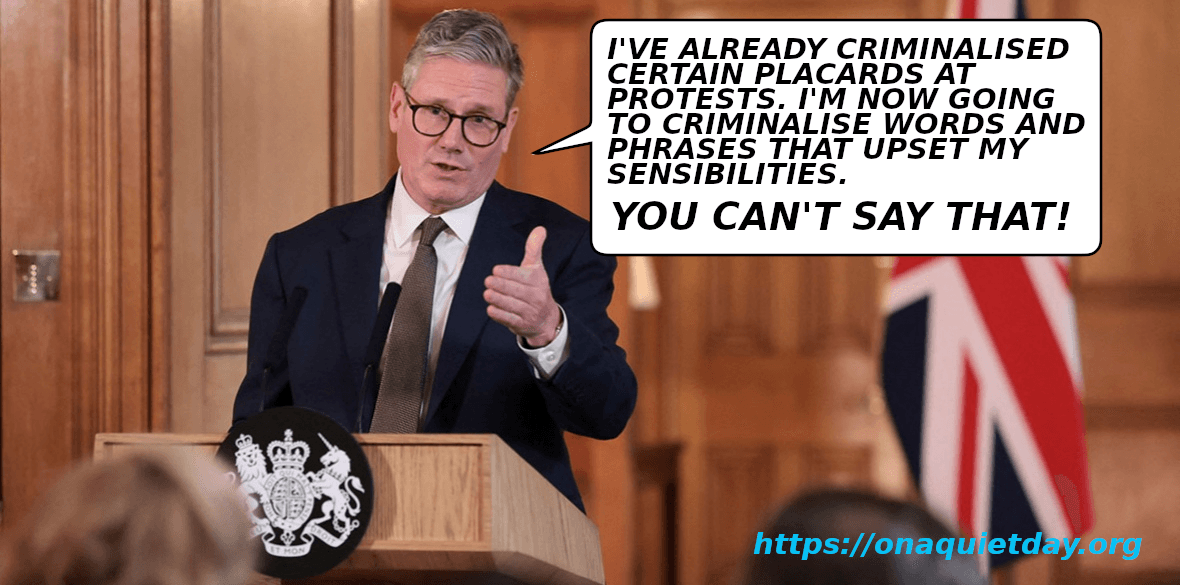
Keir Starmer says that he's banning words and phrases now as well as placards.
Keir Starmer says that he’s banning words and phrases now as well as placards.
Continue ReadingLabour facing election doomsday

DeSmog Launches Investigation Into Food and Farming Misinformation Ahead of EU Elections

Spread the love

Original article by Clare Carlile republished from DeSmog.

Credit: Alberto Perinot/X

The far right is set to piggyback on agricultural discontent to capture votes in June.

A large blue billboard stands outside a park in the town of Conegliano in northern Italy. On the left, a man pops a vast cricket into his mouth. On the right, are the words, “Let’s Change Europe before it changes us” – and the dates of the upcoming elections.  

The poster – an advert for the country’s radical right party Lega per Salvini Premier – refers to a conspiracy theory that has swept across Italy in the last 18 months. Elites in Brussels are planning to replace meat with bugs and are using environmental regulations to do so, or so the theory goes.

As millions of voters across the EU prepare to head to the polls from 6-9 June, conspiracy theories and misinformation on food and farming could pull voters towards the far right and parties opposing climate-friendly laws.

In the face of this onslaught of misinformation, DeSmog is launching a new series that investigates misleading claims and their impact on climate policy in the farming sector. 

Over the next two months DeSmog will monitor the spread of misinformation across the continent, working in seven different languages. We will look to identify false claims and uncover who is spreading these narratives online.

Agriculture accounts for 11 percent of carbon emissions in the EU, and has contributed to plummeting bird and bee numbers. But tackling the sector’s harms has become one of the most divisive issues on the continent, with tractors blocking highways across Europe during demonstrations this year. 

The protests – attended by thousands of farmers in several countries – reflected a wide range of concerns, from unfair food prices to calls for protection from increasingly extreme weather. Yet this complexity was barely represented in the media where demonstrations were cast as opposition to environmental measures. 

Far-right groups also weaponised the protests. In January, Jordan Bardella, lead EU candidate for France’s National Rally (formerly National Front), accused the country’s President Emmanuel Macron of pursuing “the death of agriculture” while Santiago Abascal, leader of Spain’s far-right party Vox, wrote to Macron demanding an end to “aggressions” against Spanish producers, who he described as “victims” of EU policy.

In the eyes of its critics, green reforms agreed in the last EU term would destroy farming. Plans to cut chemical use and make farmers protect natural habitats would lead to monumental job losses, they claim. The same arguments are used by agricultural corporations that stand to lose out if green reforms are enacted.

The most extreme opponents, including radical right think tanks and hardline farming groups, see green reforms as part of a plan by Brussels bureaucrats to control the industry and “grab land”. 

These claims, however, contradict the facts: last year, more than 6,000 scientists said that such nature-friendly measures were “the cornerstone of food security and human health”. 

The policies that are currently being attacked aim to tackle climate breakdown – the biggest threat to producers across the EU, who are already feeling the effects of global heating. A “staggering portion” of the continent has been exposed to high drought risk in recent years, according to the European Drought Observatory, leading to widespread crop losses.

Right-wing and far-right groups stand to make massive gains from stoking these tensions. A recent study by the EU’s Committee of the Regions showed that discontented rural areas could be a major source of votes.  

This series will shine a light on those candidates that are weaponising false claims for electoral gain.

Original article by Clare Carlile republished from DeSmog.

Continue ReadingDeSmog Launches Investigation Into Food and Farming Misinformation Ahead of EU Elections

Center-left alliance challenges the ruling right alliance in India’s national elections

Spread the love

Original article by peoples dispatch republished under a Creative Commons Attribution-ShareAlike 4.0 (CC BY-SA) license.

Indian Prime Minister Narendra Modi may still be popular after a decade in power but his government’s failures to address basic livelihood issues for the majority of the people may give an advantage to the opposition.

India, the world’s most populous nation, is in the middle of its 18th national elections. Two of the eight phases are already over, sealing the fate of over one third of representatives. However, the fight is still on for the majority of the seats. The incumbent Narendra Modi-led right-wing government, seeking a third straight term, is facing an upbeat center and left alliance led by Congress.

This national election for India’s lower house of the parliament, called the Lok Sabha (the house of the people), is stretched between April 19 and June 1 and takes place in eight phases. The votes will be counted on June 4 and results will be declared on the same day.

India is a parliamentary democracy with the first past the poll system. It is divided into 543 constituencies for the national elections with each constituency electing a single member for the Lok Sabha each. The party or alliance which wins the majority of seats (272) in the Lok Sabha elects the prime minister and forms the central government.

Though India has a multiparty system, most of the parties this time are aligned with the two major pre-poll alliances seeking popular mandate. The ruling Bharatiya Janata Party (BJP) led right-wing National Democratic Alliance (NDA) and the Congress-led, center-left opposition, Indian National Developmental Inclusive Alliance (I.N.D.I.A.) or just INDIA.

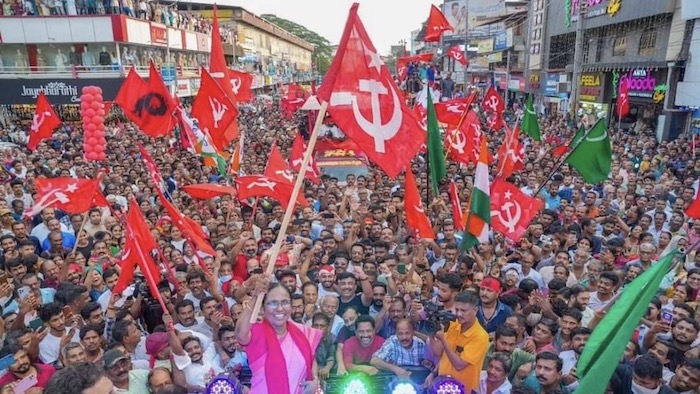
All the major left parties are part of the INDIA alliance and are contesting a large number of seats in states of Kerala, West Bengal, Tamil Nadu, Bihar and elsewhere with an objective to increase the presence of the left in the Indian parliament.

Along with the national election, three states/provinces, Odisha, Andhra Pradesh in the country’s south-east, and Sikkim in the north-east, will also elect members of their respective state assemblies.

Key issues

Unlike the last national elections in India when Prime Minister Narendra Modi was able to use the popular polarization of votes around the issue of nationalism and national security, the present elections are largely being fought on the issue of his government’s failure on all major fronts affecting the majority of the population, principally economic issues such as price rises and unemployment.

Indians are facing an unprecedented rise in the prices of all major essential commodities which has, in the absence of corresponding rise in the income, created a major crisis of living for the majority of the households in the country but particularly among the urban poor. India has seen an unprecedented decline in its standing on the annual global hunger index despite being one of the major food producers in the world and world’s fastest growing economy.

The rising inequality and the growing perception of the Modi government being pro-big capital and allegations of cronyism have also become a major poll issue. Opposition parties have pointed out that while select corporate houses in the country have risen and made tremendous profits, it is at the cost of most of the small and medium sized enterprises in the country as well as public sector entities.

The International Labor Organization (ILO) report on rising unemployment among educated youth in India has also attracted the attention of major opposition parties and become a major poll issue.

Apart from the major economic issues, the opposition has raised the issue of alleged threats to democracy under the BJP rule. They have accused BJP of trying to suppress the voices of dissent by misusing the central law enforcement agencies. Several opposition leaders such as sitting chief minister of Delhi, Arvind Kejriwal, and former chief minister of Jharkhand, Hemant Soren, were arrested in allegedly trumped up corruption charges. BJP has also been accused of intimidating opposition leaders to switch sides using the threats of persecution or by offering them money.

BJP and NDA have rejected most of the claims made by the opposition and instead accused INDIA alliance partners of being corrupt. The right-wing alliance has also declared that the INDIA alliance and particularly Congress is against the interest of the majority community in the country. It has sought the third term by also claiming it has been able to keep the Indian economy afloat amidst the challenges of COVID-19 and global recession.

Uncertain predictions

In the last elections in May 2019, the BJP-led NDA won 353 seats. BJP alone scored over 37% of votes and over 300 seats. It now seeks an over two-third majority in the ongoing elections with a slogan of “abki baar, 400 paar” (More than 400 seats in this election). While most of the pre-poll surveys predict a comfortable win for the NDA, the opposition has rejected those surveyed as compromised and claimed that the NDA will not get a majority.

There are over 970 million eligible voters in the country of over 1.4 billion according to the Election Commission of India (ECI). A significant number of them are first time voters who are facing the challenges of unemployment and price increases, and the opposition is hoping they will vote for their agenda which promises more jobs and increased social spending.

The left and other constituents of the INDIA alliance also believe that the most important factor in the revival of the opposition’s fate would be the farmers and workers who have faced complete neglect during the BJP rule in the last decade and even faced state repression during the months-long farmers’ agitation at Delhi’s borders and during the COVID-19 lockdowns.

The opposition also believes that there is growing disenchantment among Dalits and other marginalized sections of the Indian society from the Narendra Modi government as there is a growing threat to affirmative action and social justice policy measures enshrined in the Indian constitution due to BJP’s aggressive pro-corporate and pro-market orientation.

Will the BJP-led NDA fall under the weight of its own contradictions as the center-left alliance predicts, or will the BJP’s pro-corporate politics prevail? On June 4, the world will find out.

Original article by peoples dispatch republished under a Creative Commons Attribution-ShareAlike 4.0 (CC BY-SA) license.

Continue ReadingCenter-left alliance challenges the ruling right alliance in India’s national elections

After Biden HQ Arrests, Sunrise Plans 40+ Protests Across US

Spread the love

Original article by JESSICA CORBETT republished from Common Dreams under Creative Commons (CC BY-NC-ND 3.0). 
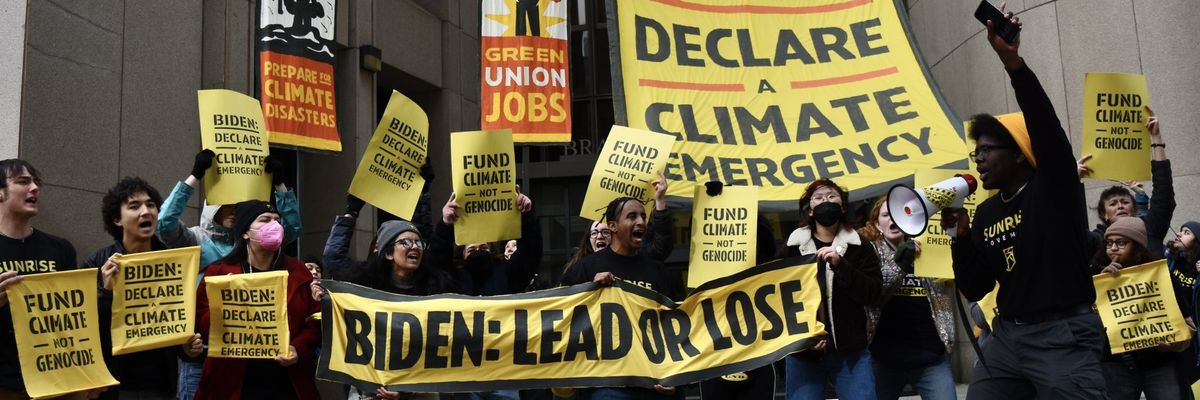
Nearly two dozen campaigners with the Sunrise Movement were arrested after assembling at U.S. President Joe Biden’s 2024 campaign headquarters in Wilmington, Delaware on February 12, 2024. (Photo: Sunrise Movement/X)

“President Biden must declare a climate emergency and go all-out to stop the climate crisis,” said the youth-led movement’s campaign director.

After nearly two dozen Sunrise Movement campaigners were arrested Monday at U.S. President Joe Biden’s 2024 campaign headquarters in Wilmington, Delaware, the youth-led climate group is planning over 40 protests across the country.

Next Monday, movement members plan to demonstrate at local Democratic Party offices and city halls to demand that Biden declare a national climate emergency and use the full extent of his powers to tackle the fossil fuel-driven global crisis.

“Biden can’t build renewables on Monday, approve fossil fuels on Tuesday, and then claim to be climate president. That’s not how science works, and young voters know it,” said Sunrise campaign director Kidus Girma in a statement Thursday. “President Biden must declare a climate emergency and go all-out to stop the climate crisis.”

“He could end the fossil fuel era by refusing to approve a single oil or gas well in this country.”

“There are dozens of things he could sign into law tomorrow if he wanted,” Girma noted. “He could make sure that every time a climate disaster hits, no one gets evicted and everyone has access to free healthcare. He could end the fossil fuel era by refusing to approve a single oil or gas well in this country.”

Sunrise is calling on the Democratic president to reverse the massive rise in U.S. fossil fuel production—rather than approving projects like Willow in Alaska—and to “create green union jobs by unleashing the full power of the Defense Production Act.”

The group’s plans for next week’s protests were announced as nine Democrats joined Republicans in the U.S. House of Representatives to pass a bill intended to reverse Biden’s recent pause on approvals for liquefied natural gas (LNG) exports, and as the Federal Energy Regulatory Commission rubber-stamped the Saguaro Connector Pipeline in Texas.

While Biden has faced intense criticism from campaigners and scientists for various decisions—from backing Willow and Mountain Valley Pipeline to continuing fossil fuel lease sales and skipping last year’s United Nations summit—former President Donald Trump, the Republican front-runner, has been far more hostile toward climate policies.

Young voters like those who belong to the Sunrise Movement were key to Biden’s defeat of Trump in 2020 and to Democrats preventing the predicted “red wave” in 2022. They are expected to play a key role in this November’s elections.

Original article by JESSICA CORBETT republished from Common Dreams under Creative Commons (CC BY-NC-ND 3.0). 

Continue ReadingAfter Biden HQ Arrests, Sunrise Plans 40+ Protests Across US