This work by Middle East Monitor is licensed under a Creative Commons Attribution-NonCommercial-ShareAlike 4.0 International License.
An aerial view of the destruction around Masjid Ahl As Sunna, Jalal Street, and Abu Hamid Roundabout in Khan Yunis, Gaza on October 19, 2025. [Muhammed Eslayeh – Anadolu Agency]
Europe must play a central role in rebuilding Gaza as well as reviving the two-state solution to Israel-Palestine conflict, European Commission President Ursula von der Leyen said on Tuesday, Anadolu Agency reports.
Speaking on the EU’s priorities for the coming year at the European Parliament, von der Leyen stressed that Europe’s independence and influence on the global stage depend on shaping the emerging international order, starting from its immediate neighborhood.
“This is true in the Middle East, where Europe must play a role in rebuilding Gaza, in relaunching the two-state solution, as well as in encouraging the birth of a new Syria,” she said.
Von der Leyen also underscored the EU’s commitment to supporting Ukraine and strengthening Europe’s defense capabilities against a range of threats, including hybrid warfare, terrorism, and security consequences of climate change.
She highlighted the importance of a strong democracy in delivering solutions to citizens’ concerns, particularly in migration and child protection on social media.
The EU commission chief stressed the full implementation of the EU Pact on Migration and Asylum, stronger border management through Frontex, and stricter enforcement against smugglers and traffickers.
“Legal migration is welcome, and we will need more of it. But illegal migration is not, and we cannot tolerate the smugglers and traffickers working against our rules,” she said.
She said Europe must protect its children from the growing harms of social media, noting that the EU is setting up a panel of experts to deliver recommendations for protecting children online, including a digital minimum age.
“And then we will act on this in the coming year. I really hope for your support. Because we should be absolutely clear that it should be parents who raise their children, not algorithms,” she added.
The Commission Work Program 2026, she said, will focus on competitiveness, defense readiness, and democratic resilience to ensure Europe can act decisively at home and abroad.
Keir Starmer objects to criticism of the IDF. He asks how could anyone object to them starving people to death, forced marches like the Nazis did, bombing Gaza’s hospitals and universities, mass-murdering journalists, healthworkers and starving people queuing for food, killing and raping prisoners and murdering children. He calls for people to stop obstructing his genocide for Israel.Genocide denier and Current UK Prime Minister Keir Starmer is quoted that he supports Zionism without qualification. He also confirms that UK air force support has been essential in Israel’s mass-murdering genocide. Includes URLs https://www.declassifieduk.org/keir-starmers-100-spy-flights-over-gaza-in-support-of-israel/ and https://youtu.be/O74hZCKKdpAOrcas discuss Genocide-supporting and complicit Zionists. Donald Trump, Keith Starmer, David Lammy, Rachel Reeves, Angela Rayner and Wes Streeting are acknowledged as evil genocide-complicit and supporting cnuts.
Guesyts walk by a Lamborghini parked by docked yachts at a soirée in Monaco on October 5, 2019. (Photo by Chris Ricco/Getty Images for Lamborghini)
“Europe is minting billionaires at a record rate while millions of Europeans are struggling to make ends meet,” said one tax expert.
A worsening inequality crisis in the European Union—where the richest people pay proportionately less tax than ordinary citizens even as billionaire wealth is skyrocketing—is driving increasingly popular demand for a wealth tax, according to a report published Thursday.
The Oxfam briefing paper, A European Agenda to Tax the Superrichch, notes that “the richest 1% in the EU own nearly a quarter of all wealth while half the population shares just 3%.”
The report underscores that the combined wealth of EU billionaires soared by over €400 billion ($462.2 billion) in just six months this year—the equivalent of over €2 billion ($2.3 billion) a day.
“In 2025, the EU counted nearly 500 billionaires, 39 more than in 2024,” Oxfam said. “In the last year alone, a new billionaire was created, on average, every nine days in the EU. Altogether, the richest 3,600 Europeans now hold as much wealth as the poorest 181 million—equivalent to the populations of Germany, Italy, and Spain combined.”
“Europe is minting billionaires at a record rate while millions of Europeans are struggling to make ends meet,” Oxfam EU tax expert Chiara Putaturo said in a statement Thursday. “This inequality is not by accident, it is by design.”
📢 EU Billionaires’ wealth surges by over €400bn in first half of 2025.That’s over €2bn a day.🔗https://www.oxfam.org/en/press-releases/eu-billionaires-wealth-surges-over-eu400-billion-first-half-2025#TaxTheRich
Over recent decades, EU countries have slashed taxes for the richest people and corporations, while leaving ordinary people to pay the price. Today, over 80% of tax revenue in the EU comes from taxes that fall primarily on ordinary citizens, while the wealthiest can exploit loopholes, tax havens, and special regimes to pay lower effective tax rates than nurses and teachers. In Belgium, for example, members of the richest 1% contribute just 23% tax of their incomes, which is half of what the average person contributes.
“Decades of tax cuts for the wealthy and corporations resulted in the superrich paying proportionally less taxes than ordinary citizens, eroding fairness, democracy, and social cohesion,” the report states. “The EU lacks harmonized policies to curb extreme wealth concentration and tax avoidance of the wealthiest.”
“Oxfam calls for bold reforms, such as an EU-wide or national tax on the superrich and transparency mechanisms like an EU assets registry, to fund social needs, climate action, and development,” the publication adds. “Taxing the superrich is widely supported, is feasible, and is urgent.”
The report contends that an EU-wide wealth tax of up to 5% on millionaires and billionaires could potentially bring in €286.5 billion ($331.3 billion) in yearly revenue, “enough to cover the annual needs of the new EU long-term budget proposal,” while ending “harmful and wasteful” tax policies favoring the superrich would recover nearly €4 billion ($4.6 billion) annually.
While wealth taxes have been proposed in a number of European countries, including France—which according to The Economist has more billionaires than any other country in the EU—only Norway, Spain, and Switzerland have enacted a net wealth tax, according to Tax Foundation Europe.
After France’s political crisis deepened this week with the resignation of another prime minister, French economist Gabriel Zucman—known globally for advocating for a wealth tax of at least 2%—called out his country’s last three PMs for not taking the proposal seriously. He noted that “there is a very strong demand among the population for greater tax fairness and better taxation of the ultrarich.”
The Equals podcast and Belgian-Dutch philosopher Ingrid Robeyns on Thursday explored the benefits of a wealth cap.
“The idea of a poverty line is pretty well understood. No one should have so little that they can’t afford a roof over their head or go to bed hungry at night,” Equals Bulletinsaid. “But billions of people around the world can’t afford these basics, despite the wealth increase of billionaires over the last decade being enough to end poverty 22 times over.”
Embracing the concept of a wealth cap, the publication explained: “It’s about ensuring the needs of people and planet are met so everyone can flourish. You don’t have to be a communist to agree with a wealth cap, nor does it necessarily mean rejecting a market-based economy.”
France has more billionaires than any country in the EU. A new tax on their income is a popular idea. But doing so might not bring in all that much cash econ.st/4nkboVU
How much wealth is too much? Equals cited a New Economics Foundation (NEF)/Patriotic Millionaires survey published earlier this year in which one-third of millionaires said that the “extreme wealth line”—the point beyond which their fortune is considered harmful to society and the environment—should be set at $10 million.
“Society needs novel approaches to bring this complex topic to life,” NEF’s Fernanda Balata and Hollie Wright said at the time, “including narratives and practical tools more apt to address the vast cultural, moral, economic, and social barriers to tackling extreme wealth.”
This work by Middle East Monitor is licensed under a Creative Commons Attribution-NonCommercial-ShareAlike 4.0 International License.
Spanish Deputy Prime Minister and Minister of Labor and Social Economy Yolanda Diaz attends rally against Israel’s attacks over Gaza, in Madrid, Spain on June 23, 2025. [Burak Akbulut – Anadolu Agency]
Spain’s Deputy Prime Minister Yolanda Diaz urged Europe on Friday to terminate all association agreements with Israel, Anadolu reports.
“I am sending a message to the international community, essentially to Europe. We want more. All association agreements with Israel must be completely broken off,” Diaz told reporters.
Stressing that Israel violates international law, she noted that the European community looks the other way.
“The European community did what it had to do under international law when (Russian President) Putin illegitimately invaded Ukraine, and we sanctioned Russia. In Gaza, should we not do the same? Well, we believe we should,” Diaz added.
She also demanded the immediate release of Spanish citizens detained by Israel following its attack on the Gaza-bound Global Sumud Flotilla.
“I truly believe our country is exemplary. Exemplary. Just yesterday, people took to the streets to demonstrate everywhere,” she said, adding: “All of Europe is mobilizing—but there cannot be such a wide gap between the people and the European Commission.”
Israeli naval forces attacked and seized vessels of the Global Sumud Flotilla on Thursday and Friday and detained more than 450 activists from over 50 countries. The flotilla had been attempting to deliver humanitarian aid to Gaza and challenge Israel’s blockade of the enclave.
The flotilla is an international initiative to break the blockade on Gaza, home to nearly 2.4 million people, imposed by Israel for almost 18 years.
Since October 2023, Israeli bombardments have killed nearly 66,300 Palestinians, most of them women and children, in the enclave and rendered it uninhabitable.
This work by Middle East Monitor is licensed under a Creative Commons Attribution-NonCommercial-ShareAlike 4.0 International License.
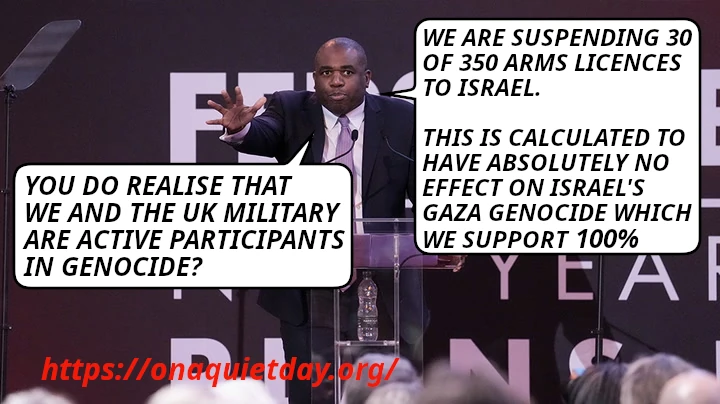
Keir Starmer objects to criticism of the IDF. He asks how could anyone object to them starving people to death, forced marches like the Nazis did, bombing Gaza’s hospitals and universities, mass-murdering journalists, healthworkers and starving people queuing for food, killing and raping prisoners and murdering children. He calls for people to stop obstructing his genocide for Israel.Genocide denier and Current UK Prime Minister Keir Starmer is quoted that he supports Zionism without qualification. He also confirms that UK air force support has been essential in Israel’s mass-murdering genocide. Includes URLs https://www.declassifieduk.org/keir-starmers-100-spy-flights-over-gaza-in-support-of-israel/ and https://youtu.be/O74hZCKKdpAGenocide denying UK Foreign Secretary David Lammy says that UK is suspending 30 of 350 arms licences to Israel. He also confirms the UK government’s support for Israel’s Gaza genocide and the UK government and military’s active participation in genocide.
Muslims pray in Plebiscito Square in Naples on April 10, 2024. (Photo by Salvatore Laporta/KONTROLAB/LightRocket via Getty Images)
“What would the reaction would be if an Arab state wrote this about synagogues and Jews?” asked one critic.
Israel faced backlash this week after its Arabic-language account on the social media site X published a message warning Europeans to take action against the proliferation of mosques and “remove” Muslims from their countries.
“In the year 1980, there were only fewer than a hundred mosques in Europe. As for today, there are more than 20,000 mosques. This is the true face of colonization,” posted Israel, a settler-colonial state whose nearly 2 million Muslim citizens face widespread discrimination, and where Palestinians in the illegally occupied territories live under an apartheid regime.
“This is what is happening while Europe is oblivious and does not care about the danger,” the post continues. “And the danger does not lie in the existence of mosques in and of themselves, for freedom of worship is one of the basic human rights, and every person has the right to believe and worship his Lord.”
“The problem lies in the contents that are taught in some of these mosques, and they are not limited to piety and good deeds, but rather focus on encouraging escalating violence in the streets of Europe, and spreading hatred for the other and even for those who host them in their countries, and inciting against them instead of teaching love, harmony, and peace,” Israel added. “Europe must wake up and remove this fifth column.”
Nothing to see here, just the official account of the Israeli government inciting against Muslims in Europe.
Mosques are now colonization tools and Muslims are a fifth column in Europe.
What would the reaction would be if an Arab state wrote this about synagogues and Jews? 1/ https://t.co/SKfq8S4PW8
Referring to the far-right Alternative for Germany party, Berlin-based journalist James Jackson replied on X that “even the AfD don’t tweet, ‘Europe must wake up and remove this fifth column’ over a map of mosques.”
Other social media users called Israel’s post “racist” and “Islamophobic,” while some highlighted the stark contrast between the way Palestinians and Israelis treat Christian people and institutions.
Others noted that some of the map’s fearmongering figures misleadingly showing a large number of mosques indicate countries whose populations are predominantly or significantly Muslim.
“Russia has 8,000 mosques? Who would’ve known a country with millions of Muslim Central Asians and Caucasians would need so many!” said one X user.
Israel’s post came amid growing international outrage over its 691-day assault and siege on Gaza, which has left more than 230,000 Palestinians dead, maimed, or missing and hundreds of thousands more starving and facing ethnic cleansing as Operation Gideon’s Chariots 2—a campaign to conquer, occupy, and “cleanse” the strip—ramps up amid a growing engineered famine that has already killed hundreds of people.
Israel is facing an ongoing genocide case at the International Court of Justice, while Israeli Prime Minister Benjamin Netanyahu and Yoav Gallant, his former defense minister, are fugitives form the International Criminal Court, where they are wanted for alleged war crimes and crimes against humanity including murder and forced starvation.
European nations including Belgium, Ireland, and Spain are supporting the South Africa-led ICJ genocide case against Israel. Since October 2023, European countries including Belgium, France, Malta, Portugal, Slovenia, the United Kingdom, Ireland, Norway, and Spain have either formally recognized Palestinian statehood or announced their intention to do so.
A firefighter works to extinguish a wildfire in the village of Vilaza in northwestern Spain on August 12, 2025. (Photo: Miguel Riopa/AFP via Getty Images)
Fire-related deaths were reported in Turkey, Spain, Montenegro, and Albania.
With firefighters in southern Europe battling blazes that have killed people in multiple countries and forced thousands to evacuate, Spain’s environment minister on Wednesday called the wildfires a “clear warning” of the climate emergency driven by the fossil fuel industry.
While authorities have cited a variety of causes for current fires across the continent, from arson to “careless farming practices, improperly maintained power cables, and summer lightning storms,” scientists have long stressed that wildfires are getting worse as humanity heats the planet with fossil fuels.
The Spanish minister, Sara Aagesen, told the radio network Cadena SER that “the fires are one of the parts of the impact of that climate change, which is why we have to do all we can when it comes to prevention.”
“Our country is especially vulnerable to climate change. We have resources now but, given that the scientific evidence and the general expectation point to it having an ever greater impact, we need to work to reinforce and professionalize those resources,” Aagesen added in remarks translated by The Guardian.
Firefighters are struggling to control wildfires blazing across Europe during a severe heatwave. pic.twitter.com/ndHTbNx6RM
The Spanish meteorological agency, AEMET, said on social media Wednesday that “the danger of wildfires continues at very high or extreme levels in most of Spain, despite the likelihood of showers in many areas,” and urged residents to “take extreme precautions!”
The heatwave impacting Spain “peaked on Tuesday with temperatures as high as 45°C (113°F),” according to Reuters. AEMET warned that “starting Thursday, the heat will intensify again,” and is likely to continue through Monday.
The heatwave is also a sign of climate change, Akshay Deoras, a research scientist in the Meteorology Department at the U.K.’s University of Reading, toldAgence France-Presse this week.
“Thanks to climate change, we now live in a significantly warmer world,” Deoras said, adding that “many still underestimate the danger.”
Parts of Europe are once again facing intense heatwaves, with destructive wildfires affecting France, Portugal and Spain.
There have been at least two fire-related deaths in Spain this week: a man working at a horse stable on the outskirts of the Spanish capital Madrid, and a 35-year-old volunteer firefighter trying to make firebreaks near the town of Nogarejas, in the Castile and León region.
Acknowledging the firefighter’s death on social media Tuesday, Spanish Prime Minister Pedro Sánchez sent his “deepest condolences to their family, friends, and colleagues,” and wished “much strength and a speedy recovery to the people injured in that same fire.”
According toThe New York Times, deaths tied to the fires were also reported in Turkey, Montenegro, and Albania. Additionally, The Guardiannoted, “a 4-year-old boy who was found unconscious in his family’s car in Sardinia died in Rome on Monday after suffering irreversible brain damage caused by heatstroke.”
There are also fires in Greece, France, and Portugal, where the mayor of Vila Real, Alexandre Favaios, declared that “we are being cooked alive, this cannot continue.”
🔥Fire danger forecast for 11–17 Aug shows extreme to very extreme FWI anomalies across Europe.
Reuters on Wednesday highlightedGreenpeace estimates that investing €1 billion, or $1.17 billion, annually in forest management could save 9.9 million hectares or 24.5 million acres—an area bigger than Portugal—and tens of billions of euros spent on firefighting and restoration work.
The European fires are raging roughly three months out from the next United Nations Climate Change Conference, or COP30, which is scheduled to begin on November 10 in Belém, Brazil.
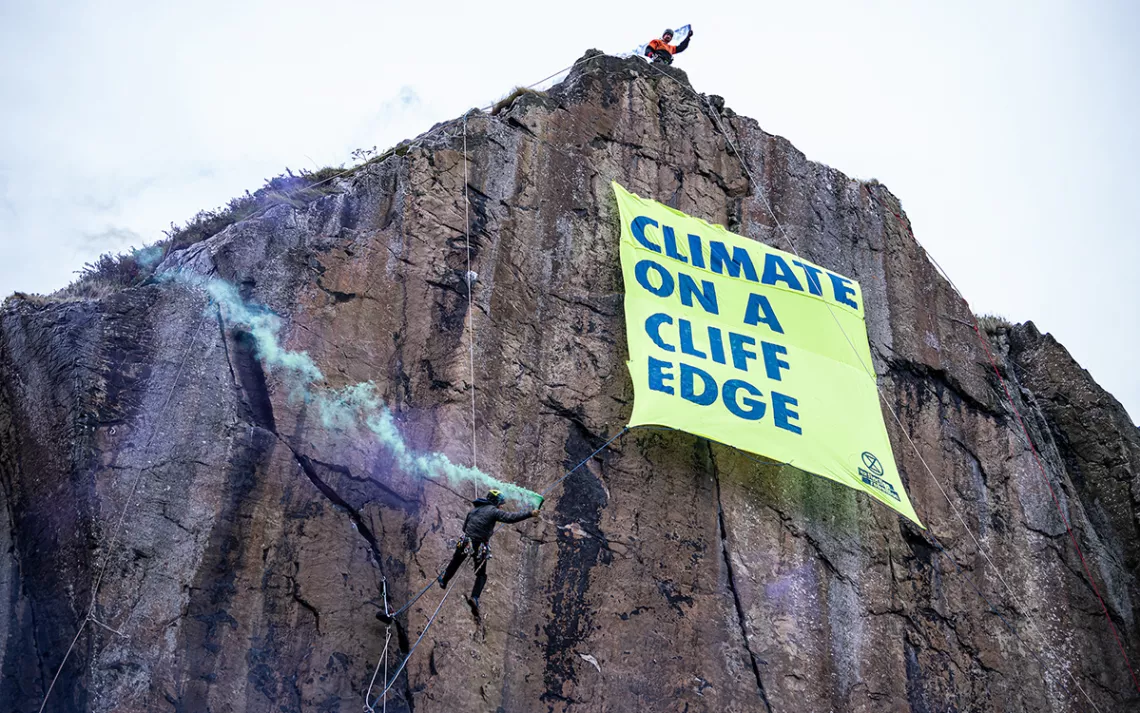
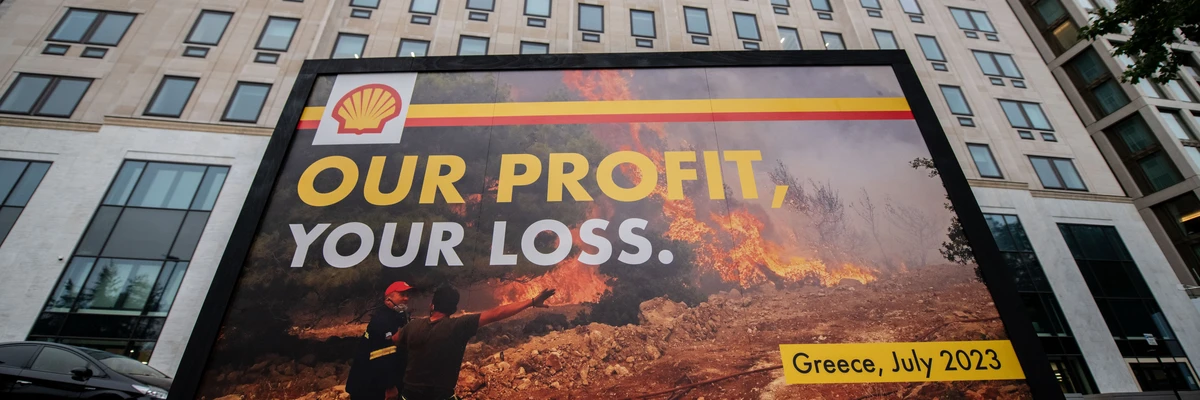
Experienced climbers scale a rock face near the historic Dumbarton castle in Glasgow, releasing a banner that reads “Climate on a Cliff Edge.” One activist, dressed as a globe, symbolically looms near the edge, while another plays the bagpipes on the shores below. | Photo courtesy of Extinction Rebellion and Mark RichardsGreenpeace activists display a billboard during a protest outside Shell headquarters on July 27, 2023 in London. (Photo: Handout/Chris J. Ratcliffe for Greenpeace via Getty Images)Donald Trump urges you to be a Climate Science denier like him. He says that he makes millions and millions for destroying the planet, Burn, Baby, Burn and Flood, Baby, Flood.Nigel Farage urges you to ignore facts and reality and be a climate science denier like him. He says that Reform UK has received millions and millions from the fossil fuel industry to promote climate denial and destroy the planet.