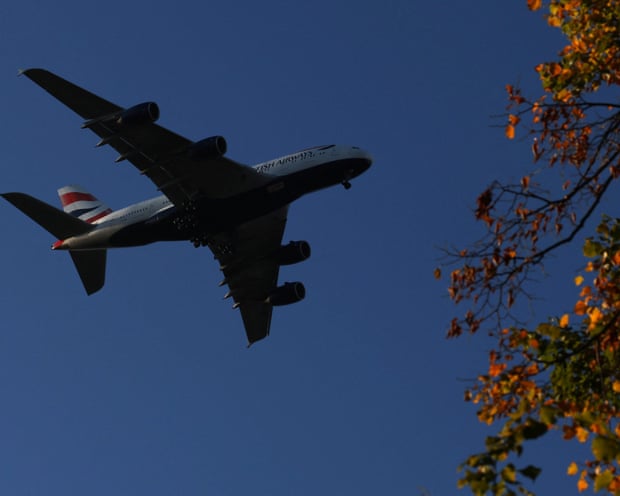
Heathrow airport wants to build a third runway and new terminals. Photograph: Toby Melville/Reuters
Climate Change Committee says government cannot expand airport without requiring aviation industry to clean up its emissions
Heathrow airport should be allowed to expand only if airlines pay for the removal of carbon dioxide from the atmosphere, the government’s climate advisers have said.
…
Nigel Topping, the chair of the CCC, said: “The government cannot expand Heathrow airport without requiring the aviation industry to clean up its emissions. Therefore, the government should legislate policies that require the aviation industry to fully address all of their emissions by 2050, either directly or by purchasing engineered removals. The polluter-pays principle must apply.”
…
But campaigners rejected the CCC’s plan of relying on nascent technologies to wipe out the impact of an expansion that would commit the UK to much higher emissions for decades, and called on ministers to halt all airport expansion.
Tony Bosworth, campaigner at Friends of the Earth, accused the CCC of “pulling its punches”, pointing to recent research by the Tyndall Centre that found SAF and carbon removals were unproven and unlikely to ramp up in time to the extent needed to justify airport expansion.
“The CCC should have made it crystal clear: there is no plausible way to expand Heathrow without wrecking the UK’s climate targets,” he said.
Frequent flying is overwhelming skewed towards the wealthy. In any year, only about half of people in England take a flight abroad, while about 80% of all flights abroad were taken by people who took two or more flights – about a quarter of the population. Frequent flyers – those who took five or more return flights abroad in 2024 – made up only 5% of the population, but accounted for a third of all flights.
Those in the highest income group took 38% of all flights abroad – four times as many flights as those in the lowest income group, according to the National Travel Survey of England in 2024.
The illegal Israeli settlement of Efrat is seen in this March 30, 2024 photo. (Photo: Wisam Hashlamoun/Anadolu via Getty Images)
“The Netanyahu government is operating on steroids to establish facts on the ground that will destroy the chance for peace and compromise,” said one group.
Israeli authorities are planning to expand a Jewish-only settlement in the West Bank by nearly 1,000 homes, a Tel Aviv-based peace group said Sunday as Israeli soldiers and settlers escalated attacks on Palestinians in the illegally occupied territory.
Peace Now said Israel’s Civil Administration has issued a new tender for the construction of 974 new housing units in Efrat, a Jewish-only colony located about 7.5 miles south of Jerusalem between Bethlehem and Hebron. The planned expansion will increase Efrat’s population of approximately 11,800 residents by 40% and geographically isolate Palestinian communities in the southern West Bank.
Emboldened by U.S. President Donald Trump’s return to power, far-right members of Israeli Prime Minister Benjamin Netanyahu’s Cabinet have vowed to annex the West Bank, which Israel has occupied since 1967 in violation of international law.
On Sunday, Israeli Finance Minister Bezalel Smotrich said that “the goal for 2025 is to demolish more than the Palestinians build in the West Bank,” according to Al Jazeera. This, following the largest Israeli seizure of Palestinian land in the West Bank in decades last year.
“The Netanyahu government is operating on steroids to establish facts on the ground that will destroy the chance for peace and compromise,” said Peace Now, referring to the longtime Israeli practice of violating international law by colonizing and annexing Palestinian land to establish what one legal scholar has described as “de facto possession with the aim of attaining de jure possession.”
Peace Now continued: “It is now clear that military action alone will not bring a solution to the conflict or security to Israel, and that ultimately we will have to reach an agreement with the Palestinians. The Netanyahu government is harming Israeli interests and torpedoing the only solution that can bring us security and peace.”
In the United States, the Council on American-Islamic Relations said in a statement Monday that “the ongoing de facto annexation of the illegally occupied West Bank through the expansion of racially segregated illegal settlements is just one aspect of the far-right Israeli government’s ethnic cleansing of the entirety of historic Palestine and of its relentless efforts to block justice for the Palestinian people.”
Aviv Tatarsky, a researcher at the Israel-based peace group Ir Amim, told Al Jazeera that “since the start of 2025, Israeli authorities have demolished 27 structures in East Jerusalem, including 18 residential units, in what appears to be a systematic effort to remove Palestinians from their homes while simultaneously expanding Israeli settlements.”
The Israeli settlement population has increased exponentially from around 1,500 colonists in 1970 to roughly 140,000 at the time of the Oslo Accords in 1993—under which Israel agreed to halt new settlement activity—to more than 500,000 today. Last July, the International Court of Justice, which is also weighing a genocide case concerning Israel’s annihilation of the Gaza Strip, said that the Israeli occupation of the West Bank, East Jerusalem, and Gaza is an illegal form of apartheid that must end “as rapidly as possible.”
News of the Efrat expansion came as Israeli soldiers and settlers escalated attacks on Palestinians across the West Bank over the weekend. Occupation forces carried out raids in the towns of al-Issawiya and Salfit, near East Jerusalem, as well as the village of Nabi Saleh near Ramallah. Israeli troops also continued their siege and assault on Jenin and the Nur Shams refugee camp, where two young women, one of them pregnant, were shot dead last week.
Armed Israeli settlers from the Mikne Avraham colony also invaded al-Minya, south of Bethlehem, wounding 16 Palestinians including a pregnant woman who was attacked with clubs and rocks, according toMiddle East Eye. The Israeli newspaper Haaretzreported Saturday that settlers sicced dogs on al-Minya residents, wounding two people.
According to the United Nations Office for the Coordination of Humanitarian Affairs, Israeli soldiers and settlers have killed 876 Palestinians in the West Bank and East Jerusalem since the October 7, 2023 Hamas-led attack on Israel.
Since launching “Operation Iron Wall” on January 21, Israeli forces have killed at least 53 Palestinians across the West Bank. The Israeli offensive has forced around 40,000 people from their homes in what experts say is the largest displacement in the West Bank since more than 200,000 Palestinians were expelled during the 1967 conquest and occupation.
I am only able to quote small sections of this copyrighted article by George Monbiot published in the Guardian. The whole article is here.
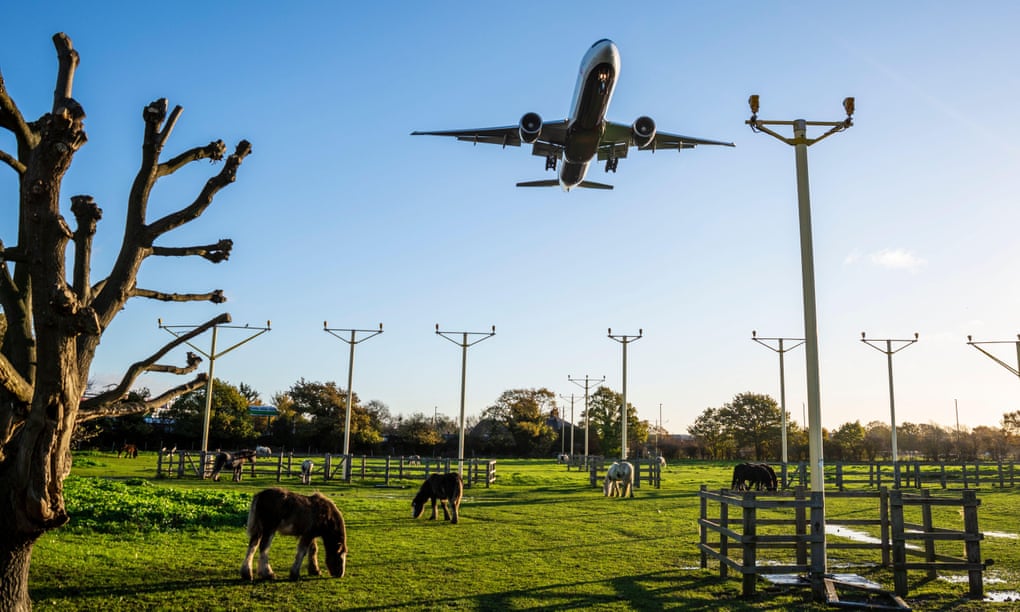
A plane comes into land at Heathrow airport, London. Photograph: Avpics/Alamy
Our rivers, our wildlife, the air we breathe: the government is sacrificing all to the insatiable god of GDP – and mocking our objections
I can scarcely believe I’m writing this, but it’s hard to dodge the conclusion. After 14 years of environmental vandalism, it might have seemed impossible for Labour to offer anything but improvement. But on green issues, this government is worse than the Tories.
The last prime minister to insist that growth should override every other consideration, and to fling insults at anyone who disagreed, was Liz Truss. She called those of us seeking to defend the living world an “anti-growth coalition”, “voices of decline” and “enemies of enterprise” who “don’t understand aspiration”.
Now Keir Starmer has picked up her theme and run with it. Those who challenge government policies that might promote GDP growth, however destructive and irrational, such as the planned expansion of Heathrow, Gatwick, Luton and Doncaster Sheffieldairports, are “time-wasting nimbys”, “zealots” and “blockers”, engaged in “self-righteous virtue-signalling”.
After all, these are the kind of people who might send “congratulations to the climate campaigners” whose legal challenge stopped plans to build a third Heathrow runway at the court of appeal. Or who insist that Heathrow expansion should be blocked because “there is no more important challenge than the climate emergency”. Oh, hang on, that was Starmer, writing in 2020. You know, the one you voted for, not the new model, channelling the worst Tory prime minister of modern times.
Now his chancellor, Rachel Reeves, insists that growth “trumps other things”, including the government’s environmental commitments. The verb is unfortunate. The government’s new rhetoric is horribly reminiscent of the convicted felon: monomania, slogans and insults take the place of nuanced and complex policy.
…
I am only able to quote small sections of this copyrighted article by George Monbiot published in the Guardian. The whole article is here.
Orcas comment on killer apes destroying the planet by continuing to burn fossil fuels.
Planes queuing for takeoff at Heathrow airport in Britain. Credit: david pearson / Alamy Stock Photo
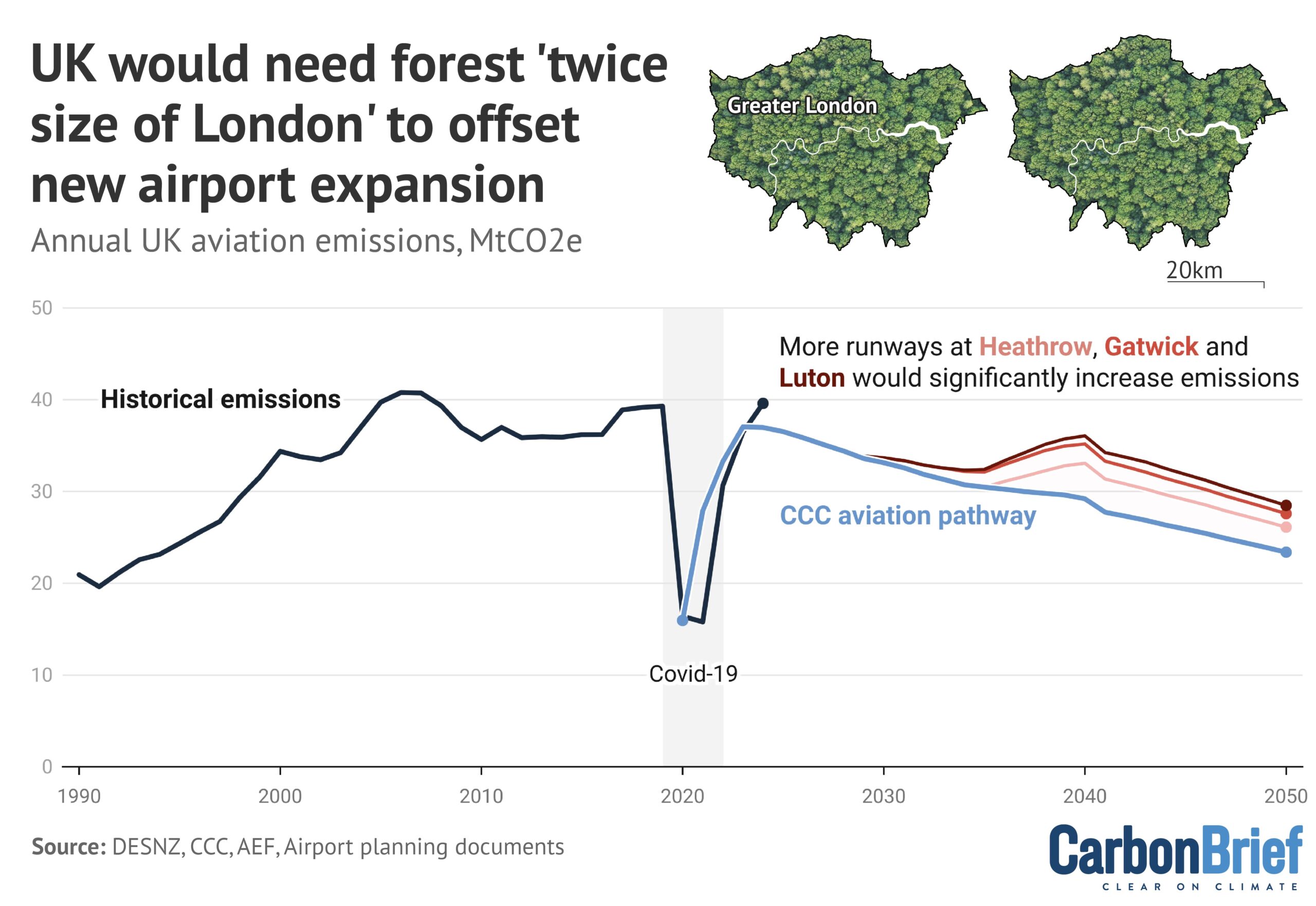
A forest twice the size of Greater London would need to be planted in the UK to cancel out the extra emissions from the expansion of Heathrow, Gatwick and Luton airports, Carbon Brief analysis reveals.
New runaways at these airports surrounding London would result in cumulative emissions of around 92m tonnes of extra carbon dioxide equivalent (CO2e) by 2050, if the number of flights increases in line with their operating company targets.
If the UK is to remain on track for net-zero, it would need to cut emissions further in other sectors of the economy or remove an equivalent amount from the atmosphere.
For example, offsetting these emissions would require more than 300,000 hectares of trees to be planted within just a few years. This equates to all the trees planted in the UK since 2000.
The Labour government is set to back all three airport expansions, according to mediareporting ahead of a speech by chancellor Rachel Reeves this week.
This is in spite of opposition from within the Labour party and the government’s climate advisors recommending against airport expansion.
Reeves has stressed that “sustainable aviation fuels” (SAFs) and electric planes could help to offset these emissions.
However, such technologies are still in the early stages of deployment and previous Carbon Brief analysis suggests the role of SAFs in achieving net-zero may be limited.
Two Londons
Reeves is expected to reveal plans for a third runway at Heathrow in a speech on Wednesday.
This, alongside suggestions she will also announce her support for the expansion of Gatwick and Luton airports, has prompted days of political debate over the friction between the government’s climate and economic plans.
Reeves sees the expansion of airports as a key part of the government’s “growth strategy”. However, senior Labour politicians, notably energy secretary Ed Miliband, have previously opposed such expansions on environmental grounds.
For her part, the chancellor told BBC News that she thought “sustainable aviation and economic growth go hand in hand”.
Carbon Brief has used estimates of passenger numbers from the airports’ planning applications, combined with assumptions used by UK government advisors the Climate Change Committee (CCC), to calculate emissions from the three expansions.
As the chart below shows, the CCC assumes aviation emissions fall in the coming years due to technological and efficiency improvements.
However, the expansion of Heathrow, Gatwick and Luton would drive an uptick in emissions around 2040 as the projects are completed, if the expected number of extra flights take off and if there are no additional improvements in aircraft efficiency.
This would amount to an additional 92MtCO2e being emitted cumulatively by 2050.
In order to remain on track for the UK’s net-zero target, these emissions would need to be avoided by additional technological innovations in the aviation sector, balanced by faster cuts in other parts of the economy – or removed from the atmosphere after being emitted.
Annual UK aviation emissions, MtCO2e. The blue line indicates the trajectory for emissions set out by the CCC. The three red lines indicate the additional emissions that would result from the expansion of Heathrow, Gatwick and Luton airports, plus the resulting flights. The airport expansions are assumed to follow approximate timelines based on their respective planning applications, with some dates assumed based on the views of AEF. The Heathrow expansion is assumed to be in operation in 2035 and at full capacity by 2040. The Gatwick expansion is assumed to be operational in 2028 and at full capacity by 2038. The Luton expansion is assumed to be operational in 2033 and at full capacity by 2043. Sources: DESNZ, CCC, AEF, airport planning documents.
Aviation is generally viewed as a difficult sector to decarbonise, due to the lack of cheap and effective technologies to cut emissions from planes.
This is why campaigners and researchers frequently stress demand reduction as the most effective way to cut aviation emissions.
The UK’s net-zero plans already allow for aviation to be one of the final sectors producing sizable volumes of emissions in 2050, when most of the economy has decarbonised.
One strategy to remove the excess emissions from the additional Heathrow, Gatwick and Luton flights would be to plant more trees. However, this would be a significant undertaking, as Carbon Brief analysis shows.
It would require planting around 301,000 hectares of new forest by around 2028 so that the trees are large enough by the middle of the century to absorb significant amounts of CO2.
This is equivalent to around twice the size of Greater London, which covers 157,000 hectares. It is 10 times higher than the UK’s most recent annual tree-planting target and equates to all of the trees planted in the past 24 years across the country.
More passengers
Government advisors at the CCC have recommended that there should be no more than a 25% growth in the number of air passengers from 2018 levels, in order to meet the UK’s net-zero goal by 2050.
This amounts to an increase from 292 million passengers to 365 million by 2050. The number of UK flights collapsed during Covid-19 lockdowns and has been slow to recover to pre-pandemic levels, but the number of air passengers in 2023 reached 273 million.
The CCC has consistentlystressed that there should be “no net increase” in airport capacity if the UK is to reach net-zero by the middle of the century, meaning any expansion is “balanced by reductions in capacity elsewhere”. It has also stated there should be no airport expansion without a UK-wide framework for managing capacity.
The committee criticised the previous Conservative government for setting “no plans” to limit growth in passenger numbers in its “jet-zero” strategy, which envisaged demand for flying increasing by 70% out to 2050.
Airport expansion at Heathrow, Gatwick and Luton would help bring the total number of passengers at these three sites up to 243 million in 2050, according to the airports’ own planning applications, compiled by the Aviation Environment Federation (AEF).
This amounts to an additional 100m passengers passing through these airports, compared to 2018 levels. This would bring the total number of UK passengers to 392 million – equivalent to a 34% increase in UK airport traffic – meaning that growth at Heathrow, Gatwick and Luton alone would be enough to breach the CCC’s guidance.
(In reality, more than 20 UK airports have plans for more capacity and some already have unused capacity, so it is unlikely that expansion would be limited to three airports around London.)
SAF concerns
The CCC leaves some flexibility in its advice to the government, allowing for future capacity growth, if “the carbon intensity of aviation is outperforming the government’s emissions reduction pathway”.
Essentially, if clean technologies slash aviation emissions faster than expected, then there will be space for more flights within a pathway to net-zero by 2050.
This has been alluded to by Reeves in recent days. She has stated that a “lot has changed in terms of aviation” and reportedly based an internal proposal to expand Heathrow on the use of “sustainable aviation fuels” (SAFs).
In reality, there has been very limited progress in developing SAFs or any other technologies to decarbonise planes in the UK. In 2023, the CCC chastised the Conservative government for “rel[ying] heavily on nascent technologies”.
Government modelling has shown SAFs will have a limited impact on cutting UK aviation emissions. Experts have pointed to the issues with the supply of materials for making SAFs and noted that none of the five SAF plants originally pegged to start construction in the UK this year are being built yet.
Methodology
This analysis is based on the CCC’s sixth carbon budget “balanced pathway” for the aviation sector, combined with data obtained from AEF on the expected increase in passenger numbers from the expansion of Heathrow, Gatwick and Luton airports.
The CCC pathway assumes that the emissions per passenger fall from 0.14 tCO2 in 2020 to 0.06tCO2 in 2050, accounting for the rollout of SAF and more efficient aircraft. It also assumes that no net expansion of airport capacity occurs.
Therefore, in this analysis, the three airport expansions are considered additional to the emissions included within the CCC pathway.
To calculate the additional emissions from the expansion of the three airports, the additional passenger numbers this would facilitate are multiplied by the emissions intensity per passenger in each year of the CCC pathway.
The additional passenger numbers from each airport are added to a Department for Transport pathway that assumes no further expansion. Each airport expansion is assumed to ramp up linearly from the year of operation to the year of operation at full additional capacity.
Based on the airport planning applications and AEF, it is assumed that:
The Heathrow expansion will be operational by 2035 and operating at full capacity by 2040.
The Gatwick expansion will be operational by 2028 and operating at full capacity by 2038.
The Luton expansion will be operational by 2033 and operating at full capacity by 2043.
The calculated CO2 removals from planting trees are based on assumptions used by the CCC’s sixth carbon budget “balanced pathway”, in which there is a 2:1 ratio of conifers to broadleaves planted across the country.
The CO2 removals per hectare for conifers and broadleaves are taken from the UK Centre for Ecology and Hydrology (CEH), whose numbers are also used by the CCC.
Based on these numbers, the cumulative emissions removed per hectare of forest after 22 years – from the start of airport expansion in 2028 to 2050 – is 304tCO2. Dividing this value by the total additional cumulative emissions from the airport expansion (92 MtCO2), gives a total area required of 301,000ha. Given that Greater London is 157,200ha, this corresponds to approximately two (1.91) times the area of Greater London.
Historical UK aviation emissions are taken from the Department of Energy Security and Net Zero (DESNZ) up to 2022. For 2023 and 2024, the emissions are estimated based on percentage annual changes in UK jet fuel use, which are then applied to the emissions from 2022.