US Billboard Campaign Blasts Fossil Fuel Giants for Causing Extreme Heat
Spread the love
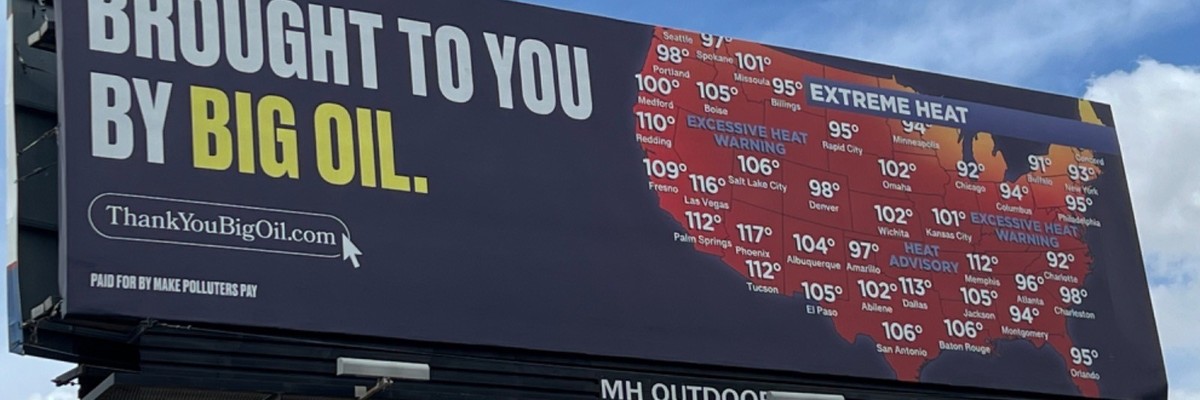
A billboard in Austin, Texas shows a U.S. map with high temperatures across the nation.
 (Photo: Fossil Free Media)

Original article by ULIA CONLEY republished from Common Dreams under Creative Commons (CC BY-NC-ND 3.0). 
“From Alaska to Maui, our communities are struggling to survive the rapidly worsening impacts of the climate crisis, all the while, Big Oil is raking in billions at our expense.”

As about 111 million people in nearly two dozen states continued to face heat advisories, with temperatures reaching as high at 115°F in some cities, the nonprofit media lab Fossil Free Media unveiled a multicity campaign with one simple goal: ensuring that all Americans understand that the intense heatwaves across much of the country this summer have not been a natural phenomenon, but the result of continued fossil fuel extraction.

Starting Thursday drivers along stretches of highway in Phoenix, Arizona; Austin, Texas; and Fresno, California will pass by prominent billboards displaying a map of record-breaking temperatures that have been recorded across the U.S. this summer.

Fresno drivers will be reminded of a 109°F day in their city while those in Phoenix will see 117°F plastered over their hometown on the map, accompanied by the words, “Brought to you by Big Oil” and ThankYouBigOil.com.

That website redirects to Fossil Free Media’s (FFM) Stop the Oil Profiteering (STOP) project, where visitors can read about the estimated cost of climate-related disasters such as hurricanes, extreme heat, and wildfires—over $600 billion from 2016-20 alone—and the 5,000 people killed by such events in that same time period.

“The fossil fuel industry has known for decades that their products are fueling climate change and extreme weather, yet they have failed to act,” reads the website. “Instead, major oil and gas companies continue to invest billions into new projects that lock in decades more fossil fuel extraction while our communities take the heat… literally.”

Jamie Henn, director of the organization, said on social media that the public “needs to understand that this summer’s brutal heatwave was brought to you by Big Oil.”

The World Weather Attribution said last month that the heatwaves experienced by people across the U.S. and Europe in July would have been “virtually impossible” without the climate crisis, which scientists have for years said is being fueled by heat-trapping emissions from oil, gas, and coal extraction.

The organization also reported this week that wildfires in eastern Canada in recent weeks were made twice as likely by the climate emergency, which as STOP said, has created “tinderbox conditions” by making droughts longer and more intense.

“From Alaska to Maui, our communities are struggling to survive the rapidly worsening impacts of the climate crisis, all the while, Big Oil is raking in billions at our expense,” said Cassidy DiPaola, spokesperson for FFM and STOP. “There’s no denying that this summer’s brutal heatwaves are being fueled by the same Big Oil companies who are spreading climate disinformation and blocking much needed climate progress.”

More than 100 people in the U.S. have died of heat-related causes so far this year, and weather experts have continued to report high temperatures throughout August after July set a world record for the hottest month in recorded history.

Jennifer Falcon, a resident of Austin, told FFM that the climate crisis has emerged as an economic justice issue in her community as Texas broke its all-time record for power consumption last month, with people across the state struggling to stay cool.

“Texans are paying 800% more to cool their homes during the extreme heat that blankets our state,” she said. “This means choosing between food on the table or cooling your home to mitigate health impacts from the sweltering heat while Big Oil profits.”

As millions of people in the U.S. faced sweltering temperatures this summer—raising the risk of heat-related illness and even severe contact burns—ExxonMobil reported $7.9 billion in profits, its second-highest profit margin for a second quarter in over a decade.

Along with the billboards, STOP unveiled an ad showcasing the Big Oil’s link to the climate extremes Americans are increasingly at risk of facing.

“Record heatwaves? You can thank Big Oil for that,” said STOP. “Deadly wildfires? Yep, that’s Big Oil. Catastrophic storms? Smog-covered cities? You guessed it—Big Oil.”

The group is one of several scheduled to lead a March to End Fossil Fuels in New York City on September 17, with the rally being held as the United Nations holds a Climate Ambition Summit.

Aimed at pressuring U.S. President Joe Biden to declare a climate emergency, Fossil Free Media said the march is expected to be “the largest climate action since before the pandemic.”

Original article by ULIA CONLEY republished from Common Dreams under Creative Commons (CC BY-NC-ND 3.0). 
Continue ReadingUS Billboard Campaign Blasts Fossil Fuel Giants for Causing Extreme Heat

Winter heatwave in Andes is sign of things to come, scientists warn

Spread the love

https://www.theguardian.com/environment/2023/aug/06/winter-heatwave-andes-sign-things-come-scientists-warn

Human-caused climate disruption and El Niño push temperature in mountains to 37C

Exceptional winter heat in the Andean mountains of South America has surged to 37C, prompting local scientists to warn the worst may be yet to come as human-caused climate disruption and El Niño cause havoc across the region.

The heatwave in the central Chilean Andes is melting the snow below 3,000 metres (9,840ft), which will have knock-on effects for people living in downstream valleys who depend on meltwater during the spring and summer.

Tuesday was probably the warmest winter day in northern Chile in 72 years, according to Raul Cordero, a climate scientist at the University of Groningen, who said the 37C recorded at the Vicuña Los Pimientos station in the Coquimbo region was caused by a combination of global heating, El Niño and easterly gusts, known by locals as Terral winds that bring hot, dry weather.

Dozens of meteorological monitoring stations at more than 1,000 metres altitude recorded temperatures above 35C in winter, according to the Extreme Temperatures Around The World blog.

https://www.theguardian.com/environment/2023/aug/06/winter-heatwave-andes-sign-things-come-scientists-warn

One of 2023’s most extreme heatwaves is happening in the middle of winter

Continue ReadingWinter heatwave in Andes is sign of things to come, scientists warn

The oil industry has succumbed to a dangerous new climate denialism

Spread the love
Opec predicts oil demand will be 10% higher by the 2040s.
Iurii

Adi Imsirovic, University of Surrey

If we have not been warned of the dangers of climate change this summer, we never will be. Extreme heat, forest fires and floods have been all over news reports. Yet the oil and gas industry remains largely in denial.

The International Energy Agency (IEA) says steep cuts in oil and gas production are necessary to reach the Paris (COP 21) goal of keeping global warming at 1.5℃. However, only a tiny fraction of the industry, accounting for less than 5% of oil and gas output, has targets aligned with the IEA’s “net zero” requirements.

The current secretary general of production cartel Opec, Haitham al-Ghais, expects global oil demand to rise by about 10% to 110 million barrels a day by 2045, a volume incompatible with the Paris goals. The UK government has just offered a helping hand, granting around 100 new North Sea licences. What are we to make of this mismatch?

The new denialism

Typical of the new breed of climate denialism is a recent report by the Energy Policy Research Foundation (ERPF), a body funded by the US government and various undisclosed corporate interests and foundations. It sees the IEA’s requirements as a “seal of approval … to block investment in oil and gas production by western companies”. The report views meeting the targets as too costly, too harsh on poor countries and too bad for the energy security of the west.

In fact, it is wrong on each account. Many eminent economists and scientists use the concept of the social cost of carbon (SCC), which is defined as the cost to society of releasing an additional tonne of CO₂. Expert estimates from 2019 put this at between US$171 and US$310 (£133 to £241). If we go with, say, US$240 per tonne, the social cost of continued carbon equivalent emissions comes out at almost US$8.5 trillion every year.

A recent study has factored into the calculation climate feedback loops. This is where one problem caused by global warming leads to others, such as melting permafrost unleashing stores of methane.

When the study estimated the economic damage that this could cause, it produced an SCC in excess of US$5,000. That implies annual costs of more like US$170 trillion a year, which makes the US$4 trillion investment into clean energy that the IEA thinks necessary to meet the Paris climate goals look like a drop in the ocean.

It may help to break this down to one barrel of oil. A special IEA report for COP28 estimates that on average, each barrel of oil emits 0.53 tonnes of CO₂ equivalent in greenhouse gas across its life cycle, 20% of which comes from production.

Going back to our average SSC per tonne of US$240, that points to a social cost of US$126 per barrel. With oil currently at US$85 per barrel, the societal damage from producing, transporting, refining and consuming it is far greater – and that’s before including climate feedbacks.

Meanwhile, the arguments by the EPRF and like-minded supporters about energy security are laughable. The history of the oil and gas industry is a history of wars and geopolitical tensions. Transitioning to cleaner fuels can only increase our energy security and reduce the need to police remote autocracies.

The argument that poor countries need to continue burning carbon for development reasons is no better. In its latest report from 2022, the Intergovernmental Panel on Climate Change (IPCC) said climate change would probably see an increase in “losses and damages, strongly concentrated among the poorest vulnerable populations”.

Equally, the World Health Organization estimates that: “Between 2030 and 2050, climate change is expected to cause approximately 250,000 additional deaths per year from malnutrition, malaria, diarrhoea and heat stress.”

How to respond

The denialists offer no alternatives to cutting carbon emissions, and often simply ignore climate change altogether. The recent ERPF report mentions climate change only four times. It is as if heatwaves, forest fires, flooding, rising sea levels and the demise of natural habitat caused by climate inaction were happening on another planet.

We still have time to limit global warming below 1.5℃. It is true that we will need oil and gas for many years, and that there are currently no alternatives for certain sectors such as air travel, shipping and some industries. Nonetheless, there is still much that can be done now to make a substantial difference.

To incentivise the transition to cleaner energy, governments need to end fossil fuel subsidies, which the IMF estimates amounted to US$5.9 trillion in 2020 alone. We also need to put a proper price on carbon – only 40 countries have attempted this so far, and none has it anywhere near the estimated social cost of emitting carbon.

Countries that resist charging their own polluters should face a carbon border adjustment mechanism, which is a tariff that effectively puts the polluter on the same footing as local players. If all the actors in the fossil fuel supply chain had to face the cost of the damage they cause, the need to phase out long-term investments in fossil fuels would become more obvious.

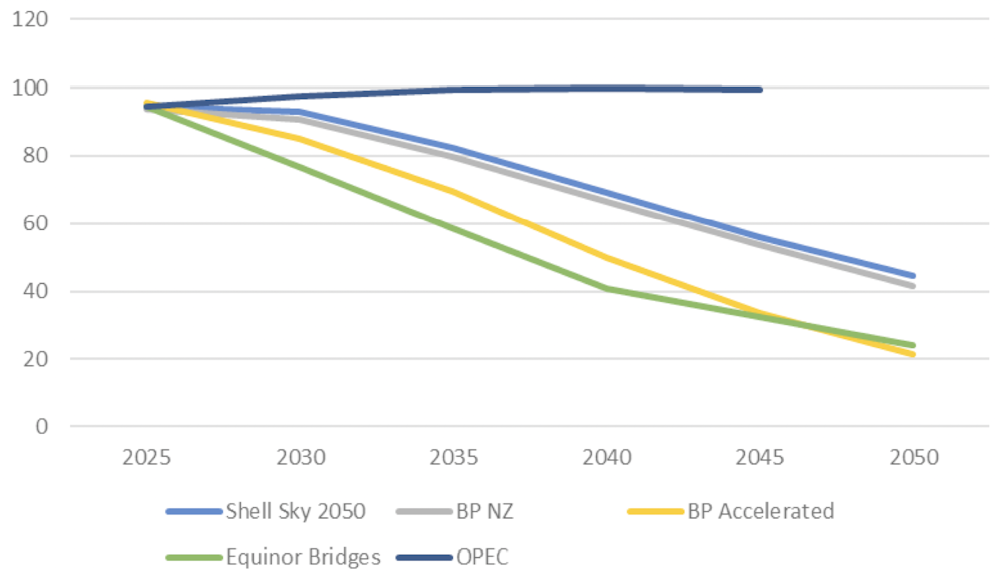
The IEA requirements for “net zero” are just one of the pathways towards meeting the Paris goal of 1.5℃ warming. Others are explored by some of the more credible actors in the petroleum industry, such as Shell, BP and Norway’s Equinor, but all require a substantial decline in oil demand and production by 2050.

Required production cuts

Graph showing the required production cuts to meet net zero
I left the IEA’s scenario off the graph because it published so few datapoints, but it is broadly in line with the others. Meanwhile, the Opec data is for reference and not a net zero scenario.
BP, Shell, Equinor and Opec

Instead of criticising efforts to slow climate change and sponsoring ridiculous reports calling for more fossil fuels, the oil industry should eliminate leakages, venting and flaring of methane, and electrify as many processes as possible using renewable power. It should also employ carbon capture, usage and storage technologies over the next ten years – yes this will increase the price of fossil fuels, but that is exactly what we need to make clean sources of energy competitive across the board and speed up the energy transition.

The sooner the industry starts facing up to the realities of climate change, the more chance it has to survive. The companies and even countries that produce fossil fuels will have to face and pay the cost for the damage they cause. Those costs are already massive and will grow. Those that survive will do so only as a provider of clean and sustainable energy.


Imagine weekly climate newsletter

Don’t have time to read about climate change as much as you’d like?

Get a weekly roundup in your inbox instead. Every Wednesday, The Conversation’s environment editor writes Imagine, a short email that goes a little deeper into just one climate issue. Join the 20,000+ readers who’ve subscribed so far.The Conversation


Adi Imsirovic, Fellow, University of Surrey

This article is republished from The Conversation under a Creative Commons license. Read the original article.

Continue ReadingThe oil industry has succumbed to a dangerous new climate denialism

Morning Star: Despite both parties’ political backsliding, Britain must take responsibility over climate change

Spread the love

https://morningstaronline.co.uk/article/e/despite-both-parties-political-backsliding-britain-must-take-responsibility-over-climate

AS heatwaves and wildfires sweep across swathes of southern Europe, north Africa and North America, today’s report from the World Weather Attribution (WWA) rang timely alarm bells.

WWA scientists predict that highly inflammatory temperatures of up to 45°C (Palermo has just reached 47°C) should no longer be regarded as unusual.

They estimate that heatwaves of the kind we have seen this July can be expected to recur around once every 15 years in North America, every 10 years in Europe and every five years in China.

Moreover, they warn that if the planet’s temperatures rise by another 1°C, on top of the 1°C increase since the late 19th century, heatwaves and wildfires will strike even more frequently.

Underlying these projections is the certainty — supported by an Everest-sized pile of scientific evidence and shared by almost all climate scientists and their professional organisations — that human activity is by far the biggest cause of global warming.

Yet the Westminster government and the Labour opposition have spent the past week — of all weeks — diluting the case and the policies for meeting Britain’s net-zero emissions target by 2050.

The Conservatives favour the exploitation of new oil, gas and coal sources while blocking onshore wind developments. With Labour’s support, they are pushing ahead with a major rearmament programme. As the Scientists for Global Responsibility point out in their invaluable report, The Environmental Impacts of the UK Military Sector (2020), the production, testing and use of armaments contribute hugely to greenhouse gas emissions — yet the figures are concealed from the public and excluded from official statistics by Britain and many other states.

The Labour leadership has announced the postponement of its Green Investment Plan even before winning a general election and taking office.

Instead of explaining the need for ultra-low emission zones (Ulez) based on genuine local consultation and support for people’s jobs and living standards, Keir Starmer blames London’s Labour mayor and Ulez for the party’s defeat in a parliamentary by-election.

https://morningstaronline.co.uk/article/e/despite-both-parties-political-backsliding-britain-must-take-responsibility-over-climate

Continue ReadingMorning Star: Despite both parties’ political backsliding, Britain must take responsibility over climate change

Twenty one Just Stop Oil supporters arrested

Spread the love

Just Stop Oil are demanding that the UK government halt any new licensing or consents for oil, gas and coal extraction in the UK.

In an escalation of resistance from previous weeks, 180 Just Stop Oil supporters, in fourteen groups, began marching on key roads in central London. They marched in groups of between 5 and 25 supporters, carrying placards reading “new oil = murder”, “ hottest June ever” and “can’t eat oil”.

Police followed numerous groups before marches began and stopped and searched dozens of people. Police began issuing Public Order Act (Section 12) notices at 8:10am, just minutes after the first march set off. Three Just Stop Oil supporters were arrested after 15 minutes of marching on Liverpool Street. Around twenty Just Stop Oil supporters were arrested as they attempted to leave Lambeth bridge, however 11 of these were de-arrested. The team in Victoria was removed by 8:35. Police were seen following marchers on the tube at 9:00am. Another two were arrested on Liverpool Street at 9:45. At 10:30 two were arrested on Victoria Street.

Frances Davis, 20, from Norwich spoke to the camera as she was held in handcuffs:

“I’ve been marching for just under 15 minutes and I’m under arrest for demanding the same thing as the IPCC (Intergovernmental Panel on Climate Change), the United Nations and the government’s own scientific advisors have been demanding- and we’ve just been ignored. We’ve tried everything else and now I’m in handcuffs, just for going on a march.”

This morning’s marches come as extreme heat continues to ravage Europe and now 110 million people have been issued extreme heat warnings in the US, as a heat dome over the US south-west has translated into coast to coast alerts. Temperature records could be broken in as many as 38 cities. In Las Vegas security guards can be seen guarding the fountains of upscale casinos and hotels to prevent people from jumping in, whilst mobile clinics are reporting treating homeless people suffering from third-degree burns.

Since the Just Stop Oil campaign launched on 14th February 2022, there have been over 2,200 arrests and 138 people have spent time in prison, many without trial. Just Stop Oil supporters Morgan Trowland and Marcus Decker are serving three-year prison sentences for resisting new oil, gas and coal in the longest sentences for peaceful climate action in British history.

Juststopoil.org.

Continue ReadingTwenty one Just Stop Oil supporters arrested