Climate Emergency Causes Extreme Wildfires to Double in Frequency: Study

Spread the love

Original article by JULIA CONLEY republished from Common Dreams under Creative Commons (CC BY-NC-ND 3.0).
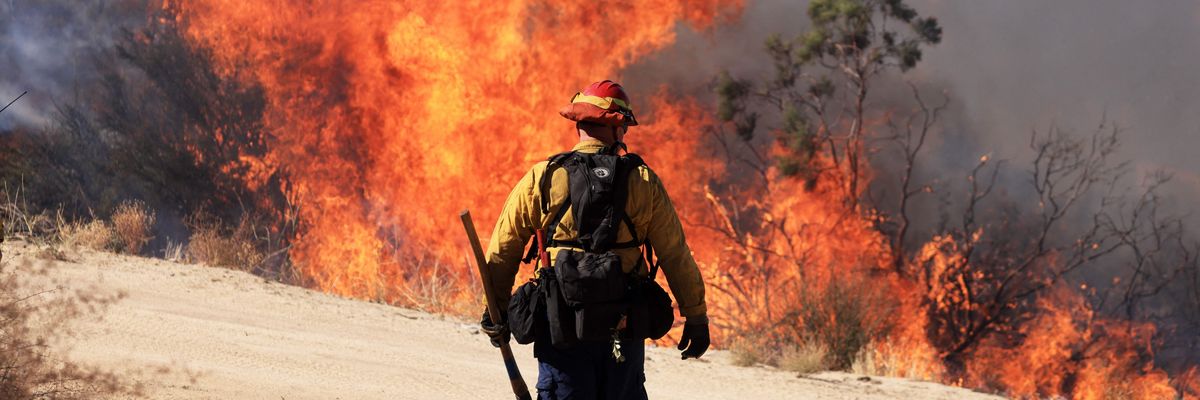
A firefighter walks toward flames as the Highland Fire burns in Aguana, California, on October 31, 2023. 
(Photo: David Swanson/AFP via Getty Images)

“Climate change is not something off in the future,” said one scientist. “It’s happening before our very eyes.”

New findings about the rising frequency of extreme wildfires have “the fingerprints of climate change” all over them, according to an Australian scientist who led a study published on Monday.

Calum Cunningham, a postdoctoral researcher at the University of Tasmania in Australia, told The Washington Post that he was driven to examine current trends in the frequency of wildfires after climate deniers suggested that because the global area being burned in blazes is declining, the idea of a growing wildfire crisis is being overblown by concerned scientists.

While the area destroyed by wildfires is indeed on the decline, analyses that include all fires—the majority of which are small and cause relatively little damage—obscured how the most extreme and destructive wildfires are rapidly growing more frequent.

Cunningham and his team analyzed data from National Aeronautics and Space Administration satellites, collecting four images of wildfires around the world per day over 21 years. They used the images to identify the 0.01% most extreme wildfires—those that release the most smoke and greenhouse gas emissions due to their size and uncontrollable nature.

Out of 30 million fires across the world over two decades, the researchers identified the 2,913 most extreme fire events and found that the frequency and intensity of such wildfires has more than doubled since 2003.

“Climate change is making fire weather more extreme and more frequent in a lot of the world.”

The problem is rapidly getting worse, the team found: The six years with the most extreme wildfires had all occurred since 2017.

Trends were particularly troubling in particular regions, like temperate conifer forests in the western United States and the Mediterranean, where the number of extreme fires rose by more than 10 times in 20 years.

In boreal forests in places like northern Europe and Canada, the frequency of the most intense and hard-to-control blazes increased by seven times.

“It’s absolutely in keeping with what climate change is doing to fire weather around the world,” Cunningham told the Post. “Climate change is making fire weather more extreme and more frequent in a lot of the world.”

The “fire weather” that’s driven the increase includes hotter and drier conditions, with temperatures staying high even overnight when they ordinarily would have have dropped in previous decades, giving firefighters a chance to make headway in putting out blazes.

“Rarely did we have 100,000-acre fires 20 years ago,” veteran firefighter Bobbie Scopa told the Post. “But now, it’s not uncommon.”

The researchers pointed to a “scary” feedback loop created as extreme wildfires create carbon emissions—leading to more planetary heating and even more fires.

“Climate change is not something off in the future,” Cunningham told the Post. “It’s happening before our very eyes. This is the manifestation of the reshaping of the climate we are doing.”

The study was published in Nature Ecology & Evolution days after wildfires scorched more than 14,000 acres in Southern California and more than 24,000 acres in New Mexico, where two people were killed. Last year, climate scientists were stunned by an unprecedented wildfire season in relatively damp Eastern Canada, where wildfires were made twice as likely by the climate emergency according to the World Weather Attribution.

Climate scientist and author Bill McGuire called the findings “terrifying, of course, but just not a surprise,” considering governments in the countries that produce the most fossil fuels are continuing to support and subsidize energy sources that heat the planet.

“This is certifiably insane,” McGuire said.

Original article by JULIA CONLEY republished from Common Dreams under Creative Commons (CC BY-NC-ND 3.0).

Continue ReadingClimate Emergency Causes Extreme Wildfires to Double in Frequency: Study

What grief for a dying planet looks like: Climate scientists on the edge

Spread the love

https://www.aljazeera.com/features/2024/6/16/what-grief-for-a-dying-planet-looks-like-climate-scientists-on-the-edge-2

Environmental engineer Wolfgang Metzeler-Kick, centre, and energy engineer Richard Cluse, right, began a hunger strike in March in Berlin, Germany, under the motto “starving until you are honest” in a protest organised by Scientist Rebellion. The protesters seek acknowledgement from the German chancellor of the severity of the climate crisis [Sean Gallup/Getty Images]

Desperate climate scientists embrace civil disobedience and specialised therapy to deal with their growing anxiety over global warming.

“I was scared as hell. … I remember feeling very nervous.”

On April 6, 2022, Peter Kalmus, a climate scientist at NASA’s Jet Propulsion Laboratory, got a ride into downtown Los Angeles, where he was about to handcuff himself to the door of a JPMorgan Chase bank alongside three fellow scientists.

“There was a moment,” he says of the decision to engage in civil disobedience when he “realised that I just had to do it, to find that courage”.

He was joining more than 1,000 activists taking to the streets in nearly 30 countries across the globe under the slogan “1.5C is dead, climate revolution now!” – a campaign led by Scientist Rebellion, an activist group of scientists, academics and students committed to disruptive, nonviolent action to raise alarm over the global climate emergency.

“I was really scared,” Kalmus reiterates over a call, about how his colleagues, the police and, especially, his employer would respond. “I thought there was a very good chance that I’d get fired, which was probably my biggest concern.”

But by that point, he had exhausted all other avenues. For Kalmus, civil disobedience came as a culmination of decades of attempts to raise awareness of the climate emergency by other means. With what he sees as half the country being in denial of the urgency of the climate crisis, Kalmus says he didn’t know what else to do; this was the next logical step and one he admits has been the most effective.

Joining a global day of action in 2022 to ban private jets, Peter Kalmus and local activists chain the doors of a private airport in Charlotte, North Carolina, to underscore the disproportionately high impact the wealthy have in terms of carbon emissions [Courtesy of Will Dickson]

During a speech he delivered that day, which has gone viral around the world, Kalmus is visibly emotional, breaking down in tears as he tells the onlookers: “So I’m here because scientists are not being listened to. I’m willing to take a risk for this gorgeous planet – for my sons,” he gasps as he tries to control the tremor in his voice. “I’ve been trying to warn you for so many decades, and now we’re heading towards a f****** catastrophe.”

After a standoff with police and an eight-hour stint in jail, Kalmus was charged with misdemeanour trespassing, but the charges were later dropped. That first arrest felt exhilarating and freeing, he says, but the incident led to a months-long investigation by NASA’s ethics and human resources departments, and the resulting stress caused Kalmus’s diverticular disease to flare up. While he was stuck in a holding pattern awaiting the outcome of the inquiry, which ended in his favour (Kalmus is still employed by NASA and spoke to Al Jazeera in a private capacity), Kalmus felt like the institution was making a mistake by not supporting his activism “since climate activists are clearly on the right side of history”, he says.

Article continues at https://www.aljazeera.com/features/2024/6/16/what-grief-for-a-dying-planet-looks-like-climate-scientists-on-the-edge-2

Continue ReadingWhat grief for a dying planet looks like: Climate scientists on the edge

South Asia sizzles: Record heatwave and extreme weather blamed on climate crisis

Spread the love

https://globalvoices.org/2024/05/06/south-asia-sizzles-record-heatwave-and-extreme-weather-blamed-on-climate-crisis/#

Screenshot from YouTube video by Abhi and Niyu via Zoom.Earth. April 7, 2024. Fair use.

A scorching heatwave is ravaging South and Southeast Asia, impacting hundreds of millions with its intense heat. With April temperatures shattering previous records, the region is witnessing extreme weather patterns, wildfires, and tragic heat-related deaths. Schools have been forced to close, agricultural production and storage of perishable foods have been disrupted, and the risk of heatstroke and other health problems has risen significantly.

Climate scientist Roxy Koll tweeted:

The scientists attribute the heatwave to the diminishing influence of the 2023–2024 El Niño event, which started in July 2023.

Forest fires and heatstroke deaths in Bangladesh

Bangladesh has experienced increasingly extreme weather conditions in recent years, and April 2024 stands out as the hottest month since 1948, with average temperatures ranging from 40–42 degrees Celsius (104–107.6 degrees Fahrenheit) in over 80 percent of the country.

Climate journalist Rafiqul Montu posted on X (formerly Twitter):

Wildfires erupt amid extreme heat and dry conditions

Typically in April, Bangladesh receives 130.2 millimetres of rain, however, this year, there was almost none. The government announced the closure of government schools affecting 33 million students nationwide, while private schools with better facilities transitioned to online education. In just one week of April, over 10 deaths across the country were attributed to heatstroke.

However, the most notable impact was the wildfires in different parts of the Sundarbans Reserve Forest, the world’s largest mangrove forest. Sundarbans is a remote area, lacking adequate firefighting resources nearby. The Forest Department, along with fire service personnel, local villagers, and other volunteers, could only start firefighting efforts 17 hours after the first fire. As of the time of writing this report, a significant portion of the huge fire in the Amurbunia area of the Chandpai range is still burning, posing a threat to its rich biodiversity.

Article continues at https://globalvoices.org/2024/05/06/south-asia-sizzles-record-heatwave-and-extreme-weather-blamed-on-climate-crisis/#

Continue ReadingSouth Asia sizzles: Record heatwave and extreme weather blamed on climate crisis

London seeing more days above 30C, experts say

Spread the love

https://www.bbc.co.uk/news/articles/cx9wprd0kw9o

The capital is seeing an increase in extreme heat events, a researcher said

London is seeing an increase in the number of days where the temperature climbs above 30C (86F), new analysis shows.

The International Institute for Environment and Development (IIED) analysis shows the capital has experienced 116 days higher than 30C in the past three decades – more than half of which occurred in the last 10 years.

Really extreme temperatures have become more frequent too, with seven days above 35C in the past three decades, five of which occurred within the last five years, statistics from 1994-2023 show.

A researcher behind the study said London must adapt to the “new reality”.

The analysis found consecutive days above 30C were becoming more common – in the 1990s and 2000s there were two years in each decade with three or more days in a row where temperatures soared over 30C.

But since 2017, every year except 2021 has seen the temperature climb above 30C in London for three or more consecutive days each summer.

https://www.bbc.co.uk/news/articles/cx9wprd0kw9o

Continue ReadingLondon seeing more days above 30C, experts say

Food security threatened by extreme flooding, farmers warn

Spread the love

https://www.bbc.co.uk/news/science-environment-68792017

Record-breaking rain over the past few months has left fields of crops under water and livestock’s health at risk, adding to pressures on food producers.

The flooding and extreme weather linked to climate change will undermine UK food production unless farmers get more help, the National Farmers Union said.

The NFU is calling on the government to do more to compensate flooded farmers and support domestic food production.

The government said it was looking to expand a new compensation scheme.

The NFU has warned of “substantially reduced output” and “potential hits” to the quality of crops in this year’s harvest thanks to weeks of rain since the autumn.

NFU vice president Rachel Hallos said UK farmers were “on the front line of climate change – one of the biggest threats to UK food security”.

“These extremes could soon become the norm,” she told the BBC. “We need a clear plan from government to prepare, adapt and recover from our changing climate in the short and long term so that we can continue to produce food and care for the countryside.”

https://www.bbc.co.uk/news/science-environment-68792017

Dead lambs and ‘decimated crops’ on rain-soaked farms

“We’ve been underwater for coming up to six months”

Continue ReadingFood security threatened by extreme flooding, farmers warn