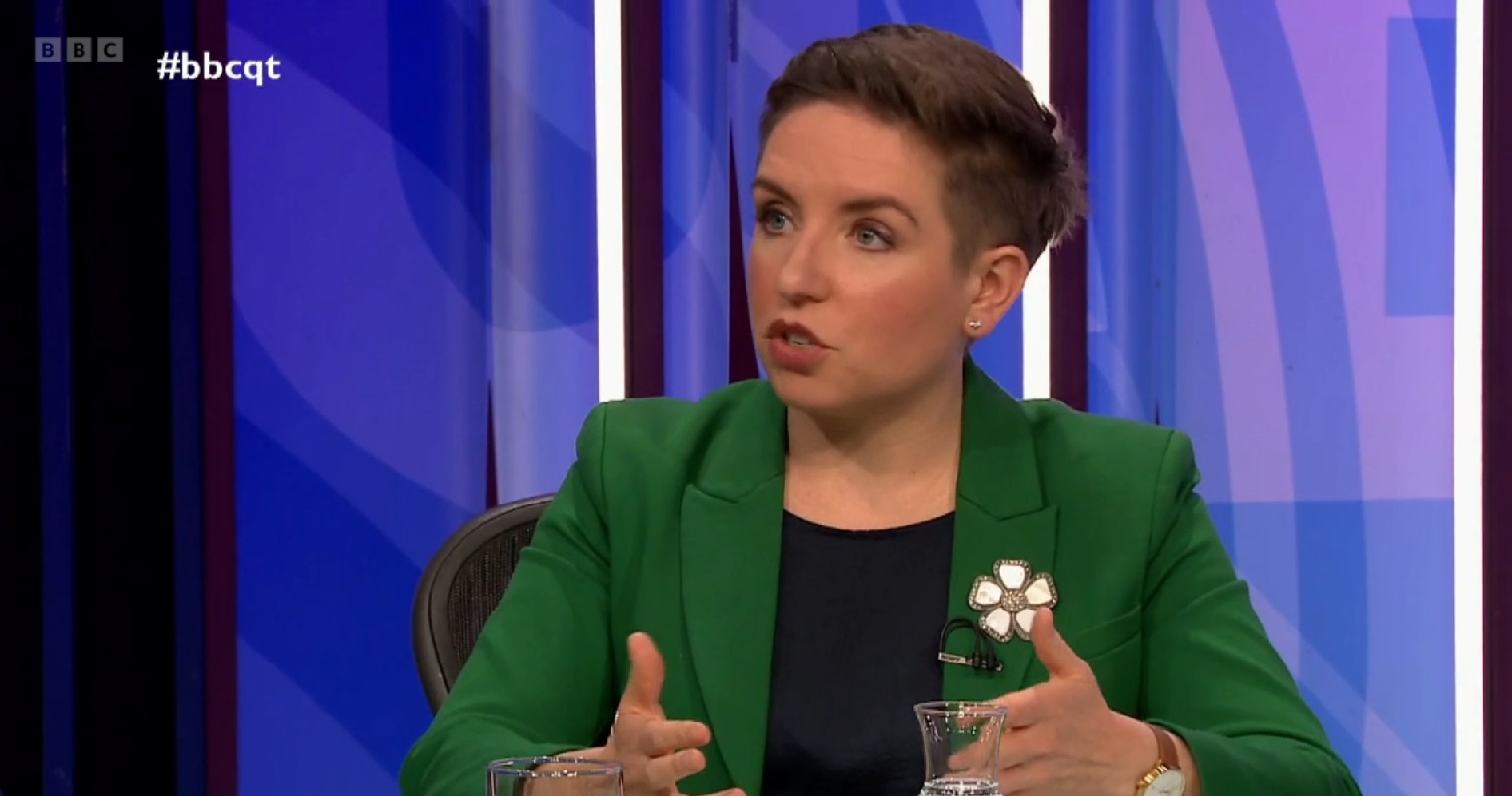
Image of the Green Party’s Carla Denyer on BBC Question Time.
Reacting to news that 2023 is set to become the warmest year on record following unprecedented October temperatures, co-leader of the Green Party, Carla Denyer, said:
“Another week, another indicator that our climate is in meltdown. News that 2023 will almost certainly be confirmed as the hottest year on record, comes just a day after the government made the totally reckless decision to push for new oil and gas licences. This represents a massive two fingers up at communities at home and abroad who are on the front line of floods, droughts and fires, and to future generations who face an uninhabitable planet if we continue with business as usual. It’s also another alarming example of the Conservatives’ allergy to evidence-based policymaking.
“This is another wake-up call – as if any more were needed – on the urgent need to transform our economy and society – ramping up cheaper and abundant renewable resources such as solar and wind power, insulating millions of homes, investing in the infrastructure for active travel, boosting public transport and changing land management practices so that nature can thrive and help to soak up the emissions we’ve released.
“Only Greens give the climate crisis the focus it needs, which is why, whoever forms the next government, we need more Green Party MPs in parliament pushing for climate action.”
Governments plan to increase oil and gas production until at least 2050, UN-backed study reveals.
Major fossil fuel-producing countries plan to extract more than double the amount of fossil fuels in 2030 than is consistent with the Paris climate accord’s goal for limiting global temperature rise.
This is despite frequent and devastating heatwaves, droughts, floods and wildfires in recent months.
Coal production needs to ramp sharply down to address climate change, but government plans and projections would lead to increases in global production until 2030, according to a United Nations-backed study released Wednesday.
Global oil and gas production, meanwhile, would increase until at least 2050, the Production Gap Report states.
This conflicts with government commitments under the climate accord, which seeks to keep global temperature rise below 1.5 degrees Celsius.
Glaring gap between climate goals and fossil fuel extraction
The report examines the disparity between climate goals and fossil fuel extraction plans, a gap that has remained largely unchanged since it was first quantified in 2019.
“Governments’ plans to expand fossil fuel production are undermining the energy transition needed to achieve net-zero emissions, creating economic risks and throwing humanity’s future into question,” Inger Andersen, executive director of the United Nations Environment Programme, said in a statement.
As world leaders convene for another round of United Nations climate talks at the end of the month in Dubai, seeking to curb greenhouse gases, Andersen said nations must “unite behind a managed and equitable phase-out of coal, oil and gas – to ease the turbulence ahead and benefit every person on this planet.”
Image of InBedWithBigOil by Not Here To Be Liked + Hex Prints from Just Stop Oil’s You May Find Yourself… art auction. Featuring Rishi Sunak, Fossil Fuels and Rupert Murdoch.
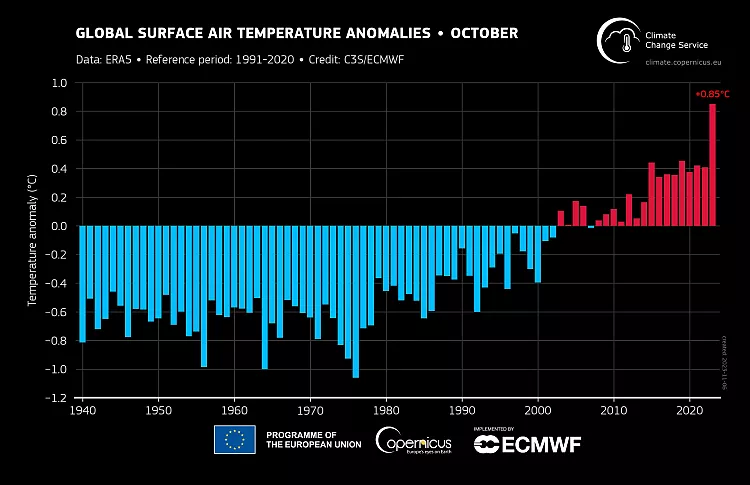
After four months of global records being “obliterated”, temperatures in October have left climate scientists nearly certain that 2023 will be the hottest on record.
Scientists now say that 2023 is “virtually certain” to be the warmest year on record.
Data from the Copernicus Climate Change Service (C3S) reveals that this October was the warmest on record globally. As a whole, it was 1.7ºC above pre-industrial averages after four consecutive months of temperature records being broken.
In Europe, it was the fourth warmest October on record with temperatures 1.3ºC higher than the 1991 to 2020 average.
“October 2023 has seen exceptional temperature anomalies, following on from four months of global temperature records being obliterated,” says Samantha Burgess, deputy director of C3S, the European Union’s climate change agency.
Globally averaged surface air temperature anomalies relative to 1991–2020 for each October from 1940 to 2023. Data Source: ERA5.C3S/ECMWF
Green Party co-leader Adrian Ramsay has called for next week’s King’s Speech to tackle the climate and nature emergencies.
Green Party Co-leader Adrian_Ramsay. Wikipedia CC.
Ramsay said:
“Rishi Sunak has decided when in a climate hole keep digging. Pushing ahead with new oil and gas drilling licences is an act of environmental vandalism. Especially at a time when the country is reeling from hugely damaging storms and floods, which scientists warn will become more frequent, ferocious and destructive as our planet heats.
“It seems fossil fools are driving government energy policy – pushing a false narrative that extracting more climate-wrecking oil and gas out of the North Sea will lead to energy security and lower bills. Nothing could be further from the truth.
“Green lighting energy giants to exploit fossil fuel reserves they then sell on the global market at global prices cannot provide either security or cheaper energy bills. This can only come from ramping up cheaper and abundant renewable resources such as solar and onshore wind together with a mass home insulation programme.
“That’s why Green MP Caroline Lucas has set out five Bills that the government ought to introduce to tackle the climate and nature emergencies and address the cost-of-living crisis, including a Just Fossil Fuel Phaseout Bill and a Green New Deal Bill.
“The attack on road safety measures is a further deplorable and desperate attempt to pick up a few votes through creating a culture war. But the fact that the Conservatives need to go to such extremes to create a wedge issue with Labour shows that Labour simply aren’t offering the bold alternative or hopeful vision that our communities so desperately need.
“It is clear, whoever forms the government after the next general election, we are going to need more Green MPs pushing legislation that will lead to a greener, fairer, healthier and safer country.”
In the wake of the destructive Hurricane Otis, we find ourselves at a pivotal moment in the history of weather forecasting. The hurricane roared ashore with 165mph winds and torrential rainfall, slamming into the coastal city of Acapulco, Mexico and claiming the lives of at least 48 people.
The speed at which Otis intensified was unprecedented. Within 12 hours it went from a regular tropical storm to a “category 5” hurricane, the most powerful category and one which might occur only a few times worldwide each year.
This rare and alarming event, described by the US National Hurricane Center as a “nightmare scenario”, broke records for the fastest intensification rate over a 12-hour period in the eastern Pacific. Otis not only caught residents and authorities off guard but also exposed the limitations of our current predictive tools.
I specialise in the study of natural disasters with the goal of improving our ability to predict them and ultimately to save lives. It is critical that we address the pressing concerns related to the tools we use for forecasting these catastrophic events, all while recognising the significant influence of rapid climate change on our forecasting capabilities.
The predictive tools we rely on
At the core of weather forecasting are computer programs, or “models”, that blend atmospheric variables such as temperature, humidity, wind and pressure, with fundamental physics.
Since the atmospheric processes are nonlinear, a small degree of uncertainty in initial atmospheric conditions can lead to a large discrepancy in final forecasts. That’s why the general practice now is to forecast a set of possible scenarios rather than predict the single scenario most likely to occur.
Hurricane Otis reaches its maximum intensity just as it hits Acapulco on October 25. ABI / NOAA GOES-16 / wiki
But while these models are instrumental in issuing early warnings and evacuation orders, they have fundamental limitations and carry a significant degree of uncertainty, especially when dealing with rare or extreme weather. This uncertainty arises from various factors including the fundamentally chaotic nature of the system.
First, the historical data is incomplete, since a hurricane such as Otis might occur only once in several millennia. We don’t know when an east Pacific storm last turned into a category 5 hurricane overnight – if ever – but it was certainly before modern satellites and weather buoys. Our models struggle to account for these “one in 1,000-year events” because we simply haven’t observed them before.
The complex physics governing the weather also has to be simplified in these predictive models. While this approach is effective for common scenarios, it falls short when dealing with the intricacies of extreme events that involve rare combinations of variables and factors.
And then there are the unknown unknowns: factors our models cannot account for because we are unaware of them, or they have not been integrated into our predictive frameworks. Unanticipated interactions among various climatic drivers can lead to unprecedented intensification, as was the case with Hurricane Otis.
The role of climate change
To all this we can add the problem of climate change and its impact on extreme weather. Hurricanes, in particular, are influenced by rising sea surface temperatures, which provides more energy for storms to form and intensify.
The connection between climate change and the intensification of hurricanes, coupled with other factors such as high precipitation or high tides, is becoming clearer.
With established weather patterns being altered, it is becoming even more challenging to predict the behaviour of storms and their intensification. Historical data may no longer serve as a reliable guide.
The way forward
The challenges are formidable but not insurmountable. There are a few steps we can take to enhance our forecasting and better prepare for the uncertainties that lie ahead.
The first would be to develop more advanced predictive models that integrate a broader range of factors and variables, as well as consider worst-case scenarios. Artificial intelligence and machine learning tools can help us process vast and complex datasets more efficiently.
But to get this additional data we’ll have to invest in more weather monitoring stations, satellite technology, AI tools and atmospheric and oceanographic research.
Since even world experts and their models can be caught out by sudden weather extremes, we also need to educate the public about the limitations and uncertainties in weather forecasting.
We must encourage preparedness and a proactive response to warnings, even when predictions seem uncertain. And of course we still have to mitigate climate change itself: the root cause of intensifying weather events.
Hurricane Otis provided a stark and immediate reminder of the inadequacies of our current predictive tools in the face of rapid climate change and increasingly extreme weather events. The urgency to adapt and innovate in the realm of weather forecasting has never been greater.
It is incumbent upon us to rise to the occasion and usher in a new era of prediction that can keep pace with the ever-shifting dynamics of our planet’s climate. Our future depends on it.
Don’t have time to read about climate change as much as you’d like?