Right-Wing Sleuths Find the LA Fires Culprit: Once Again, It’s Wokeness

Spread the love

Original article by Ari Paul republished from FAIR under a Creative Commons Attribution-NonCommercial-NoDerivs 3.0 Unported License.

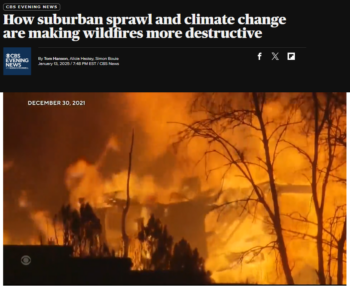
CBS Evening News (1/13/25) cited Colorado’s 2021 Marshall Fire as another example of how climate disruption is making wildfires more destructive.

The devastation of the ongoing Los Angeles fires is an alarm going off, but also the result of society having hit the snooze button long ago (Democracy Now!1/9/25CBS1/13/25). Game-changing fires destroyed Paradise, California (NPR11/8/23), in 2023, and Lahaina, Hawaii, in 2024—clear warnings, if any were still needed, that the climate catastrophe had arrived.

“The evidence connecting the climate crisis and extreme wildfires is clear,” the Nature Conservancy (7/9/24) said. “Increased global temperatures and reduced moisture lead to drier conditions and extended fire seasons.”

The scientific journal Fire Ecology (7/24/23) reported that “climate change is expected to continue to exacerbate impacts to forested ecosystems by increasing the frequency, size and severity of wildfires across the western United States.”

Now we are watching one of America’s largest cities burn. It’s a severe reminder that the kind of disruption we experienced in the beginning of the Covid pandemic in 2020 is the new normal under climate change.

The right-wing media, however, have found a culprit—it’s not climate change, but Democratic Party–led wokeness. The coverage demonstrates once again that the W-word can be used to blame literally anything in the Murdoch fantasyland.

‘Preoccupation With DEI’
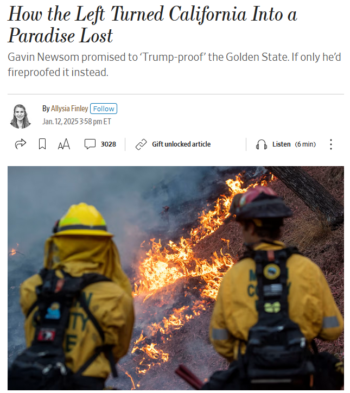
Alyssia Finley (Wall Street Journal1/12/25): “A cynic might wonder if environmentalists interfered with fire prevention in hope of evicting humans.” Another cynic might wonder if the Journal publishes smears without evidence as part of its business model.

“Megyn Kelly sounded off on Los Angeles Fire Department Chief Kristin Crowley and Mayor Karen Bass,” the New York Post (1/8/25) reported. Former Fox News host Kelly said “that the officials’ preoccupation with diversity, equity and inclusion [DEI] programs distracted them from the city’s fire-combating duties.”

Wall Street Journal editorial board member Allysia Finley (1/12/25) echoed the charge: “Bloated union contracts and DEI may not have directly hampered the fire response, but they illustrate the government’s wrongheaded priorities.” In other words, the paper didn’t have evidence to blame the fires on firefighter salaries or department diversity, but decided to insinuate as much anyway.

Other conservative journalists were more direct, like CNN pundit Scott Jennings, who went on CNN NewsNight (1/8/25) to assert:

As a matter of public policy in California, the main interest in the fire department lately has been in DEI programming and budget cuts, and now we have this massive fire, and people are upset.

As the Daily Beast (1/9/25) noted, “His response was part of a Republican kneejerk reaction that included President-elect Donald Trump blaming ‘liberals’ and state Gov. Gavin Newsom.”

The Washington Post (1/10/25) reported that Trump-supporting X owner Elon Musk

has been inundating his 212 million followers with posts casting blame for the blazes on Democrats and diversity policies, amplifying narratives that have taken hold among far-right activists and Republican leaders.

Liel Leibovitz, editor-at-large at the conservative Jewish magazine Tablet, blamed the LA devastation on the “woke religion” (New York Post1/9/25).

“There are many things we’ve learned that the Los Angeles Fire Department needs—and more women firefighters isn’t one of them,” moaned National Review editor-in-chief Rich Lowry (New York Post1/15/25). “Los Angeles for years has been in the grips of a bizarre obsession with recruiting more women firefighters.”

Blaming gay singers
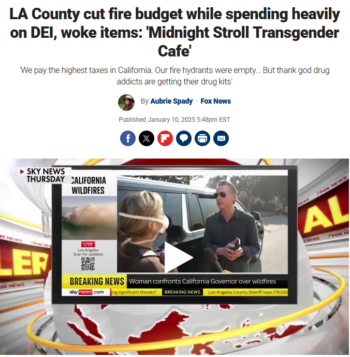
Mentioned by Fox News (1/10/25): $13,000 allocated to Lesbian, Gay, Bisexual and Transgender Heritage Month programs. Not mentioned by Fox News: a $126 million boost to the LAPD budget.

Fox & Friends (1/9/251/9/25) blamed the city’s Democratic leaders and the fire chief for the destruction. Fox News Digital (1/10/25) said:

While Los Angeles officials were stripping millions in funding from their fire department ahead of one of the most destructive wildfires in state history, hundreds of thousands of dollars were allocated to fund programs such as a “Gay Men’s Chorus” and housing for the transgender homeless.

You may notice the shift from “millions” to “hundreds of thousands”—the latter, obviously, can’t explain what happened to the former. What can far better explain it is that the city focused much more on funding cops than firefighters (Intercept1/8/25). The mayor’s budget plan offered “an increase of more than $138 million for the Los Angeles Police Department; and a decrease of about $23 million for the LA Fire Department” (KTTV4/22/24). KABC (1/9/25) reported more recent numbers, saying the “fire department’s budget was cut by $17.6 million,” while the “city’s police department budget increased by $126 million,” according to the city’s controller.

And in 2023, the LA City Council approved salary increases for cops over objections that these pay boosts “would pull money away from mental health clinicians, homeless outreach workers and many other city needs” (LA Times8/23/23). The cop-pay deal was reportedly worth $1 billion (KNBC8/23/23).

LAFD cuts under Mayor Bass were, in fact, big news (KTTV1/15/25). Fox overlooked the comparison with the police, one regularly made by city beat reporters who cover public safety and city budgets, and went straight to blaming gay singers.

Crusade against ‘woke’
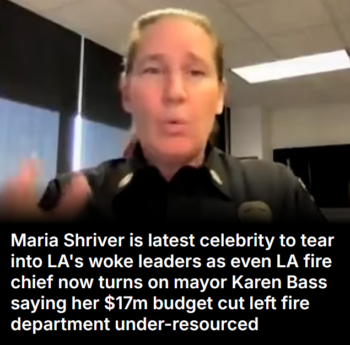
Contrary to the Daily Mail‘s headline (1/14/25), former California first lady Maria Shriver Maria Shriver did not “tear into LA’s woke leaders”; rather, she complained about LA’s insufficient funding of public needs.

Or take the Daily Mail (1/14/25), a right-wing British tabloid with a huge US footprint, whose headline said former California first lady “Maria Shriver Is Latest Celebrity to Tear Into LA’s Woke Leaders.” But the story went on to say that Shriver had decried the cuts to the LAFD, citing no evidence that she was fighting some culture war against women firefighters.

Shriver, the ex-wife of actor and former California Gov. Arnold Schwarzenegger, was pointing the finger at austerity and calling for more public spending. In other words, Shriver was siding with LAFD Chief Kristin Crowley, who had complained that city budget cuts had failed her department (CNN1/12/25). The Mail’s insistence on calling this a crusade against “woke” is just another example of how tediously the conservative media apply this word to almost anything.

While these accusations highlight diversification in the LA firefighting force, the right never offers real evidence that these hiring practices lead to any kind of hindering of fire response, as University of Southern California education professor Shaun Harper (Time1/13/25) noted. If anything, the right admits that miserly budgeting, usually considered a virtue in the conservative philosophy, is the problem.

Equal opportunity disasters

These talking points among right-wing politicians and their sycophants in the media serve several purposes. They bury the idea that climate change, driven by fossil fuels and out-of-control growth, has anything to do with the rise in extreme weather. They pin the blame on Democrats: LA is a blue city in a blue state. And they continue the racist and sexist drumbeat that all of society’s ills can be pinned on the advancement of women and minorities.

There is, of course, an opportunity to look at political mismanagement, including the cutbacks in the fire department. But natural disasters—intensified by climate change and exacerbated by poor political leadership—have ravaged unwoke, Republican-dominated states, as well, meaning Democrats don’t have a monopoly on blame.

Hurricane Ian practically destroyed Sanibel Island in Florida, a state that has been living with Trumpism for some time under Gov. Ron DeSantis. Hurricane Helene also ravaged that state, as well as western North Carolina, a state that went to Trump in the last three elections. Hurricane Harvey drowned Texas’ largest city, Houston, and the rest of Texas has suffered power outages and shortages, due to both extreme cold and summer spikes in energy demand.

Climate change, and the catastrophes it brings to the earth, does not discriminate against localities based on their populations’ political leanings. But conservative media do.

Metastasizing mythology
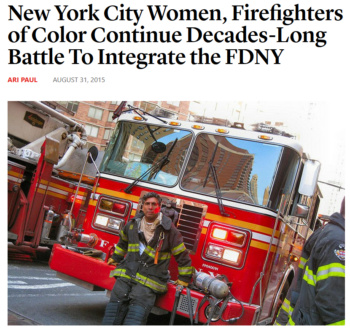
Ari Paul (In These Times8/31/15): “The more progress made in racial and gender diversity, the more white male firefighters will denounce the changes and say that increased diversity is only the result of lowering standards.”

Meanwhile, real firefighters know what the real problem is. The Western Fire Chiefs Association (3/5/24) said:

Global warming pertains to the increased rise in Earth’s average surface temperature, largely caused by human activity, such as burning fossil fuels and deforestation. These practices emit greenhouse gases like carbon dioxide (CO2), methane (CH4) and nitrous oxide (N2O) into the atmosphere. These gases trap heat, resulting in a gradual increase in global temperatures over time. Recent data on fire and trends suggests that global extreme fire incidents could rise by up to 14% by the year 2030, 30% by 2050, and 50% by the end of the century. The impact of global warming is seen particularly in the western United States, where record-setting wildfires have occurred in recent years. Fourteen of the 20 largest wildfires on record have been in California over the past 15 years.

Conservative media can ignore all this, because the notion that cultural liberalism has tainted firefighting isn’t new. I covered efforts to diversify the New York City Fire Department as a reporter for the city’s labor-focused weekly Chief-Leader, and I saw firsthand that the resistance to the efforts were based on the idea that minority men weren’t smart enough and women (white and otherwise) weren’t strong enough (PBS3/28/06New York Times3/18/14In These Times8/31/15).

What I found interesting in that case was that other major fire departments had achieved higher levels of integration, and no one was accusing those departments of falling behind in their duties. At the same time, while the FDNY resisted diversification, the New York Police Department, almost worshipped by right-wing media, embraced it (New York Post9/8/146/10/16).

This racist and sexist mythology has metastasized in the Republican Party and its propaganda apparatus for years. With Trump coming back into power, these media outlets will feel more empowered to regurgitate this line of thinking, both during this disaster in LA and in the disasters ahead of us.

FAIR’s work is sustained by our generous contributors, who allow us to remain independent. Donate today to be a part of this important mission.

This work is licensed under a Creative Commons Attribution-NonCommercial-NoDerivs 3.0 Unported License

Continue ReadingRight-Wing Sleuths Find the LA Fires Culprit: Once Again, It’s Wokeness

LA fires show the human cost of climate-driven ‘whiplash’ between wet and dry extremes

Spread the love
Allison Dinner / EPA

Doug Specht, University of Westminster

October to April is normally considered to be the wet season in California, yet this January, the region is experiencing some of the most devastating fires it’s ever seen.

As of January 10, five major fires in and around Los Angeles have burned over 29,053 acres, leading to the evacuation of more than 180,000 people, the destruction of over 2,000 buildings (mainly homes), and an estimated damage cost of at least US$52 billion (£42.5 billion). Ten lives have been lost, and these numbers are expected to rise as the fires continue to burn.

The exact causes of each fire are still under investigation. However, several factors have contributed to their rapid spread and intensity.

The seasonal Santa Ana winds are particularly strong this year, bringing low humidity, dry air and high wind speeds. Southern California has received less than 10% of its average rainfall since October 2024, creating dry conditions that make the area highly vulnerable to fire.

Unusually wet winters in both 2022-23 and 2023-24 led to increased vegetation growth, providing more fuel for the fires. This cycle of wet and dry extremes, known as “hydroclimate whiplash”, is part of the increasingly intense climate cycles caused by climate change.

Hydroclimate whiplash can occur virtually anywhere. These cycles can cause extreme wildfires, such as those in California, where rapid vegetation growth is followed by drying. They can also exacerbate flooding when unusually heavy rains hit the dry-baked ground, then run off over the land rather than seeping in, leading to flash flooding.

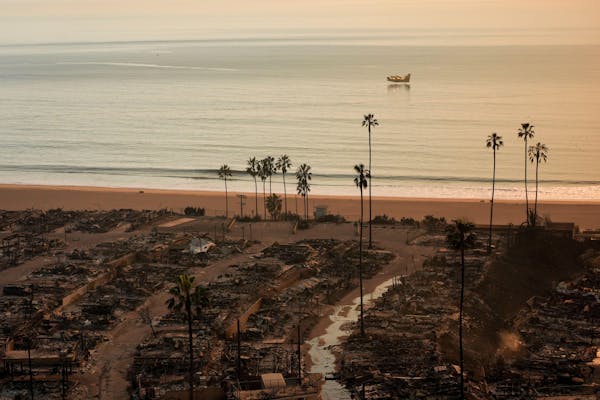
In Los Angeles, some neighbourhoods have been almost entirely destroyed. Jae C. Hong / Alamy

The human impact of hydroclimate whiplash

Rapid transitions between extreme wet and dry conditions have significant and wide-ranging impacts on people, a focus of my academic research, affecting everything from public health to economic stability and social equity.

As we have seen in California, there is the immediate impact of loss of life, property and livelihoods. We have also seen this during whiplash-induced floods and landslides, such as those experienced across California in 2023 and east Africa in 2024, when years of drought were followed by weeks of rain.

Fires exacerbate respiratory and cardiovascular diseases through their polluting smoke. Flooding creates conditions for waterborne illnesses such as cholera, leptospirosis or norovirus to rip through populations. Extreme swings in temperature can also create more heat-related illnesses, as human bodies struggle to adapt quickly. It is estimated that the health-related impacts of climate change will cost US$1.1 trillion by 2050.

But this number pails into insignificance against the projected US$12.5 trillion in economic losses worldwide due to climate change by 2050. Critical infrastructure, including water supply systems, wastewater treatment plants and transportation networks, is at risk of damage or destruction. Food insecurity and scarcity will also increase during hydroclimate whiplash events.

And these impacts are not evenly distributed. While this month’s wildfires are affecting some of the richest communities in the US, it is generally low-income communities and vulnerable populations that are disproportionately affected, with limited resources to prepare for or recover from extreme events. Across the world, poorer populations are experiencing a 24%-48% increase in drought-to-downpour events, exacerbating their vulnerability and widening the health equity gap.

All these events and concerns also lead to mental health issues such as anxiety, depression and post-traumatic stress disorder (PTSD), resulting from displacement and trauma. Such human impacts are harder to measure, and often under-reported.

Adaptation and resilience

As climate change intensifies hydroclimate whiplash events, the human impacts are expected to grow more severe. Addressing these challenges will require coordinated efforts across multiple sectors, with a focus on both mitigation and adaptation strategies to protect human health, economic stability and social equity.

Governments and local authorities will need to implement co-management approaches for both drought and flood risks, alongside developing more flexible water management systems and infrastructure. Investing in natural infrastructure to enhance biodiversity and ecosystems will reduce risks to humans, both by restricting the effects of climate change and lowering the risks of fire and flooding.

As individuals we can often feel powerless, but environmental campaigns and movements have been highly successful in changing government policies. In the UK, the 2008 Climate Change Act and the net zero by 2050 legislation were the direct result of citizen lobbying and action, and the same can be said for numerous renewable energy transition policies around the world.

In California, we have seen the devastating effect of hydroclimate whiplash – and this won’t be the last we see. By calling on our governments to produce adaptation and resilience strategies that recognise climate change as a long-term human and economic risk factor, we can be more prepared for these events.

Doug Specht, Reader in Cultural Geography and Communication, University of Westminster

This article is republished from The Conversation under a Creative Commons license. Read the original article.

Continue ReadingLA fires show the human cost of climate-driven ‘whiplash’ between wet and dry extremes

Climate Emergency Causes Extreme Wildfires to Double in Frequency: Study

Spread the love

Original article by JULIA CONLEY republished from Common Dreams under Creative Commons (CC BY-NC-ND 3.0).

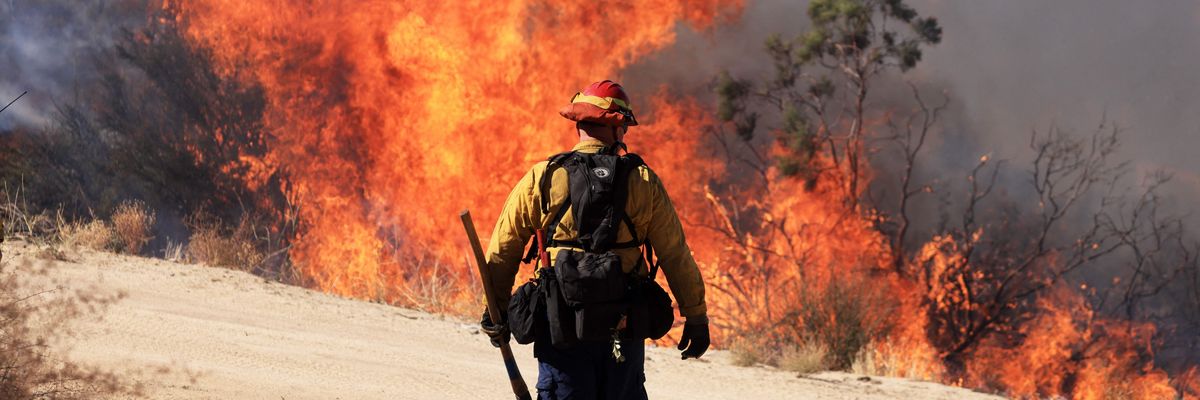
A firefighter walks toward flames as the Highland Fire burns in Aguana, California, on October 31, 2023. 
(Photo: David Swanson/AFP via Getty Images)

“Climate change is not something off in the future,” said one scientist. “It’s happening before our very eyes.”

New findings about the rising frequency of extreme wildfires have “the fingerprints of climate change” all over them, according to an Australian scientist who led a study published on Monday.

Calum Cunningham, a postdoctoral researcher at the University of Tasmania in Australia, told The Washington Post that he was driven to examine current trends in the frequency of wildfires after climate deniers suggested that because the global area being burned in blazes is declining, the idea of a growing wildfire crisis is being overblown by concerned scientists.

While the area destroyed by wildfires is indeed on the decline, analyses that include all fires—the majority of which are small and cause relatively little damage—obscured how the most extreme and destructive wildfires are rapidly growing more frequent.

Cunningham and his team analyzed data from National Aeronautics and Space Administration satellites, collecting four images of wildfires around the world per day over 21 years. They used the images to identify the 0.01% most extreme wildfires—those that release the most smoke and greenhouse gas emissions due to their size and uncontrollable nature.

Out of 30 million fires across the world over two decades, the researchers identified the 2,913 most extreme fire events and found that the frequency and intensity of such wildfires has more than doubled since 2003.

“Climate change is making fire weather more extreme and more frequent in a lot of the world.”

The problem is rapidly getting worse, the team found: The six years with the most extreme wildfires had all occurred since 2017.

Trends were particularly troubling in particular regions, like temperate conifer forests in the western United States and the Mediterranean, where the number of extreme fires rose by more than 10 times in 20 years.

In boreal forests in places like northern Europe and Canada, the frequency of the most intense and hard-to-control blazes increased by seven times.

“It’s absolutely in keeping with what climate change is doing to fire weather around the world,” Cunningham told the Post. “Climate change is making fire weather more extreme and more frequent in a lot of the world.”

The “fire weather” that’s driven the increase includes hotter and drier conditions, with temperatures staying high even overnight when they ordinarily would have have dropped in previous decades, giving firefighters a chance to make headway in putting out blazes.

“Rarely did we have 100,000-acre fires 20 years ago,” veteran firefighter Bobbie Scopa told the Post. “But now, it’s not uncommon.”

The researchers pointed to a “scary” feedback loop created as extreme wildfires create carbon emissions—leading to more planetary heating and even more fires.

“Climate change is not something off in the future,” Cunningham told the Post. “It’s happening before our very eyes. This is the manifestation of the reshaping of the climate we are doing.”

The study was published in Nature Ecology & Evolution days after wildfires scorched more than 14,000 acres in Southern California and more than 24,000 acres in New Mexico, where two people were killed. Last year, climate scientists were stunned by an unprecedented wildfire season in relatively damp Eastern Canada, where wildfires were made twice as likely by the climate emergency according to the World Weather Attribution.

Climate scientist and author Bill McGuire called the findings “terrifying, of course, but just not a surprise,” considering governments in the countries that produce the most fossil fuels are continuing to support and subsidize energy sources that heat the planet.

“This is certifiably insane,” McGuire said.

Original article by JULIA CONLEY republished from Common Dreams under Creative Commons (CC BY-NC-ND 3.0).

Continue ReadingClimate Emergency Causes Extreme Wildfires to Double in Frequency: Study