‘Fossil Fuels Are Killing Us’: Scientists Publish Sweeping Review of Industry Harms

Spread the love

Original article by Jessica Corbett republished from Common Dreams under Creative Commons (CC BY-NC-ND 3.0).

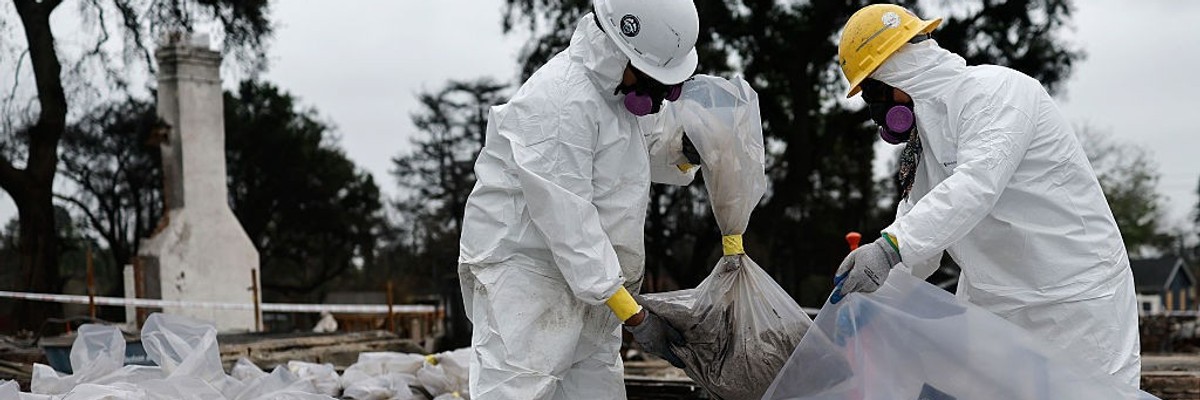
U.S. Army Corps of Engineers contractors in protective gear remove hazardous materials from a home destroyed in the Eaton Fire on March 26, 2025 in Altadena, California. (Photo: Mario Tama/Getty Images)

“We’ve got to work fast to end fossil fuel operations near our homes, schools, and hospitals and trade fossil fuel infrastructure for healthy, clean energy,” said one co-author.

“The evidence is clear that fossil fuels—and the fossil fuel industry and its enablers—are driving a multitude of interlinked crises that jeopardize the breadth and stability of life on Earth.”

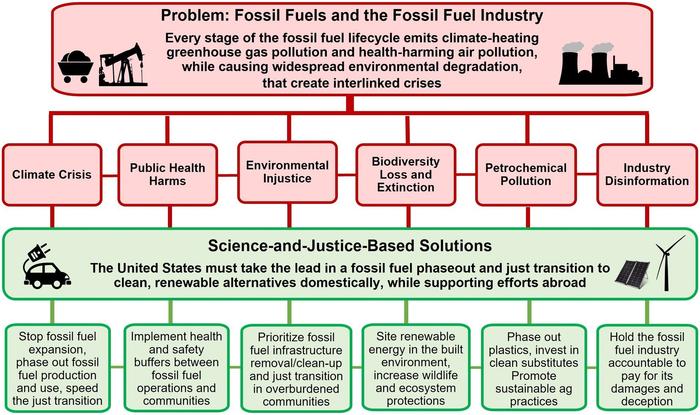
That’s the first line of the abstract for an article published Monday by top scientists who reviewed “the vast scientific evidence showing that fossil fuels and the fossil fuel industry are the root cause of the climate crisis, harm public health, worsen environmental injustice, accelerate biodiversity extinction, and fuel the petrochemical pollution crisis.”

The new paper in the peer-reviewed journal Oxford Open Climate Change highlights the diverse impacts of “every stage of the fossil fuel life cycle” and stresses that the “industry has obscured and concealed this evidence through a decadeslong, multibillion-dollar disinformation campaign aimed at blocking action to phase out” its deadly products.

“The fossil fuel industry has spent decades misleading us about the harms of their products and working to prevent meaningful climate action,” said co-author Naomi Oreskes, professor of the history of science at Harvard University, in a statement. “Perversely, our governments continue to give out hundreds of billions of dollars in subsidies to this damaging industry. It is past time that stops.”

“The most polluted communities should be prioritized for clean energy investments and removal and cleanup of dirty fossil fuel infrastructure.”

While the researchers focused on the United States, “as the world’s largest oil and gas producer and dominant contributor to these fossil fuel crises,” their review—including proposed “science-and-justice-based solutions” for an economywide effort to “forge a path forward to sustaining life on Earth”—applies to the whole world, which is quickly heating up due to emissions from coal, gas, and oil.

The article features sections on the fossil fuel-driven climate crisis, public health harms, environmental injustice, biodiversity loss and extinction, petrochemical pollution, and industry disinformation. Each section lays out the “problem” and “solutions.”

The climate emergency section includes details such as “the production and combustion of oil, gas, and coal are responsible for nearly 90% of human-caused carbon dioxide (CO2) emissions and approximately 79% of total greenhouse gas emissions,” and “failures in political will to implement necessary climate action have made the 1.5°C benchmark nearly impossible to achieve without overshoot,” referring to a primary goal of the 2015 Paris agreement.

Although the current U.S. administration has demonstrated its alliance to the fossil fuel industry—including with President Donald Trump’s recent energy emergency declaration—the scientists still emphasized what’s possible in the country.

“In the USA, powerful policy levers are available to governments and civil society at the local, state, national, and international levels to phase out fossil fuels and transition to a clean, renewable energy economy,” they wrote. “These levers include regulation (e.g. applying and enforcing existing laws), legislation (e.g. polluters pay laws, fossil fuel subsidy reform, land use laws limiting drilling), and litigation (e.g. holding fossil fuel companies accountable, defending existing law).”

They also warned that “last-ditch efforts to prolong the fossil fuel industry are proliferating. These include counterproductive false solutions, like carbon capture and storage (CCS), which would perpetuate fossil fuel use while capturing only some of the resulting emissions, and hydrogen made from fossil fuels.”

The public health section notes that “air pollution from fossil fuel combustion accounts for 8.7 million (equaling 1 in 5) premature deaths per year worldwide and 350,000 premature deaths per year in the USA. In a single year, air pollution from oil and gas production in the USA resulted in 410,000 asthma exacerbations, 2,200 new cases of childhood asthma, and 7,500 premature deaths in 2016.”

Co-author David J.X. González, an assistant professor of environmental health sciences at the University of California, Berkeley, said Monday that “we’ve got to work fast to end fossil fuel operations near our homes, schools and hospitals and trade fossil fuel infrastructure for healthy, clean energy.”

“Oil, gas, and coal will continue to condemn us to more deaths, wildlife extinctions, and extreme weather disasters unless we make dirty fossil fuels a thing of the past.”

The paper points out that “climate change is increasing incidence of physical and mental health impacts and mortality through multiple pathways: worsening extreme events including heatwaves, severe storms, floods, droughts, and wildfires; shifting ranges of disease vectors; threats to food security; and displacement and forced migration, which restrict access to healthcare and other basic services.”

“These harms, though broadly felt, also disproportionately impact marginalized communities which are already disproportionately burdened by other socioenvironmental hazards, as well as susceptible populations including young children, people with certain disabilities, people experiencing homelessness, pregnant people, people with chronic diseases, and older adults,” the publication continues.

University of Montana associate professor of environmental studies Robin Saha, another co-author, said that “decades of discriminatory policies, such as redlining, have concentrated fossil fuel development in Black, Brown, Indigenous, and poor white communities, resulting in devastating consequences.”

“For far too long, these fenceline communities have been treated as sacrifice zones by greedy, callous industries,” Saha added. “The most polluted communities should be prioritized for clean energy investments and removal and cleanup of dirty fossil fuel infrastructure.”

The paper’s other co-authors are Robert Bullard of Texas Southern University, Boston University’s Jonathan J. Buonocore and Mary D. Willis, Trisia Farrelly of the Cawthron Institute, William Ripple of Oregon State University, and the Center for Biological Diversity’s Nathan Donley, John Fleming, and Shaye Wolf.

“The science can’t be any clearer that fossil fuels are killing us,” declared Wolf, the paper’s lead author and the center’s climate science director. “Oil, gas, and coal will continue to condemn us to more deaths, wildlife extinctions, and extreme weather disasters unless we make dirty fossil fuels a thing of the past. Clean, renewable energy is here, it’s affordable, and it will save millions of lives and trillions of dollars once we make it the centerpiece of our economy.”

Original article by Jessica Corbett republished from Common Dreams under Creative Commons (CC BY-NC-ND 3.0).

Orcas comment on killer apes destroying the planet by continuing to burn fossil fuels.
Continue Reading‘Fossil Fuels Are Killing Us’: Scientists Publish Sweeping Review of Industry Harms

ExxonMobil Plans to Keep an Entire Generation on the Hook for Its Climate Destruction

Spread the love

Original article by Allie Lindstrom republished from Common Dreams under Creative Commons (CC BY-NC-ND 3.0).

ExxonMobil CEO Darren Woods sits during testimony before the U.S House Committee on Oversight and Reform on October 28, 2021.  (Photo: Screenshot/C-SPAN)

Public pensions must exit Exxon to protect workers’ savings and retirement.

It is no secret that ExxonMobil poses some of the most powerful opposition to climate action at every level of government. Environmentalists have long pointed out that Exxon Knew about climate change, and instead of pivoting their business model to a more sustainable energy future, buried the evidence and began a decades-long disinformation campaign.

Leaders across the country have wisened up to the oil major’s dirty politics, which is why the House Oversight Committee has been investigating Exxon and its peers, and state attorneys general have sued the company for damages. Most recently, California AG Rob Bonta, alongside environmental organizations like the Sierra Club, sued the company for lying to the public about the recyclability of plastics.

If the tide is turning against Exxon, why haven’t investors caught on?

Unrestricted funding for companies engaged in fossil fuel expansion threatens workers’ right to dignified retirement safety, a right that unions have fought hard to win.

ExxonMobil sparked headlines and investor outrage this spring when the company sued its own shareholders over a climate-related shareholder resolution. Public pensions representing trillions in worker savings across the country pushed back and mounted a vote-no effort against CEO Darren Woods and Director Joseph Hooley, but Wall Street asset managers watered down their efforts instead offering unwavering support of Exxon.

To add insult to injury, Woods made an appearance at the Council of Institutional Investors—a nonprofit dedicated to advocating for the investor rights of public, union, and private employee benefit funds—in September. There, he promised to continue to crack down on “extreme” investors who are concerned that the company’s business model has loaded the economy with systemic financial risks and instability. Never mind that such a definition of extreme would describe many of the institutions present, which represent over 15 million workers and $5 trillion in assets under management.

But perhaps most indicative of ExxonMobil’s commitment to business-as-usual pollution is the bonds they’ve issued this fall, with a maturity date of 2074.

These long-dated bonds represent unrestricted funds for ExxonMobil to continue to pursue fossil fuel expansion and plastic pollution well past most of the world’s—and investors’—Net Zero by 2050 goals. This is an especially risky gamble for investors with long-term obligations, including public pension funds that manage millions of workers’ retirement savings.

Not only is the future of oil and gas uncertain, but prolonged pollution wrought by disinformation and investor cash increases economy-wide systemic risks. Investors—and the everyday people who rely on institutions to manage their savings—will be left holding the purse strings as climate change wreaks havoc. Moreover, bond ownership does not come with the shareholder rights investors hope to use to influence company behavior. This gives Exxon complete freedom to use the funds however it wishes, even if that’s out of alignment with investor interests.

This increasing risk is why we joined California Common Good and pension beneficiaries to testify during a recent CalPERS Board meeting to ask CalPERS to issue a moratorium on purchasing Exxon bonds.

The Sierra Club represents millions of members, many of whom are saving for retirement in the face of an uncertain future and working tirelessly to protect the communities and places they love. Whether relying on a public pension plan or a private asset manager, our members rely on investment professionals to keep their futures in mind. Unrestricted funding for companies engaged in fossil fuel expansion threatens workers’ right to dignified retirement safety, a right that unions have fought hard to win. That’s why we call on investors, particularly public pension funds, to refuse to participate in Exxon’s bond issuances.

Original article by Allie Lindstrom republished from Common Dreams under Creative Commons (CC BY-NC-ND 3.0).

From Your Site Articles

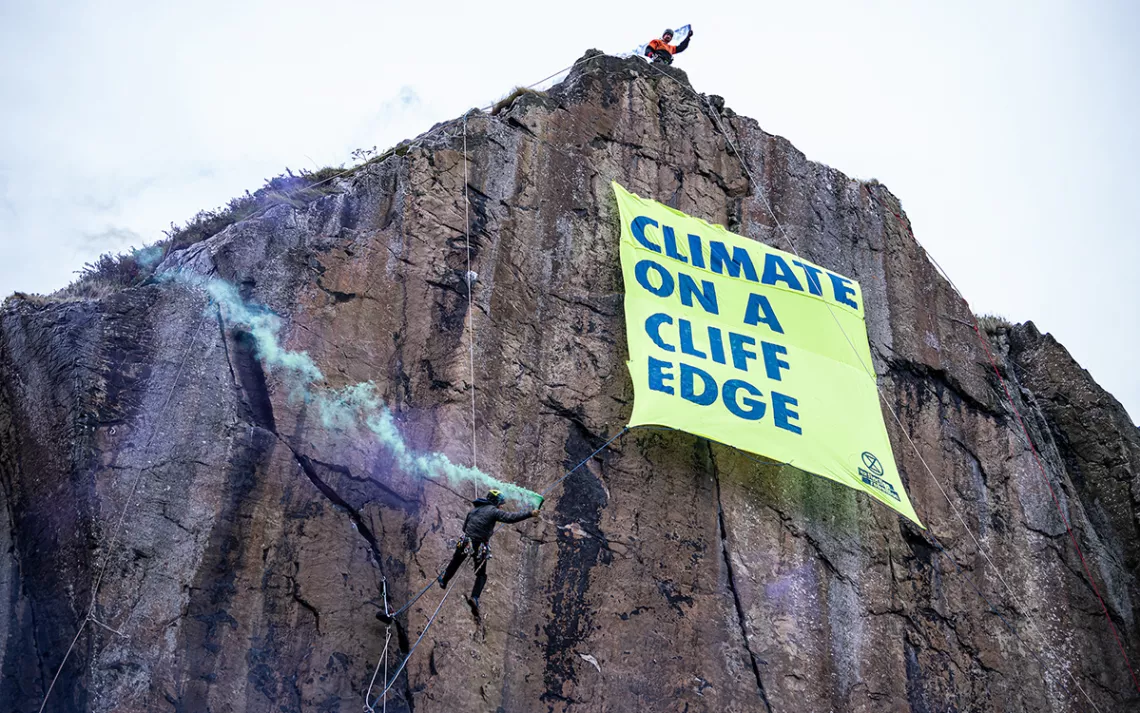
Experienced climbers scale a rock face near the historic Dumbarton castle in Glasgow, releasing a banner that reads “Climate on a Cliff Edge.” One activist, dressed as a globe, symbolically looms near the edge, while another plays the bagpipes on the shores below. | Photo courtesy of Extinction Rebellion and Mark Richards
Orcas comment on killer apes destroying the planet by continuing to burn fossil fuels. Second version, corrected text.
Continue ReadingExxonMobil Plans to Keep an Entire Generation on the Hook for Its Climate Destruction

Exxon’s Own Research Confirmed Fossil Fuels’ Role in Global Warming Decades Ago

Spread the love

https://insideclimatenews.org/news/02052024/from-the-archive-exxon-research-global-warming/

Exxon’s Richard Werthamer (right) and Edward Garvey (left) are aboard the company’s Esso Atlantic tanker working on a project to measure the carbon dioxide levels in the ocean and atmosphere. The project ran from 1979 to 1982. Credit: Courtesy of Richard Werthamer

Top executives were warned of possible catastrophe from greenhouse effect, then led efforts to block solutions.

At a meeting in Exxon Corporation’s headquarters, a senior company scientist named James F. Black addressed an audience of powerful oilmen. Speaking without a text as he flipped through detailed slides, Black delivered a sobering message: carbon dioxide from the world’s use of fossil fuels would warm the planet and could eventually endanger humanity.

“In the first place, there is general scientific agreement that the most likely manner in which mankind is influencing the global climate is through carbon dioxide release from the burning of fossil fuels,” Black told Exxon’s Management Committee, according to a written version he recorded later.

It was July 1977 when Exxon’s leaders received this blunt assessment, well before most of the world had heard of the looming climate crisis.

A year later, Black, a top technical expert in Exxon’s Research & Engineering division, took an updated version of his presentation to a broader audience. He warned Exxon scientists and managers that independent researchers estimated a doubling of the carbon dioxide (CO2) concentration in the atmosphere would increase average global temperatures by 2 to 3 degrees Celsius (4 to 5 degrees Fahrenheit), and as much as 10 degrees Celsius (18 degrees Fahrenheit) at the poles. Rainfall might get heavier in some regions, and other places might turn to desert.

https://insideclimatenews.org/news/02052024/from-the-archive-exxon-research-global-warming/

Continue ReadingExxon’s Own Research Confirmed Fossil Fuels’ Role in Global Warming Decades Ago

Why California is Taking Big Oil to Court — and Why it Matters

Spread the love

Original article by Dana Drugmand republished from DeSmog.

The sweeping complaint details the fossil fuel industry’s coordinated campaign to deceive the public about the dangers of fossil fuels.

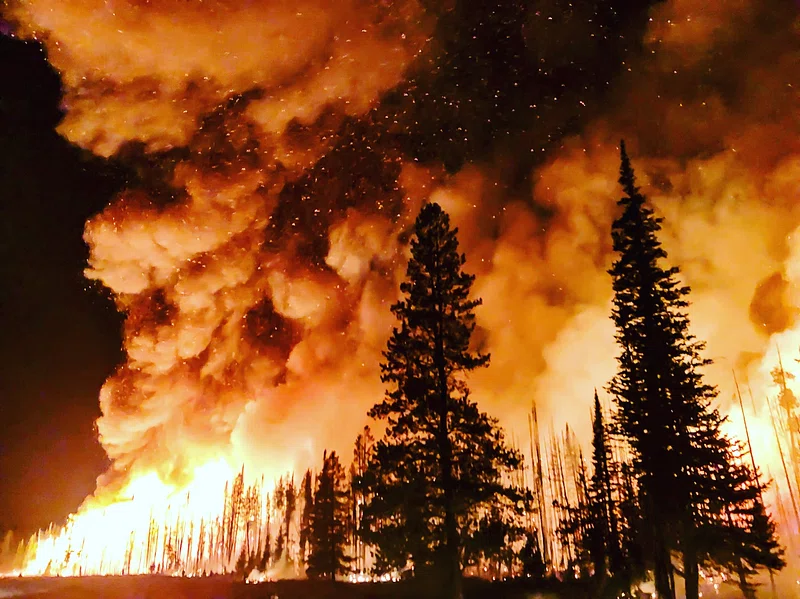
Canadian wildfire 2023

“This is a historic moment,” Rob Bonta, California’s attorney general, told reporters on Sunday, as he stood alongside Gov. Gavin Newsom on the opening day of Climate Week NYC.  The pair of California leaders were there to discuss the lawsuit the state had recently filed against Big Oil on behalf of the people of California to hold fossil fuel companies accountable for the effects of climate change.

While it is not the first to seek accountability from the fossil fuel industry for its role in fueling the climate crisis, California’s lawsuit stands out in several ways: The state has a reputation for leading on climate policy; it is on the frontlines of climate change; it is a producer of oil and gas; and it is, to date, the most politically and economically powerful state to sue Big Oil.

More than three dozen states and cities are suing oil, gas, and coal companies over their role in causing climate change. But California is the first fossil-fuel-producing state to do so. That sends a clear political message that the industry “is less powerful and trusted than before,” Nick Caleb, a climate and energy attorney with Breach Collective, told DeSmog. It may signal that fossil fuel companies do not have much of a future powering the state’s economy, Caleb said. 

California is facing major economic and humanitarian costs from the climate emergency. The state, with a population of nearly 40 million people, has racked up several billions of dollars in climate-related damages on top of the tragic costs to human lives. Some insurance companies are backing away from the state due to the outsized risks. 

“It’s incalculable in terms of the dollars, the lives lost, the funerals, and dead bodies in Paradise, California,” Newsom said on Sunday. In 2018, the Camp Fire decimated the northern California community and killed at least 85 people.

“We all know how California has suffered from climate impacts,” Christiana Figueres, one of the key architects of the Paris Agreement, told journalists at a Covering Climate Now conference at Columbia Journalism School in New York City on Thursday. She called California’s lawsuit “a major, major upgrade … in the liabilities and in the reach that climate litigation can have.” 

The lawsuit names five companies — ExxonMobil, Shell, Chevron, BP, ConocoPhillips — and one lobby group, the American Petroleum Institute. It asserts that the companies knew about the climate risks associated with burning fossil fuels and greenhouse gas emissions, yet underplayed them to the public, and it argues that the climate disasters and devastation California is experiencing could have been largely avoided or mitigated were it not for the lies and deceit of the fossil fuel industry. “California is in the throes of a climate crisis,” the case contends.  

The 135-page complaint, filed Friday in superior court in San Francisco, lays out the evidence of the alleged deception in great detail. Bonta called it the “most sweeping complaint thus far.”

“You cannot read it without crawling out of your skin,” Newsom added at Sunday’s press briefing.

Many of the details and revelations are known, but are worth recapping as they explain why major oil companies are facing similar lawsuits from so many  states and municipalities.

A Public Campaign of Deception

First, as the complaint notes, “Defendants have known about the potential warming effects of GHG emissions since as early as the 1950s.” Nuclear physicist Edward Teller warned the oil industry at an API event in 1959 that global warming might melt the polar ice caps and submerge coastal cities. 

In the late 1960s, as the complaint details, the Stanford Research Institute issued reports that accurately predicted the atmospheric carbon dioxide (CO2) concentration in 2000. The reports, commissioned by API, further warned of the Antarctic ice cap melt, and explicitly connected CO2 rise to fossil fuel combustion. 

More warnings came from industry scientists in the 1970s, but these were not disseminated publicly. Instead, Exxon realized that legislation affecting its business could take shape and decided to closely monitor the science but not publicly acknowledge or act on it. “In 1979, API and its members, including the Fossil Fuel Defendants, convened a Task Force to monitor and share cutting-edge climate research among members of the oil industry,” the complaint explains. This close assessment of potential climate impacts and climate modeling continued into the 1980s. 

In 1988, an internal Shell report titled “The Greenhouse Effect” further pointed to fossil fuels as the cause of rising CO2 concentrations and warned of the devastating impacts on society.

The very real prospect of legislation and international action to combat climate change in the late 1980s and early 1990s, prompted a U-turn within the industry. The industry shifted tactics “from general research and internal discussion on climate change to a public campaign aimed at deceiving consumers and the public, including the inhabitants of California,” the complaint states. In publications and advertorials, the industry directly contradicted what it had known for decades about the role of fossil fuels in increasing CO2 emissions and temperature rise. During this time the Global Climate Coalition actively worked to undermine the public’s understanding of climate science and even to manipulate the Intergovernmental Panel on Climate Change, the UN’s climate science body.

Exxon and other oil majors also funded “fringe scientists” to peddle their views and  funded dozens of think tanks and front groups to promote climate denial. The complaint calls out a few of these groups, including: the Heritage FoundationHeartland InstituteCompetitive Enterprise InstituteFrontiers of Freedom, and Committee for a Constructive Tomorrow.

A Conspiracy to “Conceal and Misrepresent”

The California lawsuit does not bring racketeering charges as some recent climate accountability lawsuits have. It does, however, refer to a conspiracy. According to the complaint, the defendants, through their trade associations and front groups like the Global Climate Coalition, “conspired to conceal and misrepresent the known dangers of burning fossil fuels.” While conspiracy is not charged, the lawsuit references it “for the purposes of establishing that California state court is the correct jurisdiction and venue for this case,” Caleb explained. 

“Although the Fossil Fuel Defendants were competitors in the marketplace, they combined and collaborated with each other and with API on this public campaign to misdirect and stifle public knowledge in order to increase sales and protect profits,” the complaint argues. 

The industry’s alleged deception delayed a transition to alternative and cleaner forms of energy and enabled a much greater buildup of greenhouse gas (GHG) emissions than otherwise would have occurred, the lawsuit argues, adding: “Defendants could have chosen a different path.”

Ben Franta, head of the Climate Litigation Lab at Oxford University and one of the key researchers to uncover evidence of the industry’s early climate change awareness and subsequent efforts to deceive, told DeSmog: “The bottom line is that major fossil fuel companies knew decades ago that their own products, unless replaced with safe energy sources, would cause catastrophic damage in the 21st century. They concealed their knowledge and misled the public about the reality, seriousness, cause, and solutions to the problem in order to keep selling fossil fuels and increase industry profits.” 

API was instrumental to the execution of this plan. The trade association “played a key role in creating climate denialist organizations such as the Global Climate Coalition,” Franta said. 

In response, API called California’s lawsuit part of an “ongoing, coordinated campaign to wage meritless, politicized lawsuits” against the oil and gas industry. 

The Western States Petroleum Association, the main industry lobby for the western region including California, is not a named defendant in the complaint. Franta said API and WSPA have “both played key roles in deceiving the public about climate change and worsening climate damages,” but that “much more research to date has been conducted on API.” 

Nevertheless, “their contributions to climate change are significant and actionable under California law,” Caleb told DeSmog, adding that WSPA “deserves to be held accountable” for greenwashing and deceptive conduct. WSPA has been named as a defendant in a climate lawsuit filed in June by Multnomah County, Oregon, the first such case to do so.  

Industry’s Misleading Behavior Has “Not Stopped”

The complaint says the companies’ “efforts to mislead the public about climate change have not stopped.” In recent years, the oil and gas industry has shifted to prolific greenwashing. It portrays its products as “cleaner” or “low carbon,” and claims the industry is driving climate solutions.

“Just as tobacco companies promoted ‘low-tar’ and ‘light’ cigarettes … so too do Defendants peddle ‘low-carbon’ and ‘emissions-reducing’ fossil fuel products,” the complaint notes.

Yet Big Oil is now retreating on its meager climate commitments and doubling down on oil and gas production, even after raking in record profits in 2022. For instance, in June, Shell announced it would not follow through on its earlier promise to gradually decrease oil production through 2030.

“The fact that they’re still at it, rolling back ambition in real time … is shameful,” Newsom said on Sunday.

“They need to be held accountable. They need to pay for the damage that they’ve caused. They knew, they knew for years,” Bonta added. 

In an emailed statement, a Shell spokesperson said the company’s “position on climate change has been a matter of public record for decades”, adding: “We do not believe the courtroom is the right venue to address climate change.”

ExxonMobil, Chevron, BP, and ConocoPhillips did not immediately respond to requests for comment.

Lawsuit Opens the “Floodgates”

Newsom and Bonta made clear on Sunday that they’re hoping the state’s decision to sue Big Oil could therefore encourage other jurisdictions to do the same. California’s actions on climate have often broken new ground and inspired other states to follow suit — a phenomenon is called the “California effect.” For example, the state has set  increasingly stringent vehicle tailpipe emissions standards, implemented the country’s first economy-wide cap-and-trade program, and has recently passed a first-in-the-nation law requiring large companies to publicly disclose their greenhouse gas emissions, 

Climate lawyers and activists called California’s move to sue Big Oil “historic” and “decisive.”

“The California lawsuit is the most significant litigation against the industry that’s happened yet,” said Steven Donziger, an environmental and human rights attorney who successfully sued Chevron and faced retaliation for it. “All of these lawsuits together collectively can really force the phaseout of the industry. They’re important.”

“California’s lawsuit provides major momentum in the race to protect a livable planet,” Kassie Siegel, director of the Center for Biological Diversity’s Climate Law Institute, said in an emailed statement. “This case opens a new avenue for California to lead the nation in ending deadly fossil fuels.”

Geoffrey Supran, associate professor of environmental science and policy and director of the Climate Accountability Lab at University of Miami, noted that California “is a bellwether for U.S. environmental action,” and that momentum to hold Big Oil accountable through litigation has been mounting for several years.

“Now that the fifth largest economy in the world has waded in, the floodgates are truly open,” he said.

As a state that still produces oil and gas, however, some say California is still not moving quickly enough to sever ties with the industry it is now suing. Mark Jacobson, professor of civil and environmental engineering at Stanford University, said that California “can do a lot more, faster,” noting the state continues to permit fossil gas usage in buildings, has not banned oil and gas drilling, and plans to phase out new gasoline-powered vehicles only by 2035, which is “five years after we need to transition 80 percent of the world away from fossil fuels.”  

Campaign Demands “Polluters Pay”

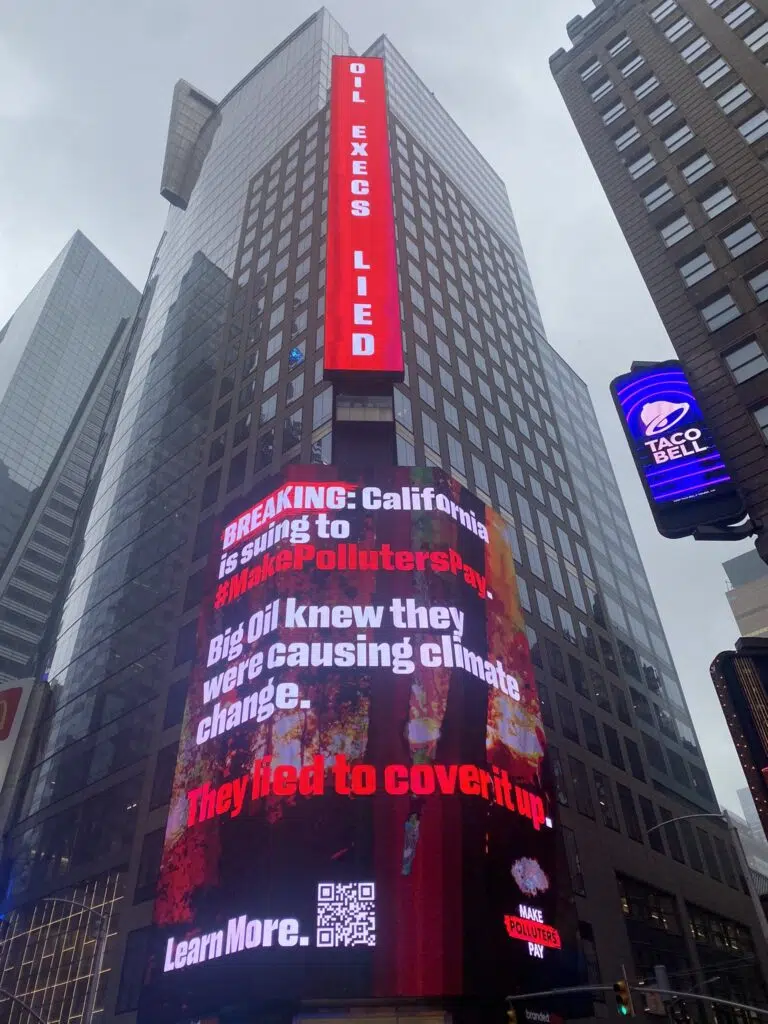
A new activist campaign called “Make Polluters Pay,” which launched Monday in New York City, with a Times Square billboard and a six-figure digital ad buy and online petition, is supporting California’s call for more climate accountability lawsuits.

The “Make Polluters Pay” campaign billboard in New York’s Time Square on September 18, 2023. Credit: Jamie Henn, Fossil Free Media

“Make Polluters Pay will be the first big public-facing campaign to build support for these climate lawsuits and the broader effort to hold the fossil fuel industry accountable for the damage they are doing to our health, climate and communities,” Jamie Henn, founder of Fossil Free Media, told DeSmog.

“I think California’s lawsuit is going to turn these climate liability cases into a serious movement that not only excites environmental lawyers, but the public writ large,” he added. “A few hundred million Americans experienced the brutal heat waves and other climate disasters this summer and they’re looking for someone to hold responsible. And when it comes to climate destruction, the answer is clear: it’s Big Oil.”  

Original article by Dana Drugmand republished from DeSmog.

Continue ReadingWhy California is Taking Big Oil to Court — and Why it Matters