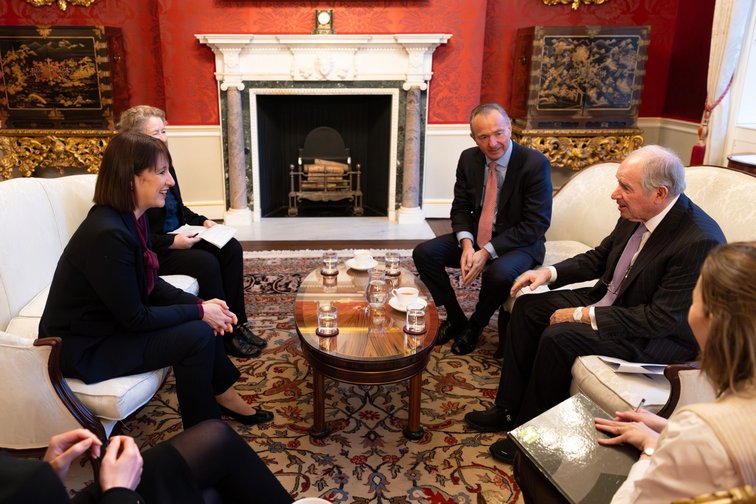
The Chancellor held meetings with a number of finance bosses in the weeks following the budget, including Blackstone’s Stephen Schwarzman | UK government / Treasury
Revealed: Head of world’s biggest asset manager lobbied chancellor on tax rules weeks before policy was tweaked
Rachel Reeves changed the government’s position on non-doms weeks after one of the world’s most powerful financiers asked her personally not to increase the tax burden on the super rich.
Documents released to openDemocracy under the Freedom of Information Act reveal Stephen Schwarzman, the CEO of leading asset manager Blackstone, raised “concerns” with Reeves about her plans to reform the tax treatment of non-domiciled individuals at a meeting in Downing Street in December.
The chancellor had previously used the autumn Budget in late October to re-commit to Labour’s manifesto promise to abolish the non-dom tax regime, which allows wealthy individuals who live in the UK to be domiciled elsewhere for tax purposes.
But around a month after meeting with Schwarzman, Reeves watered down this commitment.
Speaking at World Economic Forum in Davos in January, she announced that she had been “listening to the concerns of the non-dom community” and would soften the government’s plans.
The government blocked a request from openDemocracy for details of the discussion between Reeves and Schwarzman, as well as other meetings between senior ministers and major financial institutions, including BlackRock and JP Morgan, but has released a heavily redacted follow-up letter.
openDemocracy approached both the Treasury and Blackstone for comment, but neither had responded at the time of publication.
Reeves’ heavily redacted letter
Schwarzman and a senior lobbyist from Blackstone met with the chancellor and her top advisers on 5 December, as part of a series of meetings between the government and the finance sector.
The Treasury told openDemocracy that the meeting’s purpose was “to gather perspectives on the UK as an investment destination and how to strengthen the UK’s position as a world leading investment management hub”.
While the government has so far rejected openDemocracy’s Freedom of Information requests about what was discussed at the meeting, it did release a heavily redacted follow-up letter that Reeves sent to Schwarzman a week later.
Despite the redactions, the letter shows that the tax treatment of high-net worth individuals was a major topic of discussion between the pair.
“Dear Stephen,” the chancellor wrote, “It was my pleasure to meet with you last week. Thank you for your time and the ideas you shared on how I and the government may seek to achieve our ambitions for growth across the UK.”
A section titled “the tax regime for non-domiciled individuals” reveals that Schwarzman “mentioned concerns” about non-dom tax treatment and inheritance tax.
“You noted the significant contribution that non-domiciled individuals make to the UK and mentioned concerns around non-domiciled individuals leaving in response to the reforms announced at the Budget,” Reeves wrote.
“I want to reassure you that I do value the contribution that non-domiciled individuals make to the economy and want to encourage them to spend and invest more of their money in the UK.”
Reeves also used the letter to highlight that some non-doms will be able to “take advantage of a three-year Temporary Repatriation Facility”, a scheme created by the Conservative government that enables former non-doms to bring foreign income and gains into the UK at a discounted tax rate for the first three years.
Reeves also sought to assuage Schwarzman’s apparent concerns about the UK’s inheritance tax (IHT).
“New arrivals to the UK will benefit from 100% UK tax relief on their [foreign income and gains],” she wrote, “provided they have been non-UK tax resident for the previous 10 years.”
The majority of Reeves’ letter to Schwarzman was redacted, raising questions about what else the giant asset manager lobbied for during the meeting.
A Labour MP, who spoke to openDemocracy on condition of anonymity, said: “The chancellor needs to come clean about why she reversed the policy on non-doms. She was lobbied by Blackstone then the policy was quickly dropped.
“She had no similar response to pensioners or Waspi women when she decided not to fulfill their needs. Who’s side is she on?”
The government has also refused to release any records from a number of other meetings with leading financial institutions in response to a series of Freedom of Information requests by openDemocracy.
‘Listening to the non-dom community’
The previous Conservative government announced plans to phase out the non-dom system, which allows wealthy people who live in the UK but are domiciled elsewhere for tax purposes to only pay tax on money they earn in the UK, rather than on all their earnings.
Unveiling the plans in last year’s Spring budget, Tory chancellor Jeremy Hunt said there would be a two-year transition period in which existing non-doms would pay a reduced rate on their overseas income.
The following month, Labour went one step further, with Reeves promising that if elected the party would raise £2.6bn by closing “loopholes” in the plans to abolish non-dom exemptions.
The new chancellor repeated this pledge at the Autumn budget in late October. She said the non-dom tax regime would be replaced with “a new residence-based scheme with internationally competitive arrangements” and the transition period upped from two to three years.
Weeks after the Blackstone meeting, Reeves attended the gathering of the World Economic Forum in Davos, where she sought to reassure the international business community that the UK is an attractive place to invest.
She announced that the government would alter the policy, in effect allowing current non-doms to pay the reduced rate of tax on more of their earnings throughout the already-extended transition period.
“We have been listening to the concerns that have been raised by the non-dom community,” she said.
Many organisations and individuals have lobbied the government about the policy, including a group formed specifically to oppose the plans, the Foreign Investors for Britain, which has reportedly been in regular contact with No 10’s business adviser, Varun Chandra.
But an intervention from Schwarzman would carry considerable weight.
Schwarzman’s firm, Blackstone, is the largest asset manager in the world, controlling more than $1trn in assets globally. As CEO, Schwarzman’s personal remuneration package for last year was worth over $1bn, and a Forbes estimate in November 2024 put his net worth at around $53bn.
Schwarzman is a Republican donor who worked with the first Trump administration and backed the president’s re-election campaign in 2020. He said he would not support Trump at the 2024 election, calling on the party to “turn to a new generation of leaders”, but later U-turned on this to endorse the now-president.
Blackstone is believed to be the largest commercial landlord in history, holding huge swathes of residential real estate. In 2019, the UN’s special rapporteur on housing said in an open letter that the firm was “having deleterious effects on the right to housing” and accused it of “using its significant resources and political leverage to undermine domestic laws and policies that would in fact improve access to adequate housing consistent with international human rights law.” The firm disputed the contents of the special rapporteurs’ letter.
Keir Starmer, Angela Rayner and Rachel Reeves wear the uniform of the rich and powerful. They have all had clothes bought for them by multi-millionaire Labour donor Lord Alli. CORRECTION: It appears that Rachel Reeves clothing was provided by Juliet Rosenfeld.Keir Starmer says pensioners can freeze to death and poor children can starve and be condemned to failure and misery all their lives.
On March 2 2022, delegates to the UN environment assembly adopted an ambitious resolution to develop the text of a new treaty by the end of 2024 to end plastic pollution. With 24 days of formal negotiation between almost 200 countries completed, spread over meetings in Peru, France, Kenya and Canada, the fifth and final negotiation meeting is about to take place in Busan, South Korea. This is crunch time. Agreement must be found or the opportunity to take global action to tackle plastic pollution might be lost.
I have studied international action to tackle plastic pollution for the past decade. During this time, I have witnessed remarkable growth in plastic waste – an estimated 400 million tonnes is thrown away every year. Plastic pollution is now ubiquitous.
The issue of plastic pollution has moved up the public and political agenda in a way few could have predicted. Global action has always been the missing piece of the picture, as the plastics economy transcends national boundaries, and actions in one jurisdiction, while locally beneficial, tend not to address global pollution patterns.
To tackle plastic pollution, a shift in the entire plastics economy is needed. This should focus on reuse and refill schemes, which reduce the need for new plastic products and the substitution of plastics with other materials that are less polluting or harmful.
With my team of policy researchers, I have attended the last three plastics treaty negotiation meetings as an observer to gauge progress towards a global treaty. For the most part, progress has been slow, largely because of delaying and blocking tactics by a few countries that depend on fossil fuel industries. Lobbying from the petrochemical industry frustrates progress further. Given the tight timescale to agree the treaty, I worry that no agreement will be reached.
Three priorities
Final negotiations must include three things.
An immediate priority is to agree on the rules governing how decisions are taken in the negotiations between member states, known as the “rules of procedure”. At present, decisions are taken by consensus, meaning all delegations must agree before a decision is reached.
Given the entrenched positions of some countries, consensus-based decision-making is unlikely to yield rapid agreement because the positions of some nations are so far apart. The rules of procedure needs to include a voting mechanism so that when there is decisive agreement between most nations a decisions can be taken and progress can be made, when consensus cannot be reached.
The second critical issue is finance. Plastic pollution is a challenge most acutely faced by low- and middle-income countries. The plastics treaty is only likely to be effective if there’s adequate funding for countries most affected by plastic pollution to take action.
As witnessed in the climate debate, finance is incredibly contentious and raises critical questions. That includes who will pay for the problems plastic pollution has already caused and the new measures to tackle plastic pollution, plus how supporting countries can best provide necessary technology and training.
The role of the private sector is also significant in the plastics economy, and discussions are underway about innovative options for private finance to support treaty implementation. For the treaty to be credible, agreement on the broad terms of a finance mechanism for treaty implementation is essential.
The treaty must also focus on actions most likely to reduce plastic pollution. There is clear evidence that reducing the production of primary plastic polymers reduces plastic pollution most efficiently and effectively.
Plastic is made at such a rate that it is impossible for waste management systems to keep up. So a treaty that focuses on waste management will not reduce plastic pollution significantly enough. Only putting the brake on plastic production will stop the inundation of plastic waste.
There are, of course, many other important elements to agree on during negotiations. Criteria must be set to identify problematic, unnecessary and avoidable plastics that companies should stop making. Problematic plastics have harmful effects on human health or the environment, so any chemicals of concern must be removed from plastic materials and products. Unnecessary plastics are those with a function that is deemed non-essential, while avoidable plastics have an essential function but could be replaced by a non-plastic alternative.
Demonstrators calling for no funding for Israel in the conflict in Gaza are seen outside the U.S. Capitol before the House passed the foreign aid package on Saturday, April 20, 2024. (Photo: Tom Williams/CQ-Roll Call, Inc via Getty Images)
“It has been difficult for the U.S. public, journalists, and members of Congress to get an accurate understanding of the amount of military equipment and financial assistance that the U.S. government has provided.”
U.S. armed aid to Israel and related spending on American militarism in the Middle East cost taxpayers at least $22.76 billion over the past year, according to new research published Monday.
The Costs of War Project at Brown University’s Watson Institute for International & Public Affairs—which has long been the premier source for statistics on the human and economic costs of ongoing U.S.-led post-9/11 wars and militarism in the Middle East and beyond—called the $22.76 billion estimate “conservative.”
“This figure includes the $17.9 billion the U.S. government has approved in security assistance for Israeli military operations in Gaza and elsewhere since October 7—substantially more than in any other year since the U.S. began granting military aid to Israel in 1959,” report authors Linda Bilmes, William Hartung, and Stephen Semler wrote. “Yet the report describes how this is only a partial amount of the U.S. financial support provided during this war.”
BREAKING: One year after Oct. 7, our new analysis reveals that the cost of war in Gaza and beyond to U.S. taxpayers is conservatively estimated to be $22.76 billion… and counting. [THREAD} https://t.co/92XL9eBpOLpic.twitter.com/M7pFVc2obB
In addition to the repeated multibillion-dollar rounds of military aid to Israel, related U.S. operations in the region, particularly bombing and shipping defense in and near Yemen—where Houthi rebels have attacked maritime commerce and launched missiles at Israel—have cost over $2 billion since last October.
“It has been difficult for the U.S. public, journalists, and members of Congress to get an accurate understanding of the amount of military equipment and financial assistance that the U.S. government has provided to Israel’s military during the past year of war,” the report states. “There is likewise little U.S. public awareness of the costs of the United States military’s own related operations in the region, particularly in and around Yemen.”
The analysis adds that regional hostilities “have escalated to become the most sustained military campaign by U.S. forces since the 2016-19 air war” against the so-called Islamic State in Iraq and Syria.
“The Costs of War project has an obligation to look at the consequences of the U.S. backing of Israel’s military operations after October 7, especially as it reverberates throughout the region,” Costs of War director Stephanie Savell said in a statement. “Our project examines the human and budgetary costs of U.S. militarism at home and abroad, and for the last year, people in Gaza have suffered the highest consequences imaginable.”
According to the Gaza Health Ministry and international agencies, Israel’s yearlong assault on Gaza has left at least 149,000 Palestinians dead, maimed, or missing, and millions more forcibly displaced, starved, or sickened. U.S. military aid to Israel has continued in successive waves, even as the country stands trial for genocide at the International Court of Justice.
The Hamas-led October 7 attack on resulted in more than 1,100 Israeli and other deaths—at least some of which were caused by so-called “friendly fire” and intentional targeting under the Hannibal Directive—with more than 240 people kidnapped.
Although the Costs of War Project report mainly covers U.S. aid to Israel since last October, it also notes that since 1948—the year the modern state of Israel was founded, largely through the ethnic cleansing of Palestine’s Arabs—American taxpayers have contributed over a quarter trillion inflation-adjusted dollars to the key Mideast ally.
A second report published Monday by the Costs of War Project found that around 90% of Gaza’s population has been forcibly displaced by the Israeli onslaught and 96% of Gazans face “acute levels of food insecurity.” The publication cites a letter sent last week by a group of U.S. physicians to President Joe Biden—who has repeatedly declared his “unwavering” support for Israel—stating that “it is likely that the death toll from this conflict is already greater than 118,908, an astonishing 5.4% of Gaza’s population.” That figure includes 62,000 deaths due to starvation.
“In addition to killing people directly through traumatic injuries, wars cause ‘indirect deaths’ by destroying, damaging, or causing deterioration of economic, social, psychological and health conditions,” report author Sophia Stamatopoulou-Robbins wrote. “These deaths result from diseases and other population-level health effects that stem from war’s destruction of public infrastructure and livelihood sources, reduced access to water and sanitation, environmental damage, and other such factors.”
The new report comes less than two weeks after Israel secured yet another U.S. armed aid package, this one worth $8.7 billion. Meanwhile, the Federal Emergency Management Agency said it faced a nearly $9 billion shortfall for Hurricane Helene relief efforts.
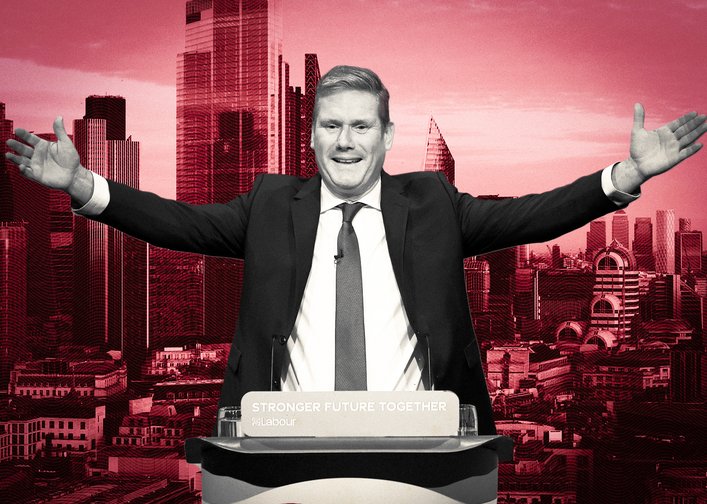
Senior Labour figures have met hundreds of times with lobbyists for big business, banks and arms firms in the last year | Tim Grist Photography/Dan Kitwood/Getty / Composition by James Battershill
An openDemocracy investigation reveals the secretive mass lobbying campaign that shaped Starmer’s policies
Twelve months before seizing power in last week’s historic election victory, Keir Starmer and the Labour Party welcomed with open arms an unprecedented lobbying campaign by the UK’s most powerful corporations.
Weapons manufacturers implicated in human rights abuses in Gaza bent the ears of would-be defence secretaries. Incoming climate change ministers met with oil companies. Labour ministers who will now be responsible for curbing the excesses of the City of London were wined and dined by financial services executives. Public affairs firms representing asset managers, the tobacco industry, gig economy firms and tax-avoiding mega corporations secured meeting after meeting after meeting with future ministers.
In a high-voltage campaign that was simultaneously secretive yet enacted in plain sight, lobbyists worked hard to ensure the policies of the UK’s first ostensibly progressive government in 14 years reflected the interests of their influential clients. And Labour was only too happy to engage.
Westminster’s lax transparency rules mean there is no official record of this mammoth public affairs offensive. The rulebook says the public has no right to know which companies lobby the opposition – a position shared by Starmer’s Labour. In every instance, the party has refused to disclose what was discussed, what promises were made, and even who was at its meetings, saying: “We should not be treated as the government.”
Now, an investigation by openDemocracy lays bare the astonishing access that Big Business had to Starmer and his frontbench team.
openDemocracy spent months gathering information about lobbying meetings from a variety of open sources, including parliamentary meeting rooms’ booking logs, social media posts and events publicised by lobbying firms. These meetings, spanning the past 18 months, have included private meetings, exclusive Q&A sessions, dinners, mixers, briefings, client roundtables, overseas visits and seminars.
We have identified hundreds of meetings that senior figures in the party held with corporate lobbyists, financial institutions and business groups. On average, they met with influential business leaders every single working day of the past year.
This is about more than private dinners and smoked salmon breakfasts. Starmer’s cabinet is about to begin implementing the programme for government laid out in Labour’s manifesto. As Rachel Reeves, his new chancellor, said last month, the “fingerprints” of business are all over Labour’s policies, shaped as they were through an unprecedented level of engagement with corporate lobbyists, financial institutions and business groups.
Experts warn the consequences of the party effectively outsourcing its policy-making to private corporations will be far-reaching for British society. Labour has pledged to build new towns, to increase green investment, to reform health and social care and to launch major infrastructure projects. Mick McAteer, a former director of the UK’s financial services regulator has warned that the much-vaunted partnership with private finance which lies at the heart of all these plans “will result in a massive transfer of wealth from local communities to the City of London and global financial institutions over the next decade”.
The corporate lobbyists
Lobbying is a huge business in the UK. Dozens of agencies make millions every year advising clients on how to influence policy to their benefit and get their messages heard by the politicians who write laws, set regulations and sign off on public sector contracts. The last decent estimate of the industry’s size is from 2007, when Gordon Brown was still the prime minister. A study by the Hansard Society then put it at around £1.9bn. Insiders suggest it has certainly grown in the nearly two decades since.
A big part of a lobbyist’s work is getting their clients access to the right people, which often relies on the lobbyist themself knowing the right people – or having contacts who do. Around 18 months ago, after the spectacular implosion of the Liz Truss regime meant the chances of Labour taking power started to look more likely, the public affairs industry began to reorient en masse.
To prepare for a Labour government, lobby firms began establishing dedicated ‘Labour Units’. They hired former Labour MPs and staffers to make use of their contact networks, with a few even snapping up prospective candidates or seconding staff members directly into the offices of senior party figures. Lobbying firms Global Counsel, Lowick Group, FGS Global and Weber Shandwick have all sent members of staff to work in the offices of senior Labour figures in the past two years – at a combined cost to the firms of more than £100,000.
Other lobbying companies have given donations in cash or in-kind to influential MPs, despite industry rules seeming to bar this practice. New deputy prime minister Angela Rayner alone has received donations from two lobbyists – Sovereign Strategy and Pentland Communications – in the past year.
openDemocracy reached out to each of the firms mentioned above to ask whether they expect to receive anything in exchange for seconding members of staff at their own cost or donating to MPs, but received no response.
The lobbyists’ efforts bore fruit: in the twelve months leading up to the election, not a week went by without a member of Labour’s frontbench team attending a private client roundtable organised by a lobbying firm. These meetings, industry insiders say, represent only a fraction of the work a firm does in connecting its clients with politicians. They often serve merely as an introduction, with clients then able to follow up on issues discussed at the meetings or raise more sensitive matters, either through the agency or in some cases directly with politicians.
One firm, Arden Strategies, was able to secure more private client roundtables with Labour than any other, as far as openDemocracy can establish. The lobby shop, run by former Labour minister Jim Murphy, put its clients in a room with senior Labour figures on at least nine occasions – with politicians lobbied including Reeves, business and trade secretary Jonathan Reynolds and Starmer’s head of business engagement.
Unlike many firms, Arden doesn’t publish a general client list on the Public Relations and Communications Association register. But openDemocracy can reveal that the firm’s major clients include leading arms manufacturer Northrop Grumman and two of the UK’s largest power distribution companies, UK Power Networks and SGN.
Labour needs to take on the vested interests of big corporations, not give them the pen to write policy
Unlike in many other democracies, such as Canada, Germany and Scotland, voters have no right to know who is lobbying opposition politicians in Westminster. Only government ministers are required to regularly publish a list of any meetings they have with businesses, charities, think tanks and corporate lobbyists, along with a brief description of what was discussed. Details of government politicians’ meetings are not disclosed unless a specific Freedom of Information request is made asking about them, and the government may well decide to refuse to answer such requests.
This heavily flawed system is a major issue in a year such as this one, when the opposition’s election victory was almost a foregone conclusion and interest groups have been queuing up to influence its plans for government.
While firms do not need to declare which opposition politicians they’ve lobbied, many advertise their ability to secure access to the shadow frontbench. openDemocracy monitored the leading lobbying firms and found dozens of public references to meetings involving senior Labour politicians. In every instance where openDemocracy asked the lobbying firms and Labour which clients were present at these meetings, neither would provide any details.
Tim Bierley, campaigner at Global Justice Now, warned that Labour may be treating lobbyists as “independent experts” rather than people “responsible primarily for boosting their shareholders’ income”.
Bierley added: “On climate, trade and the economy, the interests of giant corporations are extremely different from the public’s – their outsized influence would blur any visions of progress under Labour.
“To provide a remotely adequate response to crises on multiple fronts, Labour needs to take on the vested interests of big corporations, not give them the pen to write policy.”
The City
Few interest groups carry as much sway with Labour as the representatives of the City of London – and the wider financial services sector that the City rests at the heart of. In recent years, no other industry has more effectively forged ties with the party.
In the weeks before polling day, Labour’s shadow City minister Tulip Siddiq – who is expected to keep the post in government – took to LinkedIn to share manifesto documents on three occasions. Tellingly, it wasn’t her party’s manifesto she was sharing, but those of three major financial services industry representative bodies, UK Finance, TheCityUK and the Association of British Insurers.
“I have worked closely with TheCityUK and its members in recent years,” wrote Siddiq in one of the posts, “to formulate the Labour Party’s policies for the financial and professional services sector.”
Her other two posts are seemingly copy-and-paste jobs, with near-identical wording. In both, Siddiq told of how “delighted” she had been to “work closely” with the Association of British Insurers and UK Finance “to inform Labour’s plans for the sector”.
All three posts suggest that the lobbyists for the City of London and the financial institutions were directly involved in shaping the policies and regulatory approach that will apply to their own industry.
When Labour published a policy document earlier this year laying out its plans for the financial services sector, the party held a no-press-allowed soiree in the City of London’s Guildhall, sponsored by the City of London Corporation, to thank the industry for its contributions. The plans were criticised for committing the party to the same lax regulatory approach taken by the Conservatives, with campaigners describing the document as “a love letter to the city”.
Labour’s frontbench team, including Siddiq, has met with City lobbyists on more than 20 occasions in the past year – not counting its significant engagement with the British Private Equity and Venture Capital Association, which openDemocracy revealed last month. BlackRock, Macquarie, HSBC, Bloomberg, Lloyds, Brookfield Asset Management and Blackstone are among firms to have secured access to leading members of the new government, including Starmer, Reeves, Reynolds and the chancellor of the Duchy of Lancaster, Pat McFadden.
Mick McAteer, a former board member at the Financial Conduct Authority and a campaigner for economic social justice at the Financial Inclusion Centre, told openDemocracy that the close relationship between incoming ministers and the Labour Party can essentially be seen as a kind of quid-pro-quo.
Lobbyists for financial institutions push Labour to commit to a favourable regulatory environment while dangling the promise of vast amounts of private capital. McAteer is increasingly concerned this relationship will amount to a rehashed form of the Private Finance Initiatives (PFI) favoured by New Labour, in which private firms provide all or most of the investment to build infrastructure such as hospitals and schools, and generate profits from lucrative contracts to maintain the infrastructure long after it has been built.
These public-private partnerships, McAteer warns, will shape almost every aspect of Labour’s agenda in government – from its plans for house-building to energy generation and distribution – and will represent a bad deal for the public.
“Private investment is by definition more expensive than public investment, because of the high returns that financial institutions expect to make for their shareholders,” MacAteer said. “These returns have to be paid for in some way, so ultimately, the costs get passed on to households through higher bills.”
The financial services sector has consolidated its relationship with Labour in different ways. HSBC has had a staffer in Reynolds’ office for almost a year, for example, and NatWest had a similar arrangement with the new business secretary for a few months prior to that. Staffers seconded from the firms have been involved in policy development and business engagement – but because they are still paid by their employers while working for Labour, the Electoral Commission classes the arrangements as political donations.
Then there are two advisory panels made up of executives from major financial institutions, which Labour set up while in opposition but that will continue to advise it on where and how to deploy billions worth of private sector investment in government. One board, the National Wealth Fund Taskforce, is headed by Mark Carney, the former Bank of England director general who now works for Brookfield Asset Management. The other, the British Infrastructure Council, includes senior figures from investment firms such as M&G and BlackRock.
McAteer warns these advisory panels constitute a major conflict of interest. “The British Infrastructure Council is full of representatives from firms that stand to financially benefit, who will not just be determining where the money goes, but in what form does the money go, what are the terms of the deals, and that the capital is de-risked before they’ll commit the finance.
“There’s a reason why they want to be on this infrastructure council, they’re not charities. This is not a criticism, it’s just how finance institutions work, and how markets work. They exist to get the best deal for their shareholders and their owners.
“This thing has been sold as a win-win for the economy and for the investors, but somebody pays for that. Ordinary households pay for it, and more importantly, because they don’t have a say in this, it will be future generations who will pay for this.”
He added: “Because these firms will have ownership of the economy and they’ll be able to extract value for as long as that infrastructure lasts. Ordinary people are really going to end up on the wrong side of some very, very badly designed transactions here, shaped by the financial institutions in the City of London.
“They’ve been lobbying for this for a couple of years – and they’ve got what they wanted.”
openDemocracy reached out to each of the firms mentioned above, but only HSBC provided a response. A spokesperson said: “HSBC regularly engages with the major political parties in the UK on issues facing our customers and the wider financial services industry.”
The consultants
If the City of London’s financial institutions stand to win big from Labour’s PFI 2.0, then so, too, do the City management consultancies and accountancies that work so closely with them.
Firms such as the ‘Big Four’ consultancies – Deloitte, KPMG, Ernst and Young (EY) and PriceWaterhouseCoopers (PwC) – and the industry lobbying body, the Management Consultants Association, have met with senior Labour figures at least 13 times since March last year.
Lord Sikka, a Labour peer and Emeritus professor of accounting at the University of Essex, said his party should not be working so closely with management consultancies.
“I think this new form of PFI would be disastrous, it would be a continuation of what we’ve seen in the UK since the late 1970s, a kind of right-wing coup which has seen a restructuring of the state so that it has become a guarantor of corporate profits, rather than an entrepreneurial state which invests,” Sikka said.
“PFI, privatisation and outsourcing – the very things these companies advise on and profit from – are all examples of that.”
Though Starmer doesn’t appear to have attended many of the meetings openDemocracy has uncovered, he was present at a day of business roundtable events at EY’s London offices in March 2023. There, the Labour leader, along with Reeves and Reynolds, heard from business leaders about “the potential value of public and private sector collaboration”, according to a LinkedIn post by EY’s managing partner. The trio returned to EY in November, along with the now chief secretary to the Treasury, Darren Jones, for similar discussions with a few dozen business leaders.
Jones has also attended secretive meetings with elusive consultant Hakluyt, which was founded by former MI6 operatives in 1995 and claims to work with “at least one of the world’s top five corporations in every major sector globally” and “three-quarters of the top 20 private equity firms in the world”. The firm also organised a dinner with Labour MP Peter Kyle, then the shadow secretary for science, innovation and technology, while he was in the US earlier this year.
Hakluyt counts among its advisory board former executives from Rolls Royce and Coca-Cola, as well as former senior civil servants and politicians. It has previously been linked with large oil and gas interests, having been accused by The Sunday Times in 2001 of deploying an agent to spy on Greenpeace campaigners on behalf of oil companies. In recent years Hakluyt has sought to “demystify” and says it now has “no relationship with the spooky world”. A spokesperson said Hakluyt is not a lobbying organisation and does not advise political parties.
Speaking at last year’s Labour Party Conference, Reeves pledged to slash public spending on consultants if elected. This promise also made it into the party’s manifesto. But as economists and authors Mariana Mazzucato and Rosie Collington highlight in their book, The Big Con, the industry has been known to offer its services pro-bono during times of austerity, in hopes of securing lucrative paid contracts in future. In 2011, the then head of public sector at KPMG described the strategy to the Guardian, in the context of working with David Cameron’s coalition government: “We can’t afford to [work pro bono] indefinitely, but we can in the short-term. We’re hoping to position ourselves well when the government decides it is willing to pay.”
In a similar vein, when Labour’s shadow Treasury team was working on its aforementioned plan for financial services, City consultancy Oliver Wyman donated a staff member to help out – at a cost of more than £58,000 for the past year, according to Electoral Commission data. Senior staffers at leading consultancies Grant Thornton and EY have held parliamentary passes as members of Starmer’s team for the past year or so, according to the register of MPs’ staff interests. Since 2021, firms including PwC and Baringa have provided combined pro-bono services to the party worth more than £650,000.
“There are huge questions about why these firms have been providing free staff,” Lord Sikka said, “because obviously that has a cost to them and they would expect a return because they’ve made an investment.”
None of the firms mentioned above responded to openDemocracy’s request for comment.
Labour is sending a clear message to arms dealers – that it will be business as usual
The arms dealers
In March last year, Labour’s then shadow defence secretary, John Healey, and minister for defence procurement, Chris Evans, filed into a function room in the Churchill War Rooms along with executives from 20 of the world’s biggest arms manufacturers, including BAE Systems, Leonardo, Lockheed Martin, RTX, Rheinmetall and Rolls Royce.
The private event at the historical attraction in Westminster was arranged by public affairs firm Rud Pedersen. The firm’s head of defence and security is a former Labour staffer who worked in the party’s shadow defence team between December 2018 and September 2020.
Since last March, party figures have met with representatives from defence firms on at least 13 occasions, including two visits to sites run by BAE Systems and German defence contractor Rheinmetall. Labour’s then shadow science minister Chi Onwurah and armed forces minister Luke Pollard attended a private meeting – hosted by the industry lobbying body, ADS Group – with BAE Systems, Rolls-Royce and Thales at the Labour Party Conference.
A BAE Systems spokesperson said: “As the UK’s largest defence company, employing more than 45,000 people in the UK with thousands more in the supply chain, we regularly engage with political representatives to increase awareness and understanding of the significant contribution our industry makes to the UK’s security and prosperity.”
Most recently, Reeves attended a private client roundtable event hosted by lobbying firm Headland in March this year. The CEO of German AI defence startup Helsing was also present, as was Headland staffer and new Labour MP, Gregor Poynton.
While Labour has consistently ruled out progressive policies such as scrapping the two-child benefit cap or boosting local government funding, it has committed to increasing defence spending to 2.5% of GDP, up from 2.3% last year. Despite a YouGov poll from April indicating that the majority of the public backs a ban on exporting arms to Israel, the party has declined to call for an end to arms sales to the country.
Emily Apple from the Campaign Against the Arms Trade described arms trade lobbyists’ access to the upper echelons of the Labour Party as “hugely alarming”.
She said: “These meetings give [some of] the companies profiting from Israel’s genocide in Gaza a huge amount of influence over Labour’s future defence and foreign policy. This rings alarm bells over whether a future Labour government will uphold international law and impose an arms embargo on Israel or any other human rights-abusing regime.
“These companies profit from death and destruction. Labour should be taking a stand and reducing the influence of these death merchants on political policy. Instead, these meetings mean Labour is sending a clear message to arms dealers – that it will be business as usual for them to continue boosting their share prices through perpetuating conflict and misery across the world.”
openDemocracy reached out to each of the firms mentioned above, but only BAE Systems responded. A spokesperson said: “As the UK’s largest defence company, employing more than 45,000 people in the UK with thousands more in the supply chain, we regularly engage with political representatives to increase awareness and understanding of the significant contribution our industry makes to the UK’s security and prosperity.”
If business wins, who loses?
On Friday morning, during his first address to the nation as prime minister, Starmer said voters had given him a mandate “to do politics differently”. But the representatives of big business, finance and the arms trade, which have worked hard to influence his party, will hope it plans to continue the status quo: prioritising their interests over those of working people.
One week earlier, as now-chancellor Rachel Reeves prepared for a Monday morning sit-down with the heads of financial firms, the couriers’ branch of the IWGB trade union held its annual group meeting in a sunny courtyard in east London. There, some of the most marginalised workers in the UK reflected on the struggles and victories of the past year and looked ahead to the future.
The IWGB, one of many smaller independent trade unions with no affiliation to the Labour Party, works across a number of sectors where the power gap between workers and employers is most acute. From Hartlepool to Hackney, its members are outsourced security guards and cleaners, foster carers, receptionists and couriers.
Many of the corporations that have spent the past 18 months wooing Labour are the same firms severely exploiting these workers, the IWGB’s general secretary, Henry Chango Lopez, told openDemocracy.
“These huge corporations,” Chango Lopez said, “have access to vast sums of money to lobby governments – a method of policy influence that is simply not available to working people. That many senior members of the Labour Party have allowed those employers to get anywhere near influencing policy is indicative of where the government’s priorities lie.”
ActionAid found that since the Paris agreement, banks have funded the largest Big Ag companies doing business in the Global South to the tune of $370 billion and the fossil fuel sector to the tune of $3.2 trillion.
Since the international community promised to limit global heating to 1.5°C above preindustrial levels, the world’s major banks have funneled 20 times more money to climate-polluting industries in the Global South than Global North governments have given those same countries to address the climate emergency.
That’s just one of the findings of How the Finance Flows: The Banks Fueling the Climate Crisis, an ActionAid report released Monday.
“This report names the biggest offenders in the banking world and calls on them to see that they are destroying the planet, while harming the present and future for their children,” Ugandan climate activist Vanessa Nakate wrote in the foreword. “It’s time to hold financial institutions to account, and demand that they end their funding of destructive activity.”
The report focuses on the financing of two major climate-heating industries in the 134 nations of the Global South: fossil fuels and industrial agriculture.
“People generally know that fossil fuels are the number one cause of greenhouse gas emissions. But what is less understood is that industrial agriculture is actually the second biggest cause of climate emissions,” Teresa Anderson, the global lead on climate justice at ActionAid International, said during a press briefing ahead of the report’s release.
This is because of the sector’s link to deforestation, as well as the emissions required to produce industrial fertilizers, she added.
In total, since the 2015 Paris agreement, banks have funded the largest Big Ag companies doing business in the Global South to the tune of $370 billion and the oil, gas, and coal sectors to the tune of $3.2 trillion.
“Global banks often make public declarations that they are addressing climate change, but the scale of their continued support of fossil fuels and industrial agriculture is simply staggering.”
The top three banks that invested the most in these sectors were the Industrial and Commercial Bank of China at $154.3 billion, China CITIC Bank at $134.7 billion, and the Bank of China at $125.9 billion. Citigroup came in fourth at $104.5 billion, followed by HSBC at $80.8 billion.
While China features prominently in the report as the world’s largest economy, Anderson noted that much of what it produces ends up purchased by consumers in the Global North.
The top three banks in the Americas funding big agriculture and fossil fuels were Citigroup, JPMorgan Chase, and Bank of America. While Citigroup was the leading regional funder of fossil fuels, JP Morgan Chase gave the most to industrial agriculture.
In Europe, the top funders after HSBC were BNP Paribas, Société Générale, and Barclays, while Mitsubishi UFJ Financial rounded out the top Asian funders.
Where is all that money going? When it comes to agriculture, the leading recipient was Bayer, which bought out Monsanto in 2018. Banks have given it $20.6 billion to do business in the Global South since 2016.
Much of the fossil fuel money went to China’s State Power Investment Corporation and other Chinese companies; commodities trader Trafigura; and the usual fossil fuel suspects like ExxonMobil, BP, Shell, Saudi Aramco, and Petrobras.
“This is absurd,” Anderson said of the findings. “Global banks often make public declarations that they are addressing climate change, but the scale of their continued support of fossil fuels and industrial agriculture is simply staggering.”
ActionAid called the report the “flagship” document of its Fund Our Future campaign to redirect global money from climate crisis causes to climate solutions. The report calls on banks to make good on their climate promises and stop funding fossil fuels and deforestation, as well as to put additional safeguards in place to protect the rights of local communities, raise the ambition of their goals to reach “real zero” emissions, and improve transparency and other measures to make sure the projects they fund are behaving ethically.
“This can be stopped,” Farah Kabir, the country director of ActionAid Bangladesh, said during the press briefing. “The banks cannot continue to fund fossil fuel industries and industrial agriculture.”
In addition, the report offers recommendations to Global North governments to ensure a just transition to a sustainable future for everyone. These included setting stricter regulations for the banking, fossil fuel, and agricultural industries as well as ending public subsidies for these sectors and channeling the money to positive solutions like renewable energy and agroecology.
However, the form that funds take when sent to the Global South makes a big difference, said ActionAid USA executive director Niranjali Amerasinghe. Instead of coming in the form of private loans, it needs to be in the form of public money.
“Providing more loans to countries that are already in significant debt distress is not going to support their transition to a climate-compatible future,” she said.
One reason that loans are counterproductive is that nations that accept them are forced to provide a return on investment, and currently the main industries that offer this are in fact fossil fuels and industrial agriculture.
In addition to public funds, debt forgiveness or restructuring and new taxes could also help these countries with their green transition. If companies like Exxon or Bayer doing business in the Global South “were taxed in an equitable way, that would allow those governments to raise public revenue that can then be used to support climate action,” Amerasinghe said.
In particular, the report emphasizes agroecology as a climate solution that should be funded in Global South countries.
“Climate change is real in Zambia.”
Mary Sakala, a frontline smallholder farmer from Zambia, spoke at the press briefing about how the climate crisis and current agricultural policy put a strain on her community.
“Climate change is real in Zambia,” she said, adding that it had brought flooding, droughts, pests, and diseases that meant that “families currently, as I’m speaking right now, sleep on an empty stomach.”
Sakala saw hope in agroecology, which would help with food security and resilience, and make farmers less dependent on the government and large companies.
“We need policies to allow [us] to conserve our environment in a cultural way, to help us eat our food,” Sakala said. “We want… every seed to be utilized and saved and shared in solidarity.”
And she said that the companies and governments of the Global North have a duty to help them get there.
“Those people who are continuing to pollute and let the climate change increase, those people need to pay us, because we are suffering from the things that others are doing,” she said.