Critics Warn Media Outlets Failing to Explain Climate Cause Behind Los Angeles Fires

Spread the love

Original article by Eloise Goldsmith republished from Common Dreams under Creative Commons (CC BY-NC-ND 3.0).

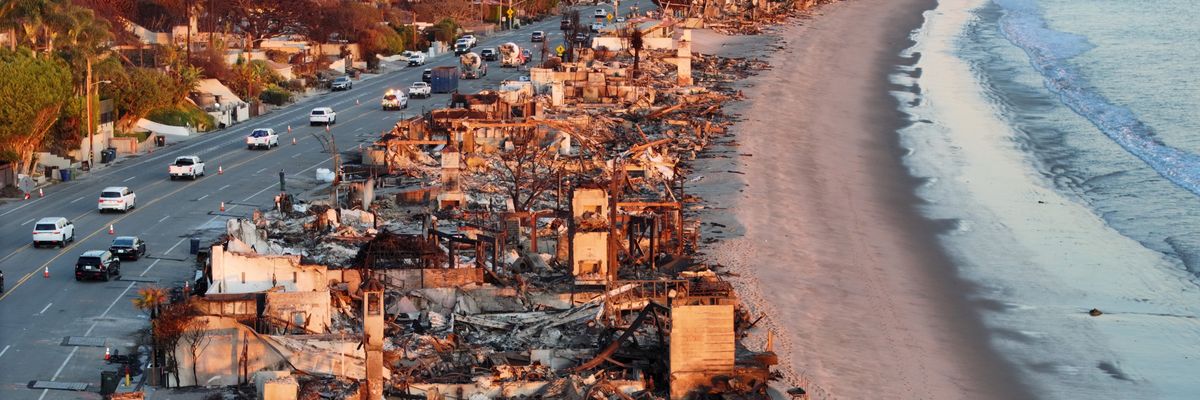
An aerial view of repair vehicles at sunset passing near beachfront homes that burned in the Palisades Fire on January 15, 2025 in Malibu, California. (Photo: Mario Tama/Getty Images)

“Too much of the coverage has simply ignored the climate crisis altogether, an inexcusable failure when the scientific link between such megafires and a hotter, dryer planet is unequivocal,” wrote the founders of Covering Climate Now.

Covering the who, what, when, where, and why is journalism 101. So why are too few media outlets explaining the role that the climate crisis plays in the “why” behind the fires ravaging the Los Angeles region?

That’s the central question posed in an opinion piece published in The Guardian and elsewhere on Thursday authored by Mark Hertsgaard and Kyle Pope, the founders of Covering Climate Now, a global collaboration of over 500 news outlets aimed at improving climate coverage, of which Common Dreams is a part.

Hertsgaard and Pope wrote that “too much of the coverage has simply ignored the climate crisis altogether, an inexcusable failure when the scientific link between such megafires and a hotter, dryer planet is unequivocal.”

They added: “Too many stories have framed the fires as a political spat between U.S. President-elect Donald Trump and California elected officials instead of a horrifying preview of what lies ahead if humans don’t rapidly phase out fossil fuels. Too often, bad-faith disinformation has been repeated instead of debunked.”

Misinformation, in many instances stemming from right-leaning sources, have proliferated since the blazes broke out last week. Trump in a social media post appeared to point the finger at California’s statewide water management plans for fire hydrants running dry as firefighters fought the blazes last week. Southern California does have plenty water stored, but the city’s infrastructure was not designed to respond to a fire as the large as the ones that broke out, experts told PBS. Another user on the platform X falsely claimed that California turned away fire trucks from Oregon because of their emission levels, according to KQED.

Hertsgaard and Pope also called for outlets to name names. “Rarely have stories named the ultimate authors of this disaster: ExxonMobil, Chevron, and other fossil fuel companies that have made gargantuan amounts of money even as they knowingly lied about their products dangerously overheating the planet,” they wrote.

While the fires are still burning, researchers are already drawing the links between climate change and the blazes. In a thread on Bluesky, the climate scientist Daniel Swain explained the concept of climate “hydroclimate whiplash”—which southern California experienced in 2024—and how this can create ideal conditions for fires to spread.

The authors of the opinion piece noted that there have been bright spots when it comes to covering the fires with an eye toward the climate emergency and debunking false and misleading claims about the fires. The duo highlight a Time story that is titled “The LA fires show the reality of living in a world with 1.5C of warming” and a column written by the Los Angeles Times’ Sammy Roth, which began: “Los Angeles is burning. Fossil fuel companies laid the kindling.”

Hertsgaard and Pope wrote, “When a house is on fire, by all means let journalism show us the flames.”

“But tell us why the house is burning, too,” they added.

Original article by Eloise Goldsmith republished from Common Dreams under Creative Commons (CC BY-NC-ND 3.0).

Orcas comment on killer apes destroying the planet by continuing to burn fossil fuels.
Continue ReadingCritics Warn Media Outlets Failing to Explain Climate Cause Behind Los Angeles Fires

Barclays’ billions of ‘sustainable’ finance for fossil fuel industry is greenwash, says investor

Spread the love

Original article by Josephine Moulds Nimra Shahid republished from TBIJ under a Creative Commons Attribution-NonCommercial-NoDerivs 3.0 Unported License.

The bank has funded the companies behind a controversial pipeline and aggressive oil expansion as part of their commitment to fighting climate change

Barclays has been branded “totally dishonest” by one of its investors for calling tens of billions of dollars for fossil fuel companies “sustainable finance”.

The UK high street bank says it is helping to address climate change by raising $1 trillion in sustainable and transition finance by 2030. This includes sustainability-linked loans and bonds, in which a company agrees to meet certain climate-related targets or else face a higher interest rate.

But these targets can be weak and the penalties for failing to meet them paltry. The company can also use the money raised how it sees fit, meaning supposedly sustainable finance could fund polluting activities.

Andrew Harper of Epworth, an investment manager owned by the Methodist church that invests in Barclays, said: “We’re concerned because the bank is making such a substantial claim and the public thinks the climate emergency is being worked towards being solved. Meanwhile, the problem is getting worse and worse. We think it’s totally dishonest.

“If they are calling the financing of any fossil fuel companies sustainable finance, that to me is greenwash.”

Barclays said: “We are committed to being transparent and report separately on the green finance, sustainable finance and the sustainability-linked finance mobilised towards our $1 trillion target, so stakeholders and investors have a clear understanding of what we are reporting.” It said it set out very clear requirements for energy clients’ targets and transition plans in order to access finance.

‘Deeply problematic’ deals

Barclays helped raise $41bn in sustainability-linked finance for fossil fuel companies last year, according to an analysis by the Bureau of Investigative Journalism of data from LSEG, the financial markets group. The $41bn figure covers the total value of the deals Barclays worked on alongside other banks. Barclays itself counts only the funding it is directly responsible for, which it said was $10.9bn across all sectors last year.

Katharina Lindmeier, responsible investments manager at the publicly owned workplace pension scheme Nest, which also invests in Barclays, said TBIJ’s findings were “very concerning”. She added: “We’ll be raising this research with their management team directly at the next opportunity.

“Regulators are looking closely at the issue of greenwashing and if there is any uncertainty, it’s better to be cautious than to mislead customers. Any loans which help companies expand oil and gas infrastructure should not be classed as sustainable.”

The Financial Conduct Authority, the UK regulator, wrote to banks last year highlighting concerns about this type of loan, including weak incentives, potential conflicts of interest, and low ambition. It said that these may lead to accusations of greenwashing.

Anders Schelde, chief investment officer of AkademikerPension, another Barclays investor, said sustainability-linked finance for oil and gas companies is “in most cases deeply problematic”. He said: “We don’t count sustainability-linked bonds and loans as green investments in our own accounting because we know there are so many problems with them. The penalties are low and the targets often insufficient.”

Last year, Barclays helped raise $3bn worth of sustainability-linked loans and bonds for Enbridge, a company that is dramatically expanding oil and gas infrastructure across North America.

Enbridge is behind the construction of a controversial 1,000-mile pipeline that cuts through Indigenous land in the US to pump tar sands oil. It paid US police to crack down on protesters and has been fined millions of dollars for repeated environmental violations.

Barclays classifies the Enbridge debt as sustainable because the company has set a target to cut emissions from its own operations. In part, it intends to do this by using solar power to pump oil through its pipelines.

“The real source of emissions from a company like Enbridge will be from the oil and gas its pipelines help transport,” said Jeanne Martin from responsible investment charity ShareAction. “We do not need greener pipelines, we need to stop the reckless expansion of the fossil fuel industry.

“If the conditions that a bank sets to provide financing to oil and gas transport companies don’t tackle oil and gas, the bank will be accused of greenwashing.”

Barclays also helped raise a $2.8bn sustainability-linked loan for Harbour Energy, the UK’s largest oil and gas producer. Harbour extracted the equivalent of nearly 70m barrels of oil last year, which if burned would produce the equivalent of eight coal-fired power stations’ annual emissions.

Scientists agree that developing any new oil and gas fields will derail climate targets and push global heating beyond 1.5 degrees – which the UN says will threaten lives, food sources and economies worldwide.

It seems that Harbour is aggressively exploring for new oil and gas as it hopes to extract a further 880 million barrels of reserves in the coming decades. It does not appear from Harbour’s public statements that the company has any plans to shift its focus to renewables.

Yet Barclays’ loan to Harbour Energy is called sustainable because the company has committed to reducing emissions from the process of extracting oil and gas. This, however, takes no account of the vast majority of Harbour’s emissions, which are generated from burning the oil and gas itself.

Enbridge paid US police to crack down on protesters opposing its Line 3 pipeline
Nicole Neri/Bloomberg via Getty Images

The notorious oil trader Trafigura also benefited from more than $5.4bn in loans that Barclays called sustainable finance. Counting its supply chain and all the emissions generated by the oil it trades and transports, Trafigura was responsible for more greenhouse gas emissions last year than Spain.

Trafigura’s interest payments are linked to certain sustainability targets, including a pledge to cut emissions – but only from its own operations rather than the burning of the fuels it trades and transports. This accounts for about 1% of the company’s total emissions.

Trafigura said Barclays was one of 54 banks involved in the deal, and said “sustainability-linked loans are an important tool in incentivising reductions in emissions”. It added that its direct emissions were less than 1% of Spain’s. While it reports its indirect emissions, it does not consider all of them “to be within our current sphere of influence”.

Enbridge said it takes climate change seriously and is committed to reducing its greenhouse gas emissions. It said sustainability-linked finance plays an important role in meeting emission-reduction goals and supporting the transition to a lower carbon economy. The company also said that the 1,000-mile Line 3 pipeline had local and tribal approvals and met the strictest environmental standards, and that payments to law enforcement were made and administered via a third party.

Harbour did not respond to a request for comment.

Barclays said: “Sustainability linked loans and bonds are an important sustainable finance tool, incentivising borrowers, particularly in hard to abate sectors, to achieve sustainability objectives over time.”

Net-zero banking

Barclays has committed to cut its emissions – including of the companies it finances – to net zero by 2050. To reach this target, it will have to stop providing money to companies that refuse to shift away from fossil fuels.

Enbridge’s Line 3 project cuts through Indigenous land
Tim Evans/Bloomberg via Getty Images

But a report out today shows that the bank’s funding for fossil fuels increased in 2023 from 2022, which troubled shareholders who have been urging it to reduce lending in line with its climate targets. Barclays was Europe’s top funder of the fossil fuel industry last year, according to the report led by the Rainforest Action Network.

Lindmeier, the Nest investment manager, said: “We want to see Barclays immediately reduce its financing to companies behind new fossil fuel expansion. Any delays could leave the company more exposed to bad loans and potentially cost them millions of pounds.”

Laura Hillis from the Church of England pensions board, another Barclays investor, said: “We are looking for banks to produce a clear climate plan and to see the commitments carry through into lending decisions. Our concern is that these fossil fuel financing figures show that is not happening at the pace we’d like.”

Climate-conscious investors have been putting pressure on Barclays to make good on its net-zero pledge and earlier this year the bank committed to stop providing specific project finance for oil and gas expansion and related infrastructure.

However, less than 2% of Barclays’ funding for oil and gas last year fell under the label of “project finance”. Almost all of it comes in the form of general, unrestricted finance for the companies undertaking those projects.

“Barclays’ new oil and gas policy is an important step forward for the bank but it should have gone so much further,” said Martin from ShareAction, which brought together Barclays shareholders to urge the bank to restrict lending to oil and gas companies.

“Ultimately, the bank has kept the right to finance companies that have plans to massively expand the fossil fuel industry with no strings attached, and that’s a real problem.”

Original article by Josephine Moulds Nimra Shahid republished from TBIJ under a Creative Commons Attribution-NonCommercial-NoDerivs 3.0 Unported License.

Continue ReadingBarclays’ billions of ‘sustainable’ finance for fossil fuel industry is greenwash, says investor

Just Stop Oil threatens fresh civil resistance if politicians fail to take action on fossil fuels

Spread the love

https://morningstaronline.co.uk/article/just-stop-oil-threatens-fresh-campaign-civil-resistance-if-leaders-fail-take-action

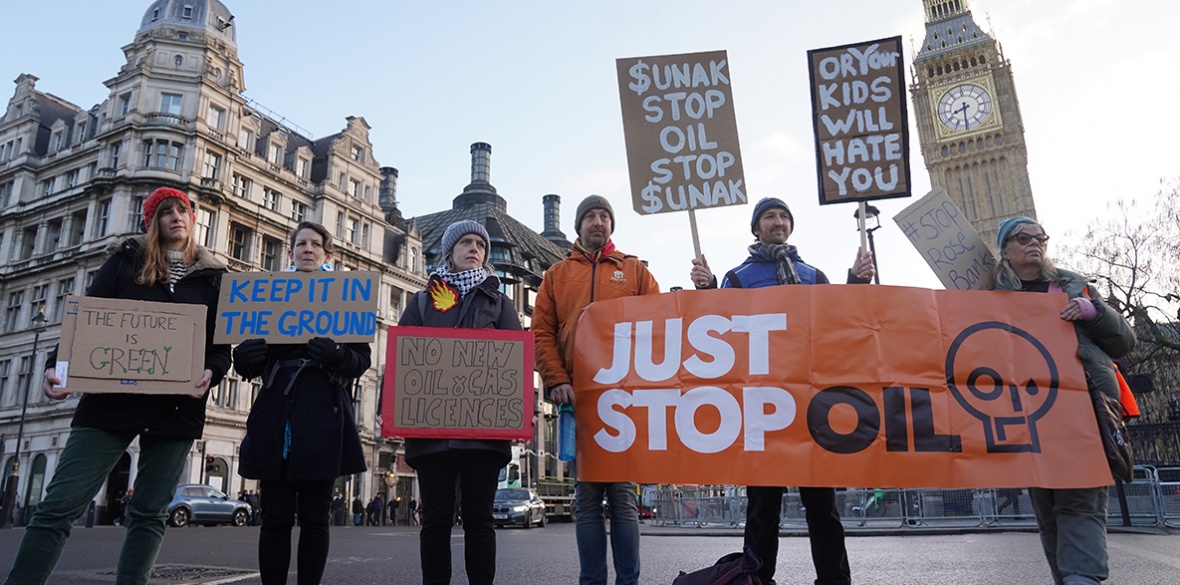
Protesters from Just Stop Oil, Extinction Rebellion, Fossil Free London and Scientist Rebellion take part in an ‘emergency demonstration’ at Parliament Square, central London, January 22, 2024

CLIMATE activists have vowed to launch a new campaign of civil resistance if Britain’s next PM fails to sever reliance on fossil fuels.

Just Stop Oil has delivered letters to the leaders of all major parties ahead of the election on July 4 demanding they commit to signing a fossil fuel non-proliferation treaty, which would halt expansion and manage a just transition.

They said: “It is clear that continuing to extract and burn fossil fuels in 2024 is nothing short of an act of war against humanity. “

The group warned that if the incoming leader does not establish a legally binding treaty to stop fossil fuel extraction by 2030, they would launch a “campaign of civil resistance,” co-ordinated with movements in Austria, Canada, Norway, the Netherlands and Switzerland.

https://morningstaronline.co.uk/article/just-stop-oil-threatens-fresh-campaign-civil-resistance-if-leaders-fail-take-action

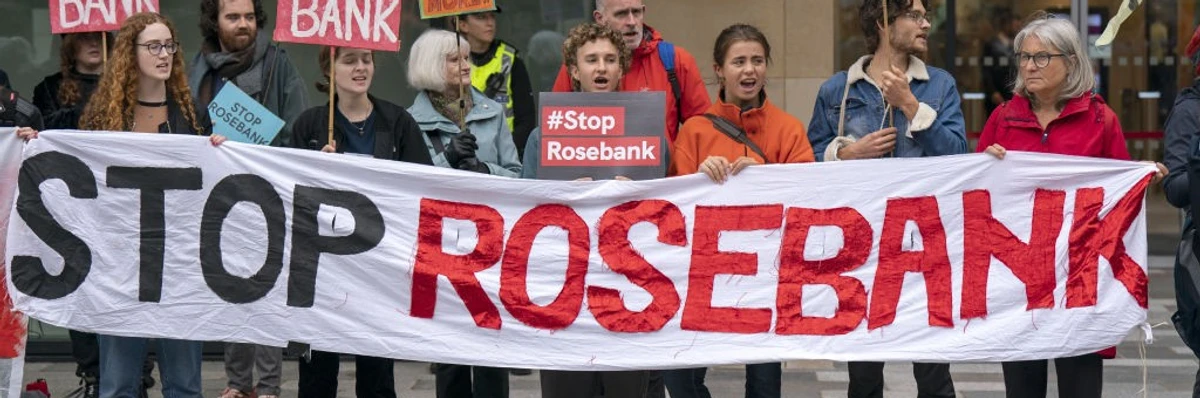
Campaigners take part in a Stop Rosebank emergency protest outside the U.K. Government building in Edinburgh, after the controversial Equinor Rosebank North Sea oil field was given the go-ahead Wednesday, September 27, 2023. (Photo: Jane Barlow/PA Images via Getty Images)
Continue ReadingJust Stop Oil threatens fresh civil resistance if politicians fail to take action on fossil fuels

77% of Top Climate Scientists Think 2.5°C of Warming Is Coming—And They’re Horrified

Spread the love

Original article by OLIVIA ROSANE republished from Common Dreams under Creative Commons (CC BY-NC-ND 3.0).

Scientists engage in civil disobedience on the steps of the Congress of Deputies in Madrid, Spain on April 6, 2022. 
(Photo: Scientist Rebellion)

“I expect a semi-dystopian future with substantial pain and suffering for the people of the Global South,” one expert said.

Nearly 80% of top-level climate scientists expect that global temperatures will rise by at least 2.5°C by 2100, while only 6% thought the world would succeed in limiting global heating to 1.5°C above preindustrial levels, a survey published Wednesday by The Guardian revealed.

Nearly three-quarters blamed world leaders’ insufficient action on a lack of political will, while 60% said that corporate interests such as fossil fuel companies were interfering with progress.

“I expect a semi-dystopian future with substantial pain and suffering for the people of the Global South,” one South African scientist told The Guardian. “The world’s response to date is reprehensible—we live in an age of fools.”

“What blew me away was the level of personal anguish among the experts who have dedicated their lives to climate research.”

The survey was conducted by The Guardian‘s Damian Carrington, who reached out to every expert who had served as a senior author on an Intergovernmental Panel on Climate Change (IPCC) report since 2018. Out of 843 scientists whose contact information was available, 383 responded.

He then asked them how high they thought temperatures would rise by 2100: 77% predicted at least 2.5°C and nearly half predicted 3°C or more.

“What blew me away was the level of personal anguish among the experts who have dedicated their lives to climate research,” Carrington wrote on social media. “Many used words like hopeless, broken, infuriated, scared, overwhelmed.”

The 1.5°C target was agreed to as the most ambitious goal of the Paris agreement of 2015, in which world leaders pledged to keep warming to “well below” 2°C. However, policies currently in place would put the world on track for 3°C, and unconditional commitments under the Paris agreement for 2.9°C.

The survey comes on the heels of the hottest year on record, which already saw a record-breaking Canadian wildfire season as well as extreme, widespread heatwaves and deadly floods. The first four months of 2024 have also been the hottest of their respective months on record, and the year has already seen the fourth global bleaching event for coral reefs.

“They can say they don’t care, but they can’t say they didn’t know.”

“I think we are headed for major societal disruption within the next five years,” Gretta Pecl of the University of Tasmania told The Guardian. “[Authorities] will be overwhelmed by extreme event after extreme event, food production will be disrupted. I could not feel greater despair over the future.”

Scientists said that governments and companies that profit from the burning of fossil fuels had prevented action. Many also blamed global inequality and the refusal of the wealthy world to step up, both in terms of reducing their own emissions and helping climate vulnerable nations adapt.

“The tacit calculus of decision-makers, particularly in the Anglosphere—U.S., Canada, U.K., Australia—but also Russia and the major fossil fuel producers in the Middle East, is driving us into a world in which the vulnerable will suffer, while the well-heeled will hope to stay safe above the waterline,” Stephen Humphreys at the London School of Economics said.

Despite their grim predictions, many of the scientists remained committed to researching and speaking out.

“We keep doing it because we have to do it, so [the powerful] cannot say that they didn’t know,” Ruth Cerezo-Mota, who works on climate modeling at the National Autonomous University of Mexico, told The Guardian. “We know what we’re talking about. They can say they don’t care, but they can’t say they didn’t know.”

Others found hope in the climate activism and awareness of younger generations, and in the finding that each extra tenth of a degree of warming avoided protects 140 million people from extreme temperatures.

“I regularly face moments of despair and guilt of not managing to make things change more rapidly, and these feelings have become even stronger since I became a father,” said Henri Waisman of France’s Institute for Sustainable Development and International Relations. “But, in these moments, two things help me: remembering how much progress has happened since I started to work on the topic in 2005 and that every tenth of a degree matters a lot—this means it is still useful to continue the fight.”

Peter Cox of the University of Exeter added: “Climate change will not suddenly become dangerous at 1.5°C—it already is. And it will not be ‘game over’ if we pass 2°C, which we might well do.”

“I’m not despairing, I’m not giving up. I’m pissed off and more determined to fight for a better world.”

Many of the scientists who still saw a hope of keeping 1.5°C alive pinned it on the speeding rollout and falling prices of climate-friendly technologies like renewable energy and electric vehicles. Also on Wednesday, energy think thank Ember reported that 30% of global electricity came from renewables in 2023 and predicted that the year would be the “pivot” after which power sector emissions would start to fall. Experts also said that abandoning fossil fuels has many side benefits such as cleaner air and better public health. Though even the more optimistic scientists were wary about the unpredictable nature of the climate crisis.

“I am convinced that we have all the solutions needed for a 1.5°C path and that we will implement them in the coming 20 years,” Henry Neufeldt of the United Nations’ Copenhagen Climate Center told The Guardian. “But I fear that our actions might come too late and we cross one or several tipping points.”

Several scientists gave recommendations for things that people could do to move the needle on climate. Humphreys suggested “civil disobedience” while one French scientist said people should “fight for a fairer world.”

“All of humanity needs to come together and cooperate—this is a monumental opportunity to put differences aside and work together,” Louis Verchot, based at the International Center for Tropical Agriculture in Colombia, told The Guardian. “Unfortunately climate change has become a political wedge issue… I wonder how deep the crisis needs to become before we all start rowing in the same direction.”

The publication of The Guardian‘s survey prompted other climate scientists to share their thoughts.

“As many of the scientists pointed out, the uncertainty in future temperature change is not a physical science question: It is a question of the decisions people choose to make,” Texas Tech University climate scientist Katharine Hayhoe wrote on social media. “We are not experts in that; And we have little reason to feel positive about those, since we have been warning of the risks for decades.”

Aaron Thierry, a graduate researcher at the Cardiff School of Social Sciences, pointed out that The Guardian‘s results were consistent with other surveys of scientific opinion, such as one published in Nature in the lead-up to COP26, in which 60% of IPCC scientists said they expected 3°C of warming or more by 2100.

James Dyke of the University of Exeter’s Global Systems Institute argued that there was room for scientists to share more negative thoughts without succumbing to or encouraging defeatism.

“I hear the argument that we must temper these messages because we don’t want people to despair and give up. But I’m not despairing, I’m not giving up. I’m pissed off and more determined to fight for a better world,” Dyke said on social media.

NASA climate scientist Peter Kalmus shared the article with a plea to “please start listening.”

“Elected and corporate ‘leaders’ continue to prioritize their personal power and wealth at the cost of irreversible loss of essentially everything, even as this irreversible loss comes more and more into focus. I see this as literally a form of insanity,” Kalmus wrote, adding that “capitalism tends to elevate the worst among us into the seats of power.”

However, he took issue with the idea that a future of unchecked climate change would be only “semi-dystopian.”

“We’re also at risk of losing any gradual bending toward progress, and equity, and compassion, and love,” Kalmus said. “All social and cultural struggles must recognize this deep intersection with the climate struggle.”

Original article by OLIVIA ROSANE republished from Common Dreams under Creative Commons (CC BY-NC-ND 3.0).

[dizzy: It is generally accepted by knowledgeable parties that 2.5C is “locked-in” in the sense that emissions already made will cause it. We need immediate reduction in climate heating gases by abandoning fossil fuels. Politicians worldwide are neglecting this necessary action and are indeed creating a worse situation by promoting fossil fuels through widespread and generous subsidies.]

14/5/24 I’m trying to verify the “locked-in” claim that I make above. It’s not particularly supported by this report.

14/5/24 8.30 pm BST

If greenhouse gas emissions stopped but greenhouse gases stayed at a fixed level then there’d be another ~0.5-0.6°C of slow warming in the pipeline, but in reality CO₂ would fall due to natural carbon sinks once emissions stop and largely cancel out this warming.

Aerosols mask ~0.6°C of warming, but even in the unlikely scenario of their sudden elimination models show only ~0.2-0.4°C of extra warming by 2100 as a result. A gradual partial phase-out of aerosol emissions could limit this unmasking effect to ~0.1-0.2°C spread over time, and cuts in non-CO₂ greenhouse gases like methanes could entirely counteract aerosol removal, minimising its impact.

Overall this likely reduces “locked-in” warming from the climate lag and aerosols to a negligible amount on top of the current (2021) warming of ~1.2°C – in contrast to the extra ~1.4°C sometimes claimed – and any short-term warming from aerosol reductions can be reduced and compensated for by reducing other short-lived greenhouse gases like methane.

All of this is quite academic of course – politicians do not intend to address global warming and instead intend to continue trashing the planet.

Continue Reading77% of Top Climate Scientists Think 2.5°C of Warming Is Coming—And They’re Horrified