Big Oil Rallies to Obstruct Accountability
Original article by Emily Sanders republished from DeSmog.
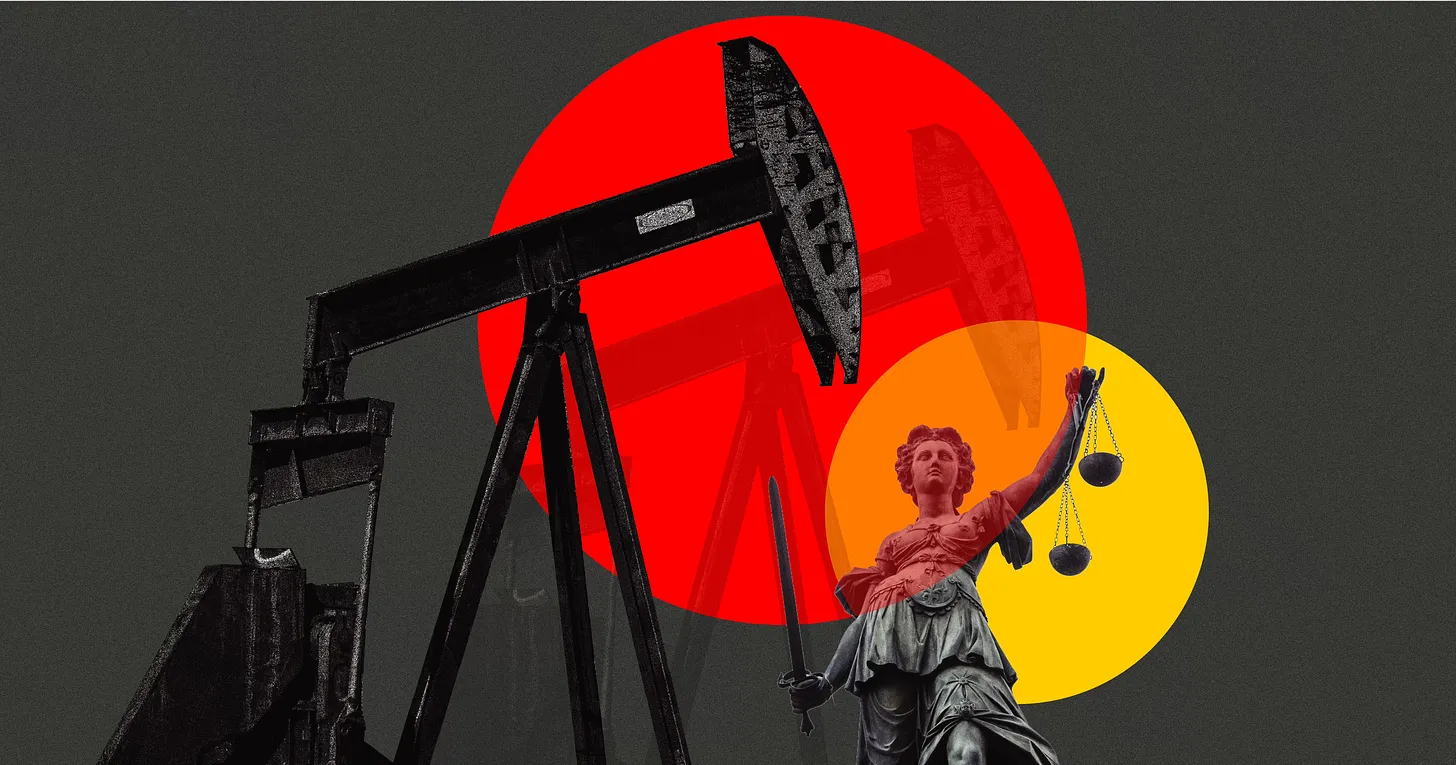
Fossil fuel interests are deploying unprecedented strategies to hide evidence of companies’ deception and block liability lawsuits before they reach trial.
This article by ExxonKnews is published here as part of the global journalism collaboration Covering Climate Now.
In the face of mounting scrutiny from local, state, and federal officials, fossil fuel companies and their allies are deploying a range of tactics to obstruct ongoing lawsuits and investigations concerning evidence that the industry has misled the public about the harms it knew its products would cause to the climate, environment, and human health.
Far-right industry allies with ties to Chevron have mounted an “unprecedented” pressure campaign calling on the Supreme Court to stop a potentially historic climate deception lawsuit against oil majors from going to trial. Republican attorneys general are separately urging the Supreme Court to throw out similar climate fraud lawsuits from five states. Plastics industry trade associations are suing the California state attorney general’s office to block an investigation into whether oil companies lied about plastic recycling. And fossil fuel giants and their trade groups have responded to congressional subpoenas with highly redacted records and “baseless” First Amendment legal defenses.
“I think we’re seeing an escalation by the industry to do anything it can to avoid being held accountable for the consequences of climate change,” said Lisa Graves, executive director of investigative watchdog group True North Research and an expert on dark money special interest groups. “It continues to try to thwart efforts to try to mitigate climate change and it continues to try to stop efforts to get any compensation for the harms it has caused, not just through the burning of fossil fuels but also by the delay and deceit that it has promoted through front groups.”
State and local climate lawsuits, which accuse oil and gas majors of lying about the dangers of fossil fuels and seek to hold them accountable for the resulting damages, are advancing in state courts despite the industry’s efforts. Most recently, a Colorado judge denied nearly all motions by ExxonMobil and Suncor Energy to dismiss the City and County of Boulder’s case against them.
It’s the fifth time to date that a court has rejected Big Oil’s efforts to dismiss climate accountability lawsuits — bringing the companies closer to facing trial and potentially billions of dollars in liability. If any of the cases go to trial, said Michael Gerrard, director of the Sabin Center for Climate Change Law at Columbia University, “it will shine a very harsh light on the fossil fuel companies and it could lead to crushing monetary judgments.”
“Clearly the defendants here are using everything they can think of to derail these cases,” Gerrard said. That attitude has been most evident in Big Oil’s response to a lawsuit from Honolulu, which could be among the first communities to put the companies on trial.
In February, oil company defendants — including Exxon, Chevron, BP, and Shell — petitioned the U.S. Supreme Court to review a Hawai‘i state Supreme Court ruling that allowed Honolulu’s case to move toward trial. The case, the companies argued in their petition, is preempted by federal law and should be dismissed.
But after traditional legal arguments have failed to shield the industry to date, allies seem to be turning to more extreme and novel measures.
Leonard Leo to the Rescue?
In the weeks and months before the Supreme Court was scheduled to hear Big Oil’s petition in Honolulu’s lawsuit, a flood of social media ads and op-eds called for the Supreme Court justices to take up — and throw out — the case.
“To end this nuisance charade, the Supreme Court needs to take up the Honolulu case and declare once and for all that public nuisance is for local issues, not global climate change,” reads the narrator of one such video ad posted to X.
The name behind that ad, the Alliance for Consumers, is part of an organization called the Concord Fund, formerly known as the Judicial Crisis Network. Those groups, Graves and others have pointed out, are projects of billionaire Leonard Leo, head of the far-right legal advocacy group the Federalist Society and known as the architect of the current Supreme Court. CRC Advisors — one of the Leo-backed companies in the effort — appears to have had Chevron, a defendant in Honolulu’s case, as a client.
The fossil fuel industry also helped fund the Federalist Society, and partners at major law firms representing oil and gas companies — including Theodore Olson of Gibson Dunn, the law firm representing Chevron against Honolulu and other communities’ climate liability cases — sit on its board.
Former Hawai‘i Supreme Court Justice Michael Wilson, who served on the state’s highest court for a decade, called the pressure campaign targeting the Supreme Court a “powerful intervention” by “the strongest special interest group in the history of human civilization.”
“This is the most important case in the United States from the point of view that it will allow a jury of citizens to see the fraud and to decide what to do about it,” said Wilson. “This is a high-risk strategy that shows that the fossil fuel industry is desperate.”
Oil companies, which quietly funded front groups like the American Legislative Exchange Council (ALEC) to sow climate denial and oppose climate action on their behalf, are now rallying their allies and benefactors to strike at lawsuits that seek to hold them accountable, explained Graves. In April, 20 Republican attorneys general filed a brief with the U.S. Supreme Court in support of the oil companies’ petition.
The attorneys general are all members of the Republican Attorneys General Association, or RAGA, which helps Republican attorneys general with their election or reelection campaigns. Its top donor in 2024 was Leo’s Concord Fund.
“The Leo-tied groups are a soup-to-nuts intervention machine, from the Republican attorneys general to the judges he helped put on the court,” said Graves.
In June, the Supreme Court delivered a one-line order asking the U.S. Justice Department to weigh in on the case — an “extraordinary” response at this stage, according to Wilson, considering that the case has not yet gone to trial. If the Solicitor General neglects to weigh in before the election, that response could be in the hands of a Trump administration. Trump has promised that if re-elected, he will “stop the wave of frivolous litigation from environmental extremists.”
A ‘Highly Unusual’ Request
In May, 19 members of RAGA made a “highly unusual” request to the Supreme Court: to intervene in and undermine climate accountability lawsuits filed by five states — California, Connecticut, Minnesota, New Jersey, and Rhode Island — claiming that their cases would impose “ruinous liability” on fossil fuel companies and threaten “our basic way of life.”
The Supreme Court has original jurisdiction over disputes between states — meaning it can hear a case without it first being heard by another court — but such challenges are more commonly brought over issues like water rights, said Gerrard of Columbia’s Sabin Center. “I’ve never previously heard of an instance where there’s an effort to invoke the original jurisdiction of the [U.S.] Supreme Court to swat down litigation,” he said.
RAGA obtains some of its largest donations from the fossil fuel industry — including Koch Industries, Exxon, and the American Petroleum Institute, all of whom are defendants in climate liability cases — according to an analysis by the Center for Media and Democracy.
“These AGs have now placed their allegiance directly with the special interest group that is threatening the survival of future generations,” said Wilson.
The filing argues that “oil and natural gas have supported improvements in environmental quality and have reduced weather-related deaths,” and claims that “America’s air is cleaner than a century ago thanks in part to the increased use of oil and natural gas.”
It isn’t the first time Republican attorneys general have rushed to shield oil companies from accountability for their climate deception — and overtly used climate denialist talking points first leveraged by Big Oil in their defense. In 2016, Exxon sued the attorneys general of New York and Massachusetts in an attempt to block investigations into the company’s private research and public communications about climate change, claiming the probe was an attack on their free speech and other constitutional rights.
Republican attorneys general from 12 states filed a 2018 brief in support of the oil giant, arguing that “Climate change is the subject of legitimate international debate.”
“[T]he most undeniable fact about climate change is that, like so many other areas of science and public policy, the debate remains unsettled, the research is far from complete, and the path forward is unclear,” they wrote.
A(nother) First Amendment Fight
Another industry strategy to block accountability is playing out in response to California Attorney General Rob Bonta’s investigation into whether Exxon and other petrochemical companies deceived the public about the efficacy of plastic recycling as a solution to plastic waste. In May, the American Chemistry Council and Plastics Industry Association — two major trade groups representing oil and chemical giants including Exxon, Chevron, Amoco, Dow, and DuPont — filed a lawsuit against the attorney general in federal court, claiming the investigation violates their free speech rights.
Bonta, who had said he would decide whether to sue Exxon by the summer, responded with petitions asking the Sacramento County Superior Court to order the groups to comply with his office’s subpoenas.
“For years, the plastics industry has engaged in an aggressive campaign to deceive the public, perpetuating a myth that recycling can solve the plastics waste and pollution crisis,” Bonta said in a statement. “The continuous delay tactics are failing to comply with our subpoena. Enough is enough: What are they trying to hide?”
Members of Congress have similarly accused the Big Oil companies of trying to obstruct investigations.
When Senate Budget Chairman Sheldon Whitehouse (D-RI) and House Oversight Ranking Member Jamie Raskin (D-MD) referred their years-long investigation into the industry’s climate deception to the Justice Department, the lawmakers wrote that “some companies claimed that the First Amendment or undefined ‘privilege’ protected them from the House Oversight Committee’s subpoena.” The main subjects of that investigation have been Exxon, Shell, Chevron, BP, API, and the U.S. Chamber of Commerce.
“The companies further obstructed the investigation by significantly redacting or entirely withholding more than 4,000 documents without any valid basis,” the lawmakers wrote, adding that their refusal to comply “provides a basis to infer that there is even more damning evidence of deceptive practices by the companies and their trade associations waiting to be uncovered.”
Fossil fuel companies and the law firms representing them have used a First Amendment defense to try to dismiss the climate accountability lawsuits, claiming company statements on climate change are protected political speech. One of the most prominent voices for that argument have been attorneys at Gibson Dunn, the firm that represents Chevron, and whose partner Theodore Olson sits on the Federalist Society board.
If these “overt” and “brazen” efforts to escape accountability can be overcome, the industry will no doubt face a reckoning, said Wilson, the former Hawai‘i Supreme Court justice. Communities like Honolulu “are being ravaged by climate” and “will apply the rule of law fairly,” he said.
“Hawai‘i is not a place that can be manipulated by the fossil fuel industry. That is a very big threat to the most powerful special interest group that’s now maintaining its power based on complicity.”
Original article by Emily Sanders republished from DeSmog.
Report Details Big Oil Lobby’s Relentless Opposition to a Green Transition
Original article by JESSICA CORBETT republished from Common Dreams under Creative Commons (CC BY-NC-ND 3.0).
Climate campaigners said the “brilliant and disturbing” publication “shows the crucial need for increased awareness of the delaying tactics of fossil fuel companies.”
Echoing years of academic, congressional, and journalistic research, a U.K.-based think tank on Thursday released a report detailing how top fossil fuel industry trade groups have “used a playbook of narratives and arguments to systematically oppose, weaken, and delay the transition to renewables and electric vehicles (EVs) since at least 1967.”
The new InfluenceMap analysis focuses on the American Petroleum Institute (API), FuelsEurope, and Fuels Industry U.K.—whose spokespeople responded to the report by insisting to SustainableViews that the oil and gas industry is playing an “essential” role in the transition and it is necessary to harness “vast energy resources, from oil and natural gas to renewables.”
Meanwhile, InfluenceMap’s report calls out the organizations for their use of three narratives over the past five decades that “has likely contributed to delaying the energy transition and continues to pose a serious threat to policy progress on climate change.”
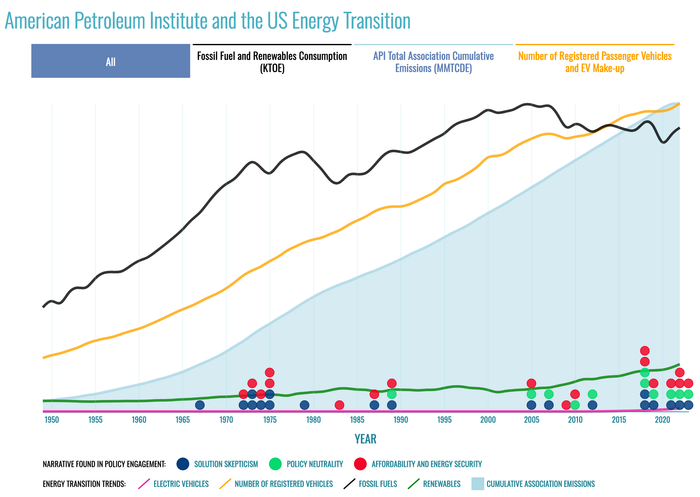
“Between 1950 and 2022, the members of these associations have a combined contribution of approximately 350 billion tons of greenhouse gas emissions, accounting for approximately 18% of the world’s total cumulative CO2 emissions from fossil fuels and industry,” the report notes.
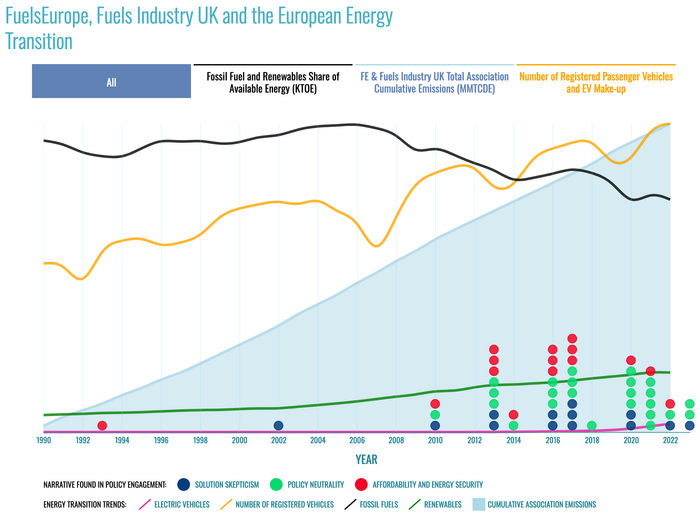
InfluenceMap traced the narratives “across 51 separate instances of the associations’ advocacy against fossil fuel alternatives between 1967 and 2023,” the publication explains. “These narratives include ‘Solution Skepticism,’ which has been in use for 56 years, ‘Policy Neutrality’ for 34 years, and ‘Affordability and Energy Security’ for 51 years.”
The group defined the narratives as follows:
- Solution Skepticism: downplays the impact and viability of alternative energy.
- Policy Neutrality: promotes consumer choice, market solutions, and minimal government intervention.
- Affordability and Energy Security: paints fossil fuel alternatives as a risk to cost-effective and secure energy.
“Despite advancements in understanding the threats posed by the climate crisis, these narratives persist as of 2023,” the report says. It also emphasizes that the narratives contradict science-based policy recommendations from the United Nations’ Intergovernmental Panel on Climate Change (IPCC) and the International Energy Association (IEA).
Some examples identified by InfluenceMap include API comments on the Clean Air Act and amendments in 1967, 1970, and 1989 as well as the association’s remarks on the Inflation Reduction Act of 2022 and pollution standards for heavy-duty vehicles last year. The publication also points to FuelsEurope’s 2021 comments on European Union Performance Standards and the group’s participation in a 2022 letter about the Energy Performance of Buildings Directive.
InfluenceMap produced graphics to display its findings, including one that shows key members of each association as of March. Members of all three include BP, ExxonMobil, Shell, and Phillips 66.
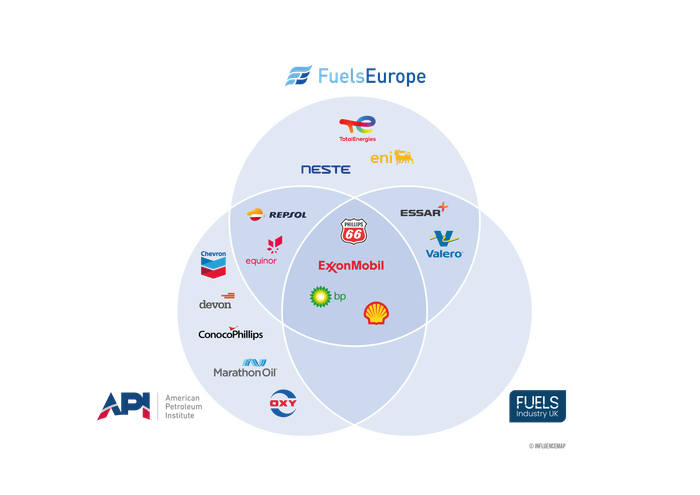
“Some of the world’s largest oil and gas companies are still paying a high premium to participate in industry associations that may no longer represent them on climate policy,” the report states, pointing to how associations’ actions contrast with public positions taken by some major fossil fuel corporations. “Meanwhile, Shell, Chevron, and Exxon have disclosed that they pay between $5 million and $12.5 million per year to hold a membership with the API.”
The think tank also made a pair of graphics showing how the trade associations’ documented use of the three narratives aligns with fossil fuel and renewables consumption, association members’ cumulative emissions, and the number of EVs compared with the total number of registered passenger vehicles since the 1950s.
“This report shows that even faced with mounting scientific evidence over decades, the oil and gas industry have pushed ahead with a damaging messaging strategy they developed as early as the 1960s,” said Tessa Khan, founder and executive director of Uplift, which supports a rapid and fair transition away from fossil fuel production in the U.K.
“It shows the crucial need for increased awareness of the delaying tactics of fossil fuel companies from policymakers if they are to successfully drive the energy transition forward at the pace we need,” Khan added.
Calling the report “brilliant and disturbing,” the U.K.-based Fossil Free Parliament said that “this is exactly why we need to remove the industry’s seat at the table in Westminster.”
In the United States, Democratic federal lawmakers recently concluded a probe into BP, Chevron, ExxonMobil, Shell, API, and the U.S. Chamber of Commerce for decades of spreading climate disinformation, after which they urged the U.S. Department of Justice to investigate all six.
Original article by JESSICA CORBETT republished from Common Dreams under Creative Commons (CC BY-NC-ND 3.0).
- House Report On Big Oil Greenwashing Shows ‘Big Tobacco Playbook All Over Again’ ›
- Senate Hearing Exposes Big Oil’s ‘Campaign Of Deception And Distraction’ ›
- ‘Scathing Indictment’ Of Big Oil Lies Unveiled On Eve Of Senate Hearing ›
- Big Gas Has Followed The Tobacco Playbook For Spreading Lies And Indoor Air Pollution ›
Tory government met with oil and gas lobbyists daily last year

https://morningstaronline.co.uk/article/tory-government-met-oil-and-gas-lobbyists-daily-last-year
THE Tory government met representatives from the oil and gas sector an average of 1.4 times per working day in 2023, an investigation by Global Witness revealed today.
At least 65 fossil fuel organisations and industry bodies were identified as meeting with ministers over the year, according to the group.
Global Witness analysed data by Transparency International UK, looking at any organisation that “could be reasonably assumed to have the goal of influencing policy or legislation in the interests of a fossil fuel company and its shareholders.”
According to its findings, ministers met representatives from the oil and gas sector at least 343 times last year, up from 330 meetings held in 2022.
More widely, the group found that meetings between oil and gas lobbyists and the government have been steadily increasing over the past 11 years.
November 2023 saw record-high levels of meetings when the government met oil and gas lobbyists at least 63 times, equivalent to almost three meetings every working day, the campaigners said.
The Offshore Petroleum Licensing Bill, which would mandate annual licensing of new oil and gas fields in the North Sea, was introduced the same month, they noted.
The end of November also marked the start of the UN climate change conference Cop28 in Dubai.
…
Article continues at https://morningstaronline.co.uk/article/tory-government-met-oil-and-gas-lobbyists-daily-last-year
There is no climate plan other than to let the planet burn
You know this don’t you? Temperature records continually getting broken, US Secretary General Antonio Guterres continually warning about climate hell, politicians and fossil fuel cnuts continuing to destroy the planet.
The solution is known and has been know since the 1960s and 70s – it is simply to stop burning fossil fuels. Fossil fuel companies have known, lied and deceived. Politicians in the pocket of the fossil fuel industry offer and do nothing.
Action was needed decades ago and shite politicians have failed us all. You can’t leave it to the profiteers or the politicians that they own if you want a planet you can live on – they quite clearly don’t give a feck about anything other than money and power.