Rosebank shows the UK’s offshore oil regulator no longer serves the public good

Spread the love
Igor Hotinsky / Shutterstock

Gisa Weszkalnys, London School of Economics and Political Science and Gavin Bridge, Durham University

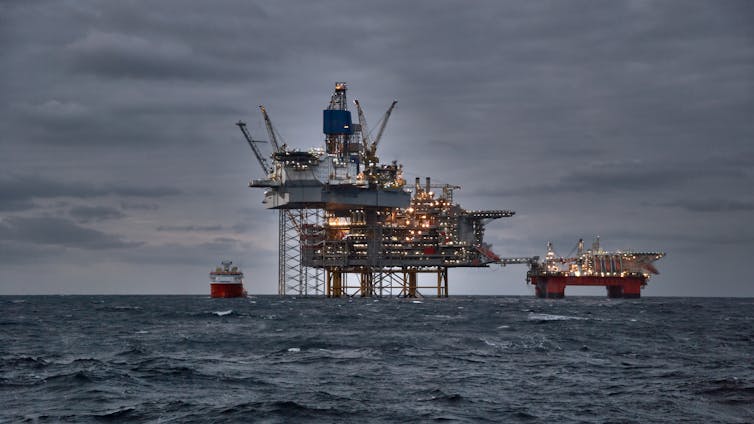
In a four-line statement announcing the approval of the new Rosebank oil field 80 miles west of Shetland, the UK’s offshore oil and gas regulator showed its mission no longer serves the public good.

The announcement by the North Sea Transition Authority (NSTA), which regulates oil and gas extraction in the waters off the British coast, asserted that net zero considerations had been taken into account – a technical definition that makes it appear long-term oil production is compatible with climate goals. This has outraged and dismayed climate scientists, campaigners, and the many other people concerned about the UK’s faltering climate leadership.

The approval greenlights a process that is expected to produce first oil by 2026, and around 300 million barrels of oil (and a smaller amount of gas) over the next two decades. The project’s developers are Equinor, an oil company owned for the most part by the Norwegian state, and Ithaca Energy, owned by the Delek Group listed on the Tel Aviv stock exchange.

The decision is out of step with demands for rapid action on climate change coming from a range of quarters. This includes shareholder activists demanding corporations accelerate decarbonisation, direct action groups such as Just Stop Oil, and financiers concerned about the risks of “asset stranding” as renewables become cheaper than fossil fuels.

Public protests and legal challenges to the NSTA spotlight the irrationality and recklessness in the government’s expressed support for issuing new licenses. Activists are not alone in making this point.

A welter of scientific studies and reports by international agencies confirm that new fossil fuel extraction is incompatible with keeping global temperature increases well below 2°C.

Rosebank has been a major focus for climate activism in the past couple of years, as science, international policy and campaigners turn their attention to stopping new extraction, rather than solely focusing on reducing emissions. Calls to end new licensing for oil and gas are in line with climate science.

But a climate politics focused on new licensing alone misses the point. The thing is, like other North Sea oil fields yet to be approved, Rosebank was licensed for oil and gas extraction years ago.

The NSTA approval process follows licensing, sometimes after considerable time has passed. And it is this approval process that locks the UK into hydrocarbon production for years to come.

End ‘maximising economic recovery’

The core objective of the NSTA is to maximise the economic recovery of UK petroleum – a principle shorthanded as MER – as set out in the 1998 Petroleum Act. In practice, this means the regulator’s primary mission is to facilitate the extraction of oil and gas.

A revised strategy in 2021 paired MER with an obligation to support the UK’s net zero commitments. And the former Oil and Gas Authority changed its name to include an explicit reference to the “transition” in 2022, underpinned by ambitions for emissions reduction and decarbonisation.

NSTA sees its job as effecting the industry’s alignment with these goals. It is now also in charge of licensing for carbon capture and storage and offshore hydrogen storage.

Rosebank’s approval therefore reveals a deeper truth: the regulator’s guiding objective fails the public good test. Regulation aims to avoid economic, environmental and social harms, and ensure the public good through delivering collective benefits and upholding socially-desirable ideals. The Rosebank decision arguably breaches this principle.

Supporters of Rosebank argue it will contribute to the UK’s energy security and deploy decarbonisation technologies that reduce CO₂ emissions overall. These arguments do not stand scrutiny, however: oil from Rosebank, like around 80% of North Sea oil production, will be sold directly into international markets and will not materially affect the price of petrol or diesel for UK motorists.

Much of the value of that oil will flow into the portfolios of Equinor and Ithaca. That value could be harnessed to speed up transition to renewables or ensure its benefits are widely distributed, but that’s largely down to Equinor and Ithaca – not the UK government.

The NSTA asserts that its decision has “tak[en] net zero considerations into account”, yet the sector’s own decarbonisation ambitions count only those emissions associated with producing a barrel of oil, and exclude those from burning it (70%-90% of its total impact).

Rewrite the Petroleum Act

A decade ago, a decision by NSTA would not have raised much attention. Now it highlights a significant problem in need of reform. Piecemeal adaptation has left MER and other core regulatory principles untouched, which is at odds with the climate emergency.

Existing licensed fields escape the weak scrutiny embodied in instruments such as the climate compatibility checkpoint, a series of tests to be applied in decisions about future licensing rounds. What’s more, as a litmus test for approval, Rosebank indicates other licensed projects may get the go-ahead, like Cambo.

Removing NSTA’s central objective to maximise economic recovery requires nothing less than a rewrite of the Petroleum Act. This would be an opportunity to fundamentally revise what the North Sea is for, and whether or how to exploit its resources in the future. A start would be to consider a reversal of direction – a “minimising” of economic recovery, for example – which redefines the “economic” in terms of what is socially necessary.

Such a move will inevitably entail reviewing licences already in place, and will likely generate challenges from the sector and other powerful incumbents. Rosebank exposes, however, how the new mission of the offshore regulator has to be about securing a new public good. This needs wider social debate, and should ultimately be decided through parliament.


Imagine weekly climate newsletter

Don’t have time to read about climate change as much as you’d like?

Get a weekly roundup in your inbox instead. Every Wednesday, The Conversation’s environment editor writes Imagine, a short email that goes a little deeper into just one climate issue. Join the 20,000+ readers who’ve subscribed so far.The Conversation


Gisa Weszkalnys, Associate Professor of Anthropology, London School of Economics and Political Science and Gavin Bridge, Professor of Geography and Fellow of the Durham Energy Institute, Durham University

This article is republished from The Conversation under a Creative Commons license. Read the original article.

Continue ReadingRosebank shows the UK’s offshore oil regulator no longer serves the public good

‘Dystopian’: UAE Used Global Climate Summit to Push $100 Billion in New Oil Deals

Spread the love

Original article by JULIA CONLEY republished from Common Dreams under Creative Commons (CC BY-NC-ND 3.0). 

United Arab Emirates’ minister of industry and CEO of the Abu Dhabi National Oil Company, Sultan Ahmed Al Jaber, speaks at an event in Houston on March 6, 2023.  (Photo: Mark Felix/AFP via Getty Images)

“Make no mistake, COP28 was hijacked by the interests of the fossil fuel industry,” said one campaigner.

A new analysis released by human rights and anti-corruption group Global Witness on Wednesday left no room for doubt, said one campaigner, that the host country of last year’s United Nations climate summit, the United Arab Emirates, prioritized fossil fuel interests over the planet.

“Make no mistake, COP28 was hijacked by the interests of the fossil fuel industry,” said Patrick Galey, senior investigator for Global Witness, referring to the 28th Conference of the Parties of the United Nations Framework Convention on Climate Change (UNFCCC).

The analysis showed that the UAE’s Abu Dhabi National Oil Company (ADNOC) used the COP28 presidency of its CEO, Sultan Ahmed Al Jaber, to seek deals worth nearly $100 billion with oil, gas, and petrochemical companies in at least 12 countries.

Fossil fuel firms, said Galey, “weren’t content simply to block or stall genuine climate policy but used the opportunity to pursue more climate-wrecking oil and gas deals.”

Al Jaber previously denied that ADNOC used COP28 to further its business interests after a leak of briefing documents that instructed the company to discuss fossil fuel deals with at least 16 states that were present at the talks.

According to Global Witness, the company sought deals with at least 11 of those countries and at least one other that had not been included in the leaked documents.

The group’s investigation found that the UAE redoubled its investment in oil and gas in Egypt in 2023, the year Al Jaber presided over COP28. ADNOC finalized a deal with TotalEnergies Marketing Egypt, purchasing a 50% stake in the company for a reported $200 million—resulting in the UAE now jointly operating 240 service stations across the country and contributing to its record profits posted in 2023.

Other deals sought by ADNOC with COP28 participants include a joint venture with BP to buy a 50% stake in NewMed Energy in Israel and multiple bids for a stake in Braskem, the largest petrochemical producer in Latin America. The company is part-owned by Brazil’s state-run oil and gas producer Petrobas.

ADNOC also finalized deals worth an estimated $17 billion with Lukoil in Russia and Wintershall in Germany to develop the Hail and Ghasha gas field in the UAE.

Global Witness’ findings bolstered a report by the Center for Climate Reporting and the BBC in November, which showed Al Jaber used his position at COP28 to push for fossil fuel deals with foreign governments.

The report confirms the worst fears of climate campaigners, who were incensed in early 2023 when Al Jaber was named the president of the U.N.’s largest annual climate conference and warned of conflicts of interest due to his position at the helm of ADNOC.

As it turns out, said Galey, “the UAE knew exactly what it was doing and was not let down—COP28 seems to have been molded towards the benefit of its state oil company.”

“As depressing as it is dystopian, climate talks must never be allowed to create more climate chaos,” he added.

The analysis was released weeks after U.S. Sen. Jeff Merkley (D-Ore.) and Rep. Jan Schakowsky (D-Ill.) led 24 Democratic lawmakers in writing to Secretary of State Antony Blinken and White House Senior Advisor John Podesta, urging them to support conflict of interest guidelines ahead of COP29, which is scheduled to take place in November in Baku, Azerbaijan.

With Mukhtar Babayev, the country’s ecology and natural resources minister who worked for a state-owned oil and gas company for more than 20 years, set to preside over the conference, Galey said that “COP28 seems to have provided other petrostates with a sinister playbook to copy and paste from.”

“As the UAE passes the baton onto Azerbaijan, we are now looking at the possibility of consecutive COPs being hijacked for the interests of big polluters and their profits,” said Galey, noting that scientists have warned the planet is “dangerously close” to heating that exceeds 1.5°C.

Global Witness pointed to recently announced plans to partially privatize the State Oil Company of Azerbaijan (SOCAR) ahead of COP29, “with its downstream and petrochemical subsidiaries made available to help attract foreign investments.”

Rep. Rashida Tlaib (D-Mich.), who signed the letter spearheaded by Merkley and Schakowsky, said Global Witness’ report “is a disturbing warning about the potential for further fossil fuel corruption at COP29, which incredibly will also be hosted by another fossil fuel executive.”

“I will continue urging the U.S. and UNFCCC to adopt new policies to prevent these absurd conflicts of interest that frustrate the international community’s work to address the urgent threats of climate change,” she said.

Global Witness reached out to ADNOC, SOCAR, and COP29 for comment regarding its investigation, and was told that ADNOC is working to “secure, reliable, and responsible supply of energy to support a just, orderly, and equitable global energy transition and that allegations regarding Al Jaber’s deal-making at COP28 are “false, not true, incorrect, and not accurate.”

A COP29 spokesperson said Azerbaijan is “100% committed to bringing countries together with the ambition of keeping the 1.5° target within reach.”

Rep. Barbara Lee (D-Calif.), said in a statement Wednesday that Babayev should be removed “from any leadership role at COP29.”

“It is an absolute scandal that the UNFCCC has two years running put an oil and gas executive in charge of this event,” she said, “thus putting foxes in charge of the henhouse.”

Original article by JULIA CONLEY republished from Common Dreams under Creative Commons (CC BY-NC-ND 3.0). 

Continue Reading‘Dystopian’: UAE Used Global Climate Summit to Push $100 Billion in New Oil Deals

Six medics on trial after raising alarm about climate change’s danger to public health

Spread the love

https://morningstaronline.co.uk/article/six-medics-trial-after-raising-alarm-about-climate-changes-danger-public-health

ACHARITY director has questioned whether putting medical professionals “behind bars” is in the public interest as six medics face imprisonment for raising awareness of climate change’s impact on public health.

The medics, who in 2022 cracked panes of glass at JP Morgan’s offices in Canary Wharf, London, could lose their professional status.

They plastered posters on the office reading: “In case of medical climate emergency break glass,” during a record-breaking heatwave.

Despite acknowledging in a leaked report that climate change was a threat to the human race, JP Morgan has poured £339 billion into the fossil fuel sector since the 2015 Paris Agreement.

Psychiatrist Dr Juliette Brown, dementia nurse Maggie Fay, GPs Dr David McKelvey, Dr Patrick Hart, consultant Dr Alice Clack and mental health specialist Ali Rowe are on trial this week for criminal damage at Snaresbrook Crown Court.

The medics have been denied all legal defences by the judge, echoing clampdowns on other climate protesters.

https://morningstaronline.co.uk/article/six-medics-trial-after-raising-alarm-about-climate-changes-danger-public-health

Continue ReadingSix medics on trial after raising alarm about climate change’s danger to public health

The World’s Largest Funder of Fossil Fuel Expansion

Spread the love

Original article by ALEC CONNON republished from Common Dreams under Creative Commons (CC BY-NC-ND 3.0). 

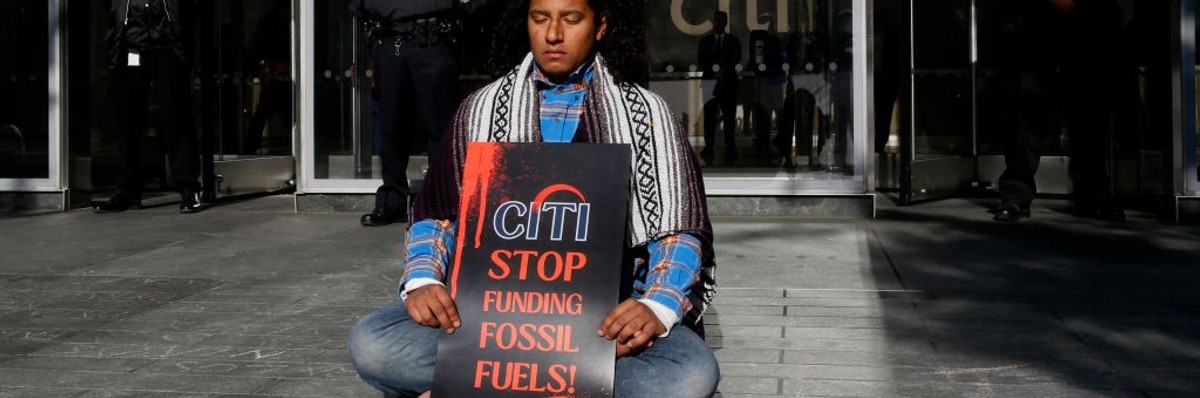
Environmental activist protest outside CitiBank Headquarters in New York City on April 25, 2023, calling for an end to fossil fuel financing.
 (Photo by Leonardo Munoz / AFP via Getty Images)

Here’s why we will be using our bodies to shut down Citibank’s global headquarters over and over again, this summer.

This summer, along with dozens of others, I’ll be helping to run the Summer of Heat on Wall Street, a campaign of sustained nonviolent civil disobedience against the banks, investors, and insurance companies financing fossil fuel expansion.

As we have written about here already, our plan is simple: using our bodies, we will continually blockade the New York headquarters of the Wall Street giants bankrolling coal, oil, and gas expansion; week after week, we will disrupt the companies disrupting our climate and our planet.

We’re targeting several companies―including the insurance company, Chubb, and the private equity group, KKR―but our number one target will be Citigroup. Here’s why.

Since the adoption of the Paris Agreement in 2015, Citi has provided $204.46 billion in financing to the company’s most rapidly developing new coal, oil, and gas fields. Remarkably, Citi has provided more money to those oil and gas companies than even JPMorgan Chase―the bank that climate activists like to call the “Doomsday Bank.”

To be clear, I’m talking here only about the financing Citi has provided for companies developing new oil and gas reserves, not merely investing in infrastructure to keep the oil pumping from existing reserves. When we take into account financing to all fossil fuel companies, Citi has provided a little shy of $400 billion to coal, oil, and gas companies since 2015. But focusing on expansion is important.

Numerous climate experts, from the International Energy Agency to the Intergovernmental Panel on Climate Change, have made it clear that to stave off the worst of climate catastrophe, there must be no investment in new fossil fuel expansion. But last year alone, Citibank provided $14.6 billion to the companies most rapidly expanding their coal, oil, and gas operations.

Citibank’s financing of fossil fuel expansion not only drives climate chaos, it also results in environmental racism. To give just one example, 70% of the air pollution generated by ExxonMobil is dumped on communities of color, contributing to the higher levels of heart disease, strokes, cancer, and other illnesses that are widely associated with living near oil and gas infrastructure.

Citibank’s top fossil fuel client is ExxonMobil. Yet when asked by Congress if she knew what environmental racism was, Citi CEO Jane Fraser replied: “Only vaguely.”

Not content with merely financing fossil fuels, Citi also works to block climate action both from its own investors and the U.S. government.

CEO Jane Fraser is chair of a group called the Financial Services Forum and a board member of the Bank Policy Institute, groups that have fought tooth and nail to weaken climate-financial regulation advanced by the Biden Administration. Citi also donates to several high-profile politicians who work against action on climate, including Congressman Andy Barr who has led the charge in a series of fossil fuel-backed, right-wing attacks designed to prevent the financial industry from taking action on climate.

For the past three years, Citi has faced a shareholder resolution from investors calling for a report on how the bank ensures that the oil, gas, and mining companies it finances respect Indigenous rights and sovereignty. Yet, in spite of Ms. Fraser’s previous claims in 2020 that Citi was committed to being ”an anti-racist institution,” Citi has fought the resolution each year, urging investors to vote against it, even as they remain one of the world’s largest funders of oil and gas in the Amazon rainforest.

Besides its role in the climate crisis and environmental racism, there are plenty other reasons to be angry at Citibank, too. In the early 20th century, Citi actively lobbied the US government to invade and occupy Haiti, which it promptly did, resulting in decades of bloodshed and misery for Haitians. A century later, Citi did as much as any bank to cause the financial crisis of 2008, which led to nearly 3.8 million Americans losing their homes; no bank received a larger bailout from the government than Citi.

And then there’s the fact that Citi is the foreign bank with the largest presence in Israel and a major financier of weapons manufacturers that are currently providing Israel with fighter jets and missiles being used to massacre Palestinians.

All of this is why Citibank is our number one target this summer.

To kick off the campaign, we will disrupt and shut down Citibank’s headquarters in Manhattan every day, all week long. We start on Monday, June 10th. We hope that you join us.

Original article by ALEC CONNON republished from Common Dreams under Creative Commons (CC BY-NC-ND 3.0). 

‘Just The Beginning’: 50+ Arrested For Blockading Citigroup Bank Over Climate Crimes ›

Continue ReadingThe World’s Largest Funder of Fossil Fuel Expansion

Green Party criticises Labour’s Great British Energy and climate proposals

Spread the love
Green Party Co-leader Adrian Ramsay. Wikipedia CC.

Reacting to Labour’s announcement on Great British Energy, Green Party co-leader Adrian Ramsay said: 

“We need real change if we are to meet the demands of the climate crisis. These Labour plans do not deliver it. 

“Compared to Labour’s original commitment to spend £28bn a year on green investment, this announcement of just £8.3bn over the course of the parliament looks tiny and is nowhere near enough to deliver Labour’s promise of ‘clean electricity.’  

“Labour’s targets focus on the electricity supply. However, to achieve net zero we need to see the electrification of home heating. This aim was ditched when Labour cancelled its £28 billion investment pledge.  

“Domestic energy security is vital, but that must begin with energy efficiency. That means providing the national programme of home insulation delivered by local authorities that will ensure warm homes and cut bills. This was another victim of Labour’s ditching of its original £28 billion investment pledge.  

“We want to see community owned assets and schemes that genuinely benefit people, not the private companies seeking to use public funds channeled through Great British Energy to continue profiteering while the planet burns and people’s bills remain too high. 

“Where is the support for local area heat networks which would make a real change and offer great long-term investments ideal for community ownership? 

“Labour has spent too long listening to the pleadings of energy companies for public investment in unproven technological solutions like carbon capture that simply won’t deliver the immediate real change we need. 

“The Green Party is committed to democratically controlled community ownership for a greater share of the energy market and a faster transition to Net Zero over the next ten years. 

“We would invest the money so that communities could take ownership and see less income in the hands of companies that have made excessive profits from fossil fuels or run our water companies into the ground.” 

Ed Miliband and the Labour party full of shit on climate

Continue ReadingGreen Party criticises Labour’s Great British Energy and climate proposals