This work by Middle East Monitor is licensed under a Creative Commons Attribution-NonCommercial-ShareAlike 4.0 International License.
The Israeli and German flags are shown in front of the German parliament building in Berlin. [Photo via Getty Images]
A German court ruled that comparing Israel to the Nazi regime is not a criminal offense, the legal website beck online reported, Anadolu reports.
In the case, in several Instagram posts, a user had compared the actions of the state of Israel to the methods of the Nazi regime—and in doing so used the Nazi swastika and the Nazi party flag.
Citing her right to freedom of speech, a higher regional court in the southwestern city of Zweibruckem has acquitted her of any wrongdoing, according to the report published earlier this week.
According to the court, the criminal offense of using symbols of unconstitutional organizations is not fulfilled if someone uses the symbols to sharp criticize the state of Israel’s methods and thereby clearly distances herself from or condemns Nazi-era injustices.
The user in question posted a table in her story comparing the actions of the Nazis with Israel’s actions in the Middle East conflict. Above it was a split image showing the flag of Israel on one side and the flag of the Nazi party—with a partially visible swastika—on the other.
Another post showed a wall with a Star of David, in the center of which was a Nazi swastika. Soldiers were firing from the wall into the walled-off area, with blood flowing out from beneath the walls. The user also included the hashtags #freepalestine and #gazaunderattack.
A lower court in the city of Ludwigshafen had sentenced the woman to a fine of €2,400 ($2,768) for using symbols of unconstitutional organizations. On appeal, the Zweibrucken court overturned the decision. It cautioned against interpreting the criminal offense too broadly in light of freedom of expression.
UK Prime Minister Andy Burnham admits to blatently lying and engaging in deception to become leader of the UK Labour Party and Prime Minister.Keir Starmer objects to criticism of the IDF. He asks how could anyone object to them starving people to death, forced marches like the Nazis did, bombing Gaza’s hospitals and universities, mass-murdering journalists, healthworkers and starving people queuing for food, killing and raping prisoners and murdering children. He calls for people to stop obstructing his genocide for Israel. New Labour UK Prime Minister Andy Burnham continues Labour party policy of active support and complicity in Israel’s genocide.
Palestine Action joke that appeared in the UK satirical publication ‘Private Eye’.
Sharing a Private Eye cartoon led to the arrest of a retired head teacher under the Terrorism Act
Full legal review set for September
High Court cites ‘recipe for chaos’ if legality of order isn’t reviewed as soon as possible
Dilemma sharpens for Met Chief ahead of mass protest on 9 August
“Recipe for chaos”
Today, 30 July, the High Court granted permission to Huda Ammori, co-founder of Palestine Action, to bring a full judicial review against the order of the Home Secretary, Yvette Cooper, proscribing the group as a ‘terrorist organisation’.
The ruling comes as a blow to Cooper, whose lawyers argued vigorously that the application should be refused, on the basis that the Terrorism Act contains a statutory process to apply for de-proscription.
Such a process can take years, however, whereas the judicial review is now due to be heard in September.
Mr Justice Martin Chamberlain rejected the Home Secretary’s position stating that:
“[T]he proscription order is likely to give rise to a substantial interference with rights guaranteed by the common law and by Articles 10 and 11 ECHR …
If the legality of the proscription order can properly be raised by way of defence to criminal proceedings, that would open up the spectre of different and possibly conflicting decisions on that issue in Magistrates Courts across England & Wales or before different judges or juries in the Crown Court. That would be a recipe for chaos. To avoid it there is a strong public interest in allowing the order to be determined authoritatively as soon as possible.”
He granted Huda Ammori leave to bring a full judicial review on the basis that it is arguable that:
1. The order is a disproportionate interference with Articles 10 and 11 of European Convention on Human Rights [the rights to freedom of expression and peaceful assembly]; and that
2. The Home Secretary should have consulted PA before making it and, by failing to do so, acted in breach of natural justice and/or contrary to Article 6 ECHR [the right to a fair hearing].
Dilemma for Met Commissioner ahead of mass protest on 9 August
It sharpens the dilemma for Sir Mark Rowley, the Met Commissioner, ahead of what is expected to be a mass protest of more than 500 people planned for 9 August [1A]. It would already be a huge and costly operation for the Met to arrest so many people for holding cardboard signs, people who are motivated by horror at the genocide in Gaza and a desire to uphold democratic freedoms. The prospect of the order being ruled unlawful opens up the further possibility that all those arrested and detained will later be awarded compensation payments for unlawful arrest.
As some of his colleagues have shown around the country, police have discretion as to whether to conduct arrests or not. Police in Totnes, Derry and Kendall for example have chosen to leave peaceful protestors be. On 9 August, Sir Mark will face a stark choice – to risk his own reputation with an absurd and costly operation to arrest 500 peaceful protestors for terrorism offences, or to undermine the Home Secretary’s position by applying common sense and allowing peaceful protestors to exercise their democratic rights.
A spokesperson for Defend Our Juries, the groups organising the protests, said:
“Yvette Cooper has no-one to blame for this crisis but herself. She was warned by her advisers that the ban would be “novel and unprecedented”, which is Whitehall mandarin-speak for ‘mad’.
If it wasn’t the police or the intelligence agencies pushing for the ban, who was it?
One of the grounds for the High Court’s ruling today was the Home Secretary’s failure to consult appropriately. While she consulted with the Israeli government and Elbit Systems on the merits of the order (and no prizes for guessing their position) she failed to consult with those adversely affected, such as Palestine Action and civil liberties organisations.
If you only consult with those who stand to benefit from your proposal, those who are committing and supporting genocide, but not those who will be adversely affected, not those who are acting to prevent genocide, your bias is already exposed.
We are confident the High Court will soon strike down this absurd and repugnant order, made at the bidding of the perpetrators of genocide.”
Chorus of criticism, mockery and defiance
The ruling comes amid a crisis of credibility for the order, which has been lambasted by lawyers, politicians and the UN alike, and openly mocked and defied across the country, on the streets, in print and online, already resulting in over 200 arrests for Terrorism Act offences.
In the House of Lords last week, former Secretary of State for Northern Ireland Lord Hain asked: “How have we got to the point where peacefully holding up a placard about the carnage in Gaza is equated with terrorism by Al Qaeda on 9/11 or Islamic State on countless occasions. And shouldn’t the police be concentrating on real terrorism and real crime, not targeting peaceful protesters?” [1]
Derry City and Strabane District Council ignored legal advice to pass a motion calling for the immediate overturning of the proscription, with Councillors openly wearing “We Are All Palestine Action” shirts.[1B].
Speaking to Al Jazeera, the former chief political commentator of The Daily Telegraph, Peter Oborne, warned that Yvette Cooper’s controversial ban of Palestine Action could lead to her resignation: “If the general populace comes to the conclusion that this is a stunt by the Starmer government … this legislation won’t take, people will regard it as ridiculous … you’ll end up having thousands of people coming out in support of Palestine Action, thousands of people declared terrorists. The law will suddenly look an ass, this government will lose a great deal of political credibility and in due course the Home Secretary might have to resign.” [2]
Tayab Ali, a leading lawyer at Bindmans, said:
“I would be extraordinarily surprised if the British Courts don’t strike [the ban] down. This is such an overreach.” [3]
After Private Eye satirised the ban with a cartoon, a retired head-teacher was arrested for displaying a copy of the cartoon, despite it being available in newsagents across the UK [4]. The comedian, Rosie Holt, has mocked “The new face of terrorism. It’s old, it’s wrinkly, it’s elderly and it’s dangerous.” [5]
On Friday, the UN Human Rights Chief, Volker Türk issued a press release stating:
“[The ban] appears to constitute an impermissible restriction on rights [to freedom of expression, peaceful assembly and association] that is at odds with the UK’s obligations under international human rights law.” [5A]
Previously, five UN Special Rapporteurs had written to the UK Government counselling against the use of Terrorism Act powers against Palestine Action [5B]. Amnesty International has spoken out against the ban, saying:
“Government embarrassment at security breaches is no proper basis for excessive and disproportionate interferences with human rights. It is precisely this kind of unlawful government action that critics of the UK’s terrorism laws warned would come one day.” [5C]
Shortly before the proscription, more than 23 organisations, led by the European Association of Lawyers for Democracy & World Human Rights, criticised the use of Terrorism Act powers against the Filton 18, members of Palestine Action, in a paper headed, “United Kingdom: The “Filton 18” case is a warning sign of democracy and rule of law decline” [5D], citing evidence political interference in the legal process by the Israeli government:
“Judicial independence and impartiality is a fundamental aspect of the right to a fair trial and the protection of human rights, and a prerequisite to the rule of law …
Documents obtained on 29 April 2025 through a Freedom of Information request have revealed that the UK government has shared contact details of counter-terrorism police and prosecuting authorities with the Israeli embassy in September 2024, during the investigation into the Filton 18 action and shortly after the Attorney General’s Office met with the Israeli ambassador to the UK. The documents disclosed were almost entirely redacted. However, documents disclosed in August 2023 evidence that the Israeli authorities have previously attempted to pressure the UK government to intervene in judicial proceedings relating to UK protests.
These communications, and the lack of transparency concerning their contents and whether these relate to the proceedings against Palestine Action members, raise serious questions around the independence and impartiality of prosecuting authorities in the Filton 18 case. These concerns are strengthened by the UN experts’ opinion that the use of anti-terrorism laws against the Filton 18 lacked a credible basis and may have pursued an ulterior purpose.”
On Saturday, police in Shenstone arrested a man in a wheel-chair, for wearing a T-shirt in support of Palestine Action. [6]
Home Office insinuations against Palestine Action contradicted by their own evidence
As part of the legal process, the Home Office was required to disclose the evidence available to the Home Secretary in support of proscription. It emerged that Home Office insinuations that Palestine Action is violent and funded by Iran were directly contradicted by the assessments provided to her.
The government’s Proscription Review Group (PRG) advised in March 2025 that a ban on Palestine Action would be “novel and unprecedented”, because “there was no known precedent of an organisation being proscribed… mainly due to its use or threat of action involving serious damage to property”. [7]
The Joint Terrorism Analysis Centre (JTAC) assessment noted: “PA media channels highly likely will only share footage, or encourage, instances of property damage. PA branded media will highly unlikely explicitly advocate for violence against persons”. [7]
On 23 June, the day of Cooper’s statement to parliament, the Times published a report saying “Iran could be funding Palestine Action, Home Office officials claimed”. This went on to be widely reported. Yet the JTAC assessment of Palestine Action’s sources of funding makes no mention of Iran, stating that Palestine Action “is primarily funded by donations, which can be made directly through their website or via crowdfunding. Other forms of revenue include the sale of merchandise”. [7]
Writing for Declassified, John McEvoy, the historian, film-maker and reporter, said:
“The discrepancy between the Home Office press briefings and the official intelligence reports raises the prospect that a state-linked disinformation campaign was waged against Palestine Action in order to manufacture public consent for proscription.” [7]
Yvette Cooper defied warnings from advisers to push through the ban
Strikingly, the Home Secretary was warned by her own advisers that proscription risked substantiating claims of pro-Israeli bias. A Community Impact Assessment produced by the Ministry of Housing, RICU (Research, Information and Communications Unit), and NPCC (National Police Chiefs’ Council), stated:
“Other reports documented Israeli embassy officials purportedly attempting to get the attorney general’s office to intervene in court cases. In the context of such reports, proscription could provide fertile ground for actors attempting to substantiate a pattern of bias”. [7]
The report goes on to say that a ban “could be seen as the partial realisation of Lord Walney’s efforts, which dissenting actors could argue were coloured by pro-Israel bias”. [7]
In May last year, Lord Walney, published a report calling for Palestine Action and Just Stop Oil to be banned. Successive governments falsely presented Lord Walney to the public as an ‘independent’ adviser on political violence and disruption. [8]
Lord Walney in fact has close ties to the Israeli government and is a paid lobbyist for the arms industry. [9] On 14 February this year, following a Defend Our Juries campaign to sack him, his role was removed, although the Home Office stated, his work would “continue to inform our approach”. [10]
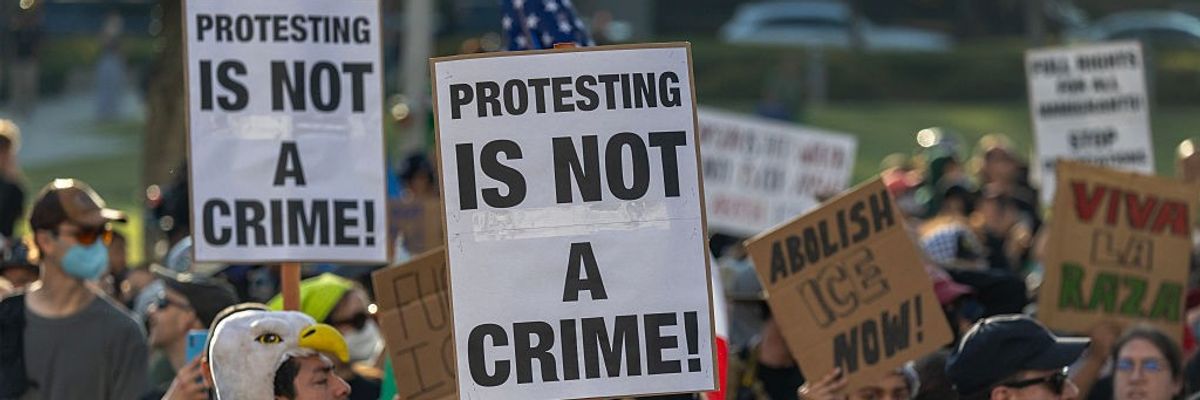
Protesters continue to march and chant in an approximately one-square mile area of downtown Los Angeles in response to a series of immigration raids, on June 11, 2025 in Los Angeles, California.
The far-right Republican president, warned the human rights group, “is continuing to send a clear and chilling message: dissent will be punished.”
The human rights advocacy group Amnesty International USA has issued a strong rebuke and warning in response to President Donald Trump’s public threat to aim “very heavy force” at law-abiding protesters voicing their constitutionally-protected free speech during organized ‘No Kings’ protests scheduled for Saturday nationwide.
In Tuesday remarks to reporters in the Oval Office, Trump said he didn’t know of any planned protests timed to coincide with his $134-million parade, taking place on his birthday, but said if there are, “these are people that hate our country.”
“For those people who want to protest, they’re going to be met with very big force,” Trump said, making no distinction between peaceful demonstrators and those who might be more confrontational or even violent.
“Now is a good moment to remind President Trump that protesting is a human right and that his administration is obligated to respect, protect, and fulfill the human rights to freedom of expression and peaceful assembly–not suppress them,” said Paul O’Brien, executive director of Amnesty International USA, in a statement on Wednesday.
Trump’s threat arrived after he overrode California Gov. Gavin Newsom to call up 4,000 National Guard troops in that state last weekend—and subsequently U.S. Marine forces—to confront large protests in Los Angeles that erupted in response to raids by Immigration and Customs Enforcement (ICE) agents and the violent arrest of union leader David Huerta, president of SEIU California.
“The militarized response to protests, including the deployment of the National Guard and the Marines in Los Angeles, further escalates tensions and is a chilling preview of even more human rights violations that could be coming,” warned O’Brien. “The U.S. military is not trained or equipped to police civilians. It increases the risk of excessive force, arbitrary arrests, and other violations of free expression and peaceful assembly. The Trump administration has already shown us that it will use any tool of the state, including ICE, police, and military forces to target immigrants, asylum seekers, protesters, and anyone who dares to defend their rights.”
Over 1,800 coordinated ‘No Kings’ protests are being organized for July 14 to counter Trump’s growing authoritarianism and to coincide with the military parade Trump is throwing for himself in Washington, D.C., at an estimated cost of $134 million.
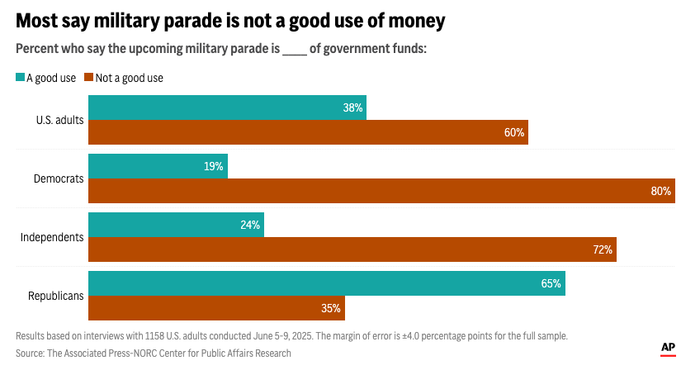
A new poll released Thursday shows a majority of Americans believe the parade is a waste of taxpayer money.
Approximately 6 in 10 Americans also say Trump’s parade is “not a good use” of taxpayer funds, according to the poll from The Associated Press-NORC Center for Public Affairs Research. That number of disapproving voters includes a number of people surveyed who have no particular criticism of the parade itself.
Beyond the wasted cost, critics of the president warn that the more dangerous aspect of the parade is how the spectacle dovetails with Trump’s broader authoritarianism, including his militarized response to dissent and weaponizing state power against his perceived political enemies.
“Make no mistake,” said Amnesty’s O’Brien. “President Trump’s response to protests has nothing to do with public safety. This is his administration’s way of stoking fear and suppressing opposition. By sending police, ICE, or the military into neighborhoods to silence voices calling for justice and human rights, President Trump is continuing to send a clear and chilling message: dissent will be punished.”
Amnesty called for an immediate halt to Trump’s “militarized response” to public protest.
“The task of any law enforcement is to facilitate—not to restrict—a peaceful public assembly,” said O’Brien. “This must be clearly understood by all law enforcement officials taking part in the management of the assembly. Law enforcement must also not use violent acts of a few as a pretext to restrict or impede the human rights of others to peacefully protest.”
Climate Science Denier Donald Trump says Burn, Baby, Burn.Elon Musk urges you to be a Fascist like him, says that you can ignore facts and reality then.
Demonstrators during a ‘Kill The Bill’ protest against The Police, Crime, Sentencing and Courts Bill in London, January 15, 2022
LABOUR was urged today to scrap Tory anti-protest laws and reject harmful rhetoric used to stigmatise peaceful demonstrations.
Peace, pro-Palestine, environmental and civil liberties groups called on ministers to champion the rights to free speech by repealing the draconian legislation aimed at silencing dissent.
Amnesty International led the calls as it published a new report warning of an increasingly wide range of means to quash peaceful demonstrations and silence free speech across Europe.
It called on Home Secretary Yvette Cooper to urgently scrap the public order elements of the Police, Crime, Sentencing and Courts Act as well as the entirety of the Public Order Act and the Serious Disruption Regulations.
Kerry Moscogiuri, of Amnesty International UK, said: “The new government must seize this moment to halt the alarming march towards repression in the UK by repealing the anti-protest laws pushed through by the previous government and ending the harmful rhetoric being used to stigmatise those who peacefully protest.
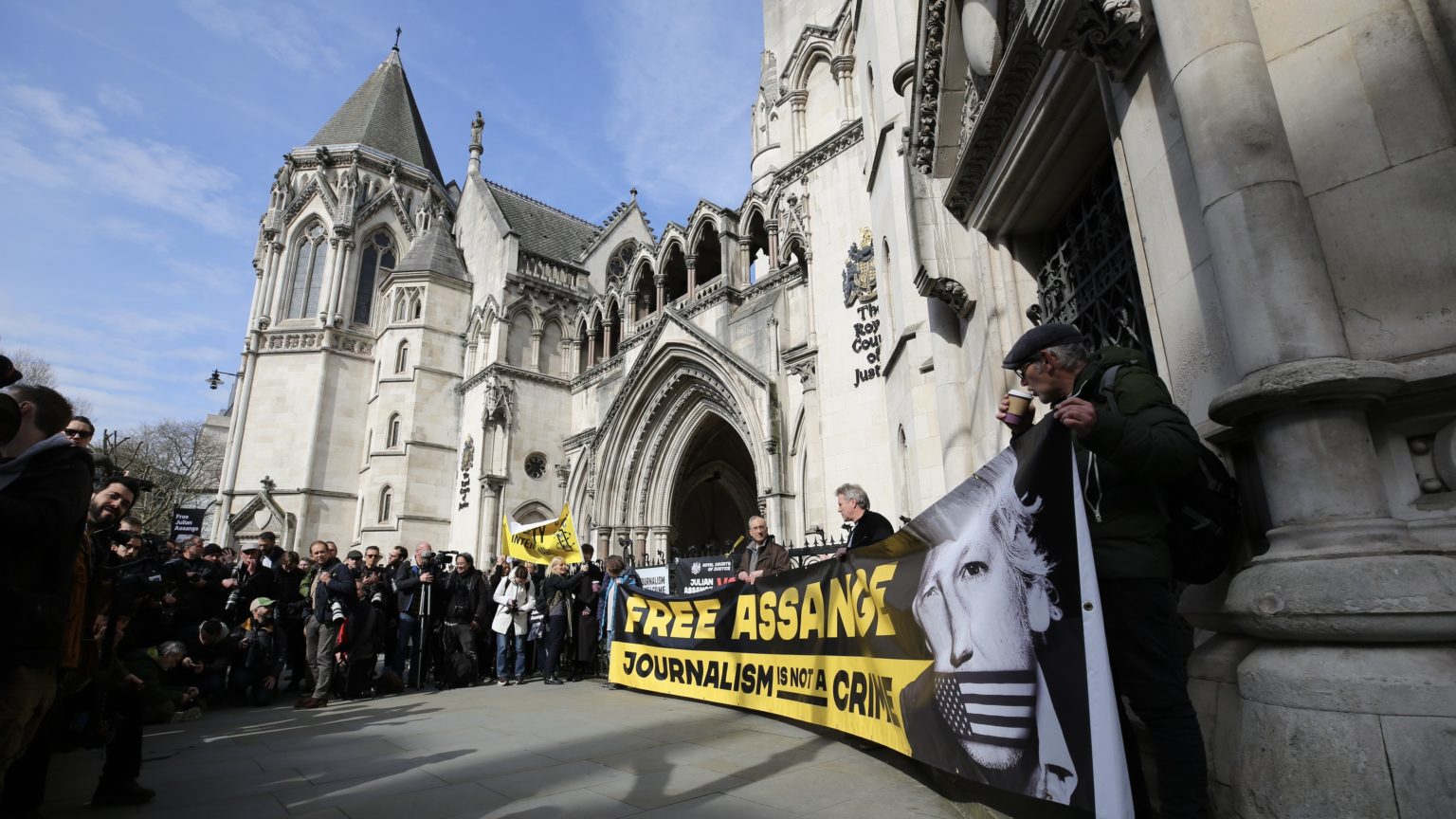
Protesters gathered outside the Royal Courts of Justice in London on Tuesday. Photo: Free Assange UK Campaign/X
The UK High Court has granted WikiLeaks founder Julian Assange provisional permission to appeal his extradition to the US, on grounds including the risk of the death penalty.
The UK High Court has granted provisional permission to journalist and WikiLeaks founder Julian Assange to appeal his extradition to the US. The ruling was handed down by judges Dame Victoria Sharp and Justice Jeremy Johnson in London on March 26, as supporters of Assange gathered outside the court to demand his freedom.
The US has sought to extradite Assange to prosecute him on 18 charges, 17 of which are under the draconian Espionage Act, for the publication of classified documents on WikiLeaks exposing war crimes and human rights abuses committed by US forces, including in Iraq and Afghanistan.
The extradition was approved by the UK Home Office in 2022, protracting an already difficult legal battle for the imprisoned journalist. Assange has been held at the Belmarsh high security prison for five years without a trial or conviction.
In its decision, the Court has granted Assange permission to appeal against his extradition, with the matter adjourned till May 20. However, the appeal will proceed only if the US and the UK are unable to provide the Court with assurances regarding Assange’s treatment following an extradition.
The US and the UK have until April 16 to file these assurances. This will also pave the way for further submissions to be made before a final decision is reached.
In the meantime, the temporary permission to appeal has been granted on three out of nine grounds including: a) that extradition may be “incompatible with the right of freedom of expression” under the European Convention on Human Rights; and b) that the applicant (Assange) might be “prejudiced on grounds of nationality” which is related to whether or not he will be protected under the First Amendment of the US Constitution given that Assange is not a citizen.
The third ground of appeal upheld by the Court for now is “inadequate speciality protection/death penalty protection”, which bars extradition under the UK’s 2003 Extradition Act.
In the application, Assange’s legal team noted that despite the fact that none of the charges leveled by the US as part of the extradition request carry the death penalty, the accusations made against him could lead to additional charges of aiding and abetting treason, which would be capital offenses.
They further highlighted statements made by US officials, including by Donald Trump, former president and potential Republican candidate for the upcoming US election, calling for the death penalty for Assange.
During the two-day “permission hearing” held in February ahead of the March 26 decision, the US prosecution admitted that there were no assurances that Assange would not be handed the death penalty.
The US now has three weeks to provide the Court with “satisfactory assurances” that Assange will be permitted to rely on the First Amendment (protecting free speech), that he will not be prejudiced at trial (including sentence) because of nationality (his status as non- US citizen), that he will be afford the same protections under the First Amendment as a US citizen, and that the death penalty will not be imposed.
This is not the first time that such proposals have been made in Assange’s case. In fact, despite a lower court acknowledging Assange’s risk of suicide in 2021, his extradition was approved based on “diplomatic assurances” given by the US.
These included that Assange would not be subject to brutal Special Administrative Measures (SAMs), that he would not be kept at the ADX Florence maximum security prison, and that he could serve a custodial sentence in Australia, his country of origin. However, these protections would not apply if Assange was deemed to have committed a “future act” that could necessitate SAMs.
The entirely unilateral nature of these assurances raised alarm, especially given that these actions would be at the discretion of US prison authorities and not subject to judicial review.
“The UK remains intent on extraditing Assange despite the grave risk that he will be subjected to torture or ill-treatment in the US,” Simon Crowther, Legal Adviser at Amnesty International, said in response to Tuesday’s ruling.
“While the US has allegedly assured the UK that it will not violate Assange’s rights, we know from past cases that such ‘guarantees’ are deeply flawed — and the diplomatic assurances so far in the Assange case are riddled with loopholes.”
Meanwhile, the Court dismissed critical grounds for appeal raised by Assange’s team, in particular that the extradition was for a political offense, and as such prohibited under the UK-US Extradition Treaty. Assange’s lawyers had argued in February that espionage was universally accepted as a political offense, given that it was an offense directed at the state.
“These were the most important revelations of criminal US state behavior in history,” Assange’s lawyer, Mark Summers, had told the Court regarding the materials published by WikiLeaks. This included the “Collateral Murder Video” in which a US Army Apache helicopter had killed 11 unarmed civilians in Baghdad in 2007.
Addressing the press outside the court, Assange’s wife, Stella, stated that the decision was “astounding”. She pointed out that though the Court had recognized the violation of Julian Assange’s rights, “what the Courts have done have done [is] to invite a political intervention from the United States to send a letter saying ‘it’s all okay’. Five years into this case, the US has managed to show the Court that their case remains an attack on press freedom, an attack on Julian’s life.”
“What the Courts have not agreed to look at is the evidence that the US has plotted to assassinate Julian, to kidnap him, because if it acknowledged that then of course he cannot be sent to the US.”
The Court astonishingly justified its refusal to admit this new evidence, of a plot by the US’ Central Intelligence Agency (CIA) to kidnap and assassinate Assange, stating that “on the face of the allegations…the contemplation of extreme measures against the applicant (whether poisoning for example or rendition) were a response to the fear that the applicant might flee to Russia”.
“The rationale for such conduct is removed if the applicant is extradited. Extradition would result in him being lawfully in the custody of the US authorities, and the reasons (if they can be called that) for rendition or kidnap or assassination then fall away”.
Meanwhile, Assange’s brother, Gabriel Shipton, reiterated that the fact that the Court had sought political assurances from the US revealed the political nature of the case itself.
Stella Assange added, “Julian is a political prisoner, he is a journalist, and he is being persecuted because he exposed the true cost of war in human lives. This case is a retribution, it is a signal to all of you, that if you expose the interests that are driving war they will come after you, they will put you in prison and they will try to kill you.”
“The Biden administration should not issue assurances, they should drop this shameful case that should have never been brought,” she said, calling people to pressure the US government and to support House Resolution 934.
The text, which is in the US Congress, states that “regular journalistic activities, including the obtainment and publication of information, are protected under the First Amendment and that the federal government should drop all charges against and attempts to extradite Julian Assange.”
“If Julian goes down for this, every serious journalist around the world is going to be slightly more cautious about exposing war crimes, corporate greed…We need the maximum pressure all across the US on the Biden administration, on the candidates in the forthcoming election, to say ‘Drop the charges against Julian Assange,’” MP and former Labor Party leader Jeremy Corbyn told Democracy Now.
If the UK High Court does not grant Assange the permission to appeal, he will have exhausted his options within the country’s legal system, and will have to approach the European Court of Human Rights (ECHR), immediately seeking an interim measure against the extradition under Rule 39 (“risk of irreparable harm”) pending a full hearing of the case. The ECHR’s verdict will be binding on the UK.