“How can the government decide what words a journal can use to describe a scientific reality? That reality needs to be named,” one journal editor said.
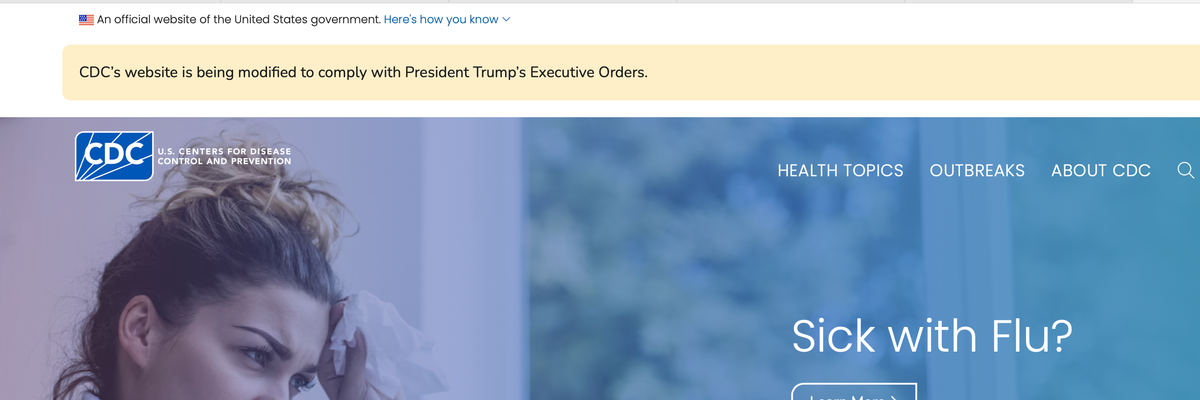
Employees at the Centers for Disease Control and Prevention have been ordered to pull any articles under consideration for publication in medical or scientific journals so that they can be checked for certain “forbidden terms” including gender, transgender, and LGBT.
The order was sent in an email to CDC division heads on Friday by the agency’s chief science officer, a federal official told Reuters on Sunday. Inside Medicine broke the news on Saturday and provided a screenshot of the full list of terms that needed to be scrubbed.
“It sounds incredible that this is compatible with the First Amendment. A constitutional right has been canceled,” Dr. Alfredo Morabia, editor in chief of the American Journal of Public Health, told Reuters. “How can the government decide what words a journal can use to describe a scientific reality? That reality needs to be named.”
“We can’t just erase or ignore certain populations when it comes to preventing, treating, or researching infectious diseases such as HIV.”
The order is an attempt to ensure that CDC is in compliance with U.S. President Donald Trump’s executive order mandating that the U.S. government only recognize two sexes: male and female. The papers will be withdrawn so that a Trump appointee can review them.
The “forbidden terms” CDC employees are supposed to avoid are, in full: Gender, transgender, pregnant person, pregnant people, LGBT, transsexual, non-binary, nonbinary, assigned male at birth, assigned female at birth, biologically male, and biologically female, according to Inside Medicine.
[In the spirit of the new authoritarian censorship] Sorry, this content could not be embedded. X
The order covers both papers under considerations and ones that have been accepted but not published. If a CDC employee worked on a paper with nongovernmental scientists but did not initiate it, they have been asked to remove their names, according to Reuters.
The new order is separate from a demand two days into the administration that government health agencies including CDC freeze all communications with the public. It follows reports on Friday that CDC webpages and datasets involving HIV, the LGBTQ community, youth health, and other topics were no longer accessible as the agency attempts to comply with the Trump executive order on transgender identity and another on banning government Diversity, Equity, and Inclusion initiatives.
“It is Orwellian, it really is,” Steven Woolf, director emeritus and senior adviser at Virginia Commonwealth University’s Center on Society and Health, told The Washington Post of the website purges. “The fact that so many websites are being scrubbed, it is an alarming development and endangers public policy and makes it difficult for decision-makers around the country, including doctors like myself, to make informed choices.”
[In the spirit of the new authoritarian censorship] Sorry, this content could not be embedded. X
In response to the purges, scientists, science journalists, and public health advocates have worked to preserve the datasets, with everything on the CDC website as of January 27, 2024 preserved at ACASignups.net and downloaded data sets also available on Jessica Valenti’s Substack Abortion, Every Day.
“Censoring data on ideological grounds is wrong. It is unscientific, and it is designed to eliminate opposition and erase dissidents,” virologist Angela Rasmussen, who was involved with the data preservation efforts, wrote on social media.
The journal article retraction order has created uncertainty and confusion at the agency, Inside Medicine reported:
How many manuscripts are affected is unclear, but it could be many. Most manuscripts include simple demographic information about the populations or patients studied, which typically includes gender (and which is frequently used interchangeably with sex). That means just about any major study would fall under the censorship regime of the new policy, including studies on Covid-19, cancer, heart disease, or anything else, let alone anything that the administration considers to be “woke ideology.”
Meanwhile, chaos and fear are already guiding decisions. While the policy is only meant to apply to work that might be seen as conflicting with President Trump’s executive orders, CDC experts don’t know how to interpret that. Do papers that describe disparities in health outcomes fall into “woke ideology” or not? Nobody knows, and everyone is scared that they’ll be fired. This is leading to what Germans call “vorauseilender Gehorsam,” or “preemptive obedience,” as one non-CDC scientist commented.
There are also concerns that censoring such a broad list of terms would have unintended consequences for public health.
“We can’t just erase or ignore certain populations when it comes to preventing, treating, or researching infectious diseases such as HIV. I certainly hope this is not the intent of these orders,” Carl Schmid, the executive director of the HIV+ Hepatitis Policy Institute, told Reuters.
Donald Trump decrees forbidden terms denying sexual diversityElon Musk urges you to be a Fascist like him, says that you can ignore facts and reality then.
Imagine that you’re the parent of a child who suffers from a rare mental health condition that causes anxiety, depression and suicidal ideation. Psychiatric medications and therapy do not work for this condition.
There is a treatment that has been shown to work in adults, but there’s very little research in kids, apart from a few small studies that have come out of the Netherlands, where they are prescribing these treatments. Doctors in your own country, however, won’t prescribe it until your child is 18, to avoid any unwanted side effects from the medication.
Meanwhile, your child has suffered for years, and attempted suicide multiple times. As a parent, what do you do? Do you take your kid overseas, or let them continue to suffer?
“Awareness of transgender children is growing,” the Guardian (8/13/08) reported 16 years ago.
This is precisely the situation that parents of trans kids in Britain were facing 16 years ago, when the Guardian (8/13/08) ran a story on their efforts to get the country’s Gender Identity Development Service (GIDS) to prescribe puberty blockers for their kids. The Guardian noted how grim the situation was for these kids and their parents:
Sarah believes that anyone watching a teenager go through this process would want them to have the drugs as soon as possible. Her daughter was denied them until the age of 16, by which point she already had an Adam’s apple, a deep voice and facial hair….
“It takes a long, long time to come to terms with. It took us about two years to stop crying for our loss and also for the pain that we knew our child was going to have to go through. No one would choose this. It’s too hard.”
Short-lived success
Dr. Hilary Cass told the BBC (4/20/24) that “misinformation” about her work makes her “very angry.”
After years of struggle, UK parents successfully lobbied the NHS to start prescribing gender-affirming medical treatments for minors under 16 in 2011. Their success, however, was short-lived.
In April, NHS England released the findings of a four-year inquiry into GIDS led by Dr. Hilary Cass, a pediatrician with no experience treating adolescents with gender dysphoria. On the recommendation of the Cass Review, which was highly critical of adolescent medical transition, the NHS services in England, Wales and Scotland have stopped prescribing puberty blockers for gender dysphoria. The British government also banned private clinics from prescribing them, at least temporarily.
Though there is much moreevidence now to support gender-affirming care than in 2008, there is also a much stronger anti-trans movement seeking to discredit and ban such care.
British media coverage has given that movement a big boost in recent years, turning the spotlight away from the realities that trans kids and their families are facing, and pumping out stories nitpicking at the strength of the expanding evidence base for gender-affirming care. Its coverage of the Cass Review followed suit.
US media, unsurprisingly, gave less coverage to the British review, but most of the in-depth coverage followed British media’s model. Underlying this coverage are questionable claims by people with no experience treating minors with gender dysphoria, and double standards regarding the evidence for medical and alternative treatments.
More evidence, worse coverage
The most impactful—and controversial—recommendation of the Cass Review is that puberty blockers or cross-sex hormones on those under 16 should be confined to clinical research settings only, due to the supposed weakness of the studies underpinning gender-affirming treatments for minors, and the possibility of unwanted side effects:
While a considerable amount of research has been published in this field, systematic evidence reviews demonstrated the poor quality of the published studies, meaning there is not a reliable evidence base upon which to make clinical decisions, or for children and their families to make informed choices.
This stands in direct opposition to guidelines and recommendations from major medical associations, such as the American Academy of Pediatrics, the Endocrine Society and the World Professional Association of Transgender Health (WPATH), which support gender-affirming medical interventions for youth.
WPATH (5/17/24) expressed bewilderment at the Cass Review’s approach, and noted that its reviews “do not contain any new research that would contradict the recommendations” of those groups, which were updated in 2022.
So what could explain the divergence? For starters, the review took place in the context of a rising anti-trans culture in England, and the NHS took the highly unusual approach of excluding experts on pediatric gender-affirming care from the review.
At the same time, the Cass Review, and the NHS England Policy Working Group that preceded it, had clinicians on its team with ties to advocacy groups that oppose gender-affirming treatment for minors, so its bias was questioned even before the review was released. The Cass Review has been a major boon for these advocacy groups, as its recommendations are exactly what those groups have been calling for.
‘Arbitrarily assigned quality’
“It’s a bad-faith claim that we don’t have enough evidence for pubertal suppressants or gender-affirming hormones,” a Harvard Med School psychiatry professor told Mother Jones (5/10/24).
The systematic review on puberty blockers conducted by the Cass Review excluded 24 studies, with reviewers scoring this research as “low quality.” But Meredithe McNamara, assistant professor of pediatrics at Yale, told FAIR that the scale the Cass Review used to grade study quality is not typically used by guideline developers. Under this methodology, the authors excluded many studies from consideration for what she describes as “arbitrarily assigned quality.”
A recent white paper from the Yale Law School Integrity Project, co-authored by McNamara, explains the flaws more in depth:
They modified the scale in an arbitrary way that permitted the exclusion of studies from further consideration, for reasons irrelevant to clinical care. For instance, in the York SR on social transition, the modified NOS asked if study samples were “truly representative of the average child or adolescent with gender dysphoria.” There is no such thing as the “average child or adolescent with gender dysphoria”—this is an inexpertly devised and meaningless concept that is neither defined by the authors nor used in clinical research. And yet it was grounds for excluding several important studies from consideration.
The Yale report highlights the problems that come from assigning authors who are unfamiliar with essential concepts in gender care. For example, puberty blockers are not intended to reduce gender dysphoria, but rather halt the effects of puberty. The systematic review looked at gender dysphoria reduction as a metric of the treatment’s success, however, which the Yale report says was an “inappropriate standard.”
Moreover, even studies scored as low quality by more standard scales are not uncommon in medicine, and do not mean “poor quality” (despite Cass’s slippage between the two) or “junk science.” Doctors can and do often make treatment recommendations based on evidence that is rated low quality. A 2020 study in the Journal of Clinical Epidemiology (9/2/20) found that 53% of treatments are supported by either “low quality” or “very low quality” evidence. Many commonly prescribed antidepressants, for example, have low-quality evidence for use in populations under 18—but many families decide, with the help of a doctor, that it’s still the best choice for their child.
This is why the guidelines supported by WPATH do not deviate from the norms of medical practice in recommending puberty blockers based on the large amount of evidence we do have. As with all medical treatments, WPATH recommends doctors should inform patients and their parents of the potential risks and benefits, and allow them to decide what is best. This approach aligns with evidence-based medicine’s requirement to integrate the values and preferences of the patient with the best available evidence.
‘Shaky foundations’
The systematic review on puberty blockers conducted by the Cass Review excluded 24 studies, with reviewers scoring this research as “low quality.” But Meredithe McNamara, assistant professor of pediatrics at Yale, told FAIR that the scale the Cass Review used to grade study quality is not typically used by guideline developers. Under this methodology, the authors excluded many studies from consideration for what she describes as “arbitrarily assigned quality.”
A recent white paper from the Yale Law School Integrity Project, co-authored by McNamara, explains the flaws more in depth:
They modified the scale in an arbitrary way that permitted the exclusion of studies from further consideration, for reasons irrelevant to clinical care. For instance, in the York SR on social transition, the modified NOS asked if study samples were “truly representative of the average child or adolescent with gender dysphoria.” There is no such thing as the “average child or adolescent with gender dysphoria”—this is an inexpertly devised and meaningless concept that is neither defined by the authors nor used in clinical research. And yet it was grounds for excluding several important studies from consideration.
The Yale report highlights the problems that come from assigning authors who are unfamiliar with essential concepts in gender care. For example, puberty blockers are not intended to reduce gender dysphoria, but rather halt the effects of puberty. The systematic review looked at gender dysphoria reduction as a metric of the treatment’s success, however, which the Yale report says was an “inappropriate standard.”
Moreover, even studies scored as low quality by more standard scales are not uncommon in medicine, and do not mean “poor quality” (despite Cass’s slippage between the two) or “junk science.” Doctors can and do often make treatment recommendations based on evidence that is rated low quality. A 2020 study in the Journal of Clinical Epidemiology (9/2/20) found that 53% of treatments are supported by either “low quality” or “very low quality” evidence. Many commonly prescribed antidepressants, for example, have low-quality evidence for use in populations under 18—but many families decide, with the help of a doctor, that it’s still the best choice for their child.
This is why the guidelines supported by WPATH do not deviate from the norms of medical practice in recommending puberty blockers based on the large amount of evidence we do have. As with all medical treatments, WPATH recommends doctors should inform patients and their parents of the potential risks and benefits, and allow them to decide what is best. This approach aligns with evidence-based medicine’s requirement to integrate the values and preferences of the patient with the best available evidence.
‘Shaky foundations’
Of eight articles the Guardian ran on the Cass Review, only one (4/9/24) quoted any trans youth or their parents.
Cass also conducted a second systematic review on cross-sex hormones, which excluded 19 studies for being “low quality.” In spite of their exclusion, the systematic review still found “moderate quality” evidence for the mental health benefits of these treatments, a fact that Cass omits from her BMJ column (4/9/24) published concurrently with the review’s release, where she claims that pediatric gender medicine is built on “shaky foundations.”
These “shaky foundations” of “poor quality” evidence that Cass trumpeted were largely gobbled up by media, despite the criticisms of both expert groups like WPATH, and trans kids and their parents. Guardian readers almost certainly wouldn’t know that the amount of data we have on these treatments since the paper’s 2008 piece has expanded considerably: Every single one of the 103 studies on puberty blockers and cross-sex hormones for minors that the Cass Review found was published after 2008. That’s not the story that’s being told; in fact, it’s not even mentioned in the Guardian’s initial story (4/9/24) on the findings of the Cass Review, which put Cass’s “shaky foundations” quote in its headline.
That story exemplifies the problem with the frequent media scrutiny of evidence quality that is completely devoid of the circumstances under which trans youth and their parents have sought these treatments for more than a decade. In fact, these teens and their parents have been all but erased from the paper’s coverage.
The Guardian released eight stories and a podcast on the Cass Review in the first month of its coverage. Only two trans youth and one parent were quoted across these nine pieces.
Readers can’t fully understand why trans youth and their parents would seek out a treatment with “low-quality” or “moderate-quality” evidence without understanding their circumstances. And they can’t fully judge a policy decision to restrict these treatments without understanding how much more evidence we have now than we did when desperate parents were seeking them out abroad.
Same problem across the pond
WBUR‘s interviewer (5/8/24) did not challenge Cass on her nonsensical statements, such as her assertion that “let[ting] young people go through their typical puberty” is the best way to “leave their options open.”
Some US outlets have, unsurprisingly, followed the British pattern in their coverage of the Cass Review, not questioning Cass’s tendentious interpretations, and sidelining the voices of trans youth and their parents.
Boston NPR station WBUR (OnPoint, 5/8/24) aired a lengthy interview with Cass. For almost two hours, host Meghna Chakrabarti gave Cass a friendly platform to pontificate on such matters as how pornography might be causing more kids to identify as trans, without asking her to substantiate her claims:
So we looked at what we understand about the biology, but obviously biology hasn’t changed suddenly in the last 10 years. So then we tried to look at, what has changed? And one is the overall mental health of teenage girls, in particular, although boys, to some degree. And that may also be driven by social media, by early exposure to pornography, and a whole series of other factors that are happening for girls.
While Chakrabarti raised some criticisms of the Cass Review, she never pressed Cass on her answers. For instance, when the host quoted WPATH’s statement that the Cass Review would “severely restrict access to physical healthcare for gender-questioning young people,” Cass suggested that trans youth will still be able to access treatment “under proper research supervision”—yet such research has yet to be announced. Chakrabarti did not press her on when these studies will start, what the criteria for participation will be, or what parents and kids are supposed to do in the meantime. Nor did she ask how long it will take to get into a study; currently the GIDS wait times are over six years.
Cass repeatedly argued that the key for youth seeking gender-affirming care was to “keep their options open.” Yet Chakrabarti never questioned how preventing young people from accessing puberty blockers helps achieve this, even when Cass argued that trans boys shouldn’t receive hormone treatment because male hormones “cause irreversible effects.” By this logic, the Cass Review should have required all trans girls to receive puberty blockers to prevent those same “irreversible effects.” Cass’s double standard also doesn’t take into account that estrogen puberty likewise causes irreversible effects that are not fully or easily reversible, such as height, voice and breast growth.
Incredibly, Cass described decisions about these treatments as very individual ones that need to be made with patients and doctors—which happens to be what WPATH recommends, and what the Cass Review has made virtually impossible. Cass told WBUR:
And for any one person, it’s just a careful decision about balancing, whether you have arrived at your final destination in terms of understanding your identity, versus keeping those options open. And that’s a really personal decision that you have to take with your medical practitioner, with the best understanding that we can give young people about the risks versus the benefits.
Rather than asking how exactly this squares with the Cass Review recommendations that have, at least for now, shut down all NHS medical gender-affirming care, Chakrabati changed the subject.
Chakrabarti’s segment also had a second part, which could have been used to interview an expert who disagreed with Cass’s findings. Instead, she interviewed two pediatric gender clinicians—one of whom, Laura Edwards-Leeper, had been a speaker at a conference against gender-affirming care in 2023—who offered no criticism aside from the fact that requiring mental health treatment for social transition would be impractical in the US, due to a lack of national healthcare.
‘Under political duress’
“There are young people who absolutely benefit from a medical pathway, and we need to make sure that those young people have access,” Cass told the New York Times (5/13/24)—before adding, “under a research protocol,” even though such research has yet to be announced.
The New York Times (5/13/24), in a published interview conducted by reporter Azeen Ghorayshi, also ignored the realities facing trans kids in Britain as a result of Cass’s recommendations. Cass accused the American Academy of Pediatrics (AAP) of not being forthright about the evidence around gender-affirming treatments, and suggested its motivations are political:
I suspect that the AAP, which is an organization that does massive good for children worldwide, and I see as a fairly left-leaning organization, is fearful of making any moves that might jeopardize trans healthcare right now. And I wonder whether, if they weren’t feeling under such political duress, they would be able to be more nuanced, to say that multiple truths exist in this space—that there are children who are going to need medical treatment, and that there are other children who are going to resolve their distress in different ways.
Ghorayshi agreed with Cass, asking her how she would advise US doctors to thread this needle:
Pediatricians in the United States are in an incredibly tough position, because of the political situation here. It affects what doctors feel comfortable saying publicly. Your report is now part of that evidence that they may fear will be weaponized. What would you say to American pediatricians about how to move forward?
This entire line of questioning ignored that this issue is politicized in Britain as well. In March, former Prime Minister Liz Truss proposed a legislative ban on gender-affirming medical treatments for minors, which the government later implemented temporarily. The British government has also implemented recommendations that make social transition in schools extremely difficult. Ghorayshi could have pressed Cass on the political situation in her own country, rather than speculating on how doctors in the US are reacting to the one here.
Cass also presented the widely discredited theory that an exponential rise in the number of children and adolescents seeking gender-affirming care over the past decade is evidence of a “social contagion”:
It doesn’t really make sense to have such a dramatic increase in numbers that has been exponential. This has happened in a really narrow time frame across the world. Social acceptance just doesn’t happen that way, so dramatically. So that doesn’t make sense as the full answer.
This gigantic leap in logic goes completely without follow-up by Ghorayshi. Exponential rises can happen easily when a number is low to begin with. According to Cass’s own report, there were fewer than 50 referrals to GIDS in 2009. And while that number increased to 5,000 for 2021–22, this is 0.04% of the approximately 14 million people under the age of 18 in Britain.
Despite Cass’s claims to the contrary, these numbers could easily show that while very few adolescents were comfortable being out as trans at the outset of the 2010s, increased social acceptance has made that possible for more of them. Ghorayshi, however, does not press her to show any evidence for her highly unscientific theory.
The therapy trap
A BBC report (5/7/24) cited Cass suggesting “‘evidence based’ treatment such as psychological support” as an alternative to puberty blockers, even though her review found no studies showing psychotherapy as an effective treatment for gender dysphoria.
One of the underlying problems with the Cass Review is that where it (dubiously) claims that medical interventions are not supported by evidence, it pushes psychotherapy as an effective treatment for gender dysphoria—with even less evidence. Most media have blindly accepted this contradiction.
In an article headlined “Cass Review Author Calls for ‘Holistic’ Gender Care,” the BBC (5/7/24) reported on Cass’s claim to the Scottish parliament implying psychotherapy and “medications” are “evidence-based” ways to treat gender-dysphoric children.
However, she told MSPs a drawback of puberty blockers, which she said had become “almost totemic” as the route to get on to a treatment pathway, was they stopped an examination of other ways of addressing young people’s distress—including “evidence-based” treatment such as psychological support or medication.
The BBC did not interrogate this claim. This is especially egregious in light of the fact that Cass’s own systematic review found no studies that show psychotherapy is an effective means of improving gender dysphoria. Moreover, it deemed nine of the ten studies of psychosocial support “low quality.”
Dan Karasic, a psychiatrist who has worked with patients with gender dysphoria for over 30 years, and an author on WPATH’s current treatment guidelines, told FAIR that there’s no evidence for her claim that psychiatric medications could be effective either:
There is absolutely no evidence to support Dr. Cass’s suggestion to substitute antidepressants for puberty blockers. It’s telling that Cass suggests an intervention utterly devoid of any evidence—antidepressants for gender dysphoria—over established treatments.
‘Alternative approaches’
The Washington Post (4/18/24) featured an op-ed criticizing the “poor quality of evidence in support of medical interventions for youth gender dysphoria”—by someone pushing evidence-free psychotherapy treatment for youth gender dysphoria.
The Washington Post (4/18/24) accepted this same fallacy when it published an op-ed on the Cass Review by Paul Garcia-Ryan. Garcia-Ryan is the president of the organization Therapy First, which supports psychotherapy as the “first-line” treatment for gender dysphoria. Garcia wrote that in light of the Cass Review’s findings on the evidence behind gender-affirming treatments, psychotherapy needed to be encouraged:
The Cass Review made clear that the evidence supporting medical interventions in youth gender dysphoria is utterly insufficient, and that alternative approaches, such as psychotherapy, need to be encouraged. Only then will gender-questioning youth be able to get the help they need to navigate their distress.
Garcia-Ryan provides no evidence that psychotherapy is an effective alternative to the current treatment model that he is criticizing—which is no surprise, given the Cass Review’s findings. This is especially disturbing, given that his organization has published “clinical guidelines” for treating “gender-questioning” youth.
One of the case studies in the Therapy First’s guidelines involved an adolescent struggling with gender dysphoria, who described their family situation—where they don’t “feel understood and supported,” and their parents “don’t think trans exists”—to a therapist. The therapist then hypothesized that the gender dysphoria may be caused by an “oedipal process,” a subconscious infatuation with the father that the child “dealt with…by repudiating her femininity and her female-sexed body.”
Op-ed pages certainly exist to represent a diversity of viewpoints. But opinion editors have a duty to not let them be used for blatant misinformation. Though Garcia-Ryan protests that Therapy First is “strongly opposed to conversion therapy,” the sort of psychoanalysis he champions has a long, dark history of being used in conversion therapy. The American Psychoanalytic Association did not depathologize homosexuality until nearly 20 years after the American Psychiatric Association did.
‘Notably silent’
The Washington Post (5/3/24) ran another pro-Cass op-ed from Benjamin Ryan, who it described as “covering LGBTQ health for over two decades”; it didn’t mention that much of that coverage has been in right-wing publications like the New York Sun and New York Post.
Rather than publishing any op-eds critical of the Cass Review for balance, the WashingtonPost (5/3/24) added a second op-ed a week later by freelance journalist Benjamin Ryan, who has recently published several pieces on trans issues for the conservative New York Sun and New York Post. Ryan criticized the American Psychiatric Association (APA) for being “notably silent” on Cass’s findings, and citing the fact that the only panel at its 2024 conference contained supporters of gender transition:
The program for the 2024 APA annual meeting lists only one panel that touches on pediatric gender-transition treatment, titled “Channeling Your Passion and ‘Inner Outrage’ by Promoting Public Policy for Evidence-Based Transgender Care.”
The panel notably includes Jack Turban, a University of California at San Francisco child psychiatrist and a vocal supporter of broad access to gender-transition treatment.
A letter to the editor in the WashingtonPost (5/10/24) noted that abstracts for the APA were due before the final Cass Review was published, so it would not have been possible to submit a panel examining its findings. This is something the Post could have easily factchecked.
In the US, gender-affirming care bans for minors have taken place amongst a similar backdrop of relentless media assault, based on similarly poor sources (FAIR.org, 8/30/23) and bad interpretations of data (FAIR.org, 6/22/23). The coverage of the Cass Review shows just how much US media have taken their cues from the Brits.
Research assistance: Alefiya Presswala, Owen Schacht