A man walks on a hot summer day in Srinagar, India-controlled Kashmir, July 25, 2024
SCIENTISTS say four billion people — about half the world’s population — experienced at least one extra month of extreme heat from May 2024 to May 2025 because of human-caused climate change.
The extreme heat caused illness, death, crop losses and strained energy and healthcare systems, according to the analysis from World Weather Attribution, Climate Central and the Red Cross.
“Although floods and cyclones often dominate headlines, heat is arguably the deadliest extreme event,” the report said.
Many heat-related deaths are unreported or are mislabelled by other conditions like heart disease or kidney failure.
The study shows how much climate change boosted temperatures in an extreme heat event and calculated how much more likely its occurrence was because of climate change.
Orcas comment on killer apes destroying the planet by continuing to burn fossil fuels.Neo-Fascist Climate Science Denier Donald Trump says Burn, Baby, Burn.Elon Musk urges you to be a Fascist like him, says that you can ignore facts and reality then.
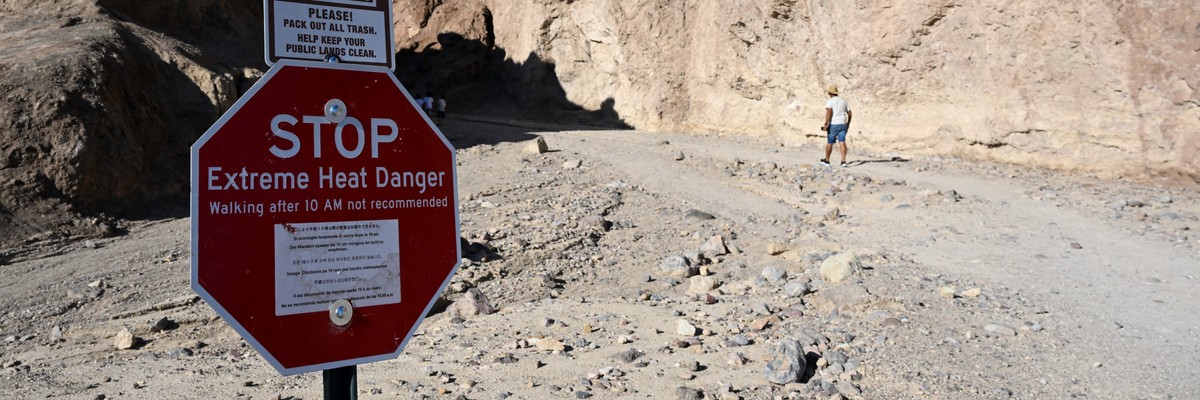
A sign says, “Stop: Extreme Heat Danger,” at the Golden Canyon Trailhead in Death Valley, California on July 9, 2023. (Photo: Tayfun Coskun/Anadolu Agency via Getty Images)
“It is likely that continued increases in average temperatures, the number of ‘hot days,’ and the frequency and intensity of heatwaves could be playing a role,” said one researcher.
As 55 million people in the U.S. Midwest faced heat alerts on Monday, research published in the peer-reviewed Journal of the American Medical Association showed that heat-related deaths in the country rose 117% between 1999 and 2023.
“The current trajectory that we’re on, in terms of warming and the change in the climate, is starting to actually show up in increased deaths,” lead author Jeffrey Howard, an associate professor of public health at the University of Texas at San Antonio, told USA Today. “That’s something that we hadn’t had measured before.”
Using a U.S. Centers for Disease Control and Prevention platform, Howard and co-authors from Pennsylvania State University and the Uniformed Services University of the Health Sciences analyzed all deaths from those 25 years coded for “hyperthermia of newborn,” “effects of heat and light,” or “exposure to excessive natural heat” as either a contributing or underlying cause of death.
They found 21,518 deaths for the full period, with 1,069 in 1999. The lowest annual figure was in 2004 (311) and the highest was in 2023 (2,325). Last year was the hottest on record globally and scientists are already warning that this year is expected to continue that trend.
“As temperatures continue to rise because of climate change, the recent increasing trend is likely to continue.”
Last year broke the record that was set in 2016—a year that’s also significant in the new study: “The number of heat-related deaths… showed year-to-year variability, with spikes in 2006 and 2011, before showing steady increases after 2016.”
Howard told CBS News that “it is likely that continued increases in average temperatures, the number of ‘hot days,’ and the frequency and intensity of heatwaves could be playing a role” in the rise since 2016.
“There is also a social and behavioral component as well,” he added, “including differences in access to air conditioning, outdoor work, the number of unhoused individuals, and things like that.”
The researcher noted that Arizona, California, Nevada, and Texas had the highest heat-related deaths—which he said is “not terribly surprising because we know that these are some of the hottest regions in the country, but it does reinforce that the risk varies regionally.”
The paper warns that “as temperatures continue to rise because of climate change, the recent increasing trend is likely to continue. Local authorities in high-risk areas should consider investing in the expansion of access to hydration centers and public cooling centers or other buildings with air conditioning.”
The authors also acknowledged limitations of their research—including “the potential for misclassification of causes of death, leading to possible underestimation of heat-related mortality rates; potential bias from increasing awareness over time; and lack of data for vulnerable subgroups”—meaning the true death toll could be higher.
A legal memo published in June by the watchdog Public Citizen detailed how local or state prosecutors could bring criminal charges against oil and gas companies for deaths from extreme heat made more likely by the fossil fuel-driven climate emergency.
“These victims deserve justice no less than the victims of street-level homicides,” said Aaron Regunberg, senior policy counsel for the group. “And this memo shows that prosecutors have a path to secure that justice, if they choose to pursue it.”
A scorching heatwave is ravaging South and Southeast Asia, impacting hundreds of millions with its intense heat. With April temperatures shattering previous records, the region is witnessing extreme weather patterns, wildfires, and tragic heat-related deaths. Schools have been forced to close, agricultural production and storage of perishable foods have been disrupted, and the risk of heatstroke and other health problems has risen significantly.
The scientists attribute the heatwave to the diminishing influence of the 2023–2024 El Niño event, which started in July 2023.
Forest fires and heatstroke deaths in Bangladesh
Bangladesh has experienced increasingly extreme weather conditions in recent years, and April 2024 stands out as the hottest month since 1948, with average temperatures ranging from 40–42 degrees Celsius (104–107.6 degrees Fahrenheit) in over 80 percent of the country.
Climate journalist Rafiqul Montu posted on X (formerly Twitter):
Wildfires erupt amid extreme heat and dry conditions
There was a continuous #HeatWave in #Bangladesh throughout April '24. Bangladesh has never seen such a hot April before. @zoom_earth map showing the heat intensity of the last day of April. The Meteorological Department has said, the abnormal heat will continue even after April. pic.twitter.com/ABE01jqTJC
#Bangladesh is burning in #heatwave. Four rounds of #heatalert have been issued in the country. Educational institutions were closed for a few days. April broke the 76-year record for consecutive heat waves. The abnormal heat wave disrupts people's life. pic.twitter.com/WgI4Od9b2z
Typically in April, Bangladesh receives 130.2 millimetres of rain, however, this year, there was almost none. The government announced the closure of government schools affecting 33 million students nationwide, while private schools with better facilities transitioned to online education. In just one week of April, over 10 deaths across the country were attributed to heatstroke.
However, the most notable impact was the wildfires in different parts of the Sundarbans Reserve Forest, the world’s largest mangrove forest. Sundarbans is a remote area, lacking adequate firefighting resources nearby. The Forest Department, along with fire service personnel, local villagers, and other volunteers, could only start firefighting efforts 17 hours after the first fire. As of the time of writing this report, a significant portion of the huge fire in the Amurbunia area of the Chandpai range is still burning, posing a threat to its rich biodiversity.

 A man walks on a hot summer day in Srinagar, India-controlled Kashmir, July 25, 2024