Metropolitan Police officers form a cordon at Parliament Square to prevent protesters reaching Westminster Bridge during a Free Palestine Coalition demonstration in central London, January 6, 2024
THE right to protest is facing an “unprecedented crisis” in England and Wales with legal reforms in the past years “fraying the fabric of democracy itself,” two major reports said today.
Law reform organisation Justice and Human Rights Watch called for the changes to be repealed and proposals for more curbs halted.
Justice chief executive Fiona Rutherford said: “Year by year, we see police powers grow, as our fundamental right to protest is treated more like a privilege.
“The law in this area has become dangerously unbalanced, empowering the state to silence voices it should be safeguarding.
“Reversing this trend is essential to restoring trust, protecting rights and preserving a healthy democracy.”
Human Rights Watch senior researcher Lydia Gall said: “The UK is now adopting protest-control tactics imposed in countries where democratic safeguards are collapsing.
“The UK should oppose such measures, not replicate and endorse them.”
Keir Starmer objects to criticism of the IDF. He asks how could anyone object to them starving people to death, forced marches like the Nazis did, bombing Gaza’s hospitals and universities, mass-murdering journalists, healthworkers and starving people queuing for food, killing and raping prisoners and murdering children. He calls for people to stop obstructing his genocide for Israel.Palestine Action joke that appeared in the UK satirical magazine ‘Private Eye’.Orcas discuss Genocide-supporting and complicit Zionists. Donald Trump, Keith Starmer, David Lammy, Rachel Reeves, Angela Rayner and Wes Streeting are acknowledged as evil genocide-complicit and supporting cnuts.
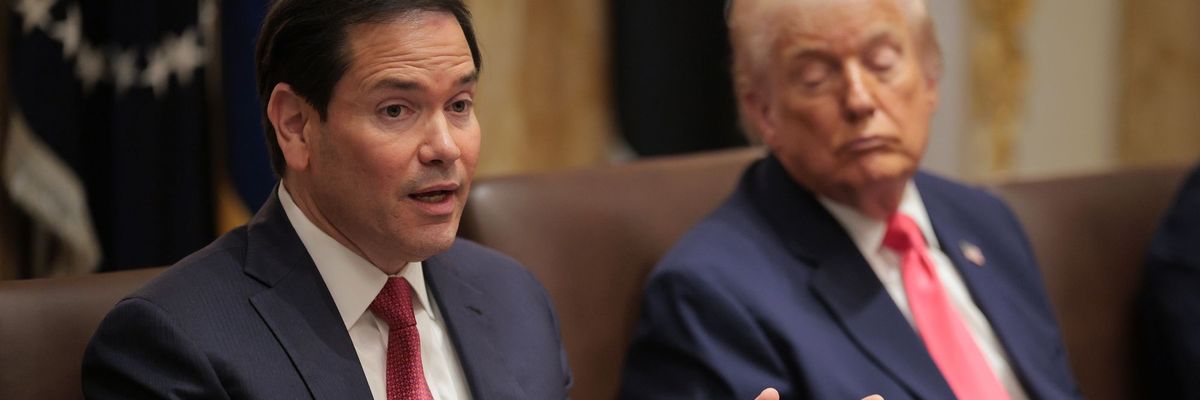
US Secretary of State Marco Rubio speaks while President Donald Trump looks on during a December 2, 2025 Cabinet meeting in the White House in Washington, DC. (Photo by Chip Somodevilla/Getty Images)
“When judicial actors are threatened for applying the law, it is the international legal order itself that is placed at risk,” the court said.
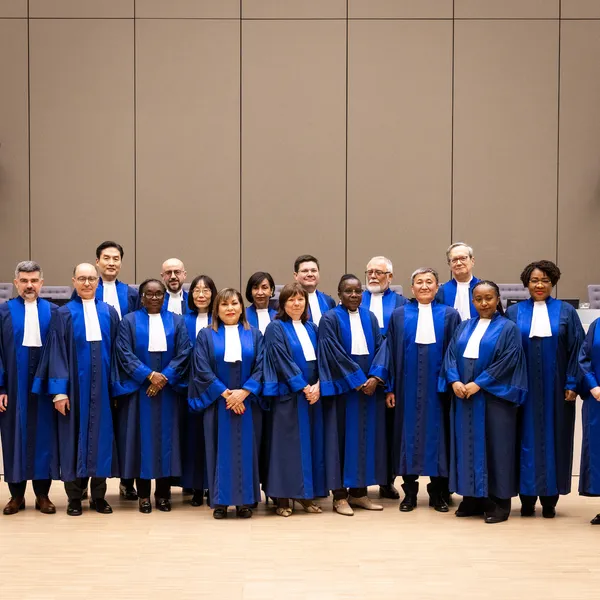
The International Criminal Court and human rights groups on Thursday condemned new US sanctions on two more of the tribunal’s judges, which brought the total number of sanctioned ICC jurists to 11 amid the Trump administration’s escalating campaign of retaliation against people and institutions seeking to hold Israel and the United States accountable for their alleged crimes.
“Today, I am designating two International Criminal Court (ICC) judges, Gocha Lordkipanidze of Georgia and Erdenebalsuren Damdin of Mongolia, pursuant to Executive Order 14203, ‘Imposing Sanctions on the International Criminal Court,’” US Secretary of State Marco Rubio said in a statement, referring to President Donald Trump’s February edict.
“These individuals have directly engaged in efforts by the ICC to investigate, arrest, detain, or prosecute Israeli nationals, without Israel’s consent, including voting with the majority in favor of the ICC’s ruling against Israel’s appeal on December 15,” Rubio added, referencing Monday’s rejection of an Israeli bid to block a probe into alleged war crimes committed during the genocidal two-year war on Gaza.
Although Israel and the US are not ICC members and do not recognize the Hague-based tribunal’s jurisdiction, Palestineis a state party to the Rome Statute governing the court. The treaty says that individuals from nonsignatory nations can be held liable for crimes committed in the territory of a member state.
Last year, the ICC issued warrants for the arrest of Israeli Prime Minister Benjamin Netanyahu and former Israeli Defense Minister Yoav Gallant for alleged crimes against humanity and war crimes in Gaza, including murder and forced starvation in a war that has left more than 250,000 Palestinians dead, wounded, or missing.
The Trump administration had previously sanctioned nine other ICC jurists: Chief Prosecutor Karim Khan (United Kingdom), Deputy Prosecutor Nazhat Shameem Khan (Fiji), Deputy Prosecutor Mame Mandiaye Niang (Senegal), Judge Solomy Balungi Bossa (Uganda), Judge Luz del Carmen Ibáñez Carranza (Peru), Judge Reine Adelaide Sophie Alapini-Gansou (Benin), Judge Beti Hohler (Slovenia), Judge Nicolas Yann Guillou (France), and Judge Kimberly Prost (Canada).
The affected judges have recently described how the US sanctions have left them and their families—who are also blacklisted—“wiped out economically and socially.”
Responding to the new US punitive measures, the ICC said Thursday that “these sanctions are a flagrant attack against the independence of an impartial judicial institution which operates pursuant to the mandate conferred by its states parties from across regions.”
“Such measures targeting judges and prosecutors who were elected by the states parties undermine the rule of law,” the court continued. “When judicial actors are threatened for applying the law, it is the international legal order itself that is placed at risk.”
“As previously stated, the court stands firmly behind its personnel and behind victims of unimaginable atrocities,” the ICC added. “It will continue to carry out its mandate with independence and impartiality, in full accordance with the Rome Statute and in the interest of victims of international crimes.”
Human Rights Watch also slammed the new US sanctions, which the group called “the latest attempt by the Trump administration to blatantly interfere with independent justice.”
The US government has imposed sanctions on two additional ICC judges in order to shield Israeli officials from charges of grave international crimes.These sanctions are the latest attempt by the Trump administration to blatantly interfere with independent justice.
Amnesty International’s Center for International Justice lamented that “once again, the US administration is attacking international justice—sanctioning two ICC judges. This cannot be normalized.””States must firmly oppose US threats and sanctions and uphold the court’s ability to pursue accountability,” the group added, “even against the most powerful perpetrators.”
Elon Musk urges you to be a Fascist like him, says that you can ignore facts and reality then.Orcas discuss how Trump was re-elected and him being an obviously insane, xenophobic Fascist.
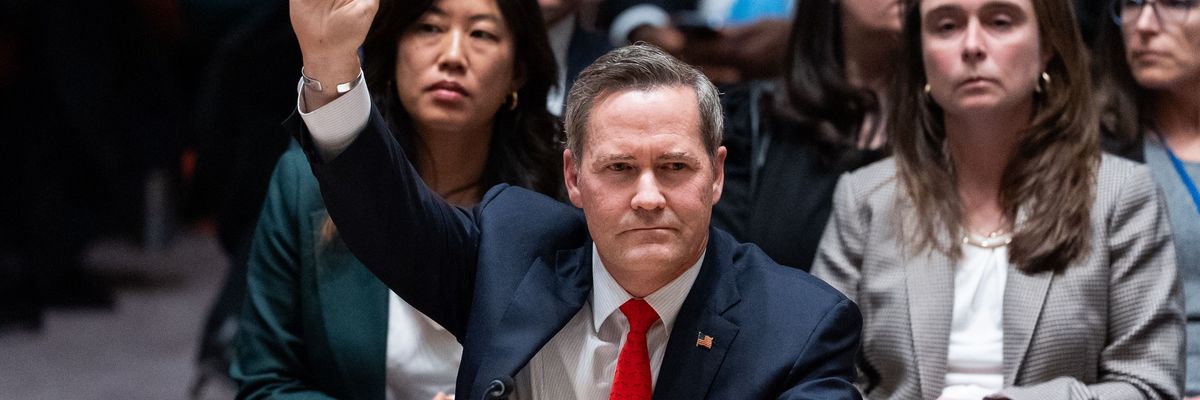
US Ambassador to the United Nations Mike Waltz raises his hand to vote in favor of a draft resolution to authorize a so-called international stabilization force in Gaza, on November 17, 2025 in New York City. (Photo by Adam Gray/Getty Images)
CodePink said the plan “will leave Palestine in the hands of a puppet administration, assigning the United States, which shares complicity in the genocide, as the new manager of the open-air prison.”
Palestine defenders decried Monday’s approval by the United Nations Security Council of a US plan authorizing a so-called international stabilization force for Gaza—a plan decried by one peace group as a denial of Palestinian self-determination.
While US Ambassador to the UN Mike Waltz hailed the approval of what he called a “historic and constructive resolution,” Hamas, which has ruled Gaza since 2007, rejected what it said “imposes an international guardianship mechanism on the Gaza Strip, which our people and their factions reject.”
“Assigning the international force with tasks and roles inside the Gaza Strip, including disarming the resistance, strips it of its neutrality, and turns it into a party to the conflict in favor of the occupation,” added Hamas, which the US labels a terrorist organization.
After waging war on Gaza for over two years, Israeli officials also rejected the resolution for opening the door to Palestinian statehood—which is officially recognized by around 150 nations but is vehemently opposed by Israel—with Prime Minister Benjamin Netanyahu calling such an outcome “unacceptable.”
The approved stabilization force will be tasked with securing Gaza’s borders, protecting civilians, facilitating humanitarian assistance, supporting a redeployed Palestinian police force, and supervising disarmament of Hamas and other militant resistance groups. Under the plan, Israeli occupation forces would fully withdraw from Gaza after the stabilization force achieves security and operational control of the Palestinian exclave.
Then, a transitional governing body—the so-called Board of Peace led by US President Donald Trump—would be established to coordinate security, humanitarian aid, and reconstruction. The plan, which builds on Trump’s 20-point peace proposal adopted in last month’s tenuous ceasefire, dangles the carrot of a pathway toward Palestinian self-determination and statehood under a reformed Palestinian governing authority.
Human Rights Watch criticized the vote in an X post stating that “the fact that the words ‘human rights’ don’t appear in the resolution adopted by the Security Council today speaks volumes.”
The US-based peace group CodePink said in a statement that “the resolution, while disguised as a peaceful and humanitarian proposal, is in reality a blueprint for the internationalization of the Israeli occupation and a complete denial of Palestinian self-determination.”
CodePink continued:
The resolution imposes a two-year mandate to “secure borders,” “protect civilians,” and “decommission weapons,” with the stated goal of disarming Palestinian resistance. However, it does nothing to address and end the root cause of the violence: Israel’s ongoing siege, occupation, and ethnic cleansing. The United States, which armed and shielded the Israeli government unconditionally as it killed and displaced hundreds of thousands of Palestinians, should not be considered a neutral actor of good faith. A military force that answers to a “Board of Peace” chaired by the US president is an extension of US and Israeli interests, plain and simple.
“The establishment of a ‘technocratic Palestinian administration’ that answers to a US-led board will strip the Palestinian people of political agency,” CodePink added. “Essentially, it will leave Palestine in the hands of a puppet administration, assigning the United States, which shares complicity in the genocide, as the new manager of the open-air prison that Israel has already established.”
Members of the New York branch of the Palestine Youth Movement led a demonstration outside the US mission to the UN in Manhattan to protest the resolution.
“We see through this thinly veiled attempt to strip the Palestinian people of their sovereignty, self-determination, and right of return,” the group said on Instagram. “The people reject any and all occupation plans for Gaza. Our movement will continue to struggle against Zionism and imperialism until Palestine is free, from the river to the sea.”
Genocide denier and Current UK Prime Minister Keir Starmer is quoted that he supports Zionism without qualification. He also confirms that UK air force support has been essential in Israel’s mass-murdering genocide. Includes URLs https://www.declassifieduk.org/keir-starmers-100-spy-flights-over-gaza-in-support-of-israel/ and https://youtu.be/O74hZCKKdpAKeir Starmer objects to criticism of the IDF. He asks how could anyone object to them starving people to death, forced marches like the Nazis did, bombing Gaza’s hospitals and universities, mass-murdering journalists, healthworkers and starving people queuing for food, killing and raping prisoners and murdering children. He calls for people to stop obstructing his genocide for Israel.Orcas discuss Genocide-supporting and complicit Zionists. Donald Trump, Keith Starmer, David Lammy, Rachel Reeves, Angela Rayner and Wes Streeting are acknowledged as evil genocide-complicit and supporting cnuts.
Indigenous demonstrators shout slogans during a demonstration at Parque Central Cayambe, Ecuador, as part of the national strike on October 1, 2025 | Felipe Stanley/Agencia Press South/Getty Images
Taking from Trump’s playbook and reviving colonial trope, President Noboa labelled Indigenous protesters ‘terrorists’
Recent years have seen Western governments extoll their democratic values while leading increasingly harsh crackdowns on dissent, with activists arrested and accused of terrorism.
Now, Ecuador has gone even further. President Daniel Noboa’s far-right government met recent nationwide anti-austerity protests with a brutality that has left two protesters dead, 473 injured, 12 missing, and 206 detained, according to the Alliance of Human Rights Organisations of Ecuador.
A 31-day national strike erupted on 22 September, nine days after Noboa removed fuel subsidies, raising the price of diesel by 55% from $1.80 to $2.80 per gallon. The demonstrations, which disrupted the movement of goods and people across the country as protesters blocked main roads, were led by Ecuador’s largest Indigenous organisation, the Confederation of Indigenous Nationalities, which represents many of the people who will be the hardest hit by the price hikes.
The government responded by imposing a state of emergency and deploying troops to break up protesters, leading to state-inflicted violence that drew criticism from civil rights groups in Ecuador and across the world.
Human Rights Watch reported it had “verified 15 videos” of “soldiers or police officers forcibly dispersing peaceful demonstrations and using tear gas and other ‘less lethal’ weapons recklessly and indiscriminately”, while Amnesty International warned of “excessive use of force against protesters by the security forces, possible arbitrary arrests, as well as the opening of abusive criminal proceedings and freezing of bank accounts belonging to social leaders and protesters”.
The unrest came as Ecuadorian voters prepare to vote on a series of referendums on 16 November. Perhaps the most controversial question they will answer is over whether to accept foreign military bases on Ecuador’s territory.
The ballot does not explicitly refer to the United States, but it may as well do; this week, US homeland security secretary Kristi Noem made her second visit to the Latin American country in four months to scout out locations for new US military bases.
Noboa’s government has long pushed for greater alignment with the US. While Ecuadorian opposition leaders warn that US military bases would threaten Ecuador’s sovereignty, both Noboa and Donald Trump’s administrations argue that they would help to stop transnational crime gangs from using the country to smuggle drugs from South America into the US.
Although polls suggest a slight majority of voters are against the bases, many are still undecided. Regardless of how they vote, Trump’s influence over Noboa’s government is already clear from the reaction to the recent Indigenous-led demonstrations. Taking from the US president’s playbook, ministers accused protesters of carrying out “terrorist acts” – directly echoing language used against activists in the US – and at least 13 people have been charged with terrorism after allegedly attacking the offices of police in Otavalo, a city in northern Ecuador.
This decision to cry terrorism is part of a strategy to turn social discontent into a security threat. Rather than answering the demands of protesters – the majority of whom were the poor people, transport workers and Indigenous peoples who will be hardest hit by fuel price increases – the government has chosen to criminalise dissent and militarise social conflict to protect its austerity measures from popular resistance.
But protest is not terrorism. It is the democratic voice of those who suffer most from inequality.
Unequal sacrifices
In Ecuador, an oil-producing country, the dispute over fuel subsidies is a recurring issue.
The subsidies have kept prices for petrol and diesel artificially low since the 1970s, but consecutive governments have argued they put too much strain on the national budget, costing the state billions, while international financial institutions have criticised them for “distorting” the economy. In 2022, the subsidies were equivalent to around 2% of Ecuador’s GDP, according to a report by the Ministry of Economy and Finance.
But for farmers, truck drivers and informal workers, the subsidies provide indispensable respite from low incomes and rising living costs. Therein lies the clash: what governments see as an easy way to make savings on their balance sheet will mean hunger for many ordinary people.
One key measure of the cost of living in Ecuador is the monthly price of the ‘basic family basket’, a government-defined set of goods needed to sustain a family of four, including food, clothing, medicine, household items and transport costs. In May this year, the price of that basic family basket reached $812, while the monthly minimum wage remained at $470. This disparity will only worsen with the removal of the diesel subsidy, which will make transport, food and the production of goods more expensive.
Previous attempts to scrap the fuel subsidies have caused the social unrest that has marked Ecuadorian politics in recent years. Two previous governments tried to do so in 2019 and 2022. Both instances sparked huge demonstrations that forced ministers into U-turns.
This time, Noboa’s government, which was elected in 2023, does not appear to be backing down. The Confederation of Indigenous Nationalities eventually called off their strike on 23 October in the wake of the state’s brutal repression, having been unable to secure any concessions.
If the government does succeed in removing the subsidies, it will lead to rising costs that will not be borne equally across Ecuador, a plurinational and multi-ethnic country where wealth is concentrated in certain areas and among certain racial groups.
The most recent data finds that 72% of the population self-identifies as mestizo, a term that refers to a person of mixed European and Indigenous American ancestry. The next largest demographic group is the Montubio people (7.4%), a rural ethnic group from coastal Ecuador; followed by Afro-Ecuadorians (7.2%), who also primarily live in the coastal provinces; then Indigenous people (7%) who largely live in the highlands and Amazon; and white people (6.1%), who have historically been based in larger cities.
The Afro-Ecuadorians and Indigenous populations in the country’s Amazon and rural coastal provinces will suffer most from the increases in transport and labour costs. Many of the families who will be affected are already impoverished, with a 40% poverty rate in these areas, far above the national rate of 28%.
Ecuador’s coast is dominated by export-oriented agribusiness and ports; the Andean highlands by public administration, services and manufacturing; while the oil extraction in the Amazonian east accounts for a large part of the country’s national income, without translating into local well-being.
The paradox is evident: the territories that produce wealth also face the greatest inequalities and deficits in health, education and basic services.
Women will also be hit harder by the removal of the fuel subsidies than men. The country’s 3.6% unemployment rate masks key gender inequalities; among women the rate is 4.6%, compared to 2.8% among men. Similarly, only 27% of women have access to adequate employment, with sufficient income and stability, compared to 41% of men, according to official figures.
The greater job insecurity created by rising food and household goods prices will disproportionately affect women. They will be forced to work longer hours to survive, particularly where they are responsible for the care of children or elderly relatives – another burden that disproportionately falls on women.
There is no neutrality in austerity: there is a regressive redistribution that privileges fiscal balance at the expense of the country’s most impoverished.
‘Terrorism’ and state coercion
While protests started in the immediate aftermath of the announcement on 13 September that the subsidies would be scrapped, the coordinated national strike began on 22 September.
Over the following 31 days, news broadcasts were full of images of this resistance across Ecuador: closed roads in Cuenca, pots and pans banging in Quito, women and children fleeing tear gas in San Rafael de la Laguna.
President Noboa imposed a state of emergency in many provinces, a measure that suspends constitutional guarantees such as the freedom of assembly, the inviolability of the home and correspondence, and the freedom of movement due to curfews. Last year, the Constitutional Court issued a warning to the president over the repeated use of this tool, which it said should be applied only in “extraordinary” circumstances.
By also condemning the protesters as “terrorists”, the government aims to delegitimise collective action, depoliticise the dispute over income and enable repression. Labelling Indigenous people as ‘offenders’ revives an old colonial trope of ‘internal enemies’, where racialised bodies are seen as a threat to order.
Noboa’s discourse is also part of a well-known Latin American genealogy: during the years of counterinsurgency, the labels of ‘subversion’ and ‘terrorism’ justified massacres, states of siege and arbitrary detentions. Today, that same language is being revived to shield a neoliberal model that is based not on consensus but on coercion.
For now, the question is not whether Ecuador can sustain fuel subsidies in the long term, but who gets to decide this. Removing subsidies without dialogue or progressive compensation mechanisms is governing against the majority.
A truly democratic policy would require real dialogue with Indigenous, Afro-Ecuadorian and peasant organisations, and including their voices in defining policies on the prices of utilities, including fuel, water and energy.
Wage and labour reform is also needed to link the minimum wage to the cost of the basic basket of goods and reduce gender and ethnic gaps, as well as territorial investment in the Amazon and rural areas to provide health, education and basic services. Finally, the demilitarisation of social conflict and the repeal of laws that criminalise protest.
The Noboa government seems to be choosing another path: shielding austerity with repression. But labelling those who defend life and bread for their families as terrorists does not resolve the conflict: it deepens it.
Protest is the language of those who refuse to be expelled from history by a model that promises order in exchange for inequality and silence.
*Rose Barboza is a Brazilian researcher and doctoral candidate in Social Sciences at the Centre for Social Studies, University of Coimbra, Portugal. She specialises in transitional justice, feminist epistemologies and critical race theory. Her current work explores comparative cases of state repression and social movements across Latin America.
As more and morescholars, and one rights groupafteranother, confirm that Israel is carrying out a genocide in Gaza, it’s becoming ever more obvious that those who deny the genocide are the intellectual and moral equivalents of people who deny other genocides, such as the ones inflicted on the Indigenous peoples of the Americas, or the Holocaust, or the Armenian Genocide.
Yet the Wall Street Journal persists in running genocide denial. Looking at how the paper does so enables us to not only refute their falsehoods, but also to gain insight into the tactics Gaza genocide denialists, and genocide deniers in general, employ. These include:
Hand-waving: brushing off the cataclysmic damage Israel and the US have done to Palestinians as merely the unavoidable byproducts of war;
Victim-blaming: saying that Palestinian resistance groups such as Hamas are to blame for the suffering in Gaza;
Inverting perpetrator and victim: presenting Palestinians, and not Israelis, as genocidal, with Israelis, rather than Palestinians, cast as the targets;
Obscurantism: offering dubious pieces of information, usually in a decontextualized manner, as if they showed that Israel has pursued its military objectives humanely;
Repudiation: flatly rejecting well-documented facts while offering little or no counter-evidence.
‘Justifiable, even necessary’
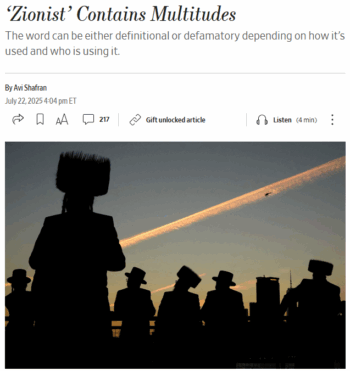
Avi Shafran (Wall Street Journal, 7/22/25): “When critics distort Israel’s goal of self-preservation into a desire for genocide, the accusers have gone from righteous protesters to ignorant haters.”
Ami Magazine columnist Avi Shafran’s Journal piece (7/22/25) utilized both hand-waving and victim-blaming. He asserted:
When critics distort Israel’s goal of self-preservation into a desire for genocide, the accusers have gone from righteous protesters to ignorant haters…. Civilians suffer and die in the prosecution of justifiable, even necessary, wars. That tragedy is intensified when you are fighting an enemy who hides behind human shields. Eradicating the engines of terror in Gaza requires attacking the places from which they operate: hospitals, schools and mosques.
Israel’s supposedly “justifiable, even necessary” war has entailed such policies (as Human Rights Watch—12/19/24—notes) as
intentionally depriv[ing] Palestinian civilians in Gaza of adequate access to water since October 2023, most likely resulting in thousands of deaths and thus committing the crime against humanity of extermination and acts of genocide.
Rather than offering a reasoned, evidence-based defense of such Israeli conduct, Shafran blithely wrote as if consciously withholding drinking water from a civilian population were as natural and inevitable as water boiling at a hundred degrees Celsius.
The author’s next move was to blame Palestinians for Israel killing Palestinians. Shafran, of course, didn’t offer a scintilla of proof for his claim that Palestinian fighters force their own people to be human shields, probably because it’s Israel—not Hamas—that routinely uses Palestinians as shields (FAIR.org, 5/13/25).
‘Systematically and deliberately devastated’
From the health workers’ open letter (Common Dreams, 10/2/24): “The human toll in Gaza since October is far higher than is understood in the United States. It is likely that the death toll from this conflict is already greater than 118,908, an astonishing 5.4% of Gaza’s population.”
Equally weak is Shafran’s suggestion that it’s Palestinians’ fault that Israel attacks Palestinian hospitals, schools and mosques. The UN Independent International Commission of Inquiry on the Occupied Palestinian Territory said that Israel damaged and destroyed more than 90% of the school and university buildings in Gaza, and found just one case where Hamas had also used a school for military purposes. The commission also said that Israeli attacks have damaged more than half of all religious and cultural sites in Gaza, and noted that
all ten religious and cultural sites in Gaza investigated by the Commission constituted civilian objects at the time of attack, and suffered devastating destruction for which the Commission could not identify a legitimate military need.
Similarly, the UN Human Rights Commission published a report late last year examining 136 Israeli strikes on at least 27 hospitals and 12 other medical facilities, and said that Israel did not substantiate its claims that Palestinian armed groups were using the structures for military purposes. In some cases, the report pointed out, Israel’s “vague” allegations “appear contradicted by publicly available information.”
Moreover, 99 American healthcare professionals who volunteered in the Gaza Strip in the months following October 7, 2023, published a letter saying that the signatories
spent a combined 254 weeks inside Gaza’s largest hospitals and clinics. We wish to be absolutely clear: Not once did any of us see any type of Palestinian militant activity in any of Gaza’s hospitals or other healthcare facilities.
We urge you to see that Israel has systematically and deliberately devastated Gaza’s entire healthcare system, and that Israel has targeted our colleagues in Gaza for torture, disappearance and murder.
Shafran pretended such evidence doesn’t exist, perhaps hoping that his audience is racist enough to believe his diatribes about wily Arabs who use places of healing, learning, worship and sanctuary to conceal “engines of terror.”
‘That side isn’t Israel’
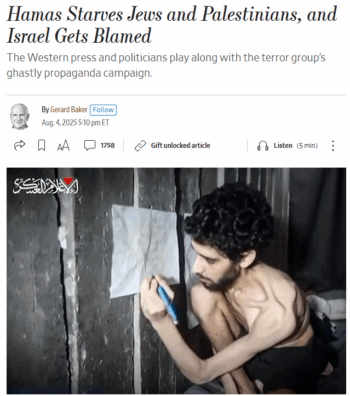
Israel blockades food going into the Gaza Strip, and the Wall Street Journal (8/5/25) blames Hamas.
Former Journal editor-in-chief Gerard Baker wrote a Journal piece (8/5/25) that inverted victim and perpetrator in Gaza. He asserted that, in the war between Israel “and its enemies in Gaza,” one side “would, if it could, conduct a genocide against the other, wiping every last remnant off the face of the planet. That side isn’t Israel.”
Baker’s strategy is to focus on what he claims Palestinian fighters “would” do in imaginary circumstances, rather than on the genocide that is actually taking place. Such speculation is pointless, because by definition it’s not possible to know what would happen in made-up scenarios. Since Baker doesn’t even bother to explain the reasons for his view that Palestinians “would” commit genocide if they could, his make-believe does not merit serious consideration.
While it is by definition impossible to decisively prove what might happen under nonexistent conditions, there is zero doubt that Israel has—in the really existing world—carried out a genocide and engaged in a pattern of conduct consistent with trying to “wip[e] every last remnant [of Palestinian life in Gaza] off the face of the planet.” Days before the Journal ran Baker’s screed, the Israeli human rights group B’Tselem published a report (7/25) documenting the Israeli genocide in Gaza:
Israel’s conduct of warfare in the Gaza Strip, which has included—among other things—massive, indiscriminate bombardment of population centers; starvation of more than 2 million people as a method of warfare; attempts at ethnic cleansing and formally including the ethnic cleansing of Gaza’s residents in the war aims; systematic destruction of hospitals and other medical facilities, which are entitled to special protection under international law, along with the vast majority of civilian infrastructure there; and the unprecedented killing of medical personnel, aid workers, persons in charge of maintaining public order, and journalists. Israel’s claim that Hamas fighters or members of other armed Palestinian groups were present in medical or civilian facilities, often made without providing any evidence, cannot justify or explain such widespread, systematic destruction.
Baker’s inversion of victim and perpetrator depends on ignoring the voluminous proof that Israel is carrying out a genocide, focusing instead on fantasies based on nothing more than orientalist depictions of Arabs as bloodthirsty savages.
‘Every martyr is a trophy’
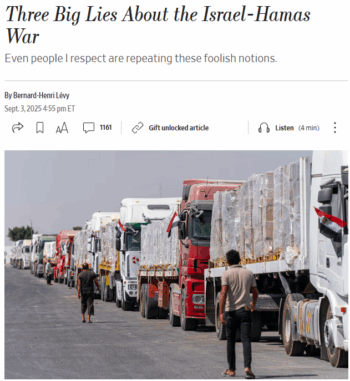
Bernard-Henri Lévy (Wall Street Journal, 9/3/25): “To speak of genocide in Gaza is an offense to common sense, a maneuver to demonize Israel, and an insult to the victims of genocides past and present.”
The notorious French intellectual Bernard-Henri Lévy published an op-ed in the Journal (9/3/25) headlined “Three Big Lies About the Israel/Hamas War.” In his view, one such lie is that “Israel is committing ‘genocide’ in Gaza.” He explained: “To say ‘genocide’ means a plan—a deliberate, targeted initiative to destroy a people. That isn’t what the Israeli army is doing.”
Here Lévy engaged in the repudiation approach to genocide denial, writing as if a well-established body of Israeli intent weren’t readily available to anyone with access to the internet. Just six days into the US/Israeli onslaught, Israeli historian Raz Segal wrote (Jewish Currents, 10/13/23) that what Israel had undertaken was “a textbook case of genocide.”
One piece of evidence Segal pointed to was Israeli Minister of Defense Yoav Gallant’s announcement that the state was “imposing a complete siege on Gaza. No electricity, no food, no water, no fuel. Everything is closed. We are fighting human animals, and we will act accordingly.”
For Segal, Gallant’s use of the phrase
“complete siege”…explicitly indexes a plan to bring the siege to its final destination of systematic destruction of Palestinians and Palestinian society in Gaza, by killing them, starving them, cutting off their water supplies, and bombing their hospitals.
Similarly, in February, US President Trump put forth a genocidal plan (Palestinian Centre for Human Rights, 2/5/25; Truthout, 2/9/25) to empty Gaza of its Palestinian inhabitants so that the US could annex the territory. Israeli Prime Minister Benjamin Netanyahu responded by saying he was “committed to US President Trump’s plan for the creation of a different Gaza.” Subsequently, Netanyahu suggested that implementing Trump’s scheme was a condition for ending the conflict.
More recently, Human Rights Watch (5/15/25) commented that an Israeli government plan codenamed “Gideon’s Chariot” was designed “to demolish what remains of Gaza’s civilian infrastructure and concentrate the Palestinian population into a tiny area,” and that this “would amount to an abhorrent escalation of its ongoing crimes against humanity, ethnic cleansing and acts of genocide.”
Thus Lévy’s denialism depends on repudiating the extensive record of Israeli leaders articulating “a plan” to “destroy a people.”
Lévy’s next move was to victim-blame: “Perhaps [Israel] is waging the war badly,” he wrote, but wondering, “who would do better in an asymmetric conflict when the enemy’s goal isn’t to minimize casualties on its own side but to maximize them, so that every martyr is a trophy?” Here Lévy traded on the racist myth that Palestinians are fanatical barbarians indifferent to the suffering of their own people.
His language is vague, so it’s hard to know for sure what he’s talking about, but it sounds like he might be invoking, as Shafran did, what Craig Mokhiber, former director of the New York office of the UN High Commissioner for Human Rights (OHCHR), calls the “double lie of ‘human shields’” (Mondoweiss, 9/21/24).
‘A genocidal army doesn’t take two years’
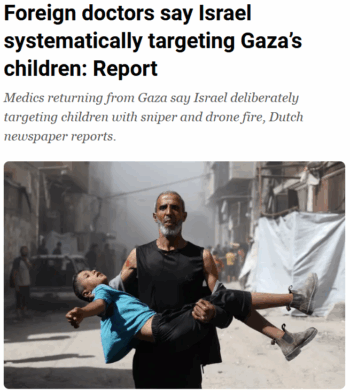
Al Jazeera (9/14/25): “Fifteen out of 17 doctors described encountering children under 15 with single bullet wounds to the head or chest. Together, they identified 114 such cases during their missions in Gaza.”
Lévy then engaged in obscurantism, denying the genocide by selecting questionable tidbits that he seems to think cast Israel in a positive light:
A genocidal army doesn’t take two years to win a war in a territory the size of Las Vegas. A genocidal army doesn’t send SMS warnings before firing or facilitate the passage of those trying to escape the strikes. A genocidal army wouldn’t evacuate, every month, hundreds of Palestinian children suffering from rare diseases or cancer, sending them to hospitals in Abu Dhabi as part of a medical airlift set up right after October 7.
That Israel hasn’t conquered Gaza to this point is a non sequitur. What Israel’s inability to subjugate Gaza shows is that Israel isn’t omnipotent, and that Palestinian fighters and their allies have mounted an effective resistance to the attempt to exterminate Gaza-based Palestinians (FAIR.org, 1/24/25). That tells us nothing about Israel’s intent or the severity of the devastation it has inflicted. (It’s worth recalling that the Warsaw Ghetto survived more than two and a half years under siege from genocidal Nazi forces.)
The SMS warnings that Lévy hails add to the “confusion, chaos and mass displacement” characterizing life in Gaza for the last two years (NPR, 12/7/23). More to the point, any “warnings before firing” that Israel has sent out aren’t going to save many Gaza residents when these messages are disseminated in the context of Israel leveling much of the Strip (BBC, 7/18/25; Guardian, 1/18/25) by bombing it with the “equivalent to six Hiroshimas,” leaving the population with effectively nowhere safe to go.
Approximately 70,000 Palestinians—the overwhelming majority of them civilians—are known to be dead, or are presumed dead under the rubble (to say nothing of the many more dead due to starvation, disease, unsanitary conditions, and lack of access to clean water), so it’s as absurd as it is obscene for Lévy to suggest that Israel is making a sincere effort to reduce Palestinian casualties. That’s what Lévy’s paragraph seems to be suggesting, irrespective of all data to the contrary.
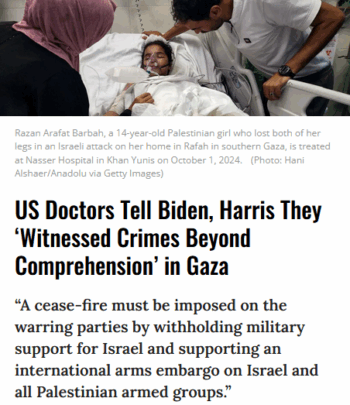
For instance, a group of 45 American physicians and nurses who volunteered in Gaza wrote a letter to the Biden/Harris administration describing treating children whose injuries the medical professionals were sure had been intentionally inflicted; “specifically, every one of us on a daily basis treated pre-teen children who were shot in the head and chest,” the letter said (CNN, 7/26/24). Deliberately sniping children every day is, to paraphrase Lévy, something a genocidal army does.
‘Delayed or denied’
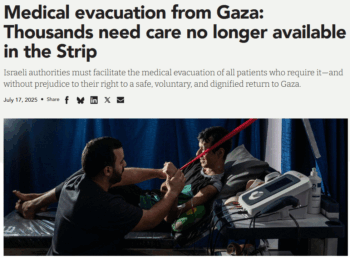
Bragging about the IDF evacuating “hundreds of Palestinian children” is actually an admission of the inadequacy of Israeli relief efforts (MSF, 7/17/25).
Nor was Lévy on solid ground when he denied that Israel policies are genocidal by claiming that it “evacuate[s], every month, hundreds of Palestinian children suffering from rare diseases or cancer.” Compare that to Doctors Without Borders/Médecins Sans Frontières report (7/17/25) that
an estimated 11,000–13,000 people—including more than 4,500 children—require medical evacuation to access care unavailable in the Strip. Yet Israeli authorities have allowed only a few of those requesting medical evacuation to do so, with many critical cases being delayed or denied regardless of medical urgency….
Doctors Without Borders/Médecins Sans Frontières (MSF) has only managed to medically evacuate 22 patients, including 13 children to our reconstructive surgery hospital in Amman, Jordan, for comprehensive rehabilitative care.
The World Health Organization (WHO) told a similar story (4/14/25):
Far too few patients have been able to leave Gaza for the urgent care they so desperately need. We estimate that up to 12,000 patients need medical evacuation but, since [Israel intensified its blockade of aid in March] we have only been able to evacuate 121 people, including 73 children.
The number of people allowed to leave Gaza for healthcare has been a minuscule portion of those who need it—never mind that the reason Palestinians need to leave Gaza for medical treatment could have something to do with destroying the Strip’s health system by “deliberately attacking and starving healthcare workers, paramedics and hospitals to wipe out medical care” in the territory. Because that’s the reality of Israel’s assaults on Palestinian healthcare, and because Lévy’s project is genocide denial, he has no choice but to obscure what Israel has done and is continuing to do.
‘Charges are a travesty’
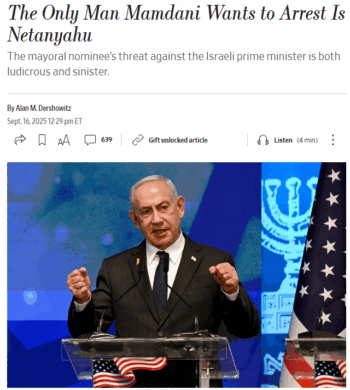
Alan Dershowitz (9/16/25) combines two of the Wall Street Journal‘s favorite causes: defending genocide and demonizing New York mayoral candidate Zohran Mamdani (FAIR.org, 7/30/25).
Attorney Alan Dershowitz—himself rathernotorious—also engaged in genocide denial on the Journal’s op-ed page (9/16/25), selecting obscurantism and repudiation as his rhetorical weapons. Dershowitz mocked New York City mayoral candidate Zohran Mamdani for saying that, if elected, he will enforce the International Criminal Court’s (ICC) arrest warrant for Netanyahu, should the prime minister visit the city:
The ICC’s charges against Mr. Netanyahu are a travesty. Its arrest warrant accuses him of intentionally starving civilians in Gaza—never mind that Israel has facilitated the delivery of more than a million tons of food to the strip. Mr. Mamdani also accuses the Jewish state of “genocide,” a charge that not even the ICC levies.
Dershowitz wrote as though it is self-evidently absurd for Mamdani to say that Israel is carrying out genocide, pointing to the fact that the ICC has not charged Israel with doing so. Yet the International Court of Justice ruled in January 2024 that it’s “plausible” Israel is committing genocide, and is working toward a definitive ruling (Guardian, 7/27/25). This is to say nothing of the many scholars and rights groups, already cited in this piece, who have concluded that the term aptly characterizes Israel’s actions. Dershowitz simply pretended this evidence doesn’t exist.
Dershowitz obfuscated Israeli policies by celebrating the volume of food allowed into Gaza, as though it were sufficient. A “million tons of food” sounds like a lot, but divided among 2 million people over two years, it amounts to a little more than one and a third pounds of food per day. (A pound and a third of rice has about 800 calories,while “the standard humanitarian ration is 2,100 calories per person per day”—London Review of Books, 5/14/25.)
It’s uncontroversial that Israel is deliberately starving civilians in Gaza. The UN’s Integrated Food Security Phase Classification (IPC) assessed that “half a million people—a quarter of Palestinians in Gaza—are suffering from famine,” a catastrophe resulting from Israeli policies, including what aid groups describe as its “systematic obstruction” of food entering the Strip (BBC, 8/22/25).
Even more contemptible
As I’ve argued previously (Electronic Intifada, 7/15/24), denying an unfolding genocide like the one in Palestine is even more contemptible than denying genocides that happened in the past, because an ongoing genocide can be stopped before even more people in the targeted population are killed, maimed and bereaved. That’s why every genocide denial is at the same time pro-genocide propaganda: Fewer people with an accurate grasp of the US/Israeli attempt to destroy Palestinians in Gaza as a people means fewer people to try and stop it from happening.
Fortunately, despite all the lies from outlets like the Journal, millions of people around the world have made Palestine solidarity activism a regular part of their lives. The more widely genocide-enabling mendacities can be exposed, the more likely to succeed will be the movements to stop the crime of crimes—and to achieve peace through liberation across the Middle East.
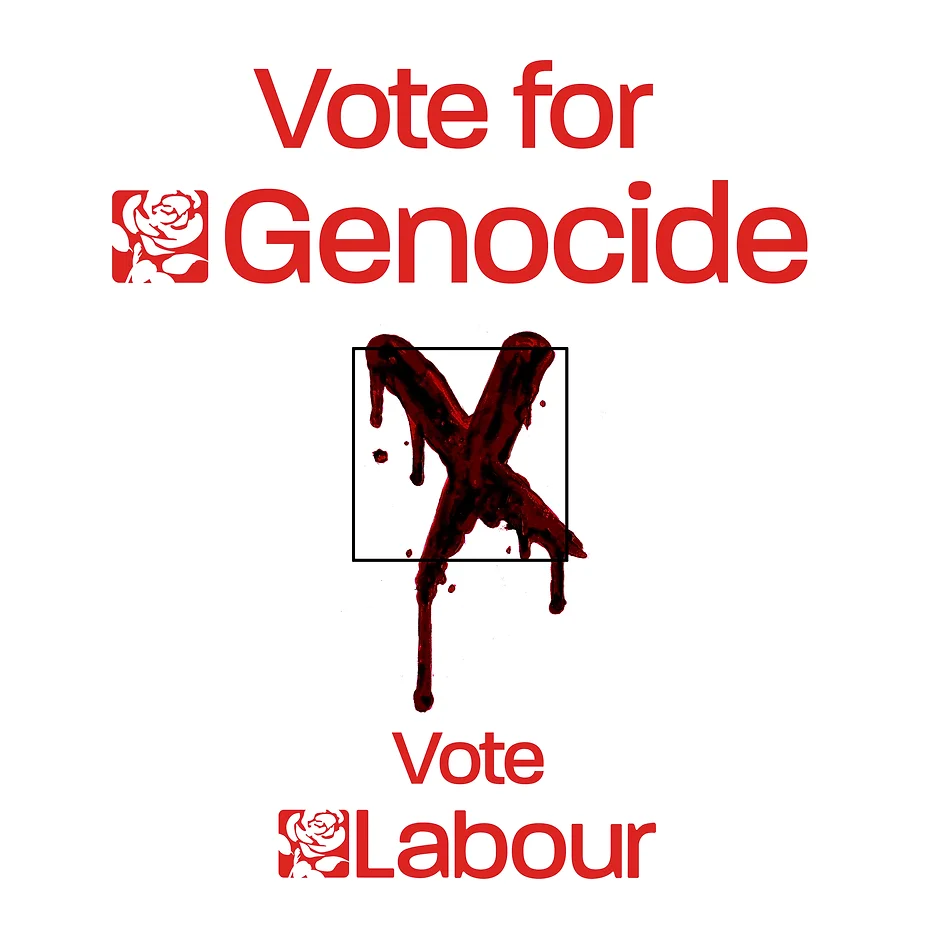
Keir Starmer objects to criticism of the IDF. He asks how could anyone object to them starving people to death, forced marches like the Nazis did, bombing Gaza’s hospitals and universities, mass-murdering journalists, healthworkers and starving people queuing for food, killing and raping prisoners and murdering children. He calls for people to stop obstructing his genocide for Israel.Genocide denier and Current UK Prime Minister Keir Starmer is quoted that he supports Zionism without qualification. He also confirms that UK air force support has been essential in Israel’s mass-murdering genocide. Includes URLs https://www.declassifieduk.org/keir-starmers-100-spy-flights-over-gaza-in-support-of-israel/ and https://youtu.be/O74hZCKKdpAVote Labour for Genocide.

 Metropolitan Police officers form a cordon at Parliament Square to prevent protesters reaching Westminster Bridge during a Free Palestine Coalition demonstration in central London, January 6, 2024