The area in Gaza which Israel’s military has told people to go to “for their safety” has been hit by 97 strikes since May, BBC Verify analysis has revealed.
The findings come as negotiations for a ceasefire between Israel and Hamas appear to be nearing a breakthrough. Mediators in Qatar say talks are in their final stages, raising hopes that an agreement could be reached soon.
On 6 May 2024, the IDF significantly expanded the zone to include the cities of Khan Younis and Deir al-Balah.
The area – much of which is a strip of land along the Mediterranean sea – is densely populated and is estimated to have over a million people living there according to international humanitarian organisations. Many people are living in tents, with limited infrastructure and limited access to aid.
Local media reports indicate more than 550 people have been killed in the 97 strikes mapped by BBC Verify.
In a statement to BBC Verify, the IDF said it was targeting Hamas fighters operating in the “humanitarian zone” and accused the group of violating international law while “exploiting” civilians as human shields and launching rockets from the area.
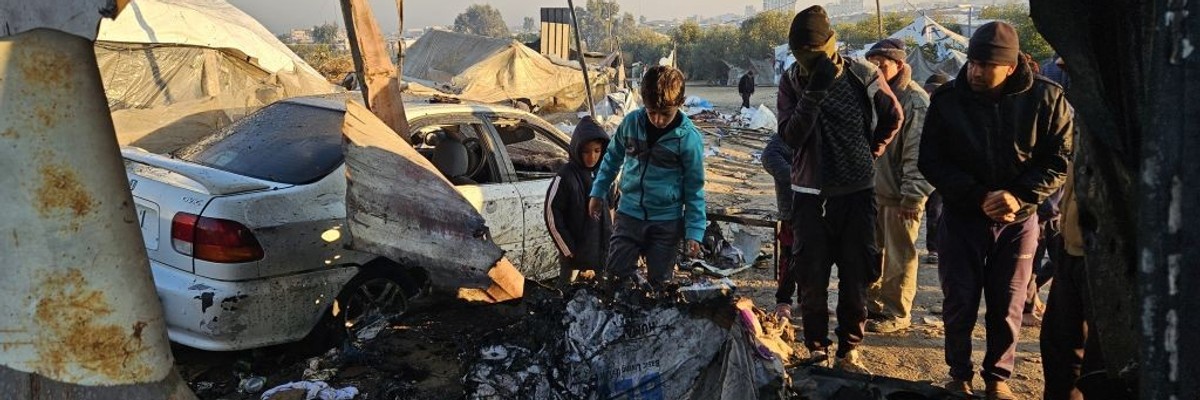
Palestinians survey damage after the Israeli military targeted Al-Mawasi, Gaza on January 2, 2025. (Photo: Hani Alshaer/Anadolu via Getty Images)
“Israel continues to bomb Gaza and restrict essential supplies from entering the strip,” said the emergency coordinator of Doctors Without Borders.
Israeli forces early Thursday carried out another attack on a so-called humanitarian “safe zone” in southern Gaza, killing at least 11 people—including three children—as the assault on the Palestinian enclave raged with no end in sight.
Reuters reported that at least 15 people were also wounded in the attack on Al-Mawasi, an overcrowded tent city on Gaza’s southern coast that Israel has repeatedly bombed. In one case late last year, the Israeli military used 2,000-pound bombs supplied by the United States to attack the camp filled with displaced families.
The Israel Defense Forces (IDF) confirmed in a social media post that it carried out the strike on the designated humanitarian zone, claiming it targeted Hassam Shahwan, whom the IDF described as the head of Hamas Internal Security Forces in southern Gaza.
Video footage shows people attempting to put out fires at the scene with buckets of water:
Thursday’s attack underscored humanitarian aid groups’ warning that nowhere is truly safe for Gazans as Israeli forces carry out deadly airstrikes across the besieged enclave. Al Jazeera reported early Thursday that in addition to the IDF’s attack on Al-Mawasi, “there has been a significant escalation of strikes in central Gaza.”
“Palestinians are mourning those killed in an Israeli strike on civilians in the suburb of central Deir el-Balah city,” the outlet reported. “The bodies—shredded into pieces—have been brought to Al-Aqsa Hospital.”
“In northern Gaza,” Al Jazeera added, “seven civilians were killed in Jabalia following an Israeli attack. In the Shati refugee camp, reports are emerging of three people killed in an attack at the central market.”
Israel’s incessant bombing is fueling a devastating humanitarian crisis worsened by falling temperatures. At least six Palestinian children—including several who were living in makeshift shelters in Al-Mawasi—have died of hypothermia in recent days.
“Last winter—although people were already displaced and the conditions were harsh—there were still some buildings to take shelter in,” Pascale Coissard, emergency coordinator at Doctors Without Borders, said Thursday. “Today, after 14 months of war and destruction of infrastructure, most of the people in Gaza are living in tents that barely isolate the cold wind and rain. Just in the past 12 hours, the rain hasn’t stopped.”
“Even before their lives have started outside the womb, babies are at risk of disease and death,” Coissard added. “Once born, babies face immediate and extreme challenges: displaced in the cold of winter, without adequate access to warmth, shelter, or healthcare, as Israel continues to bomb Gaza and restrict essential supplies from entering the strip, while looting of aid trucks within the enclave is making it difficult for that small amount of aid allowed by Israeli authorities to reach those in need.”
CNN noted earlier this week that “the cold weather has not only claimed the lives of children.”
“On Friday, the health ministry said a nurse was found dead in his tent in Al-Mawasi on Friday due to severe cold,” the outlet reported.
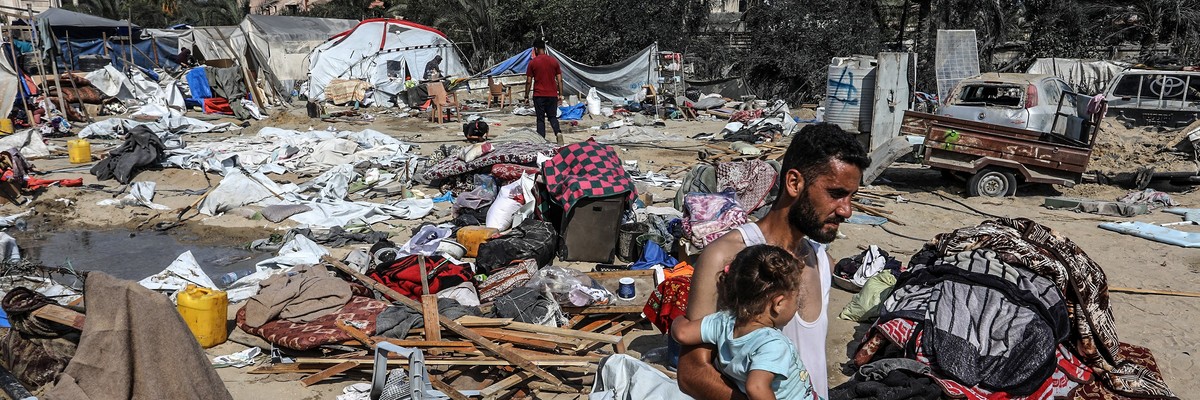
A view of destruction in the al-Mawasi area after an Israeli attack in Khan Younis in the southern Gaza Strip on July 14, 2024. (Photo: Abed Rahim Khatib/Anadolu via Getty Images
“We live in an area that is considered humanitarian and is supposed to be safe, but it is not,” one woman said. “There is no safe place for us or our children.”
Palestinians living in the so-called “humanitarian zone” designated by Israel described extreme and worsening overcrowding on Tuesday, saying that as the Israel Defense Forces has repeatedly struck the area in recent months, displaced people living there have been left feeling they “could die any minute.”
A 37-year-old mother of four, Nisreen Joudeh, told The New York Times that al-Mawasi, a stretch of coastal land to which hundreds of thousands of people from other parts of Gaza have evacuated under Israeli orders, “is no longer a safe area.”
With materials for tents now costing hundreds of dollars instead of an average of $50 as they did before Israel began bombarding Gaza and blocking humanitarian aid last October, families now commonly share the tents that have been erected along the sandy shore area.
“A tent that used to accommodate four to seven people now houses 15 to 17 people from two or more families,” a man named Karel Mohammed told the Times, and overcrowding has intensified in recent weeks as Israel forcibly displaced tens of thousands more Palestinians and ordered them to al-Mawasi.
People face “scorching heat” with very few trees to provide shade, and have access to only “primitive bathrooms,” according to Mohammed.
With Israel continuing to block large amounts of humanitarian aid—actions that United Nations experts last month said have pushed Gaza into famine—Mohammed said there is “no drinkable water, no healthy food” in al-Mawasi.
“The truth is that this area is anything but humanitarian,” said Mohammed. “Our life in these camps is like hell.”
The Times‘ dispatch from al-Mawasi came a day after the United Nations Children’s Fund (UNICEF) reported that the “lack of clean water” and the destruction of Gaza’s sanitation and sewage treatment systems” have caused a surge in diseases including diarrhea and skin disorders across Gaza.
The hygiene conditions in Gaza are appalling and threatening children’s lives and health.@UNICEF and partners are providing clean water. But more aid is urgently needed along with secure access to reach all those in need.
Mona al-Farra, another Palestinian who is sheltering in al-Mawasi in a tent crowded with nine other family members, said skin rashes among children have particularly become rampant due to a lack of clean water and medicine.
“We live in an area that is considered humanitarian and is supposed to be safe, but it is not,” she told the Times, adding that her family frequently hears airstrikes nearby. “There is no safe place for us or our children.”
Last month, at least 90 Palestinians were killed in a bombing within al-Mawasi, which the IDF said had targeted Hamas commander Muhammed Deif.
The so-called humanitarian zone covers 18 square miles, according to the U.N., or nearly 13% of the Gaza Strip. The IDF adjusted the area’s borders last month, shrinking it by about one-fifth.
Doctors Without Borders, also known as Medecins Sans Frontieres (MSF), shared on social media on Monday drawings that had been made by children in a mental health clinic in al-Mawasi, with the artwork exemplifying the “complete psychological destruction” among Gaza’s youngest residents that a report warned of earlier this year.
What a group of children in a mental health clinic in Al-Mawasi drew:
The first drawing on the wall is colorful. It shows Gaza before the war. The Gaza they miss.
“Even though the wounds are invisible, the drawings provide a glimpse into what these children have witnessed. It is beyond words,” said Samuel Johann, an emergency coordinator for MSF. “I cannot express what I feel, seeing what these children have experienced, through their eyes and the reality they are facing.”
“Today,” he said, “I heard a Palestinian colleague describe the human suffering of the war as such: ‘Only the dead have been spared this suffering.’”