How Europe’s Climate and Sustainability Rules Were Shredded While Citizens Remained in the Dark

Spread the love

Original article by Hugh Wheelan and Raj Thamotheram republished from DeSmog

(Credit: Mahen Rin/Unsplash)

Policymakers, civil society, investors, business, and the media all must answer key questions fast — before the regulatory rollback turns into a rout.

The European Union’s package of major corporate environment and sustainability laws was years in the making — and has just been quietly gutted.

A debate that reshaped corporate Europe unfolded almost entirely within Brussels policy circles. Millions of Europeans who believe climate action should be prioritised and favour greater corporate accountability never realized the regulations were under threat

This should prompt serious reflection among those of us who believe that the climate and human rights focus of the regulations was deadly serious, but that support among politicians was not.

The so-called “Omnibus” rollback — a regulatory rationalisation ascribed to competitiveness concerns amid pressure from the United States – has exempted 90 percent of Europe’s companies from climate reporting. In parallel, supply chain reporting has been seriously watered down and postponed until the end of the decade.

The overturned rules included mandatory reporting by most EU companies of their impact on climate change, and how environmental dangers could affect their business. They also forced companies selling products on the continent to report on child and forced labour issues, as well as potentially dangerous working conditions in their international supply chains.

In today’s economy, corporate lobbyists seize moments of regulatory weakness to ram home anti-growth or relative competitiveness arguments that instantly gather financial and political support.

Indeed, the printer ink had barely dried on the official publication of the EU Omnibus — finalised this month — before companies started attacking the EU’s 20-year-old Emissions Trading System (ETS) carbon pricing regime on similar international competition grounds.

If we don’t quickly digest the lessons of the Omnibus debacle, sterner tests will come as populists challenge for power across the bloc. 

Why Was the Rollback Invisible?

Why was the European public largely unaware of such a huge regulatory rollback?

The reason is that it took place in a legacy media vacuum. No major polling organisation measured citizen awareness. The BBC, The Guardian, Le Monde, and Der Spiegel barely — if at all — covered the vote. 

Further, how can we support and defend policies when we hide them behind letter jumbles like CSRD, SFDR, CSDDD — acronyms that mean nothing to the public? (The Corporate Sustainability Reporting Directive, Sustainability Finance Disclosure Regulation, and Corporate Sustainability Due Diligence Directive, respectively.)

Fluency in Brussels acronyms becomes a political liability when success requires public mobilisation. 

Campaigns succeed with vivid phrases that citizens quickly understand. Surveys consistently show that large numbers of Europeans support corporate accountability when it’s described in plain language. Germany’s “Supply Chain Law” campaign gathered over 200,000 supporters by using a clear, native-language label.

No comparable EU-wide branding effort for the sustainable finance regulations emerged. Defenders of the EU sustainability rules never attempted an equivalent translation.

By contrast, industry lobbyists framed their arguments with accessible language such as “simplification” and “cutting red tape,” while pushing the convenient elements of the Draghi report on EU competitiveness.  Advocates countered with “transposition deadlines,” “ESRS requirements,” and “regulatory coherence.” The contrast was decisive.

Post-defeat reflection on this communications failure has been nearly non-existent.

Green Groups: Bureaucratised and Compromised? 

Typically, the rallying call to voters on environmental and rights regulations comes from non-governmental organisations (NGOs). In the case of the EU climate and sustainability Omnibus, more than 360 NGOs and other civil society organisations signed a coalition statement against the “disastrous” and “dangerous” deregulation.

Over the decades, many European climate and human rights groups have evolved into Brussels-based policy shops that are staffed by lawyers and technical experts fluent in EU procedure, but which seem to be relatively poorly equipped for mass public and political campaigning.

Their efforts produced no mass protests, no breakthrough petitions, and no broad public mobilisation. 

Some NGO funding structures appear to reinforce this limitation. Major foundations often restrict grants against “political or partisan activities,” while EU funding frameworks have introduced reputational-risk benchmarks that discourage confrontational advocacy. Funders also often seek short-term results to long-term problems that require deep, structural change, not “hope-for-the-best” strategy thinking. 

A coalition spanning 27 countries that relies on consensus decision-making could not move quickly. The NGOs deployed the only tools their structures supported: letters, technical briefings, and procedural complaints. The limitation was not a strategic choice; it was institutional. 

Big-spending corporate lobbyists, meanwhile, began organising months before public announcements on the Omnibus were made. In addition, the accelerated legislative timeline of the Omnibus compressed the opposition response time from multiple years to less than one, leaving opponents flat-footed. 

ExxonMobil alone is reported to have had more than 25 meetings with the European Commission to lobby against the CSDDD, and allegedly threatened to withhold $20bn in renewables spending in Europe if it was not rolled back.

We hear there have been reflections by major NGOs on what went wrong. To stop mistakes from recurring, the publication of these learnings is essential.

Why Doesn’t Capital Defend Itself?

Institutional investors representing €6.6 trillion in assets had strong financial incentives to oppose the Omnibus. Their risk analysis was clear: Stranding of major fossil-fuel assets would likely accelerate without transition planning; weakened disclosure rules would leave investors short of necessary climate information; regulatory uncertainty would stall long-term investment; and Europe would forfeit advantages in green technology. 

Citizens’ pensions and long-term savings could face potential portfolio-wide losses if systemic climate risks go unmanaged. 

Investors wrote detailed letters explaining these dangers. 

Then they watched the regulations collapse. 

They did not mobilize beneficiaries, fund public campaigns, or coordinate with the 362 NGOs in the field. The UN-backed Principles for Responsible Investment, the huge investor environment, sustainability and governance (ESG) coalition, could only muster a hundred or so of its 5,000-plus investors to sign a letter warning against a serious unravelling of the regulations. Many of the heavyweight investors in its ranks weren’t there.

The failure reveals a deeper structural problem: Even when capital’s interests align with regulation, financial institutions often lack the political capacity and institutional mechanisms to defend those interests against coordinated opposition.

Why Didn’t Progressive Business and Labour Fight?

Allies with different tools and constituencies struggled to convert shared positions into effective action.

Eighty-eight companies — including Unilever, Mars, Nestlé, Ferrero, DP World, and Primark — signed letters opposing the rollback and acknowledged that customers demanded consistent sustainability standards.

Why didn’t they also launch consumer campaigns, threaten relocation, withdraw from trade associations backing deregulation, or apply coordinated market pressure?

Competitive dynamics discouraged unilateral action by business, and company executives feared appearing overtly political during an ESG backlash. Meanwhile, trade associations often lobbied in the opposite direction.

Trades unions showed similar restraint. Despite representing tens of millions of workers, major confederations limited their involvement largely to signing coalition letters.

Unions excel at domestic workplace negotiations but often struggle with international supply chain issues and EU-level regulatory processes. When industry framed the debate as “regulation kills jobs,” unions faced an apparent dilemma between global labour protections and local employment security. 

Did the Regulation Work?

Businesses and investors respond to clear regulatory signals. They rarely get out ahead of politics or the market without a strong policy or pricing foundation to lean on.

One of the overarching responses we’ve heard from business and finance professionals to the Omnibus policy rollback is that the EU regulatory approach in its Action Plan on green and sustainable finance suffered from a “first principles” problem, skewing heavily towards bureaucratic solutions for policy or incentives problems. 

Many told us, for example, that the EU was not prepared to put the budget stimulus alongside hard regulations to seize the future green technology opportunity. Instead, they opted for a lower cost, weaker, reporting-led investment approach (more data encourages more finance) where actual green output (business R&D, investment flows) may be slow or unclear.

This risks creating a sort of Potemkin Village of climate and sustainability progress, because reporting and compliance solutions cannot replace market drivers such as incentives, infrastructure, or price signals.  

Some of these issues are being addressed, but they have been long in the amendment, despite concerns being raised.

To work, reporting frameworks require a clear, gradual shift in rules or pricing that can surmount competition barriers by underpinning market shifts.

Without it, data collection and research are costly and lack an underlying economic “materiality” (policy push, pricing, time-horizon). They quickly become a comparative drag.

The addition of important but complicated regulations, like supply chain reporting, then gets scapegoated as a further cost to EU companies in globally competitive markets. Bureaucratic overreach is easily lobbied against on competitiveness grounds. Policy row-back then becomes itself highly disruptive, creating a cycle of negativity.

Rationalising data points for corporate reporting and focusing, for example, on the biggest corporate CO2 emitters, as the Omnibus proposes, are not in themselves problematic reforms.  

But it is vital to ensure that policy is smart, joined-up, backed by developments in the real economy, competitive, and road-tested for outcome. 

This will be key to embedding regulations that align with the capital spending decisions that companies are already taking (according to EU data) as a result of the EU’s green taxonomy for sustainable activities.

How Should We Understand the Authoritarian-Fossil Fuel Alliance? 

The Omnibus was not a result of routine corporate lobbying. It reflected a broader geopolitical alignment.

Corporate actors, political movements, and transnational advocacy networks converged around shared economic and ideological interests. Months before public announcement, extensive lobbying campaigns began, leveraging substantial financial resources to coordinate messaging across institutions.

This alignment shifted the terrain from a conventional policy dispute to a power asymmetry.

Civil society coalitions and institutional investors faced opponents with larger budgets and stronger political backing. Investor inaction and NGO limitations become more understandable in this context: The imbalance was structural, not incidental.

We need to reflect deeply on this and what it means for EU sustainability regulations. 

Europe’s Own Leverage: What Can Still Work?

The Omnibus outcome is not final. The EU rules can be improved and made to work with the right public and business support, political will, and technical know-how.

Member states can move ahead independently, setting stronger national standards like Germany’s Supply Chain Law, which companies must meet to access their markets. The EU can lean in to sustainability initiatives via issues of global security, energy transition, and justice.

The economic momentum favours transition: Renewable energy capacity continues to expand and market trends are rewarding low-carbon shifts.

Practical paths forward include coordinated member-state regulation, economic-sovereignty instruments tied to market access, judicial challenges, cross-sector coalitions among cities and businesses, and clearer public narratives that link sustainability to competitiveness and security.

Europe’s regulatory influence remains significant when it acts decisively. Large markets can still set de facto global standards. But to get there we need to start answering these hard questions.

Original article by Hugh Wheelan and Raj Thamotheram republished from DeSmog

Donald Trump urges you to be a Climate Science denier like him. He says that he makes millions and millions for destroying the planet, Burn, Baby, Burn and Flood, Baby, Flood.
Nigel Farage urges you to ignore facts and reality and be a climate science denier like him and his Deputy Richard Tice. He says that Reform UK has received £Millions and £Millions from the fossil fuel industry to promote climate denial and destroy the planet.
Elon Musk urges you to be a Fascist like him, says that you can ignore facts and reality then.
Continue ReadingHow Europe’s Climate and Sustainability Rules Were Shredded While Citizens Remained in the Dark

Can Britain re-nationalize water services?

Spread the love

Original article by Ana Vračar republished from peoples dispatch under a Creative Commons Attribution-ShareAlike 4.0 (CC BY-SA) license.

Source: We Own It/X

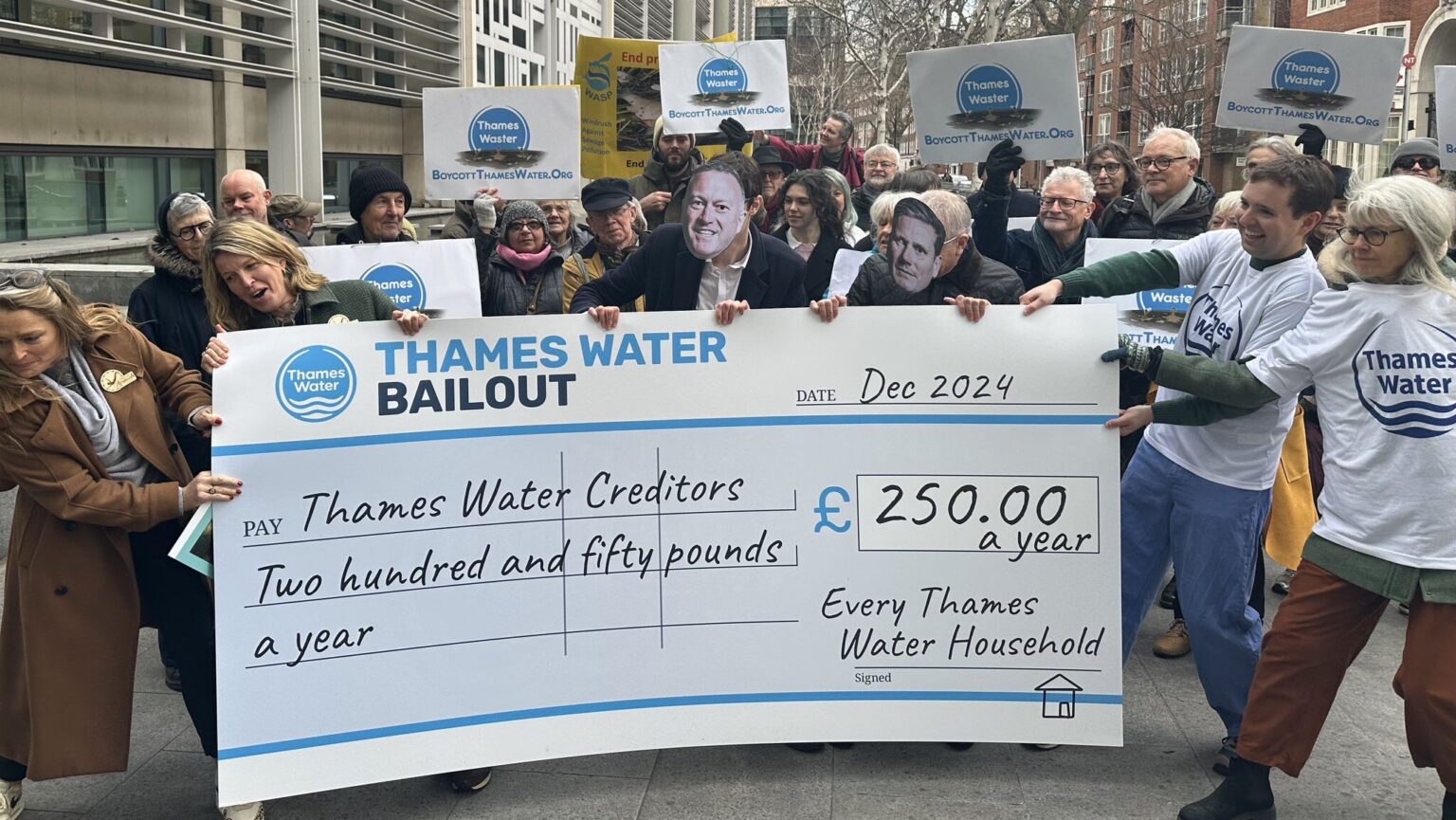
Demands for renationalization of water services in England grows as private London water supplier requests bailout

Social justice organizations in Britain are urging judges to reject a bailout request from Thames Water, one of the country’s largest water providers, serving some 16 million people in the greater London area. Campaigners argue that approving the bailout of the private utility provider would allow Thames Water to continue its mismanagement while forcing consumers to shoulder the burden—raising annual water bills by £250 (USD 317) per user.

“This is daylight robbery. There are two people who can stop it, the judge in court today and Steve Reed, the environment secretary. He can protect billpayers from this by withdrawing Thames Water’s license, on the basis of financial insolvency, illegal sewage dumping, or both,” Cat Hobbs, Director of We Own It, told Peoples Dispatch. “Tony Blair’s government defended the public interest when Railtrack went bust, why won’t this government do the same for Thames Water?”

The company warned that without the bailout, it would run out of funds by March next year. However, Thames Water customers predict that they will be unfairly burdened with the costs of the bailout, including the high interest rates that will follow, while company management will face little accountability. The We Own It campaign noted that “it is obvious that the consumer as the sole source of revenue will indirectly fund this amount by way of increases in their water bills.”

While claiming financial difficulties, Thames Water has managed to secure substantial profit margins for its investors—many of whom are based outside Britain and remain unaffected by the declining quality of local water services—while awarding generous bonuses to its management. This pattern is not unique to Thames Water: all water and sewage companies across England have followed a similar path since privatization under Margaret Thatcher’s administration. During this time, these companies have paid out £72 billion (91 billion USD) to shareholders while accumulating £60 billion (76 billion USD) in debt. The result has been a chronic lack of investment in infrastructure, leading to leaks of both water and money.

“The argument for privatization was that there would be more investment, the water would be cheaper, and the service would be more efficient,” independent MP Jeremy Corbyn remarked during a discussion on water services earlier this year. “It’s really worked out well on that, hasn’t it?”

A risk to ecosystem and human health

In addition to financial losses, privatization has led to a significant decline in water safety and quality. Private operators have regularly discharged untreated sewage into rivers and the sea, causing harm to ecosystems and posing a direct threat to human health. Regulators, meanwhile, are unable to enforce compliance with safety standards due to conflicts of interest, low fine thresholds and the fact that the infrastructure itself remains under the companies’ ownership.

Unlike other European countries that experimented with water privatization by outsourcing service provision but mostly retaining ownership of infrastructure, England sold everything. As a result, rather than waiting for contracts to expire and reclaiming control, the government would need to buy back the entire water system from companies like Thames Water. According to We Own It, the initial cost for this process could start around £15 billion (19 billion USD)—an amount the campaign estimates could be repaid within just six years.

Re-nationalizing water services has led to significant successes in other countries, according to Matthew Topham, Lead Campaigner at We Own It. “Paris took back control of its drinking water in 2010 from an outsourced private contract. Bills were immediately lowered, customer satisfaction levels are high, and last year, they were able to reinvest 89 million euros in improving the network,” he explains. He adds that public ownership has also sparked community participation, with cities like Lima, Terrassa, and Paris establishing observatories to give communities, workers, and activists a voice in managing water services.

Campaigners against the Thames Water bailout are calling precisely for a return to public ownership. They argue that this approach would not only lower costs for users but also create space for more investment in infrastructure, improving water quality. This demand resonates with over 80% of the British public, who support the idea of water services being brought back into public hands.

Read more: Labour considers expanding private sector role in NHS, undermining the already fragile public health system

The Labour government, however, does not share this vision. Under Jeremy Corbyn’s leadership, the party’s program included an ambitious plan to renationalize water services. By 2024, Labour’s election program had moved away from this idea, keeping only the possibility of granting “new powers” to regulators to block bonuses for companies proven to pollute watercourses. As many on the left predicted ahead of the July 2024 election, Keir Starmer’s administration has shown a clear inclination toward privatization, not only in water services but also in healthcare and other sectors.

The final decision on Thames Water’s bailout request is expected in early 2025, with campaigners urging the court to consider users’ concerns and reject the proposal, paving the way for better water services.

Original article by Ana Vračar republished from peoples dispatch under a Creative Commons Attribution-ShareAlike 4.0 (CC BY-SA) license.

Continue ReadingCan Britain re-nationalize water services?

UK sees privatisation ‘opportunities’ in Ukraine war

Spread the love

https://www.declassifieduk.org/uk-sees-privatisation-opportunities-in-ukraine-war/

Zelensky meets Starmer and NATO secretary general Mark Rutte. (Photo: Simon Dawson / No 10 handout)

British aid is being used to open up Ukraine’s wrecked economy to foreign investors and enhance trade with the UK.

Amid the devastating war in Ukraine, British economic aid to the country is focused on promoting pro-private sector reforms and on pressing the government to open up its economy to foreign investors. 

Recently-published Foreign Office documents on its flagship aid project in Ukraine, which supports privatisation, note that the war provides “opportunities” for Ukraine delivering on “some hugely important reforms”.

The government in Kyiv has in recent months been responding positively to these calls. Last month, president Volodymyr Zelensky signed a new law expanding the privatisation of state-owned banks in the country. 

It follows the Ukrainian government’s announcement in July of its ‘Large-Scale Privatisation 2024’ programme that is intended to drive foreign investment into the country and raise money for Ukraine’s struggling national budget, not least to fight Russia.

Large assets slated for privatisation currently include the country’s biggest producer of titanium ore, a leading producer of concrete products and a mining and processing plant. 

Ukraine envisaged privatising the country’s roughly 3,500 state-owned enterprises in a law of 2018, which said foreign citizens and companies could become owners.

The process stalled as a result of coronavirus and then Russia’s invasion in February 2022. But hundreds of smaller-scale enterprises are now being privatised, bringing in revenues of UAH 9.6bn (£181m) in the past two years. 

“The resumption of privatisation amid the full-scale war is an important step, which is already yielding results,” Ukraine’s economy minister Yulia Svyrydenko said last month. 

Another law enacted in June 2023 allows large-scale assets to be sold to foreigners or Ukrainians during the current martial law regime.  

Article continues at https://www.declassifieduk.org/uk-sees-privatisation-opportunities-in-ukraine-war/

Continue ReadingUK sees privatisation ‘opportunities’ in Ukraine war

World Leaders Failed Us, But We Have the Power to End the Era of Fossil Fuels

Spread the love

Original article by RABBI JACOB SIEGEL republished from Common Dreams under Creative Commons (CC BY-NC-ND 3.0). 

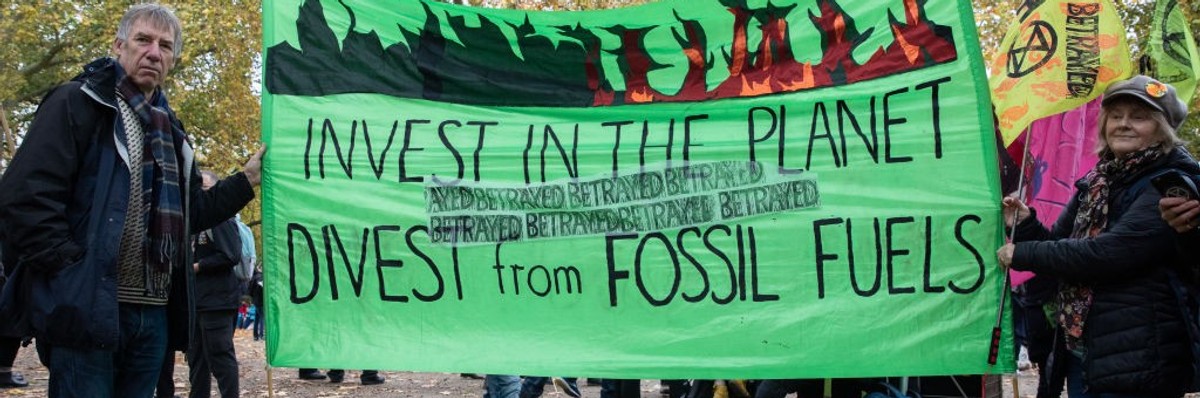
Extinction Rebellion climate activists hold a banner in Lincoln’s Inn Fields before a march on November 13, 2021 in London, United Kingdom.  (Photo by Mark Kerrison/In Pictures via Getty Images)

Over 1,600 institutions, including hundreds of faith-based organizations, have now joined the fight to move money away from polluting fossil fuels and toward clean energy solutions—yours should be next.

Last month saw an historic, albeit altogether insufficient, step forward to avoid climate catastrophe.

At the annual global UN-backed climate change conference in Dubai, known as COP28, countries for the first time unanimously acknowledged the necessity of “transitioning away from fossil fuels”: coal, oil, and gas. While short of an endorsement of a full fossil fuel phaseout—what scientists tell us is needed to avert the worst impacts of the climate crisis—it is a milestone, decades in the making.

Yet even this tepid sign of progress faced pushback from fossil fuel executives and the politicians who do their bidding.

The story of COP28 is one of the power and perniciousness of the fossil fuel industry. The CEO of the United Arab Emirates’ oil company (the 12th largest in the world) served as conference chair, and industry lobbyists outnumbered delegates from nearly every country. The final text is full of industry-friendly loopholes, giving fossil fuel corporations leeway to continue to profit off dirty energy.

Trying to address the climate crisis while expanding drilling, mining, and fracking operations is like offering chemotherapy to a lung cancer patient while handing them pack after pack of Marlboro Reds.

It’s clear we are at the end of the fossil fuel era. Solar and wind energy are the cheapest forms of energy to build.

Like tobacco companies before them, fossil fuel corporations have known for years (with shocking accuracy) about the science: their products, when used as directed, would harm the health of the planet and cause widespread devastation. But the industry has time and again blocked significant action or sought to delay it through false promises. They did so again at COP28.

As the future is at stake, it falls to the rest of us to take urgent action. Indeed, civil society institutions are not waiting. Last week marked a major achievement: 1600 institutions across the world representing more than $40 trillion (with a “T”) have now pledged to move money away from fossil fuels and toward clean energy.

Finance represents a critical lever for climate action. Fossil fuel corporations rely on an open spigot of funds – project finance through underwriting and loans from major banks, plus investment capital and approval for continued fossil fuel expansion from investors, including the world’s largest firms, BlackRock and Vanguard.

When investors move their money en masse, fossil fuel corporations face reputational and brand risk that can have knock-on effects, including lower credit ratings and challenges with securing financing for projects and operations. Crucially, doing so also erodes fossil fuel corporations’ social license to expand their operations.

The 1600 institutions that have committed to move their money include groups like the National Academy of Medicine, because profiting from burning fossil fuels violates the medical ethic of “first, do no harm.” They include universities like Brandeis, rooted in Jewish history, experience, and values, whose students and administration recognize the climate crisis as an existential threat to their future.

It’s clear we are at the end of the fossil fuel era. Solar and wind energy are the cheapest forms of energy to build. The market itself is acting on this imperative. Fossil fuels as a sector have performed worse financially over the past decade than the rest of the market. Over the last 30 years, they have shrunk from a quarter of the market to around 5%. According to a recent report, six public pensions could be $21 billion richer if they had ditched investments in coal, oil, and gas a decade ago.

As the future is at stake, it falls to the rest of us to take urgent action.

Faith-based institutions, representing more than a third of the commitments, are at the forefront of this movement for change. As Pope Francis has encouraged, we “must listen to science and institute a rapid and equitable transition to end the era of fossil fuel.”

One year ago, my organization, Dayenu: A Jewish Call to Climate Action, released a report about the investment capital of major Jewish institutions. The report found that these institutions had a substantial opportunity to move more than $3 billion in capital out of fossil fuels and into clean energy, and offered a roadmap to achieve this goal. Since last year, the climate crisis has grown more urgent, and so has the power of our faith and moral voice.

Faith groups are leading. They are making prudent, long-term decisions that will protect their communities. Join us before it is too late.

Original article by RABBI JACOB SIEGEL republished from Common Dreams under Creative Commons (CC BY-NC-ND 3.0). 

Continue ReadingWorld Leaders Failed Us, But We Have the Power to End the Era of Fossil Fuels

Climate-focused investors irked by BP’s pivot back to oil

Spread the love
Just Stop Oil protests at BP

https://www.reuters.com/business/sustainable-business/change-bp-climate-goal-concern-emissions-focused-investors-shareholder-2023-02-10/

LONDON, Feb 10 (Reuters) – Some climate-focused investors in BP (BP.L) voiced concern this week about the company’s announcement that it has scaled back climate targets and now plans to produce more oil and gas for longer, yet the company’s share price continued to surge on Friday.

Chief Executive Bernard Looney’s strategy revision on Tuesday included a cut to BP’s 2030 emissions reduction target. Three years ago, he took the helm with a vow to re-invent the oil and gas company.

Bruce Duguid, head of stewardship at Federated Hermes, which co-leads negotiations with BP over its energy transition on behalf of a large group of institutional investors called Climate Action 100+, voiced concern over Looney’s pivot.

“In the context of a very strong financial outcome, those investors with net-zero goals, including many of our clients, will be concerned at such a material change to BP’s 2030 absolute emissions reduction target,” Duguid said in a statement to Reuters.

https://www.reuters.com/business/sustainable-business/change-bp-climate-goal-concern-emissions-focused-investors-shareholder-2023-02-10/

Continue ReadingClimate-focused investors irked by BP’s pivot back to oil