Argentina’s far-right libertarian president warns in Davos, “the West is in danger”

Spread the love

[While a serious issue, there are some amusing parts to this article.]

Original article by ARG Medios at peoples dispatch republished under a Creative Commons Attribution-ShareAlike 4.0 (CC BY-SA) license.
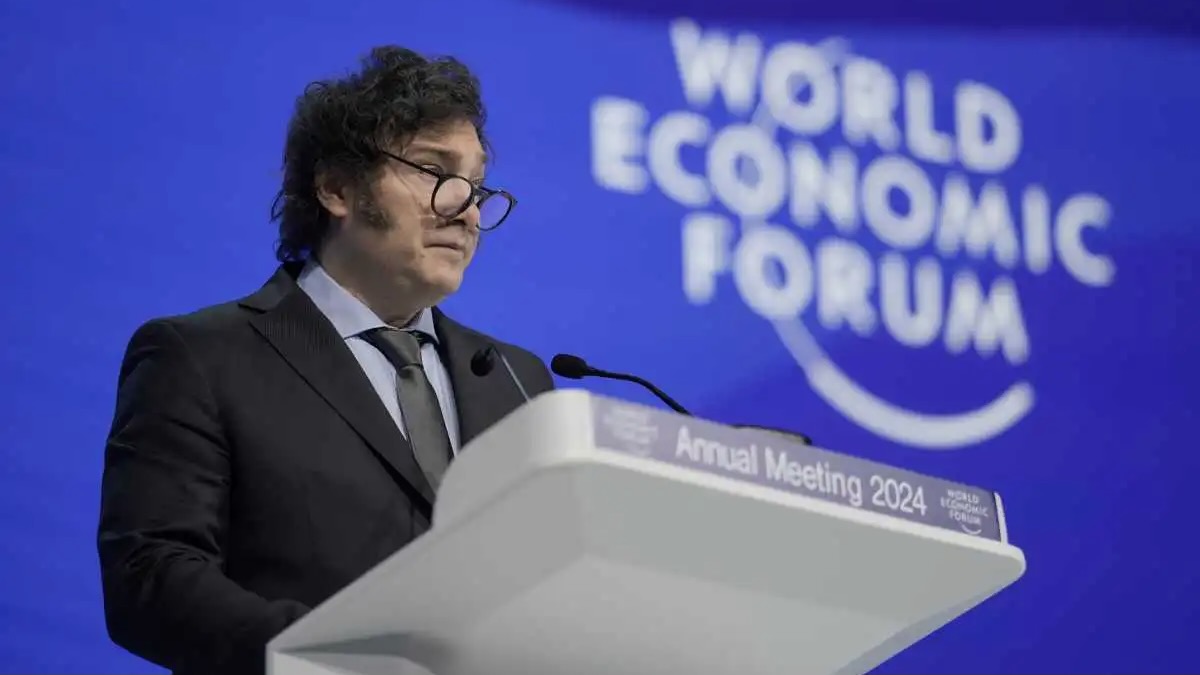
On the morning of January 17, Argentine President Javier Milei gave his first speech at the World Economic Forum in Davos, Switzerland. The far-right libertarian was sworn in on December 10, 2023 and since then has launched all-out attacks on the working class through presidential decrees and omnibus laws, all of which have been vehemently opposed on the streets.

Milei began his speech at Davos by telling those present: “I am here to tell you that the West is in danger. All over the world, leaders who must defend the values of capitalism assume a vision that leads to socialism and poverty. “The main leaders of the world have abandoned freedom for so-called collectivism, which is the cause of the problems.”

The strongest argument of his speech was going to be that capitalism is the only tool to end hunger and poverty in the world, although he added: “the leftist thinking attacks capitalism for being, according to them, unjust. They say it is bad because it is individualistic and they fight for social justice. This concept has become fashionable around the world, but social justice is an unfair, violent idea, because taxes are coercively collected. Nobody pays taxes voluntarily. The State is financed through coercion. If a company generates a good product it will do well, if the State punishes the capitalist for being successful it destroys their incentives, and the cake will be smaller. Collectivism ties the entrepreneur’s hands.”

He also spoke of enemies, who for him are those who use the State as a tool: “everyone. There are no substantive differences. Socialists, conservatives, communists, fascists, Nazis, social democrats, centrists. They are all the same.”

In this same sense, Milei attacked two of the most important agendas at the Davos Forum, gender inequality and climate change: “The first of these new battles was the ridiculous and unnatural fight between men and women. Libertarianism already establishes equality between the sexes. The founding stone of our creed says that all men are created equal, that we all have the same inalienable rights granted by the creator, among which are life, liberty and property,” he maintained.

He went further and said: “the only thing that became of this agenda of radical feminism is greater intervention by the state to hinder the economic process, giving work to bureaucrats who do not contribute anything to society, be it in the format of women’s ministries or international organizations dedicated to promoting this agenda.”

In the same sense, he denied human responsibility for climate change: “another one of the conflicts that socialists raise is that of man against nature. They maintain that human beings damage the planet and that it must be protected at all costs, even going so far as to advocate for population control mechanisms or the bloody agenda of abortion.”

Finally, the only praise in Javier Milei’s speech was for the businessmen, whom he treated as heroes and also told them: “do not let yourself be intimidated by the political caste that wants to remain in power. You are heroes, you are benefactors, let no one tell you that your ambition is immoral, do not give in to the advance of the State, The state is the problem itself, you are the protagonists of history. Long live fucking freedom!

The president returned to Argentina on Wednesday on a commercial flight, after a couple of meetings and a bold speech that was not very widely accepted in Davos. He will face a massive national strike on January 24, called for by all the major trade unions and confederations in Argentina in opposition to his pro-capitalist, pro-businessman policies.

This article was first published in Spanish on ARG Medios.

Original article by ARG Medios at peoples dispatch republished under a Creative Commons Attribution-ShareAlike 4.0 (CC BY-SA) license.
Continue ReadingArgentina’s far-right libertarian president warns in Davos, “the West is in danger”

Argentine courts grant union’s request and suspend Milei’s labor reform

Spread the love

Original article by Brasil de Fato republished from peoples dispatch under a Creative Commons Attribution-ShareAlike 4.0 (CC BY-SA) license.

The measures are part of a “decree” announced by the far-right president in December

Labor reform is one of the points of Milei’s decree (Photo: Mídia NINJA)

The Argentine judiciary has granted a request from the National Confederation of Labor (CGT), the country’s main trade union center, and suspended the effects of the labor reform provided for in the “decree” launched by the government of ultra-right Javier Milei last December. The court decision published on January 3 is a precautionary one, i.e. it suspends the measure.

The decision was taken by the National Chamber of Labor Appeals, the first instance in the Argentine judiciary for appeals on labor issues. The court argued that there was no proven need or urgency to make the decision without consulting the Argentine Congress, which is responsible for legislation.

The “decretazo” is formally called the Decree of Necessity and Urgency (DNU), and is provided for in the Argentine Constitution. However, the executive branch can only issue this type of decree when there are exceptional circumstances and it is not possible to wait for Congress to meet.

Among other measures, the Milei government’s labor reform extends the probationary period for new employees from three to eight months (thus increasing the period in which employers can fire new workers without paying severance pay).

It also authorized the dismissal of workers who take part in picket lines or occupy workplaces during stoppages or strikes, as well as changes to overtime compensation systems.

According to Argentine newspaper La Nación, Wednesday’s court decision came as a surprise to the government. Clarín, another daily in the country, said that the government will appeal to higher courts to overturn the injunction issued by the Labor Appeals Chamber.

This article was translated from an article originally published in Portuguese on Brasil De Fato.

Original article by Brasil de Fato republished from peoples dispatch under a Creative Commons Attribution-ShareAlike 4.0 (CC BY-SA) license.
Continue ReadingArgentine courts grant union’s request and suspend Milei’s labor reform

China cancels line of credit, pulling the plug on Argentina’s ‘anarcho-capitalist’ president

Spread the love

Original article by JAMES MEADWAY republished from People’s World under http://creativecommons.org/licenses/by-nc-nd/3.0/us/.

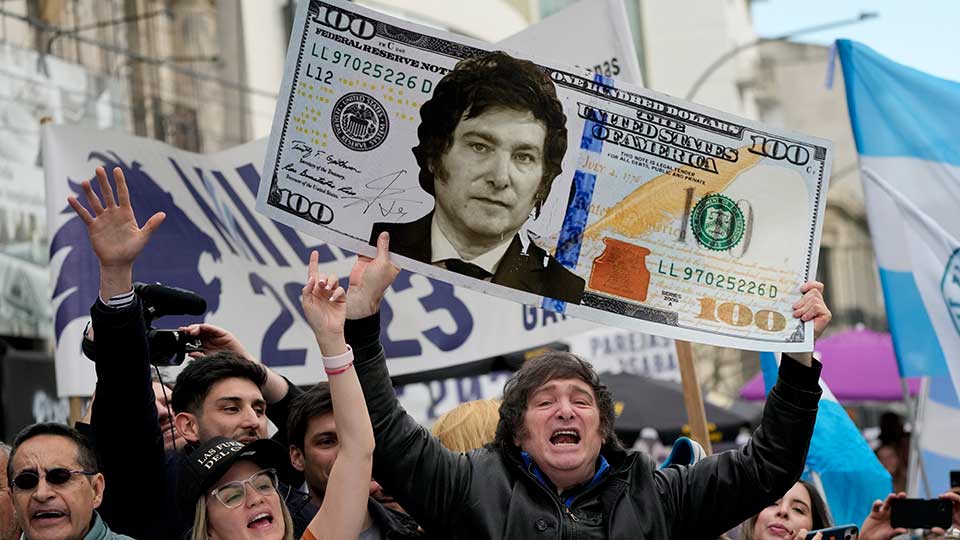
Dollarization: Javier Milei holds up a giant cardboard sign depicting a U.S. $100 banknote emblazoned with an image of his face during a rally in La Plata, Sept. 12, 2023. Milei wants to replace the peso with the U.S. dollar as Argentina’s currency and says that the country’s Central Bank should be abolished. He’s got a new financial challenge, though: China just cut his line of credit. | Natacha Pisarenko / AP

The Chinese government may have pulled the plug on far-right “anarcho-capitalist” President of Argentina Javier Milei, just weeks after his shock election win.

In a spectacular demonstration of how the lines of geopolitical power are shifting, the People’s Bank of China has withdrawn its “swapline” to the Argentinian central bank, depriving it of a vital source of cheap funding.

This leaves debt-ridden Argentina without ready access to funding to meet its promises to pay creditors. These international creditors include the IMF, to whom Argentina owes a world-record $43 billion. China provided the Argentinian government with funds for its $2.7 billion IMF repayment over the summer, lending it ultra-cheap foreign currency through its swapline arrangement.

Milei, a fanatical free marketeer, was elected with 55% of the vote in November from a population desperate for a break with the failed political Establishment. Developing his public profile through TV appearances and his 1.4 million followers on TikTok, Milei was able to present his program of ferocious spending cuts and the abolition of the Argentinian currency, the peso, as the bitter medicine the country needed to end its economic crisis. Younger voters, in particular, flocked to him in droves.

This was a product of desperation. Two-fifths of Argentinians live below the poverty line, and close to 60% of children. Inflation was over 140% when the election campaign ended, meaning prices doubling roughly every six months.

Since the government defaulted—halted payments—on its debts at the end of 2001, the two decades since have seen governments both pro and anti-neoliberal attempts to negotiate agreements with Argentina’s creditors and break the cycle of crises.

The latest round of these was a colossal 2018 loan from the IMF, attached to conditions on cutting government spending over the following three years.

But what tipped the country over the edge into its latest round of crisis has been the catastrophic drought that began in 2019. This ongoing drought is the worst for over 60 years, hammering farmers and severely cutting harvests—soybean production fell to its lowest level for a century.

For a country dependent on agricultural exports for foreign exchange earnings, it has been a disaster. Its trade deficit ballooned, taxes fell and government spending mushroomed. Government borrowing swelled and the Argentina central bank resorted to issuing more money to cover spending costs. Climate change almost certainly worsened the drought.

Milei’s program offered nothing on this—he is a climate change denier, claiming that those who “blame the human race” for climate change are “fake…only looking to raise funds for socialist bums who write for fourth-rate newspapers.”

The colorful language is very much part of his appeal, along with waving a chainsaw at his public appearances, to symbolize what he planned for government spending, and smashing a piñata of the central bank on live TV.

But cartoonish posing shouldn’t kid us: Milei’s program is neoliberalism on steroids. He campaigned on a promise to cut government spending by 15% of Argentina’s GDP.

His plan to abolish the peso and “dollarize” the economy was arguably even more radical, claiming this would prevent Argentinian bureaucrats and politicians from printing money. Although two other Latin American countries, Ecuador and Panama, use the dollar as their official currency, neither is the size of Argentina, the continent’s second-largest economy.

And while many Argentinians already use the dollar, with $246 billion in dollar savings, the government has no dollars to hand, and would have to either buy them to replace pesos, or perhaps seize them from those mostly middle-class savings.

The plan is a non-starter. Confronted with the economic realities, Milei has rapidly defaulted to conservative type, appointing a former president of the central bank, Luis Caputo, as his economy minister, and appointing a close associate of Caputo as the new central bank head. So much for “burning it down.”

The ferocious spending cuts are still planned, along with a 54% devaluation of the peso as part of a program approved by the IMF.

Far from a radical break, Milei is a stooge for the maintenance of Argentina’s failed elite—including even the rehabilitation of the dictatorship, with his running mate for Vice President, Victoria Villaruel, claiming the figure of 30,000 “disappearances” under the regime is a “myth.”

This is a familiar pattern. Across the world, supposed populists from the radical right have taken power, often with the promise of taking on corrupt local elites. They don’t follow through.

Italy’s radical right government, for example, in August threatened a windfall tax on banks that were profiteering from interest rate rises. But they rapidly backed down after howls of protests from the banks themselves.

Milei has almost certainly bitten off more than he can chew. Expecting protests, harsh new guidelines for police and military, including the criminalization of the parents of younger protests have been rushed through—“prison or bullet,” as one pro-government MP described them. Inflation has accelerated, to 3,678% a year, which the government are now using to justify their “shock therapy.”

However, it is anti-China posturing that could prove his undoing. China is Argentina’s second-biggest market for exports, and loans from China make up over 42 per cent of Argentina’s foreign exchange reserves.

Yet Milei called China an “assassin” during his election campaign, promising to sever ties and instead reorienting Argentina towards full-throated support for Israel and the U.S. Argentina’s foreign minister has confirmed that the country would not be joining the China-led BRICS coalition, as pledged by the last government.

This was treated as a “slap in the face” by China: Cutting loan support to Argentina is the inevitable response. As Milei himself might put it: Fuck around and find out.

Morning Star

Original article by JAMES MEADWAY republished from People’s World under http://creativecommons.org/licenses/by-nc-nd/3.0/us/.

Continue ReadingChina cancels line of credit, pulling the plug on Argentina’s ‘anarcho-capitalist’ president

Milei Couples ‘Total Crackdown’ on Protest With Economic Shocks in Argentina

Spread the love

Original article by Julia Conley at Common Dreams shared under Creative Commons (CC BY-NC-ND 3.0).

Argentinian President Javier Milei looks on after the polls close in the presidential runoff election on November 19, 2023 in Buenos Aires, Argentina. (Photo: Tomas Cuesta/Getty Images)

“Protest is elemental to Argentine social and political life, so it’s not difficult to imagine how this ends,” said one journalist.

As the human impact of Argentinian President Javier Milei’s “shock treatment” to the South American country’s economy became increasingly clear with rising prices on Thursday, Security Minister Patricia Bullrich announced what one journalist said were doubtlessly “preemptive” new controls on protests to discourage a struggling population from speaking out.

Bullrich said four security forces—the Federal Police, the Gendarmerie, the Naval Prefecture, and the Airport Security Police—will work together to stop protests that block streets and suggested the protocol is aimed only at ensuring “that people can live in peace” without demonstrators blocking traffic.

But as Progressive International co-general coordinator David Adler and others noted, the measures also include calls for armed forces to break labor strikes, create a national registry of people who organize protests, and sanctions against parents who bring their children to demonstrations.

The new package amounts to “a total crackdown on Argentine civil society,” Adler said.

https://twitter.com/davidrkadler/status/1735666098127733129?ref_src=twsrc%5Etfw%7Ctwcamp%5Etweetembed%7Ctwterm%5E1735666098127733129%7Ctwgr%5Edc4c076d58c4fd3232ae472103691fce93a38f1a%7Ctwcon%5Es1_c10&ref_url=https%3A%2F%2Fwww.commondreams.org%2Fnews%2Fmilei

Bullrich’s announcement came days after Milei, a far-right libertarian economist who has called the climate crisis “a socialist lie” and has been compared to former U.S. President Donald Trump, announced in the first weeks of his presidency an economic “shock treatment” package including a devaluation of the peso by 50%, from 400 pesos to the U.S. dollar to 820 pesos.

The administration also said it would cut public spending by closing some government ministries, increasing retirements ordered by decree, reducing energy and transportation subsidies, and freezing public works, with further “profound” measures expected in the future.

Milei claimed that with the spending cuts, government revenues will ultimately increase by 2.2 points, helping to confront an economic crisis in which annual inflation exceeds 160%, the country has a trade deficit of $43 billion, and $45 billion is owed to the International Monetary Fund (IMF).

But as Milei’s “open heart surgery of the economy,” as El País called the package, took hold, prices of some goods and services rose by 100% and some commuters worried that they will no longer to be able to afford their daily commutes it transit agencies are forced to raise prices due to lost subsidies.

“If [the bus fare] goes up, my salary will be spent on transport,” Julia González, who takes three buses and a train to her job in downtown Buenos Aires, toldThe Associated Press.

About 40% of Argentinians live below the poverty line and more than 9% are destitute, reported El País, with incomes insufficient to buy food.

Economist Juan Manuel Telechea told the outlet that monthly inflation could reach 30-40% due to the devaluation and that social aid will be “highly insufficient.”

Presidential spokesperson Manuel Adorni said of the economy Wednesday that Milei “found a patient in intensive care about to die,” but one trade unionist told El País the president is “exaggerating the inherited crisis situation to justify inadmissible measures, which will increase poverty levels in Argentina above 50% in a matter of days.”

“The mega-devaluation that is being carried out is a matter of concern because it may devolve into hyperinflation,” Pato Laterra, an economist at the National University of La Plata, told the newspaper.

Mark Weisbrot, co-director of the Center for Economic and Policy Research, said last month that Argentina’s current economic crisis is the result of right-wing former President Mauricio Macri’s administration, which took out the largest loan ever from the IMF and pushed the economy into a recession, with poverty and inflation rising by 50% or more.

“But a crazed, economically suicidal approach would only make things worse—and as Argentina has experienced, things can get a lot worse,” said Weisbrot. “Milei displays a callous disregard for most people’s living standards, values, and well-being, as well as a commitment to widely discredited economic policies, that is unprecedented.”

Jacob Sugarman of the Buenos Aires Heraldsaid Wednesday that it remains to be seen “how long Argentine society is willing to tolerate this kind of pain” and suggested that Bullrich’s announcement of a crackdown on dissent is likely to further anger the public.

“Protest is elemental to Argentine social and political life, so it’s not difficult to imagine how this ends,” said Sugarman, “especially with Bullrich announcing that the government will use federal forces including the National Military Police to break picket lines.”

Original article by Julia Conley at Common Dreams shared under Creative Commons (CC BY-NC-ND 3.0).

Continue ReadingMilei Couples ‘Total Crackdown’ on Protest With Economic Shocks in Argentina

The Atlas Network and the Building of Argentina’s Donald Trump

Spread the love

Original article by Lucas Araldi republished from DeSmog

Javier Milei, a climate change denier widely supported by Atlas Network, a web of free market think tanks, won the necessary votes to run in Argentina’s presidential election in October.

ANALYSIS By Lucas Araldi on Aug 22, 2023 @ 15:15 PDT

Argentine presidential candidate Javier Milei haș been influenced, and boosted, by the Atlas Network. Credit: Todo Noticias (CC BY 3.0)

Ask Argentine politician, economist, and presidential candidate Javier Milei what he thinks of climate change, and he might tell you that it’s “another lie of socialism” and “part of the agenda of Cultural Marxism.” 

The right-wing politician is part of coalition Libertad Avanza and this August won the most votes in Argentina’s primary election, enabling him to run for president on October 23. 

He gained prominence through his talk show appearances, making his debut on the political talk show Animales Sueltos (Stray Animals) in 2016. In addition, he hosted his own radio program called Demoliendo Mitos (Debunking Myths).

In 2021, Milei was elected as a national deputy for Buenos Aires. Prior to this, he had built an extensive career in both the public and private sectors as an economist, even holding the position of Chief Economist at HSBC.

Milei has been compared to right-wing populist leaders Donald Trump and Jair Bolsonaro due to his direct and aggressive way of speaking and his radical proposals. Milei would likely be flattered by the comparison — he is a huge fan of these right-wing populists that have emerged in recent years.

Milei won 30 percent of the vote in the August primary — nearly 10 percent more than the next-most-popular candidate — with a political platform that combines radical neoliberal policy proposals with a conservative populist moral agenda. His economic proposals include reducing the number of government ministries, cutting public spending, dollarizing the economy, and “exploding” the Central Bank, in Milei’s own words. 

Milei didn’t arrive at these proposals on his own; his views, particularly in regards to the economy, have been shaped by the Atlas Network, a U.S. nonprofit that works to spread free-market think tanks all over the world. 

Based in Washington, D.C., the Atlas Network supports more than 500 free-market organizations. Some of these groups, such as the Heartland Institute, are also involved in climate science denial and in campaigns against legislation to limit greenhouse gas emissions.

Around 100 think tanks in Latin America — 10 of which are in Argentina — are part of Atlas’s web. Between 2010 and 2021, Atlas gave approximately $12 million USD to think tanks in the region, mostly for “economic education,” according to U.S. tax filings analyzed by DeSmog. Across the world, including in Latin America, Atlas think tanks collaborate beyond national borders, sharing strategies and ideology. It is common, for example, for Atlas think tanks to share board members or even create their own networks, such as Red Liberal de America Latina (RELIAL).

Alberto Benegas Lynch, who serves as an adviser for Milei and also is a director at Mont Pelerin Society, is an example of transnational ties within the network. He is part of several Atlas Network groups in Latin America, such as Fundación Federalismo y Libertad and Instituto Libertad y Progreso, both in Argentina, Universidad Francisco Marroquín in Guatemala, and Centro de Estudios para el Desarrollo in Uruguay.  

Lynch is also known for making denialist statements about climate change. In an opinion article published in 2018 in the Argentinian online newspaper Infobae, for example, he argued that climate change is a fraud based on distortion of statistics. He built his argument from alleged studies of John ColemanIvar Giaever, and Patrick Moore

The Argentine newspaper La Nación describes the relationship between Milei and Lynch as one of admiration, as Milei frequently cites Lynch. Beyond that, Lynch wrote several times on the Instituto Libertad y Progreso’s website about his relationship with Milei, as well as his proposals, and how Milei means a miracle for Argentine politics.

Milei benefits from the whole infrastructure of ideas boosted by the Atlas Network to project himself as presidential. While the other traditional candidates do not have a platform of think tanks that can help them, Milei manages to move between these institutes and use them as hubs for disseminating his ideas and as a safe arena for advancing the debate on his agenda.

For instance, Milei has connections to other Latin American think tanks in the Atlas Network. He has attended conferences and participated in events promoted by the Fundación Libertad y ProgresoFederalismo y Libertad, and Fundación Atlas, all based in Argentina. He also participated in Instituto de Estudos Empresariais’s Liberty Forum 2022 in Porto Alegre, Brazil. Articles in Fundación Atlas’s blog praise him, with Axel Kaiser, executive director at Fundación para El Progreso in Chile, writing that Milei is helping restore Argentina’s Libertarian legacy by setting up a “cultural and political movement which became the third way.” In 2018, Fundación Atlas awarded Milei the Liberty Prize.

Milei sat on the advisory board of Fundación Libre (FL), an Argentine far-right think tank that was part of Atlas. FL promoted “individual freedom and republicanism” in the face of “hegemonic progressive ideology and the empire of politically correctness.” Although FL did not focus primarily on denying climate change, it did feature climate-related content, like a YouTube video criticizing Greta Thunberg, that has since been removed. 

Milei, however, is known for denying climate change, claiming that the planet’s temperature is currently at its lowest level in the past 15,000 years. His source for this belief is a graph from a 2008 study by the geologist Don J. Easterbrook — who is known for erroneously predicting “global cooling.” However, this graph is based on data only from Greenland and is not a reliable indicator of climate change, according to fact-checking groups in Argentina.

Although Milei uses climate denialism to ignite his followers, climate change was barely discussed in the Argentine primaries, even though the occurrence of extreme weather events has increased twofold since 1980 and could become even worse in the coming decades. Instead, candidates focused on the country’s current food crisis: Argentina faces one of the biggest food inflations in the world and more than 4 million people in the country are food insecure. This scenario also could become worse due to climate change’s impacts on Argentine agriculture. 

Milei’s significant result at the polls shows that the free-market, neoliberal ideals the Atlas Network is promoting have a huge organizational strength in Argentina that can be converted into votes. Even if Milei doesn’t win the October presidential election, his rise to this level of politics means a victory for the Atlas Network.

Original article by Lucas Araldi republished from DeSmog

Continue ReadingThe Atlas Network and the Building of Argentina’s Donald Trump