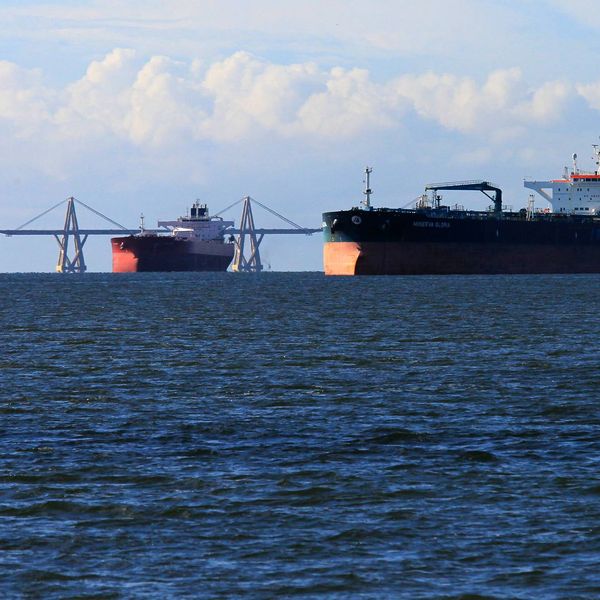
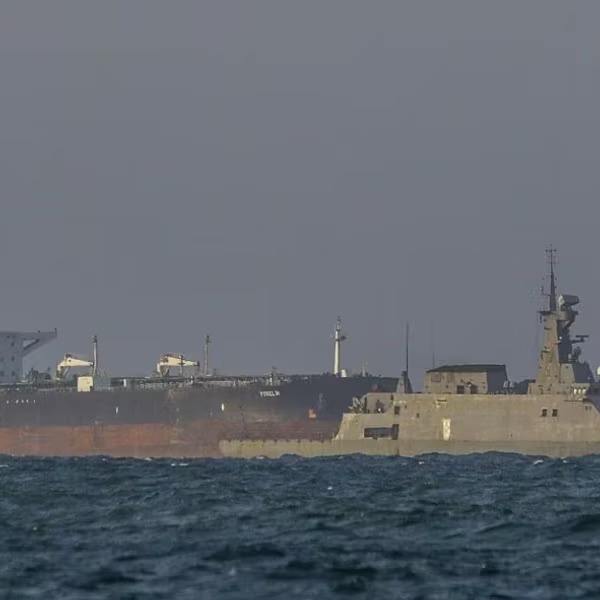
A woman watches a public television broadcast by Venezuelan Defense Minister Vladimir Padrino in Caracas, Venezuela on January 03, 2026. (Photo by Boris Vergara/Anadolu via Getty Images)
“It is brutal imperialist aggression,” said former Bolivian President Evo Morales.
The Trump administration’s military assault on Venezuela and apparent abduction of the country’s president in the early hours of Saturday morning sparked immediate backlash from leaders in Latin America and across the globe, with lawmakers, activists, and experts accusing the US of launching yet another illegal war of aggression.
Latin American leaders portrayed the assault as a continuation of the long, bloody history of US intervention in the region, which has included vicious military coups and material support for genocidal right-wing forces.
“This is state terrorism against the brave Venezuelan people and against Our America,” Cuban President Miguel Diaz-Canel wrote in a social media post, demanding urgent action from the international community in response to the “criminal attack.”
Evo Morales, the leftist former president of Bolivia, said that “we strongly and unequivocally repudiate” the US attack on Venezuela.
“It is brutal imperialist aggression that violates its sovereignty,” Morales added. “All our solidarity with the Venezuelan people in resistance.”
Colombian President Gustavo Petro, one of the first world leaders to respond to Saturday’s developments, decried US “aggression against the sovereignty of Venezuela and of Latin America.” Petro said Colombian forces “are being deployed” to the nation’s border with Venezuela and that “all available support forces will be deployed in the event of a massive influx of refugees.”
“Without sovereignty, there is no nation,” said Petro. “Peace is the way, and dialogue between peoples is fundamental for national unity. Dialogue and more dialogue is our proposal.”
The presidents of Chile and Mexico similarly condemned the assault as a violation of Venezuela’s sovereignty and international law.
“Based on its foreign policy principles and pacifist vocation, Mexico urgently calls for respect for international law, as well as the principles and purposes of the UN Charter, and to cease any act of aggression against the Venezuelan government and people,” the Mexican government said in a statement. “Latin America and the Caribbean is a zone of peace, built on mutual respect, the peaceful settlement of disputes, and the prohibition of the use and threat of force, and therefore any military action puts regional stability at serious risk.”
One Latin American leader, far-right Argentine president and Trump ally Javier Milei, openly celebrated the alleged US capture of Venezuelan President Nicolás Maduro, declaring on social media, “FREEDOM ADVANCES.”
Leaders and lawmakers in Europe also reacted to the US bombings. Pedro Sánchez, the prime minister of Spain, issued a cautious statement calling for “deescalation and responsibility.”
British MP Zarah Sultana was far more forceful, writing on social media that “Venezuela has the world’s largest oil reserves—and that’s no coincidence.”
“This is naked US imperialism: an illegal assault on Caracas aimed at overthrowing a sovereign government and plundering its resources,” Sultana added.
This story has been updated to include statements from the presidents of Chile and Mexico.
Donald Fuhrump says that Amerikkka doesn’t bother with crimes or charges anymore, not being 100% Amerikkkan and opposing his real estate intentions is enough.Orcas discuss Donald Trump and the killer apes’ concept of democracy. Front Orca warns that Trump is crashing his country’s economy and that everything he does he does for the fantastically wealthy.
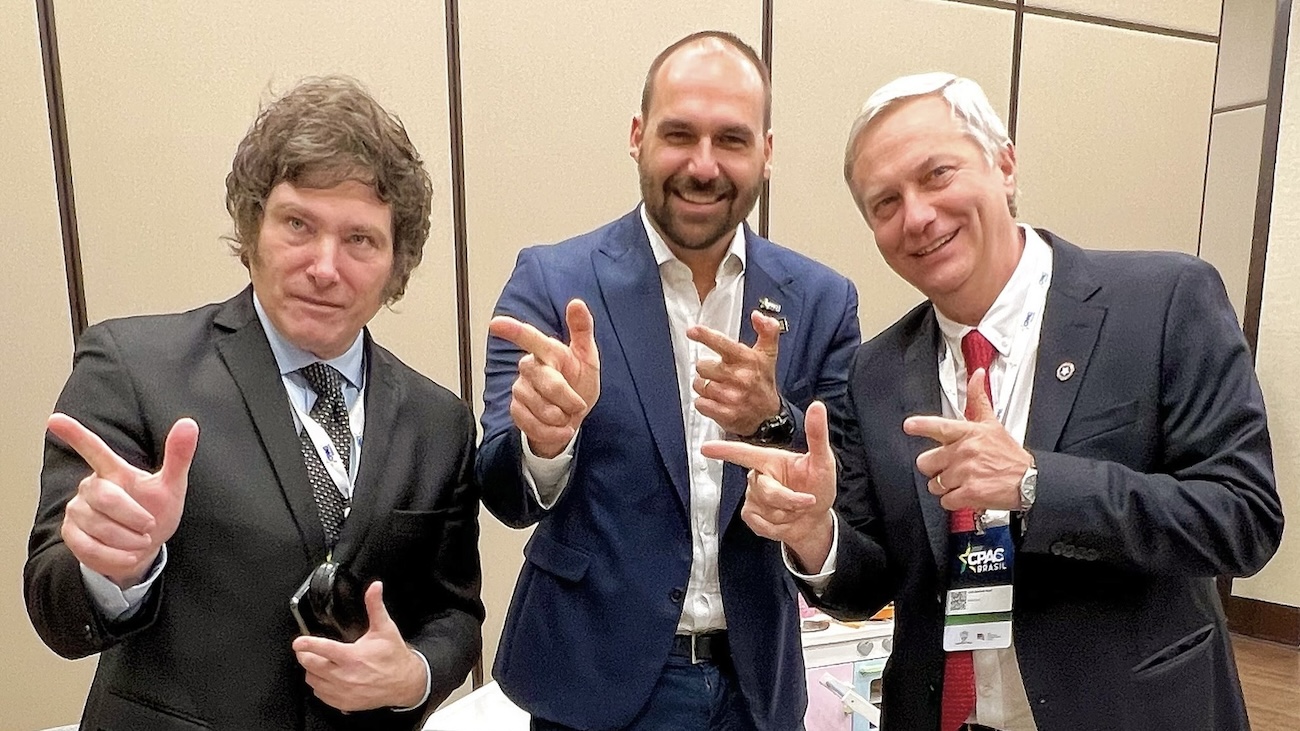
Argentine President Javier Milei, Brazilian legislator Eduardo Bolsonaro, and Chilean far-right presidential candidate José Antonio Kast at CPAC Conference in 2022. Photo: Eduardo Bolsonaro / X
The far right in Latin America is angry. Brazil’s Jair Bolsonaro and Argentina’s Javier Milei always look furious, and they always speak loudly and aggressively. Testosterone leaks from their pores, a toxic sweat that has spread across the region. It would be easy to say that this is the impact of Donald Trump’s own brand of neo-fascism, but this is not true. The far right has much deeper pedigrees, linked to the defense of the oligarchical families that have roots in the colonial era across the virreinatos (viceroyalties) from New Spain to Rio de la Plata. Certainly, these far right men and women are inspired by Trump’s aggressiveness and by the entry of Marco Rubio, a furious defender of the far right in Latin America, to the position of US Secretary of State. This inspiration and support are important but not the reason for the return of the far right, an angry tide that has been growing across Latin America.
On the surface, it looks as if the far right has suffered some defeats. Jair Bolsonaro is in prison for a very long time because of his role in the failed coup d’état on January 8, 2023 (inspired by Trump’s own failed coup attempt on January 6, 2021). In the first round of the presidential election in Chile, the candidate of the Communist Party, Jeannette Jara won the most votes and will lead the center-left bloc into the second round (December 14). Despite every attempt to overthrow the government of Venezuela, President Nicolás Maduro remains in charge and has mobilized large sections of the population to defend the Bolivarian Revolution against any threats. And, in late October 2025, most of the world’s countries voted for a UN General Assembly resolution that demands an end to the blockade on Cuba. These indicators – from Bolsonaro’s imprisonment to the vote on Cuba – suggest that the far right has not been able to move its agenda in every place and through every channel.
However, beneath the surface, there are indications that Latin America is not seeing the resurgence of what had been called the Pink Tide (after the election of Hugo Chávez in Venezuela in 1998) but is experiencing the emergence of an angry tide that slowly has begun to sweep the region from Central America down to the Southern Cone.
Elections in South America
The first round of the Chilean presidential election produced a worrying result. While Jara of the Communist Party won 26.85% of an 85.26% turnout, the far right’s José Antonio Kast came in second with 23.92%. Evelyn Matthei of the traditional Right won 12.5%, while the extreme right candidate who was once with Kast and now to his right, Johannes Kaiser, won 14%. It is likely that Jara will pick up some of the votes of the center, but not enough to overcome the advantage of the far right which looks to have at least more than 50% of the voters on its side. The so-called social liberal, Franco Parisi, who came in third, endorsed Kast in 2021 and will likely endorse him again. That means that in Chile, the presidency will be in the hands of a man of the far right whose ancestry is rooted in German Nazism (Kast’s father was a member of the Nazi Party who escaped justice through the intercession of the Vatican) and who believes that the dictatorship in Chile from 1973 to 1990 was on balance a good idea.
North of Chile, in Bolivia, the new president Rodrigo Paz Pereria, son of a former president, beat the far right’s Jorge Tuto Quiroga (a former president) in the second round of the election. This round had no candidate of the left, after the Movement for Socialism governed Bolivia continuously from 2006 to 2025. Paz’s own party has a minority position in the legislature and he will therefore have to align himself with the Quiroga’s Libre coalition and he will likely adopt a pro-US foreign policy and a libertarian economic policy. Peru will have its own election in April, where the former mayor of Lima – Rafael López Aliaga – is expected to win. He rejects the label far right but adopts all the generic policies of the far right (ultra-conservative Catholic, advocate for harsh security measures, and favors a libertarian economic agenda). Iván Cepeda of Colombia is the left’s likely candidate in their presidential election in May 2026, since Colombia does not permit second terms (so President Gustavo Petro cannot run again). Cepeda will face strong opposition from Colombia’s oligarchy which will want to return the country to their rule. It is too early to say who Cepeda will face, but it might be journalist Vicky Dávila, whose far right opposition to Petro is finding traction in unexpected parts of Colombian society. It is likely that by the middle of 2026, most of the states along the western edge of South America (from Chile to Colombia) will be governed by the far right.
Even as Bolsonaro is in prison, his party, the PL (or Liberal Party), is the largest bloc in Brazil’s National Congress. It is likely that Lula will be re-elected to the presidency next year due to his immense personal connection with the electorate. The far right’s candidate – who could be possibly Tarcísio de Freitas, the governor of São Paulo state, or one of the Bolsonaro’s (wife Michelle or son Flavio) – will struggle against him. But the PL will make inroads into the Senate. Their control over the legislature has already tightened the reins on the government (at COP30, Lula’s representative made no proposals to confront the climate catastrophe), and a Senate win will further their control over the country.
Common agenda of the angry tide
The Angry Tide politicians who are making waves have many things in common. Most of them are now in their fifties – Kast (born 1966), Paz (born 1967), Venezuelan politician María Corina Machado (born 1967), and Milei (born 1970). They came of age in the post-dictatorship period in Latin America (the last dictatorship to end was in Chile in 1990). The decade of the 1990s continued the economic stagnation that characterized the 1980s: the Lost Decade (La Década Perdida) that convulsed these countries with low growth rates and with poorly developed comparative advantages forced into globalization. It was in this context that these politicians of the Angry Tide developed their common agenda:
Anti-Communism. The far right in Latin America is shaped by an anti-left agenda that it inherits from the Cold War, which means that its political formations typically endorse the era of US-backed military dictatorships. The ideas of the left, whether from the Cuban Revolution (1959) or from the era of the Pink Tide (after 1998), are anathema to these political forces; these ideas include agrarian reform, state-led finance for industrialization, state sovereignty, and the importance of trade unions for all workers and peasants. The anti-communism of this Angry Tide is rudimentary, mother’s milk to the politicians and used cleverly to turn sections of society against others.
Libertarian Economic policies. The economic ideas of the Angry Tide are shaped by the Chilean “Chicago Boys” (including Kast’s brother Miguel who was the head of General Augusto Pinochet’s Planning Commission, his Minister of Labor, and his head of the Central Bank). They directly take their tradition from the libertarian Austrian School (Friedrich Hayek, Ludwig von Mises, and Murray Rothbard as well as Milton Friedman). The ideas were cultivated in well-funded think tanks, such as the Centro de Estudios Macroeconómicos de Argentina (founded in 1978) and the Chilean Centro de Estudios Públicos (founded in 1980). They believe the State should be a force to discipline the workers and citizens, and that the economy must be in the hands of private interests. Milei’s famous antics with a chainsaw illuminate this politics not only of cutting social welfare (the work of neoliberalism) but of destroying the capacity of the State itself.
Culture Wars. Drawing on the wave of anti-gender ideology and anti-migration rhetoric, the Angry Tide has been able to appeal to conservative evangelical Christians and to large sections of the working class that has been disoriented by changes seen to come from above. The far right argues that the violence in working class neighborhoods created by the drug industry is fostered by “liberalism” and that only tough violence (as demonstrated by El Salvador’s president Nayib Bukele) can be the solution; for this reason, they want to strengthen the military and police and set aside constitutional limitations on use of force (on October 28, the government of Bolsonaro ally Cláudio Castro in Rio de Janeiro sent in the police who killed at least 121 people in Operation Containment). It helps the far right that it adopted various conspiracy theories about how the “elites” have spread “globalized” ideas to damage and destroy the “culture” of their nations. This is a ludicrous idea coming from far right and traditional right political forces that champion full-scale entry of US corporations into their society and culture, and that have no respect for the histories of struggle of the working class and peasantry to build their own national and regional cultural worlds. But the Angry Tide has been able to construct the idea that they are cultural warriors out to defend their heritage against the malignancies of “globalization”. Part of this culture war is the promotion of the individual entrepreneur as the subject of history and the denigration of the necessity of social reproduction.
It is these three elements (anti-communism, libertarian economic policies, and the culture wars) that brings together the far right across Latin America. It provides them with a robust ideological framework to galvanize sections of the population to believe that they are the saviours of the hemisphere. This Latin American far right is backed by Trump and the international network of the Spanish far right (the Foro Madrid, created in 2020 by Fundación Disenso, the think tank of the far right Vox party). It is heavily funded by the old elite social classes, who have slowly abandoned the traditional Right for these new, aggressive far right parties.
Crisis of the Left
The Left is yet to develop a proper assessment of the emergence of these parties and has not been able to drive an agenda that sparkles with vitality. A deep ideological crisis grips the Left, which cannot properly decide whether to build a united front with the traditional right and with liberals to contest elections or to build a popular front across the working class and peasantry to build social power as a prelude to a proper electoral push. The example of the former strategy (the electoral alliance) comes from Chile, where first the Concertación de Partidos por la Democracia (Concertación) formed in 1988 to keep out the parties of the dictatorship from power and second the Apruebo Dignidad formed in 2021 that brought Gabriel Boric of the centrist Broad Front to the presidency. But outside Chile, there is little evidence that this strategy works. The latter has become harder as unionization rates have collapsed, and as uberization individualizes the working class to erode working class culture.
It is telling that Bolivia’s former socialist Vice President Álvaro García Linera looked northwards to New York City for inspiration. When Zohran Mamdani won the mayor’s race, García Linera said, “Mamdani’s victory shows that the left must commit to boldness and a new future.” It is hard to disagree with this statement; although, Mamdani’s own proposed agenda is mostly to salvage a worn-out New York infrastructure rather than to advance the city to socialism. García Linera did not mention his own time in Bolivia, when he tried with former president Evo Morales to build a socialist alternative. The left will have to be bold, and it will have to articulate a new future, but it will have to be one that emerges from its own histories of building struggles and building socialism.
Donald Fuhrump says that Amerikkka doesn’t bother with crimes or charges anymore, not being 100% Amerikkkan and opposing his real estate intentions is enough.
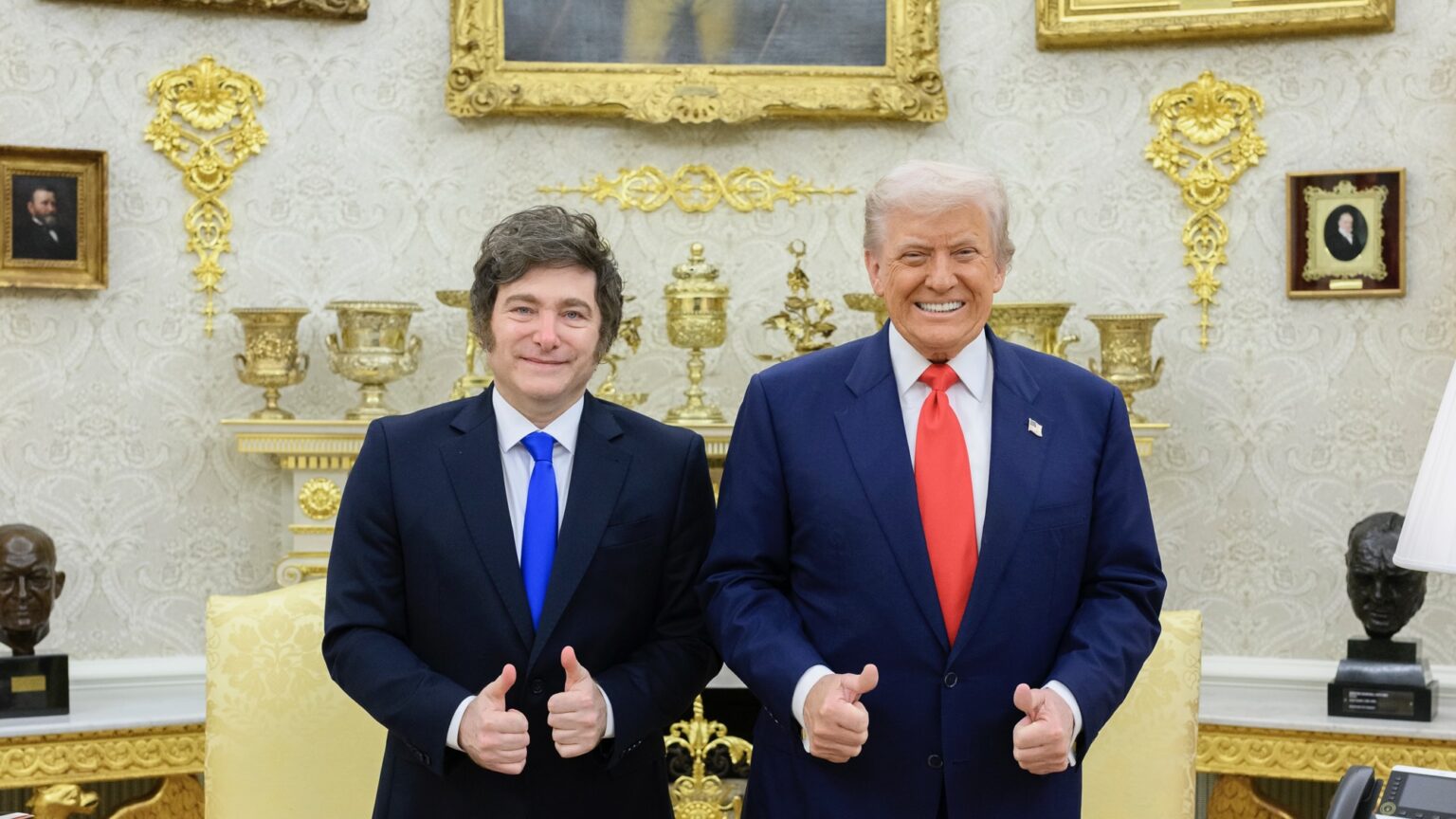
President Donald J. Trump and President of Argentina Javier Milei at the White House on Oct 14. Photo: White House
The Milei-Trump meeting secured a USD 20 billion financial bailout for Argentina’s unstable economy. Trump made future aid conditional on Milei winning the upcoming elections.
On October 14, Argentina’s right-wing president, Javier Milei, met with his US counterpart, Donald Trump in Washington. Milei, who arrived in the US capital in the early hours of the morning, hoped to secure a strategic financial bailout of almost USD 20 billion that Trump would sponsor to stabilize the economy, which has been struggling under Argentina’s libertarian government.
Traveling alongside Milei were Karina Milei, the president’s sister and secretary general of the presidency; Patricia Bullrich, minister of security; and Santiago Bausili, head of the Central Bank. Among the topics discussed were the trade relationship between the two countries and China’s influence in Argentina.
He described Argentina’s economic crisis as a “moment of acute illiquidity” in an otherwise “prudent financial strategy” that only the United States can and must save from collapse.
The South American nation has “strong economic fundamentals” and the structural reforms already underway will “generate significant dollar-denominated exports and foreign exchange reserves,” Bessent said.
The treasury secretary noted that the IMF also supports Milei’s economic policy.
Additionally, Bessent affirmed: “We have finalized a USD 20 billion currency swap framework with Argentina’s central bank. The US Treasury is prepared, immediately, to take whatever exceptional measures are warranted to provide stability to markets. I emphasized to Minister Caputo that President Donald Trump’s America First economic leadership is committed to strengthening our allies who welcome fair trade and American investment … The Trump administration is resolute in our support for allies of the United States, and to that end, we also discussed Argentina’s investment incentives and US tools to powerfully support investment in our strategic partners.”
Thus, the United States hopes to save the Argentine economy, which – despite the promises of Milei, an economist who for years has become an ideologue of the most radical neoliberalism – is faltering due to a lack of dollars. The orthodox program of reducing the size of the state, privatizing public companies, and cutting back on public policies has managed to improve certain economic indicators, such as the fiscal deficit, but for now it has run into a snag that, apparently, only the prodigious help of the United States can save.
Argentina has lost a large amount of money, causing several investors to begin selling their assets and, consequently, triggering a crisis of monetary illiquidity. With the agreement, Milei secures a historic injection of dollars that the IMF could not have offered him so quickly, considering that last April it already loaned Buenos Aires several billion.
This is of particular interest in view of the upcoming elections in Argentina on October 26; it should not be forgotten that Milei’s party already lost the last elections to Peronism (likely the most significant political force in Argentina over the last 70 years based on social justice, nationalism, and sovereignty) by a landslide. This was acknowledged by President Trump himself at a bilateral press conference, who made future economic aid conditional on Milei’s election victory: “The elections are coming very soon, and it is a very big election that will be watched by the world because [Milei] has done an incredible job, and with that comes some pain. I think the victory is very important … If a socialist, or in the case of New York City, a communist, wins, you feel a lot different about making an investment … If Milei doesn’t win … we will not be generous with Argentina if that happens.”
Trump has received heavy criticism for sponsoring Milei’s bailout, especially from some of his supporters who hoped that the slogan “America First” would materializein an opposite scenario. In addition, several US farmers have complained about Trump’s support, as Argentine soybeans compete with their production and, with this agreement, large landowners based in Argentina could benefit.
For his part, Milei, who has aligned his foreign policy almost mimically behind Washington’s, posted on X: “Thank you very much, President Trump, for receiving me at the White House. Since before becoming president, I have maintained that the Argentine Republic should be a strategic ally of the United States of America, and now that the Argentine people have entrusted me to guide the destiny of our country, fulfilling that promise is another step in the direction we set out on December 10, 2023: Make Argentina Great Again (MAGA). The support that you and your great country have given us is vitally important for the continuity of the long road of reforms we have embarked upon. Argentines know that the world’s leading power will continue to support us unless we return to populism. The situation is crystal clear: if the country strays from the path of freedom and returns to populism, the United States will cease to support our country. Otherwise, they will continue to stand by us.
Without a doubt, Milei’s hope is that long-awaited economic stability will translate into political stability that will allow him to get through the upcoming elections. However, this will be difficult for the government, given the latest polls showing growing discontent among the population over the rising cost of living, the latest corruption scandals (involving Milei’s own sister), and spending cuts that are already affecting millions of students, retirees, single mothers, etc.
Thus, Milei has bet big on Washington, just as Trump and his administration have bet big on the libertarian president. It will soon become clear whether this bet will allow Washington to maintain a totally loyal ally in South America or whether, on the contrary, Milei’s neoliberal project will be undermined by Argentina’s social and economic reality.
Donald Fuhrump says that Amerikkka doesn’t bother with crimes or charges anymore, not being 100% Amerikkkan and opposing his real estate intentions is enough.Elon Musk urges you to be a Fascist like him, says that you can ignore facts and reality then.Orcas discuss how Trump was re-elected and him being an obviously insane, xenophobic Fascist.
Argentina’s President Javier Milei delivers his speech at the Annual Meeting of World Economic Forum. Photograph: Markus Schreiber/AP
The wild politics and chainsaw made Argentina’s president an economic hero for the right. And now, with his nation’s finances in chaos: silence
So you really want to know how Prime Minister Farage would pan out? Well, speculate no longer. An excellent test case is unfolding right now, in a country that just so happens to be run by one of Nigel’s heroes. Javier Milei is “amazing”, said the CEO of the private company he calls Reform. “Cutting and slashing … doing all the things he’s done … that’s leadership.”
You may know some of this story, about how a political outsider took power in Argentina. You’ve seen photos of El Loco, the self-styled madman, in a black leather jacket, with sideburns like hedges and wielding a giant red chainsaw – all the better to slash the public sector with.
Taking over Latin America’s second-largest country made Milei the poster boy of the international hard right. Elon Musk: “I love Javier Milei.” Kemi Badenoch: “Javier Milei is the template.” Donald Trump: “My favourite president.” In office, he was lionised by Wall Street and the international commentariat. Milei’s economy was declared by no lesser sage than Niall Ferguson as a “man-made miracle”.
Donald Trump with Javier Milei at the UN general assembly in New York last month. Photograph: Evan Vucci/AP
Yet over the past few weeks, Argentina has gone into freefall. Investors have yanked billions out of the country, and the peso has dropped like a stone. A few days ago Trump was forced to pledge $20bn (£15bn) to prop up his friend, in addition to a rescue loan from the IMF. Later this month, Milei faces midterm elections that will serve as a referendum on his presidency and the results are expected to be bad. “We are seeing in real time how a government can melt in front of our eyes,” Alejandro Bercovich, a leading Argentine TV and radio journalist told me this week. “I never thought they would collapse this quickly.”
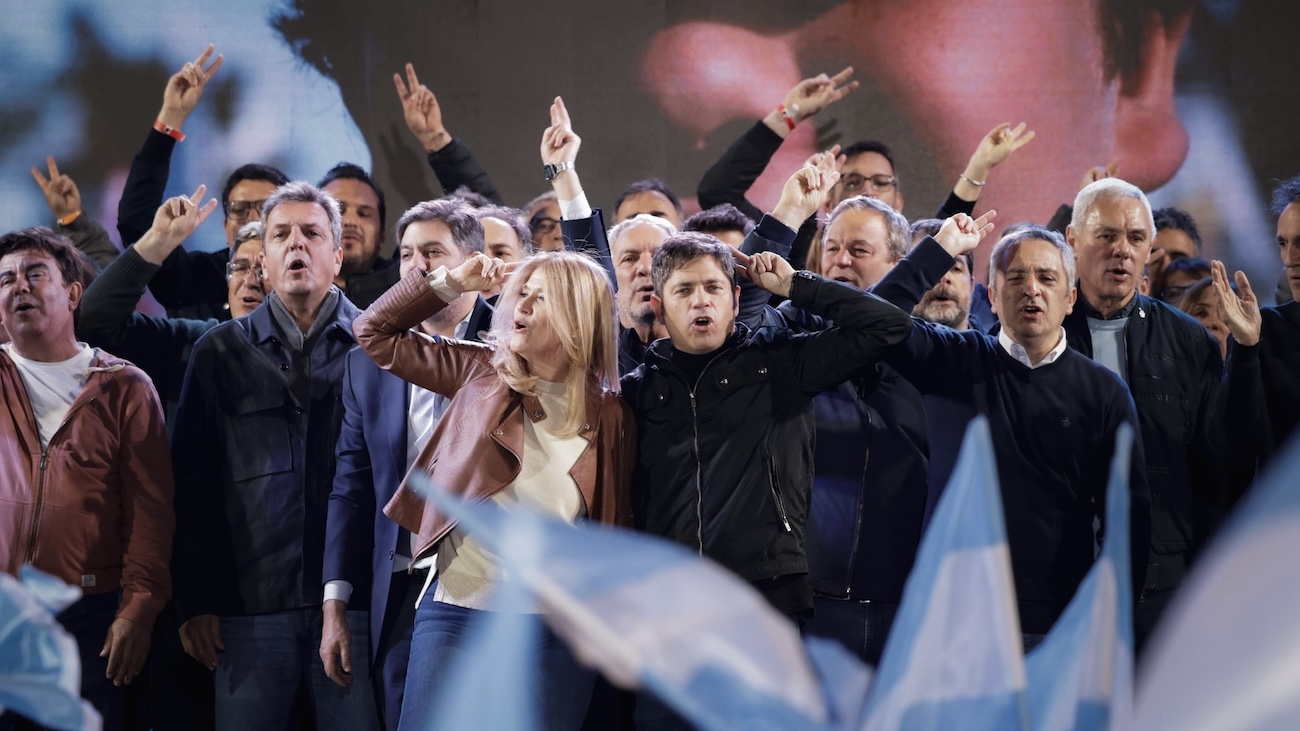
Axel Kicillof and other Peronist leaders in Buenos Aires celebrating their victory on Sunday, September 7. Photo: Fuerza Patria / X
Despite the president taking a front-line role in the election campaign and predicting victory for his party (“Buenos Aires will be painted purple,” Milei claimed), the figures speak for themselves. Voter turnout is estimated at almost 61%.
On September 7, 2025, the province of Buenos Aires dealt a crushing defeat to the right-wing libertarian project of President Javier Milei, who, after learning the results of the provincial elections, said: “Today we have suffered a clear defeat and we must accept it.”
The people of Buenos Aires province, which accounts for 38% of the country’s population, elected senators, deputies, and delegates of their municipalities. Peronism decided to join forces and form a large anti-Milei alliance called Fuerza Patria (Homeland Force), which, according to official data, obtained almost 47% of the valid votes. Meanwhile, La Libertad Avanza, Milei’s party that allied itself with the PRO (the party of former president Mauricio Macri), reached almost 34%. In third and fourth place were the centrist SOMOS and the Left Front, respectively, which each obtained almost 5%. The rest of the votes were divided among the other contenders.
In other words, Peronism won by more than 13 points over the far right, allowing it to take six of the eight electoral districts. La Libertad Avanza only managed to win the fifth and sixth districts. In addition, Peronism swept the municipal elections, winning 95 of the 135 municipalities in the province.
Milei says he will not back down
Despite the resounding defeat, Milei stated that while the necessary political mistakes must be corrected, he will not back down from his neoliberal project. “We will not back down one millimeter in the government’s policy; we will accelerate the course even more. If we have made political mistakes, we will process them and do better to win in October… We will continue to defend fiscal balance.”
He also took the opportunity to criticize his primary opposition, “They have put all the Peronist apparatus that they have been managing for 40 years into play, and this [result] is the floor for us and the ceiling for them.”
Peronism celebrates
For its part, the main opposition force, Peronism, celebrated the results. Former President Cristina Fernández, who is currently under house arrest, wrote on her X account: “Did you see that, Milei? Trivializing and vandalizing the ‘Never Again’ movement, which represents the darkest and most tragic period in Argentine history, does not come without a price. Neither is laughing at the death and pain of your opponents. But pointing fingers and stigmatizing the disabled, while your sister charges a 3% kickback on their medications, is lethal. And I’d better not even tell you how the rest (of those who still have jobs) are doing. Indebted for food, rent, expenses, or medications, and on top of that, with maxed-out credit cards. Get out of your bubble, brother.”
The Peronist governor of the province of Buenos Aires, Axel Kicillof, said to his supporters after learning the results: “The message from the polls is that you can’t govern for outsiders, for those who have the most. Milei: You have to govern for the people.” Furthermore, looking ahead to future elections, including the presidential election, Kicillof stated: “The elections have shown that there is another way, and today we are beginning to follow it.”
What is the reason for the crisis of ultraliberalism?
There are several elements which can help explain the defeat of Milei and his party on Sunday.
Other interpretations also point to an increasingly difficult management of the economy. The government has implemented a radical neoliberal policy that is in line with the demands of the International Monetary Fund (IMF). This has brought some stability to inflation, but it has also caused enormous social unrest, such as that of retirees who have taken to the streets every week to protest against government cuts to health care and freeze pensions.
In this regard, journalist Federico Rivas Molina wrote in El País: “The economic team is finding it increasingly difficult to maintain the value of the peso against the dollar. To prevent the dollarization of peso portfolios, it first raised rates to 80%, triple the inflation forecast for this year. Then it raised bank reserve requirements to 50% to reduce the amount of pesos in circulation. In the middle of last week, the floating bands it had agreed with the International Monetary Fund and sold dollars from the Treasury. Milei then blamed the turbulence on what he called ‘the kuka risk,’ that is, the fear of a Kirchnerist victory that had investors terrified. With the prophecy fulfilled, the scenario is now much more hostile than it was on Friday.”
Along these lines, Erika Gimenez, a journalist at ARG Medios, told Peoples Dispatch that Milei’s economic plan is not working and the people know it. She explained, “No one feels that their economic situation has improved under Milei’s government; quite the contrary: inflation is rising, salaries are insufficient, pensions for retirees and disabled people are being cut, among other cruel policies implemented by Milei. He is not convincing a sector that previously voted for him.”
She also expressed her opinion that Peronism, which has several internal tendencies (not always compatible), could sustain this alliance in the medium term thanks to the emergence of a figure who can bring together the different internal forces: “I think that Axel Kicillof’s leadership [in Peronism] is indisputable.”
Regarding the immediate future of Milei’s government, Gimenez said that a process of internal crisis is coming: “The figure of his sister is weighing on Milei, and despite this, he is not going to remove her. In addition, some ministers are going to resign or be fired, although it is not known which ones. There is a kind of political instability and instability in the Milei government’s economic project. It is most likely that between now and October, when there will be national legislative elections in which everyone in the country votes, political and economic stability will be at stake.”