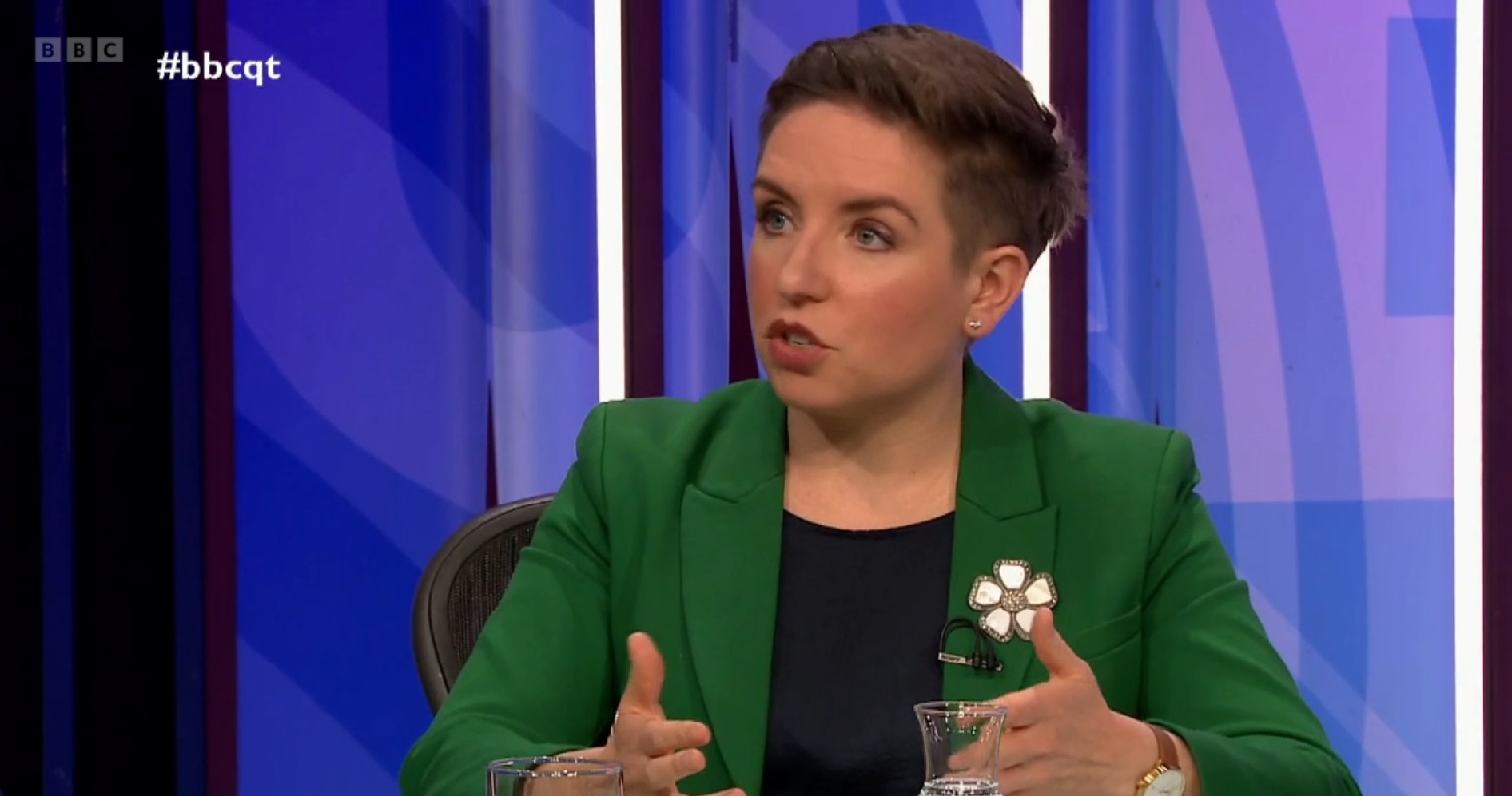
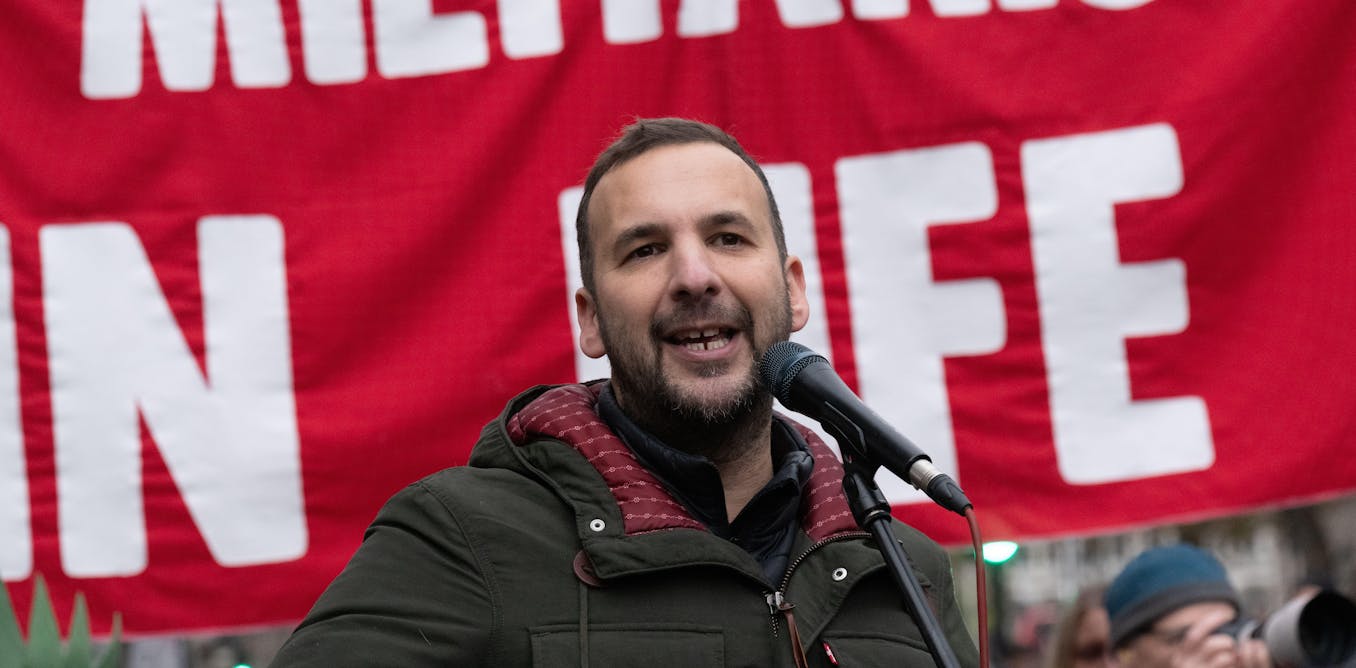
Image of the Green Party’s Bristol Central MP Carla Denyer on BBC Question Time.
Bristol Central’s Green Party MP, Carla Denyer, has responded to changes to the UK’s asylum policy, that would see asylum seekers having to wait 20 years to apply to settle permanently, and be subjected to regular reviews every two-and-a-half years, meaning people could be returned to their home nation if it is deemed safe.
Denyer said “This is a new low from this government – plumbing the depths of performative cruelty, in hopes that the public won’t notice they have no answers to the real issues facing communities across this country.
“Confiscating the belongings of people fleeing war and violence, and trapping refugees in perpetual limbo, where even those who have been granted asylum would have the constant threat of deportation hanging over their heads, undermining integration and making it impossible to put down roots. These are extreme, inhumane proposals from a desperate and failing government.
“The only way to prevent people making dangerous crossings by small boats is to open safe and managed routes for people to claim asylum in the UK. There are hints Mahmood could introduce such schemes – a sensible government would focus on this workable policy rather than divisive gimmicks.”
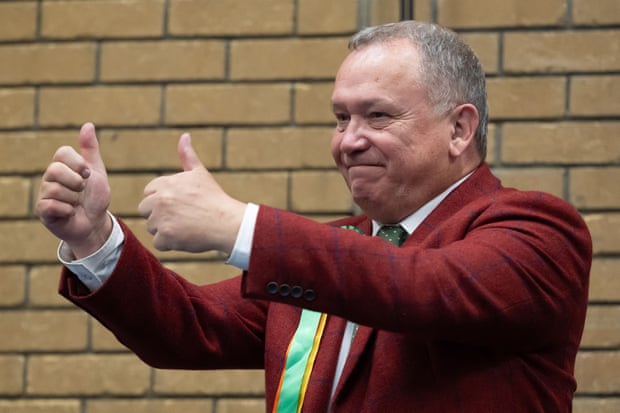
The byelection victory for Lindsay Whittle is a huge boost for Plaid, which believes it can win next year’s Senedd elections, ending a century of Labour dominance in Wales. Photograph: Matthew Horwood/Getty Images
Rhun ap Iorwerth’s party seizes Senedd seat after Reform UK challenge
Rhun ap Iorwerth’s party, which wants Wales to become independent, seized the Senedd (Welsh parliament) constituency from Labour and resisted a fierce challenge from Reform UK.
Plaid candidate Lindsay Whittle received 15,961 votes, while Reform UK’s Llyr Powell won 12,113. Labour’s vote collapsed in what had been a stronghold, with its candidate Richard Tunnicliffe polling only 3,713 votes.
Plaid emerged with a majority of 3,848 votes, and a swing of almost 27% from Labour.
In his acceptance speech, Whittle … said: “There is deep, deep disillusionment with Labour, both on a UK level and at a Welsh government level, and the people are looking for new leadership. A Plaid Cymru win here tonight is the clearest evidence yet of who is in the driving seat to lead [Welsh] government for next year. I don’t think Reform have shown they are particularly interested in Wales. It’s all about getting [Reform leader] Nigel Farage to Downing Street.”
Parliamentary press passes allow journalists more access to Westminster. (Photo: PA / Alamy)
MPs condemn ‘sinister move’ to deny access to Declassified reporters.
Parliament has been accused of an “outrageous abuse” that is “worthy of the Trump White House”, after blocking Declassified from holding a media pass.
Internal emails reveal that officials cited our “in-depth investigations… from a particular standpoint”, when rejecting our application.
They also flagged a recent investigation we published that raised concerns over pro-Israel bias in Westminster.
This is despite parliamentary authorities having a duty to remain politically impartial. Guidelines say that passes should be granted with “fair access across a range of outlets”.
The decision to deny Declassified access has been criticised by politicians across the political spectrum, including Labour, the Green Party, Plaid Cymru, and the Independent Alliance.
Almost 500 journalists currently hold a pass, which provides unfettered access to Westminster and daily government briefings. They include many from right-wing outlets like Guido Fawkes and GB News.
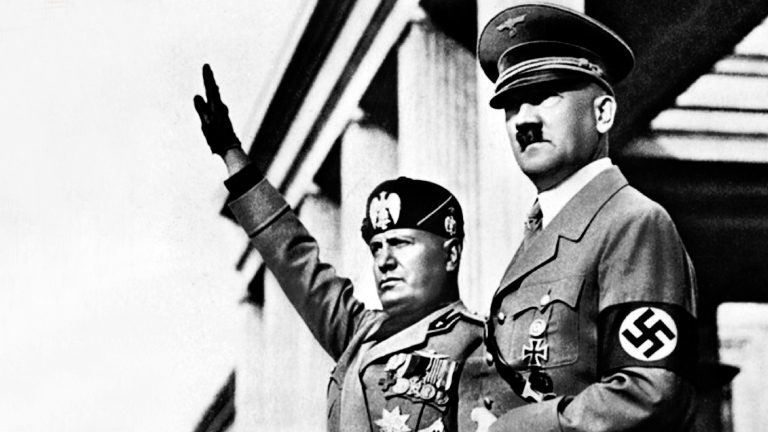
The original Fascists Mussolini and HitlerDonald Fuhrump says that Amerikkka doesn’t bother with crimes or charges anymore, not being 100% Amerikkkan and opposing his real estate intentions is enough.Elon Musk urges you to be a Fascist like him, says that you can ignore facts and reality then.
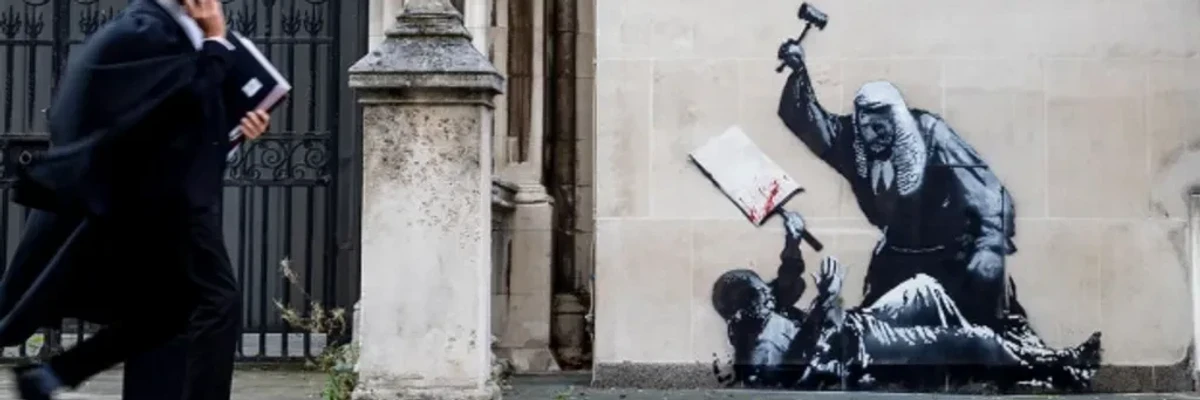
A photographed, posted by the artist himself, of a new Banksy mural that appeared outside the High Court in London on Monday, September 9, 2025. (Photo: Banksy)
“When the law is used as a tool to crush civil liberties, it does not extinguish dissent—it strengthens it,” said the group who faced nearly 900 arrests over the weekend for peaceful protest.
A mural by the world-renowned street artist Banksy depicting a judge magistrate beating a bloodied demonstrator on the ground with his gavel appeared Monday morning outside the Royal Courts of Justice building in London—a piece of commentary on the ongoing controversy surrounding the right to free speech in the UK when it comes to Palestinian rights.
The new artwork, which the artist confirmed was his in an Instagram post, comes amid uproar over a UK government law that has been used to ban individuals and entire groups from protesting under anti-terrorism laws.
On Saturday, nearly 900 people were arrested during a protest led by a group called Defend Our Juries, which has been calling for the lifting of a blanket ban on a separate group, the nonviolent Palestine Action, deemed a terrorist supporter in relation to its advocacy of Palestinian rights and a demand for an end to the genocide in Gaza.
The Met Police reported that 890 people were arrested in total on Saturday. Of those, 857 were arrested for the sole offense of voicing their support for Palestine Action, now a crime in the UK. The other 33 arrests were for various infractions, including 17 for assault of police officers.
Banksy’s artwork was seen as a keen commentary on the subject.
London-based journalist Barry Malone called the piece “extremely powerful,” especially given the context. “The timing, the placement,” he said. “It’s perfect.”
In a statement Sunday about the weekend’s arrest, Amnesty International’s director of campaigns and communications, Kerry Mascogiuri, said the “staggering number of arrests” by police at a “peaceful protest marks a new low for protest rights in this country.”
“It’s completely ridiculous for police to be targeting and arresting people for sitting down, quietly holding a sign,” Mascogiuri said.
Banksy, Royal Courts of Justice, London
Yesterday 857 people were arrested for showing support for Palestine Action – a protest group which has recently been banned in the UK.
Most sat peacefully holding a sign which read “I oppose genocide. I support Palestine Action.” pic.twitter.com/WNSVN55eaP
She said observers from Amnesty witnessed how the crowd was “entirely peaceful,” despite some people hurling insults at officers. She said it was a misrepresentation to say that protesters became violent, though some did try to prevent those targeted for arrest from being carried away.
“Police officers, on a number of occasions, were aggressive towards supporters of the protest,” Mascogiuri added. “This included violently shoving people away and pulling out batons to make space whilst protesters were arrested and hauled into police vans.
“Peaceful protest is a fundamental right,” she concluded. “The scenes yesterday were a shocking demonstration of how the UK’s overly broad terrorism laws are being used to suppress free speech.”
Meanwhile, outside the High Court in London on Monday, security guards and metal barriers were promptly dispatched to cover up the mural.
Did we just get a Banksy?
New Banksy showing judge hitting protester with gavel appears on High Court.https://t.co/fuSlsBW4tu
In a statement, a spokesperson for Defend Our Juries said the work by Banksy “powerfully depicts the brutality unleashed” on peaceful protesters by the former Home Secretary Yvette Cooper, who led the prohibition against Palestine Action.
“When the law is used as a tool to crush civil liberties, it does not extinguish dissent–it strengthens it,” the spokesperson continued.
“As Banksy’s artwork shows, the state can try to strip away our civil liberties, but we are too many in number and our resolve to stand against injustice cannot be beaten—our movement against the ban is unstoppable and growing every day,” they said. “We hope everyone who is moved by Banksy’s inspiring work of art will join our next action, which will be announced soon.”
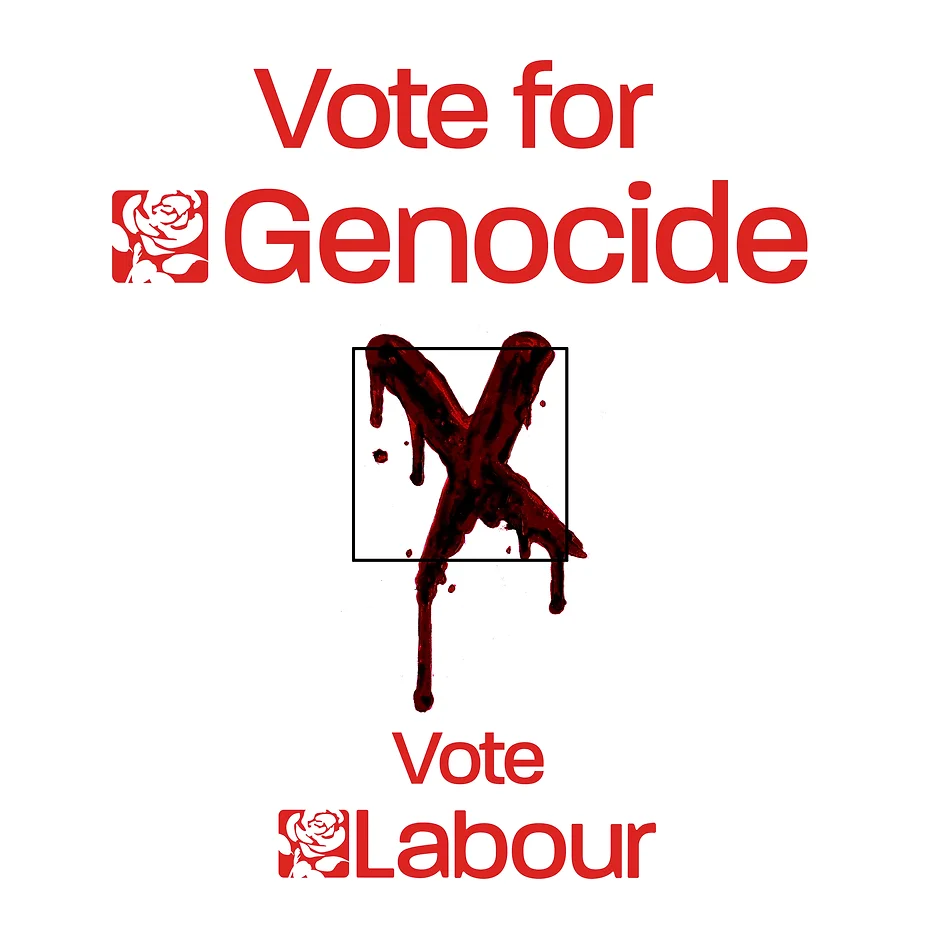
Palestine Action joke that appeared in the UK satirical magazine ‘Private Eye’.Keir “I support Zionism without Qualification” Starmer supporting genocide.Vote Labour for Genocide.
Zack Polanski is the new leader of the Green party in England and Wales after winning a leadership election promising a programme of “eco-populism”. Polanski beat incumbent leader Adrian Ramsay and his partner on the ticket, Ellie Chowns.
It’s been just over a year since the party celebrated its best ever results in the most recent general election. In July 2024, it doubled its vote share and quadrupled its representation in the House of Commons to four MPs.
The same election saw terrible results for the Conservatives and even for Labour, despite its win, raising questions about whether two-party politics was well and truly over. Since then, as professor John Curtice has vividly described, things have started to look even shakier.
This year’s local election saw a “record-breaking” fragmentation of the vote in which less than a quarter of local council seats went to the two main parties. The Greens now hold over 800 seats in more than 170 different councils, adding to their electoral portfolio – which also includes two members of the House of Lords and three London Assembly members.
While Polanski will be celebrating today, party members will look to him to raise their electoral fortunes even further. The electoral challenge for the Greens in England and Wales is two-pronged.
First, the party needs to maintain its position in the seats it has already secured. Its four MPs have fairly comfortable majorities, the smallest being Chowns’ 5,800 majority in North Herefordshire. Second, and perhaps most importantly, it needs to maximise its success in the 40 constituencies where it came second. All but one of these constituencies were won by Labour, which makes Labour voters the prime targets.
My research has shown how the Green party has followed a policy of “total engagement” in recent years. It takes its parliamentary work very seriously, using any and every opportunity to get its message across, even in lower-priority policy areas.
The goal here is to build credibility with the electorate. Small parties tend to want voters to think they are bigger than they are, so they can present themselves as realistic contenders for taking on the heavy work and responsibility of government. Caroline Lucas did a fantastic job of this, punching well above her weight as the party’s only MP between 2010 and 2024.
Together, the Green MPs have made over 380 contributions in the House of Commons. Chowns in particular has been a prolific backbencher, making 161 contributions, while the previous co-leaders Carla Denyer and Ramsay have been much quieter.
With Polanski sitting in the London Assembly rather than the House of Commons, this will inevitably change. The four Green MPs will collectively have more time on their hands and, with the right direction from their new leader, will have the space to be more strategic in their parliamentary activities.
Outsiders
But the Greens have always acted as something of an atypical party too, keeping one foot outside Westminster. Lucas was regularly involved in activism, joining protesters campaigning against tuition fee increases and fracking and to support refugees, to name just a few. She was even arrested in 2013 after joining a protest against energy firm Cuadrilla in Sussex (she was later cleared of all charges in court).
The new Green MPs have continued in this vein, with Sian Berry joining a peaceful protest against far-right agitators in Brighton last year and Chowns pressing the government to water down anti-protest laws.
The new leadership will need to decide whether this strategy enhances their electoral appeal. Does it highlight the Greens’ distinctiveness from the establishment parties, or does it imply they aren’t responsible enough to manage being a party of significant size? The answer depends on who you ask. Polanski has participated in several protests in the past, so chances are this activism will continue to be a core feature of Green party politics.
An added complication for the Greens is that two other parties are also chasing left-leaning voters. One of these is Reform UK. Although associated with rightwing views on social issues, the party came second in many Labour seats in 2024 and needs to appeal to both sides of the political spectrum.
This may explain why the Greens have focused their efforts on highlighting Reform’s failures. Berry, for instance, recently challenged Nigel Farage and his colleagues to publish a log of all their meetings since entering the Commons, arguing that it would be in the public interest.
The other outside threat is Jeremy Corbyn and Zarah Sultana’s new and currently nameless party of the left. While we know little about this party’s policy platform right now, it seems to be veering towards a similarly bottom-up democratic model of organisation which has long been favoured by the Greens – possibly even with co-leaders.
The challenge for the Greens will be to better establish their niche on the left, to ensure they capture voters who are disillusioned with Keir Starmer’s wobbly start. Part of the solution could be to focus on a handful of key policy areas which go beyond the Green party’s niche of environmental issues. At the moment, its MPs take something of a scattergun approach in the Commons, contributing on everything from local buses and universal credit to Ukraine and the Middle East.
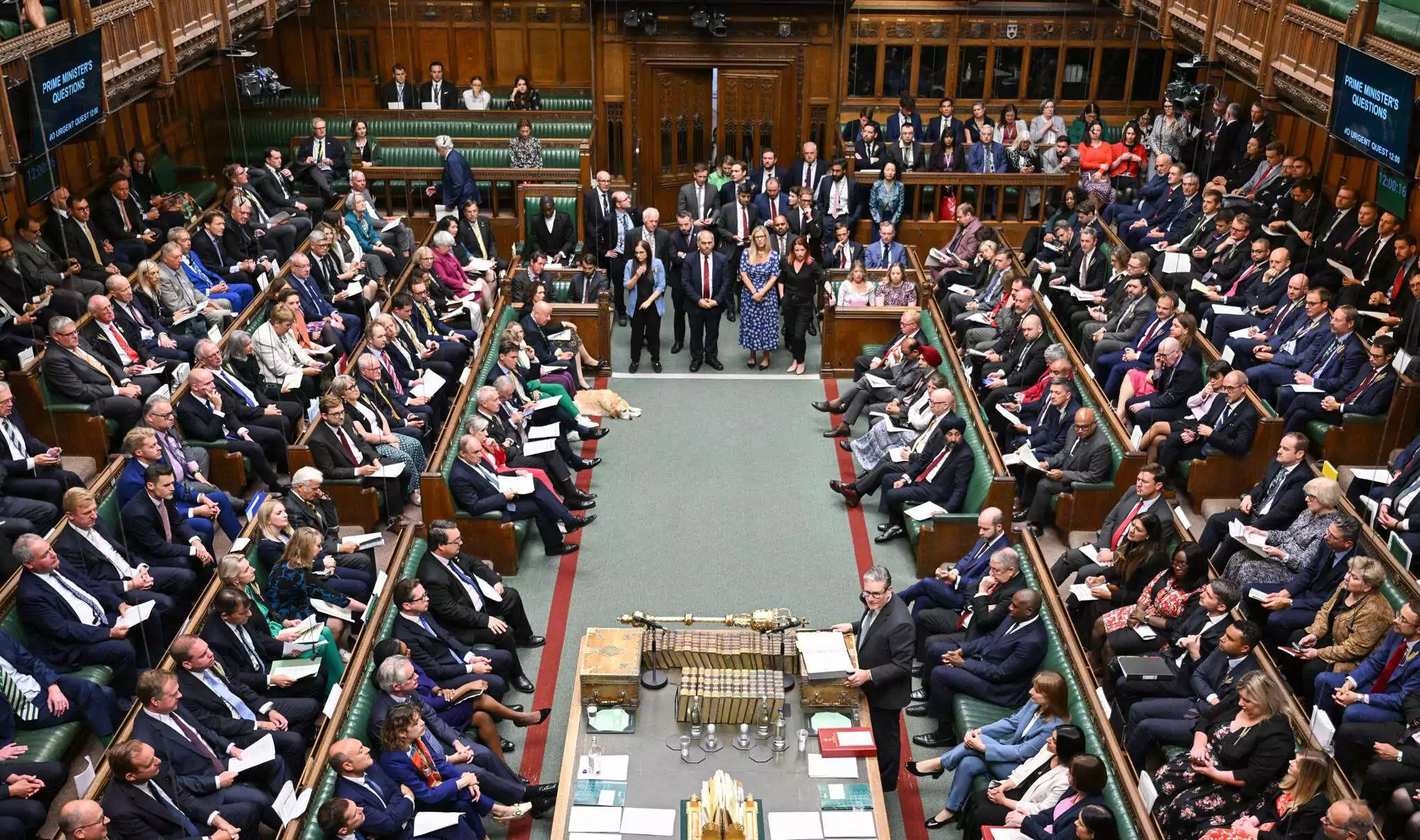
Some of the most recent questions asked during Prime Minister’s Questions by Greens hint at the options they might pursue. Ramsay has pushed for a wealth tax on the super rich, and an end to the two-child benefit cap. Both Corbyn and Sultana have, of course, been outspoken on these issues in the past.
If the Greens can’t forge a different path to this new left party, they may have no choice but to consider an electoral pact to avoid splitting the anti-Labour vote right down the middle.