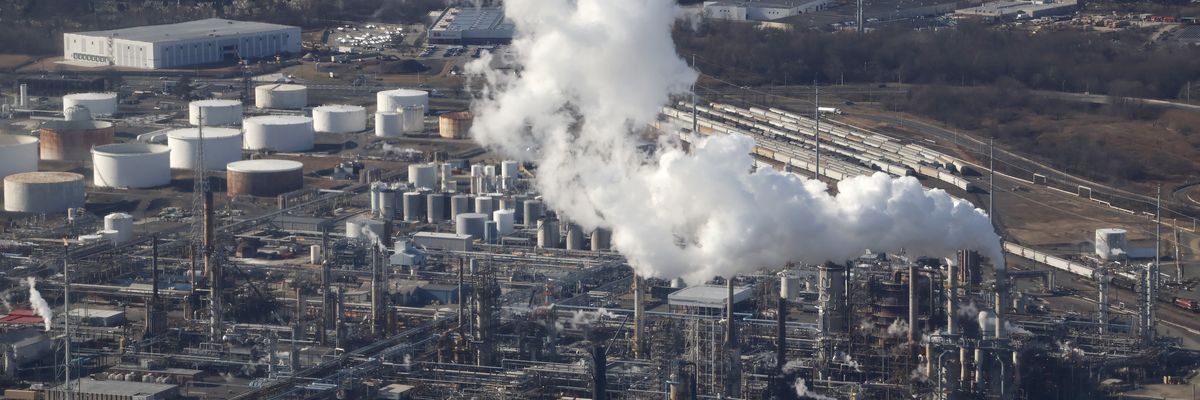
Emissions are seen from a smoke stack at the Phillips 66 Refinery on February 6, 2024, in Linden, New Jersey. (Photo: Gary Hershorn/Getty Images)
“This chaotic administration is obviously desperate to smash through every environmental guardrail that protects people or preserves wildlife, but steps like this will be laughed out of court,” said one advocate.
Numerous environmental protection groups were preparing to file lawsuits Friday after President Donald Trumpdirected federal agencies to repeal what he called “unlawful regulations” aimed at protecting the public from pollution, oil spills, and other harms—sharply curtailing the process through which rules are changed as he ordered agencies to “sunset” major regulations.
The order was issued a week-and-a-half before the deadline set by another presidential action in February, when Trump required agencies to identify “unconstitutional” and “unlawful” regulations for elimination or modification within 60 days.
Those restrictions, under Wednesday evening’s order, can be repealed without being subject to a typical notice-and-comment period.
Trump named the Environmental Protection Agency, the Department of Energy, the Nuclear Regulatory Commission, and the Bureau of Safety and Environmental Enforcement among several agencies affected by the order, and listed more than two dozen laws containing regulations that must incorporate a sunset provision for no later than September 30, 2025.
The laws include the Atomic Energy Act of 1954, the National Appliance Energy Conservation Act of 1987, and the Nuclear Waste Policy Act of 1982.
Hans Kristensen, director of the Nuclear Information Project at the Federation of American Scientists, suggested the order was Trump’s latest push to benefit corporate polluters.
The Trump corporate regime orders agencies to ‘sunset’ environmental protections, as part of an effort to make it easier for industry to pollute. thehill.com/policy/energ…
Brett Hartl, government affairs director for the Center for Biological Diversity, said it was “beyond delusional” for Trump to attempt to repeal “every environmental safeguard enacted over the past 50 years with an executive order.”
“Trump’s farcical directive aims to kill measures that protect endangered whales, prevent oil spills, and reduce the risk of a nuclear accident,” said Hartl. “This chaotic administration is obviously desperate to smash through every environmental guardrail that protects people or preserves wildlife, but steps like this will be laughed out of court.”
In a memo, the White House wrote that “in effectuating repeals of facially unlawful regulations, agency heads shall finalize rules without notice and comment, where doing so is consistent with the ‘good cause’ exception in the Administrative Procedure Act.”
“That exception allows agencies to dispense with notice-and-comment rulemaking when that process would be ‘impracticable, unnecessary, or contrary to the public interest,'” said the White House.
As climate advocates scoffed at the suggestion that regulating nuclear power and pollution-causing energy infrastructure is “contrary to the public interest,” legal experts questioned the legality of Trump’s order.
“If this action were upheld, it would be a significant change to the way regulation is typically done, which is through notice and comment,” Roger Nober, director of George Washington University’s Regulatory Studies Center, toldGovernment Executive. “If the agencies determine that a rule is contrary to the Supreme Court’s current jurisprudence, then [this order says they] have good cause to remove it and [they] can get around notice and comment. That’s certainly an untested and untried way of implementing the Administrative Procedure Act.”
Georgetown University law professor William Buzbee toldThe Hill that the Supreme Court “has repeatedly reaffirmed that agencies seeking to change a policy set forth in a regulation have to go through a new notice-and-comment proceeding for each regulation, offer ‘good reasons’ for the change, and address changing facts and reliance interests developed in light of the earlier regulation.”
“Adding a sunset provision without going through a full notice-and-comment proceedings for each regulation to be newly subject to a sunset provision seems intended to skirt the vetting and public accountability required by consistency doctrine,” he said. “Like many other attempted regulatory shortcuts of the first and second Trump administration, this [executive order] seems likely to prompt legally vulnerable agency actions.”
Public Citizen co-president Lisa Gilbert suggested that the executive order is the latest example of Trump’s push to govern the U.S. as “a king.”
“He cannot simply roll back regulations that protect the public without going through the legally required process,” Gilbert told Government Executive. “We will challenge this blatantly unlawful deregulatory effort at every step to ensure it doesn’t hurt workers, consumers, and families.”
Michael Wall, chief litigation officer at the Natural Resources Defense Council, called the order “a blatant attempt to blow away hundreds of protections for the public and nature, giving polluters permission to ignore whatever is coming out of their smokestacks while developers disregard endangered species protections and Big Oil no longer heeds the reforms put in place after the Deepwater Horizon disaster.”
“This executive order is illegal,” he said. “Congress passed these laws, and the president’s constitutional duty is to carry out those statutes; he has zero power to rewrite them.”
“There’s no magic wand the administration might wave to sweep away multiple rules on a White House whim,” Wall added. “Any changes to the rules the president wants rescinded would have to be justified, rule by rule, with facts, evidence, and analysis specific to that rule. He cannot do this by fiat.”
Orcas discuss Donald Trump and the killer apes’ concept of democracy. Front Orca warns that Trump is crashing his country’s economy and that everything he does he does for the fantastically wealthy.Neo-Fascist Climate Science Denier Donald Trump says Burn, Baby, Burn.Elon Musk urges you to be a Fascist like him, says that you can ignore facts and reality then.
dizzy: There are other demands on my life dragging me away dear audience. There are always good articles at Common Dreams.
Far-right industry allies with ties to Chevron have mounted an “unprecedented” pressure campaign calling on the Supreme Court to stop a potentially historic climate deception lawsuit against oil majors from going to trial. Graphic design by Tess Abbot
Fossil fuel interests are deploying unprecedented strategies to hide evidence of companies’ deception and block liability lawsuits before they reach trial.
This article by ExxonKnews is published here as part of the global journalism collaboration Covering Climate Now.
In the face of mounting scrutiny from local, state, and federal officials, fossil fuel companies and their allies are deploying a range of tactics to obstruct ongoing lawsuits and investigations concerning evidence that the industry has misled the public about the harms it knew its products would cause to the climate, environment, and human health.
Far-right industry allies with ties to Chevron have mounted an “unprecedented” pressure campaign calling on the Supreme Court to stop a potentially historic climate deception lawsuit against oil majors from going to trial. Republican attorneys general are separately urging the Supreme Court to throw out similar climate fraud lawsuits from five states. Plastics industry trade associations are suing the California state attorney general’s office to block an investigation into whether oil companies lied about plastic recycling. And fossil fuel giants and their trade groups have responded to congressional subpoenas with highly redacted records and “baseless” First Amendment legal defenses.
“I think we’re seeing an escalation by the industry to do anything it can to avoid being held accountable for the consequences of climate change,” said Lisa Graves, executive director of investigative watchdog group True North Research and an expert on dark money special interest groups. “It continues to try to thwart efforts to try to mitigate climate change and it continues to try to stop efforts to get any compensation for the harms it has caused, not just through the burning of fossil fuels but also by the delay and deceit that it has promoted through front groups.”
State and local climate lawsuits, which accuse oil and gas majors of lying about the dangers of fossil fuels and seek to hold them accountable for the resulting damages, are advancing in state courts despite the industry’s efforts. Most recently, a Colorado judge denied nearly all motions by ExxonMobil and Suncor Energy to dismiss the City and County of Boulder’s case against them.
It’s the fifth time to date that a court has rejected Big Oil’s efforts to dismiss climate accountability lawsuits — bringing the companies closer to facing trial and potentially billions of dollars in liability. If any of the cases go to trial, said Michael Gerrard, director of the Sabin Center for Climate Change Law at Columbia University, “it will shine a very harsh light on the fossil fuel companies and it could lead to crushing monetary judgments.”
“Clearly the defendants here are using everything they can think of to derail these cases,” Gerrard said. That attitude has been most evident in Big Oil’s response to a lawsuit from Honolulu, which could be among the first communities to put the companies on trial.
In February, oil company defendants — including Exxon, Chevron, BP, and Shell — petitioned the U.S. Supreme Court to review a Hawai‘i state Supreme Court ruling that allowed Honolulu’s case to move toward trial. The case, the companies argued in their petition, is preempted by federal law and should be dismissed.
But after traditional legal arguments have failed to shield the industry to date, allies seem to be turning to more extreme and novel measures.
Leonard Leo to the Rescue?
In the weeks and months before the Supreme Court was scheduled to hear Big Oil’s petition in Honolulu’s lawsuit, a flood of social media ads and op-eds called for the Supreme Court justices to take up — and throw out — the case.
“To end this nuisance charade, the Supreme Court needs to take up the Honolulu case and declare once and for all that public nuisance is for local issues, not global climate change,” reads the narrator of one such video ad posted to X.
The name behind that ad, the Alliance for Consumers, is part of an organization called the Concord Fund, formerly known as the Judicial Crisis Network. Those groups, Graves and others have pointed out, are projects of billionaire Leonard Leo, head of the far-right legal advocacy group the Federalist Society and known as the architect of the current Supreme Court. CRC Advisors — one of the Leo-backed companies in the effort — appears to have had Chevron, a defendant in Honolulu’s case, as a client.
The fossil fuel industry also helped fund the Federalist Society, and partners at major law firms representing oil and gas companies — including Theodore Olson of Gibson Dunn,the law firm representing Chevron against Honolulu and other communities’ climate liability cases — sit on its board.
Former Hawai‘i Supreme Court Justice Michael Wilson, who served on the state’s highest court for a decade, called the pressure campaign targeting the Supreme Court a “powerful intervention” by “the strongest special interest group in the history of human civilization.”
“This is the most important case in the United States from the point of view that it will allow a jury of citizens to see the fraud and to decide what to do about it,” said Wilson. “This is a high-risk strategy that shows that the fossil fuel industry is desperate.”
Oil companies, which quietly funded front groups like the American Legislative Exchange Council (ALEC) to sow climate denial and oppose climate action on their behalf, are now rallying their allies and benefactors to strike at lawsuits that seek to hold them accountable, explained Graves. In April, 20 Republican attorneys general filed a brief with the U.S. Supreme Court in support of the oil companies’ petition.
“The Leo-tied groups are a soup-to-nuts intervention machine, from the Republican attorneys general to the judges he helped put on the court,” said Graves.
In June, the Supreme Court delivered a one-line order asking the U.S. Justice Department to weigh in on the case — an “extraordinary” response at this stage, according to Wilson, considering that the case has not yet gone to trial. If the Solicitor General neglects to weigh in before the election, that response could be in the hands of a Trump administration. Trump has promised that if re-elected, he will “stop the wave of frivolous litigation from environmental extremists.”
A ‘Highly Unusual’ Request
In May, 19 members of RAGA made a “highly unusual” request to the Supreme Court: to intervene in and undermine climate accountability lawsuits filed by five states — California, Connecticut, Minnesota, New Jersey, and Rhode Island — claiming that their cases would impose “ruinous liability” on fossil fuel companies and threaten “our basic way of life.”
The Supreme Court has original jurisdiction over disputes between states — meaning it can hear a case without it first being heard by another court — but such challenges are more commonly brought over issues like water rights, said Gerrard of Columbia’s Sabin Center. “I’ve never previously heard of an instance where there’s an effort to invoke the original jurisdiction of the [U.S.] Supreme Court to swat down litigation,” he said.
RAGA obtains some of its largest donations from the fossil fuel industry — including Koch Industries, Exxon, and the American Petroleum Institute, all of whom are defendants in climate liability cases — according to an analysis by the Center for Media and Democracy.
“These AGs have now placed their allegiance directly with the special interest group that is threatening the survival of future generations,” said Wilson.
The filing argues that “oil and natural gas have supported improvements in environmental quality and have reduced weather-related deaths,” and claims that “America’s air is cleaner than a century ago thanks in part to the increased use of oil and natural gas.”
It isn’t the first time Republican attorneys general have rushed to shield oil companies from accountability for their climate deception — and overtly used climate denialist talking points first leveraged by Big Oil in their defense. In 2016, Exxon sued the attorneys general of New York and Massachusetts in an attempt to block investigations into the company’s private research and public communications about climate change, claiming the probe was an attack on their free speech and other constitutional rights.
Republican attorneys general from 12 states filed a 2018 brief in support of the oil giant, arguing that “Climate change is the subject of legitimate international debate.”
“[T]he most undeniable fact about climate change is that, like so many other areas of science and public policy, the debate remains unsettled, the research is far from complete, and the path forward is unclear,” they wrote.
A(nother) First Amendment Fight
Another industry strategy to block accountability is playing out in response to California Attorney General Rob Bonta’s investigation into whether Exxon and other petrochemical companies deceived the public about the efficacy of plastic recycling as a solution to plastic waste. In May, the American Chemistry Council and Plastics Industry Association — two major trade groups representing oil and chemical giants including Exxon, Chevron, Amoco, Dow, and DuPont — filed a lawsuit against the attorney general in federal court, claiming the investigation violates their free speech rights.
Bonta, who had said he would decide whether to sue Exxon by the summer, responded with petitions asking the Sacramento County Superior Court to order the groups to comply with his office’s subpoenas.
“For years, the plastics industry has engaged in an aggressive campaign to deceive the public, perpetuating a myth that recycling can solve the plastics waste and pollution crisis,” Bonta said in a statement. “The continuous delay tactics are failing to comply with our subpoena. Enough is enough: What are they trying to hide?”
Members of Congress have similarly accused the Big Oil companies of trying to obstruct investigations.
When Senate Budget Chairman Sheldon Whitehouse (D-RI) and House Oversight Ranking Member Jamie Raskin (D-MD) referred their years-long investigation into the industry’s climate deception to the Justice Department, the lawmakers wrote that “some companies claimed that the First Amendment or undefined ‘privilege’ protected them from the House Oversight Committee’s subpoena.” The main subjects of that investigation have been Exxon, Shell, Chevron, BP, API, and the U.S. Chamber of Commerce.
“The companies further obstructed the investigation by significantly redacting or entirely withholding more than 4,000 documents without any valid basis,” the lawmakers wrote, adding that their refusal to comply “provides a basis to infer that there is even more damning evidence of deceptive practices by the companies and their trade associations waiting to be uncovered.”
Fossil fuel companies and the law firms representing them have used a First Amendment defense to try to dismiss the climate accountability lawsuits, claiming company statements on climate change are protected political speech. One of the most prominent voices for that argument have been attorneys at Gibson Dunn, the firm that represents Chevron, and whose partner Theodore Olson sits on the Federalist Society board.
If these “overt” and “brazen” efforts to escape accountability can be overcome, the industry will no doubt face a reckoning, said Wilson, the former Hawai‘i Supreme Court justice. Communities like Honolulu “are being ravaged by climate” and “will apply the rule of law fairly,” he said.
“Hawai‘i is not a place that can be manipulated by the fossil fuel industry. That is a very big threat to the most powerful special interest group that’s now maintaining its power based on complicity.”
Latest documents unearthed by Dutch climate activist seen as “valuable sources” for litigators.
Newly-discovered Shell documents dating back decades could help strengthen lawsuits aiming to hold the oil major to account for climate damages, climate attorneys say.
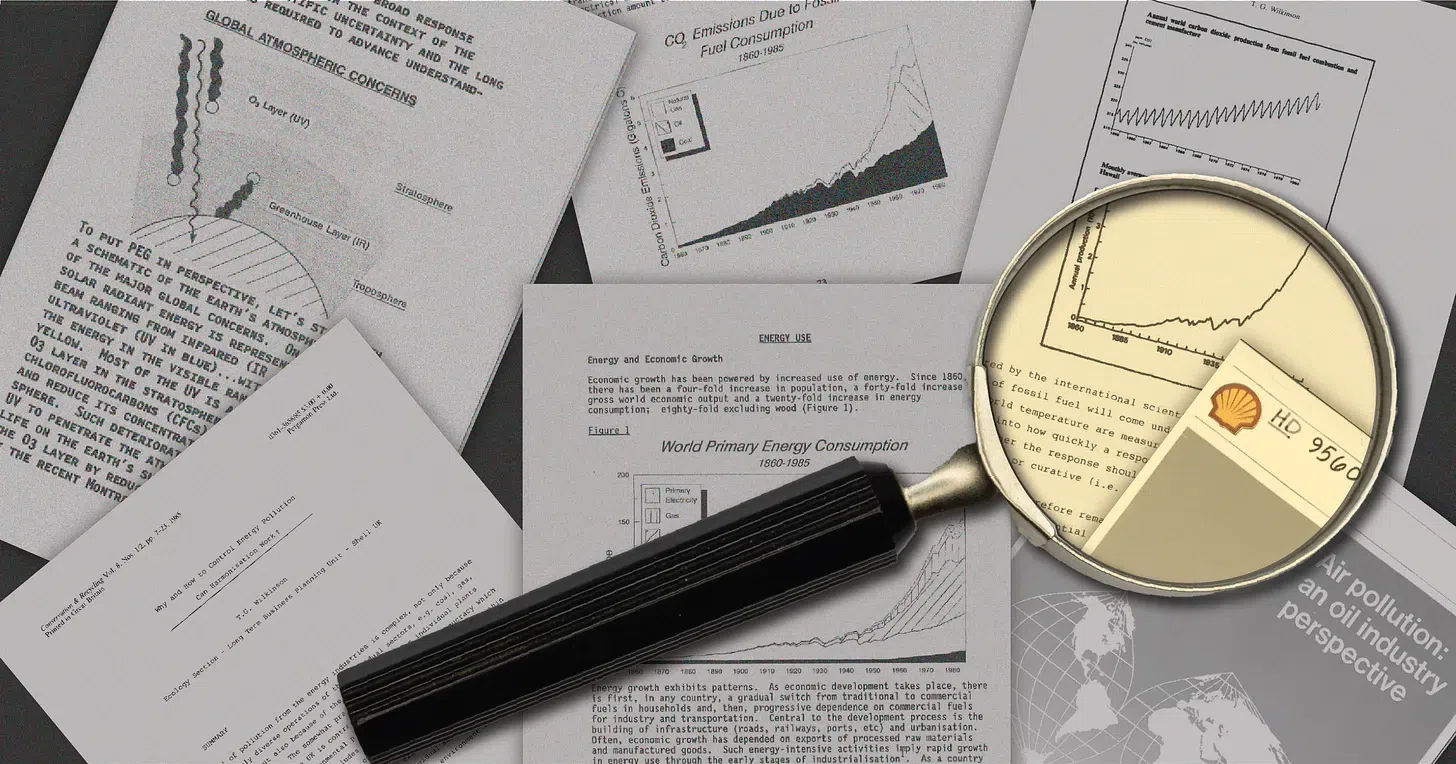
Among the files, reported for the first time today by DeSmog and Follow The Money, and published on Climate Files, there is a 1970 industry journal article where Shell appears to accept responsibility for harms caused by its products. A trove of Shell publications from the 1980s and 1990s foresee the “major adverse changes” the “greenhouse effect” is liable to cause to the climate.
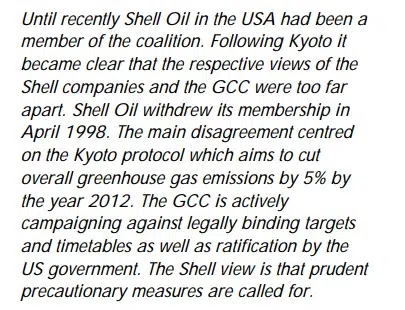
And a 1998 report spells out Shell’s reasons for leaving the Global Climate Coalition, a now defunct lobby group that worked to undermine climate science. The document shows that Shell had acknowledged the need to adopt “prudent precautionary measures” to avoid the worst impacts of the climate crisis — even as it continued to push for more production of oil and gas.
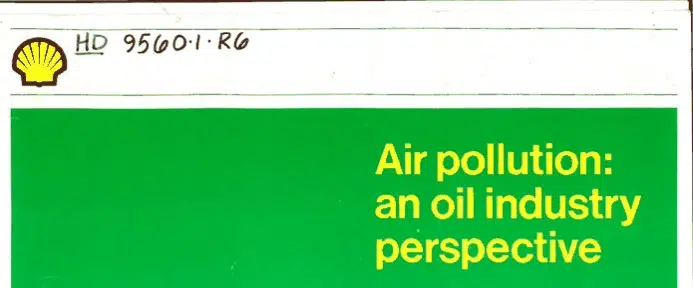
“It is feared that a further rise in carbon dioxide levels in the atmosphere could lead to a higher average surface temperature on Earth, which could have far-reaching environmental, social and economic consequences,” wrote the authors of a 1987 internal Shell publication entitled “Air Pollution: an Oil Industry Perspective.”
Cover of the 1987 internal Shell publication “Air Pollution: an Oil Industry Perspective.”
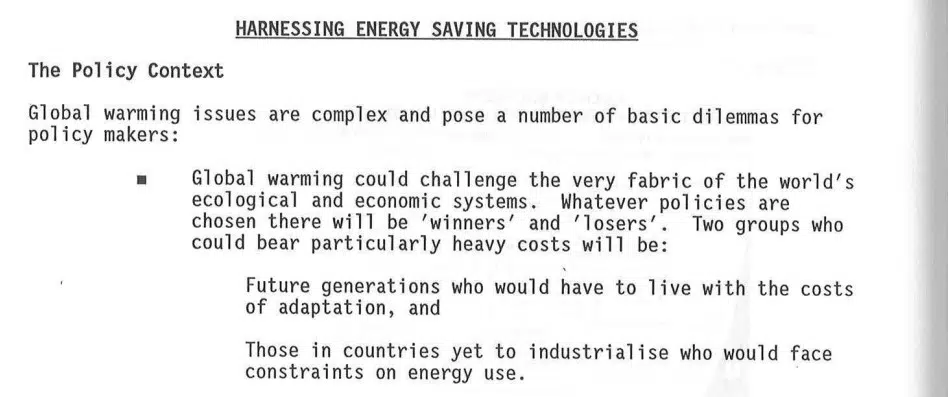
“Global warming could challenge the very fabric of the world’s ecological and economic systems,” Shell executive Ged Davis wrote in a contribution to a report by the Organisation for Economic Co-operation and Development (OECD) published two years later.
Vatan Hüzeir, a climate activist and doctoral candidate in sociology at Rotterdam’s Erasmus University, unearthed the documents over five years of research, gathering thousands of pages of Shell-related material from archives, former employees, and other sources.
The latest materials add to an initial tranche published in April last year which showed that even as Shell’s awareness of the potentially devastating consequences of climate change grew during the 1970s and 1980s, the company downplayed or omitted key risks in public communications; emphasised scientific uncertainties; and pushed for more fossil fuels.
Shell and other oil and gas companies have been named as defendants in dozens of U.S. climate lawsuits brought by the attorneys general of states such as New Jersey, Vermont, and California, as well as Washington, D.C. and other municipalities across the country. Some of these cases have been brought under consumer fraud or protection laws that penalise companies for misrepresenting their products to the public.
The Washington D.C.-based Center for Climate Integrity, which has filed briefs in support of many of the climate cases against Shell, said that the latest documents provide further evidence that the company has known for at least half a century that its products posed a threat to the climate, as well as the grave consequences of delaying action.
“These internal admissions are valuable sources for litigators around the world seeking to hold Shell accountable for its climate deception under a variety of legal theories,” Corey Riday-White, senior staff attorney at the Center for Climate Integrity, told DeSmog. “While Shell privately acknowledged the dangers of using its products as intended, the corporation publicly sowed doubt about the science and fought efforts to regulate its pollution.”
Hüzeir hopes the latest documents will support two additional and complementary legal strategies: showing that Shell has long accepted some liability for harms caused by its products — including, by implication, climate change — and demonstrating that even as Shell supported lobby groups that sought to block meaningful action to curb fossil fuel use, senior executives acknowledged the need for a “precautionary” approach to the growing climate crisis.
In response to a request for comment, Shell referred DeSmog to a previous statement it has made regarding the lawsuits.
“It is for government to determine the right trade-offs for society and put in place smart policy to enable fundamental change in the way society consumes energy,” a Shell spokesperson said.
In July 2023, 20 Democratic members of Congress cited DeSmog’s initial coverage of the documents in a letter to U.S. Attorney General Merrick Garland, in which they requested a Department of Justice investigation into the evidence that Shell, ExxonMobil and other oil majors concealed their early knowledge of climate risks.
This spring, a Dutch court is due to hear Shell’s appeal of a 2021 order to slash the company’s carbon dioxide (CO2) emissions 45 percent by 2030, issued in response to a suit filed by environmental group Milieudefensie. Six other organisations also participated in the suit, including FossielvrijNL, a campaign group chaired by Hüzeir, as well as 17,000 Dutch citizens.
“Shell must do its part to contribute to combating dangerous climate change,” Hague district court judge Larissa Alwin said, reading out the ruling.
Hüzeir believes the latest tranche of documents will strengthen cases brought by climate litigators in Europe and North America, in part by providing clues to the possible existence of additional Shell documents that could be obtained through discovery — a pre-trial procedure in the U.S. legal system that parties involved in a lawsuit use to obtain evidence from each other.
“You have to ‘crack the shell,’” Hüzeir told DeSmog. “With the existing documents in hand, and perhaps many more yet to be discovered, prosecutors, litigators and campaign groups can ground their demands for Shell to be held accountable in even more detailed fact and documentation.”
‘Annoying Consequences’
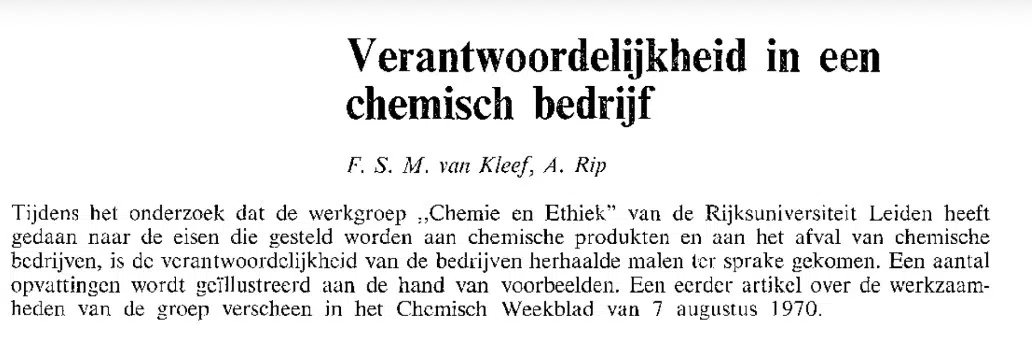
Among the new documents is an October, 1970 article in Dutch trade publication Chemisch Weekblad (Chemical Weekly), in which two authors from the University of Leiden reported on their research into “chemistry and ethics” — including the results of interviews with petrochemical executives. Representatives from Shell had appeared to acknowledge that the company bore some responsibility for the problems that its products would cause.
“If a product is used, as indicated by Shell, and annoying consequences nevertheless arise, Shell feels partly responsible,” they told the researchers.
Excerpt from an October, 1970 article in Dutch trade publication Chemisch Weekblad (Chemical Weekly).
Hüzeir said the document, and others like it, could support litigators to argue that Shell’s apparent early admission of some liability for the side-effects caused by its products should, by extension, also include climate impacts from burning its oil and gas, now known as “Scope 3” emissions.
Later documents cast new light on Shell’s growing understanding of the risks posed by climate change. In a March 1985 article in the journal Conservation & Recycling, T.G. Wilkinson, who worked at the time in the Ecology Section of Shell UK’s Long Term Business Planning Unit, explored the risks posed by “energy-generated pollution.”
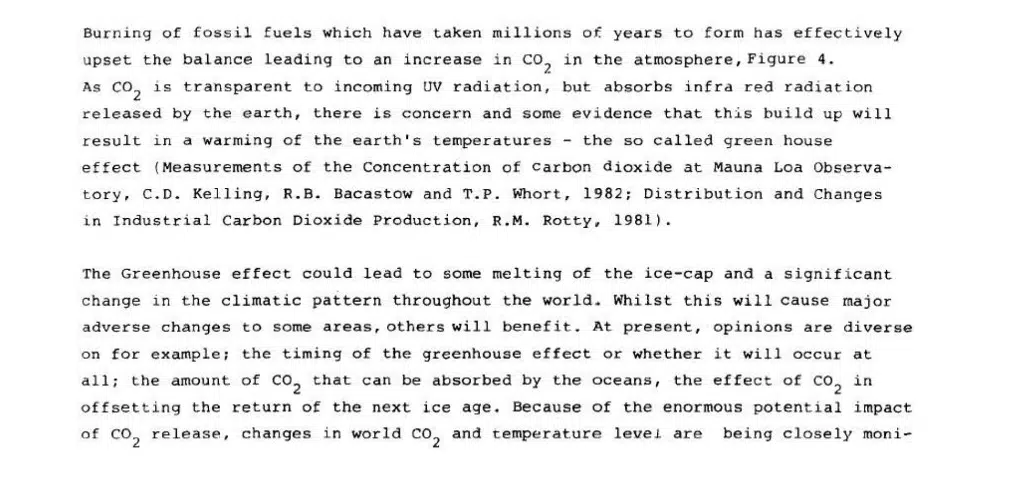
“Burning of fossil fuels which have taken millions of years to form has effectively upset the balance leading to an increase in CO2 in the atmosphere,” Wilkinson wrote. “The Greenhouse effect could lead to some melting of the ice-cap and a significant change in the climatic pattern throughout the world. Whilst this will cause major adverse changes to some areas, others will benefit.”
Excerpt from a March 1985 article in the journal Conservation & Recycling by T.G. Wilkinson, who worked at the time in Shell UK’s Long Term Business Planning Unit.
Wilkinson went on to explore whether a precautionary approach should be adopted to prevent the “potential enormous effects on the world’s climate.”
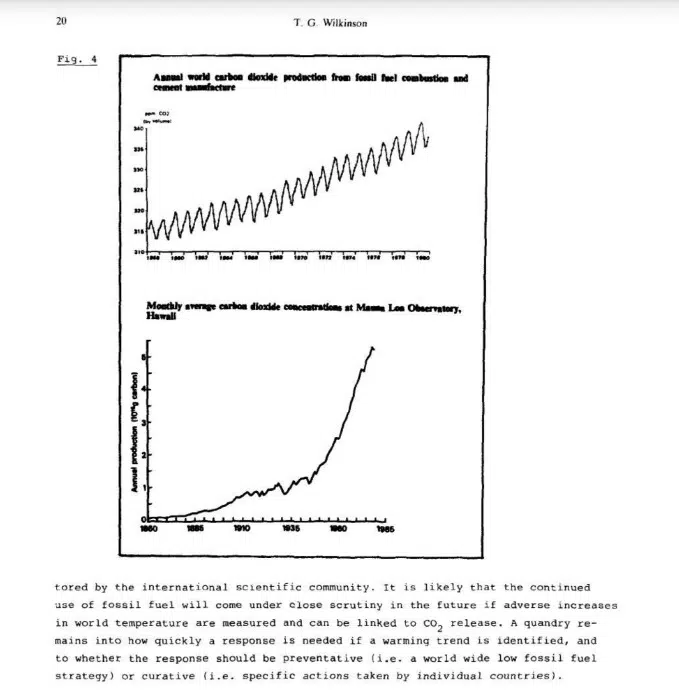
“It is likely that the continued use of fossil fuel will come under close scrutiny in the future if adverse increases in world temperature are measured and can be linked to CO2 release. A quandary remains into how quickly a response is needed if a warming trend is identified, and to whether the response should be preventative (i.e. a worldwide low fossil fuel strategy) or curative (i.e. specific actions taken by individual countries).
“The dilemma therefore remains as to whether to encourage the continued use of fossil fuels with the potential enormous effects on the world’s climate.”
Wilkinson returned to this dilemma in his conclusion, again noting the dangers posed by “emissions and discharges” caused by fossil fuels and nuclear power.
“As well as the benefits of these energy developments however, there are also consequences to the environment arising from the emissions and discharges which are part of the process operations or are implicit in the subsequent use of the fuel,” Wilkinson wrote. “There is concern that energy-generated pollution could well affect the quality of life that has at least in part been made possible by energy developments.”
Graphs showing growing carbon dioxide emissions from fossil fuels, and rising CO2 concentrations in the atmosphere, in Shell staffer T.G. Wilkinson’s March 1985 article in Conservation & Recycling.
Winners and Losers
Further evidence of Shell’s growing understanding of the risks posed by burning its products appears in the 1987 internal Shell publication “Air Pollution: an Oil Industry Perspective.”
“It is feared that a further rise in carbon dioxide levels in the atmosphere could lead to a higher average surface temperature on Earth, which could have far-reaching environmental, social and economic consequences,” the document said. “A lot of scientific research is being done to determine which climatic changes can occur and which measures should be taken.”
Shell’s understanding of the gravity of the dangers was also apparent in the 1989 OECD report, entitled “Energy Technologies for Reducing Emissions of Greenhouse Gases.” Davis, the Shell executive, who warned that “global warming could challenge the very fabric of the world’s ecological and economic systems,” also foresaw the possible cost to future generations of failing to curb emissions.
“Whatever policies are chosen there will be ‘winners’ and ‘losers,’” he wrote. “Two groups who could bear particularly heavy costs will be: Future generations who would have to live with the costs of adaptation, and…Those in countries yet to industrialise who would face constraints on energy use…How should we allocate resources between prevention and adaptation?”
An excerpt from Shell executive Ged Davis’ contribution to a 1989 report by the OECD.
Shell planners spelled out the risks even more starkly in an October 1989 confidential scenario exercise, previously reported by DeSmog. The authors warned that climate-fuelled migration could spark conflicts by swamping borders in the U.S., Soviet Union, Europe, and Australia, and that “civilisation could prove a fragile thing.”
‘Too Late’
In the 1990s, as the oil industry increasingly backed lobby groups and think tanks working to undermine climate science, the stark assessments of the risks of burning fossil fuels made by Shell staff in the previous decade gave way to a greater emphasis on scientific uncertainty.
In an October 1990 internal Dutch-language publication entitled “Climate Change,” Shell acknowledged that many leading scientists were convinced of the existence of the “greenhouse effect” — the term then used for climate change.
But the publication also echoed a message seen in other Shell documents that Hüzeir has turned up: emphasizing uncertainty about the magnitude and timing of climate impacts, “if they do come.”
“There is a considerable period of time (perhaps decades) between the increase in greenhouse gases and their ultimate effect on the climate,” the report stated. “As a result, by the time the enhanced greenhouse effect has been conclusively proven, it may be too late to do anything about it.”
Nevertheless, the report went on to acknowledge the importance of reducing greenhouse gas emissions, and referenced the possibility of using carbon taxes to promote a shift away from fossil fuels. “It is widely recognized that emissions of the main greenhouse gases must be limited if there is to be any chance of reducing the further strengthening of the greenhouse effect,” the document said.
The report also noted technologies that could reduce emissions, ranging from switching to fuels that produce less CO2 per unit of energy, to boosting nuclear and renewables such as solar and wind energy. Hüzeir hopes this explicit acknowledgement of the existence of alternatives could strengthen the hand of litigators who want to prove that Shell chose to continue boosting production of fossil fuels, even while knowing that cleaner options were available.
The cover of the October 1990 internal Dutch-language publication entitled “Climate Change.”
Shell’s emphasis on scientific uncertainty was evident again two years later, in September 1992, when the company’s Group Planning department published a “Business Environment Occasional Paper” on the “Potential Augmented Greenhouse Effect, & Depletion of the Ozone Layer.”
In contrast to Shell authors who had squarely recognised the primary role of fossil fuels in driving climate change in documents and graphs published during the 1980s, the authors emphasised that it was difficult to assess the extent to which fossil fuels were responsible.
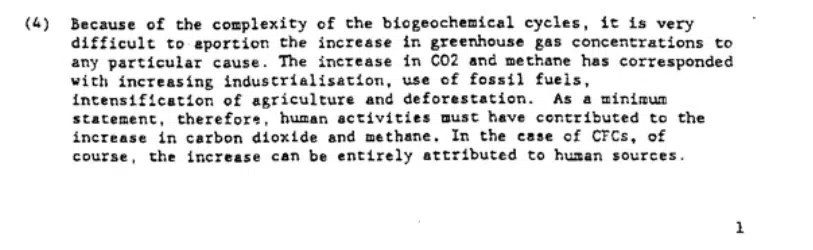
“Because of the complexity of the biogeochemical cycles, it is very difficult to aportion [sic] the increase in greenhouse gas concentrations to any particular cause,” the paper said. “The increase in CO2 and methane has corresponded with increasing industrialisation, use of fossil fuels, intensification of agriculture and deforestation. As a minimum statement, therefore, human activities must have contributed to the increase in carbon dioxide and methane.”
An excerpt from Shell’s September 1992 “Business Environment Occasional Paper” on the “Potential Augmented Greenhouse Effect, & Depletion of the Ozone Layer.”
Meanwhile, in other documents, Shell recognised the need to adopt a “precautionary” approach to climate change. In a 1993 report by the World Energy Council, a think tank backed by government and industry, where Shell’s managing director at the time, John Jennings, served on the board, the word “precautionary” appears more than 20 times.
“Given the as yet unknown consequences of continued and increasing greenhouse gas emissions and impacts, the ability to ascertain the ‘economically optimal’ level of emissions and their mitigation, as required by a cost-benefit approach, is impossible,” the report said. “As a matter of simple prudence, therefore, action based on the precautionary principle is advocated.”
An excerpt from a 1993 report by the World Energy Council, where Shell held a seat on the board.
Hüzeir argues that such explicit acknowledgements of the need for precautionary measures will further bolster lawsuits alleging that Shell had developed a thorough understanding of the dangers posed by fossil fuels, even as it issued other publications that emphasised scientific uncertainties, and backed lobby groups working to undermine climate action.
‘Profits and Principles’
Shell was a founding member of the Global Climate Coalition (GCC), the outspoken oil industry lobby group, which was formed in 1989 to actively promote uncertainty and doubt about climate science in order to delay climate action.
Hüzeir believes Shell’s explanation of why it left the GCC in 1998 in an English-language sustainability report called “Profits and Principles – Does There Have to Be a Choice?” could provide a further hook for litigators.
DeSmog has previously documented that the GCC had attempted to limit the strength of statements regarding the human causes of climate change made by the Intergovernmental Panel on Climate Change, the UN’s scientific advisory body, in the run-up to the 1997 climate conference where nations agreed to the Kyoto Protocol.
The “Profits and Principles” document said that the “main disagreement” between Shell and the GCC centred on the group’s opposition to the Kyoto agreement, which aimed to cut global greenhouse gas emissions by five percent by 2012.
“The GCC is actively campaigning against legally binding targets and timetables as well as ratification by the US government,” the report said. “The Shell view is that prudent precautionary measures are called for.”
An excerpt from Shell’s 1998 English-language sustainability report called “Profits and Principles – Does There Have to be a Choice?
Hüzeir said that Shell’s admission that it saw the need for these “precautionary measures” affirms that the company had long understood the risks posed by the climate crisis — knowledge apparent in many earlier files.
This document also raised the question of why Shell had continued to fund the GCC, as late as 1998 — the year it left the organisation — despite that understanding, Hüzeir said.
Shell’s acknowledgement that its position in GCC had become untenable could also help litigators demonstrate that oil and gas companies that remained in the group until it disbanded in 2002 had been acting in bad faith, Hüzeir added.
“We’ve heard many times from the fossil fuel industry that it was unsure whether or not to take early action on the climate crisis, because there were uncertainties in the science,” Hüzeir said. “But Shell’s deepening embrace of the precautionary principle, as revealed in this document, shows that Shell was well aware of the crisis ahead. What else did they know?”
With more proof of Shell’s climate deception, Rep. Ted Lieu is once again urging the Department of Justice to look into whether fossil fuel companies broke the law.
After new evidence emerged last week showing that oil major Shell internally acknowledged the dangers of their fossil fuel products decades ago, a member of Congress is renewing his previous call for the U.S. Department of Justice to investigate whether Shell and other Big Oil companies’ “alleged campaigns of climate deception” may have violated federal law.
The company documents, first unearthed by Dutch researcher Vatan Hüzeir and reported last week by DeSmog and Follow the Money, reveal Shell executives and employees predicting “major adverse changes” to the climate from fossil fuel emissions — and admitting Shell’s role in causing the problem. “Global warming could challenge the very fabric of the world’s ecological and economic systems,” warned Shell executive Ged Davis in one newly uncovered document from 1989.
“This new set of documents further demonstrates that Shell privately knew about the dangers its products would cause to the environment yet continued to deceive the public in pursuit of company profits. This is wrong and potentially illegal,” said U.S. Rep. Ted Lieu (D-CA), who along with Sen. Richard Blumenthal (D-CT) led 20 members of Congress in a letter last year urging the Department of Justice to look deeper into evidence that Shell, ExxonMobil, and other fossil fuel majors “lied — and continue to lie — to the public about their central role in exacerbating the climate crisis.”
“These new documents provide additional evidence and make our calls for an investigation even more urgent,” Lieu told ExxonKnews in response to the latest Shell revelations.
The lawmakers’ July 25 letter cited an initial batch of internal Shell documents released by Hüzeir last March. The evidence, they wrote, should inspire the DOJ to “investigate Exxon, Shell, and other members of the fossil fuel industry to determine whether they violated RICO, consumer protection, truth in advertising, public health, or other laws.”
A separate letter from U.S. Sens. Bernie Sanders (D-VT), Elizabeth Warren (D-MA), Ed Markey (D-MA), and Ed Markey (D-OR) urged the DOJ to go even further and “bring suits against the fossil fuel industry for its longstanding and carefully coordinated campaign to mislead consumers and discredit climate science in pursuit of massive profits.”
The latest documents add to an abundance of proof that Shell was well aware of the harm its products would cause — and acknowledged its culpability for the damage.
“If a product is used, as indicated by Shell, and annoying consequences nevertheless arise, Shell feels partly responsible,” representatives from Shell told researchers from the Dutch University of Leiden in 1970.
Those “annoying consequences” — which turned out to be more catastrophic and deadly than just annoying — were plainly elucidated by the company in the years to follow. In a 1985 journal article, Shell employee T.G. Wilkinson observed that the burning of fossil fuels has “upset the balance” of carbon dioxide in the atmosphere, and “will cause major adverse changes to some areas.”
“The dilemma therefore remains as to whether to encourage the continued use of fossil fuels with the potential enormous effects on the world’s climate,” Wilkinson wrote.
Two years later, an internal Shell report titled “Air Pollution: an Oil Industry Perspective” noted that a rise in CO2 in the atmosphere “could lead to a higher average surface temperature on Earth, which could have far-reaching environmental, social and economic consequences.”
In 1989, Shell executive Davis warned that “Two groups who could bear particularly heavy costs will be: Future generations who would have to live with the costs of adaptation, and…Those in countries yet to industrialise who would face constraints on energy use.”
Davis is now executive chair of world energy scenarios at the World Energy Council.
Armed with the information it needed to steer the world toward cleaner sources of energy, Shell embarked on a campaign to undermine climate action instead.
The same year Davis made his prediction in the OECD report, Shell helped found the Global Climate Coalition (GCC), an oil industry lobbying group that worked to spread disinformation about climate science.
A year later, in an internal publication, Shell admitted the need to reduce greenhouse gas emissions and embrace alternative sources of energy — but stated that “by the time the enhanced greenhouse effect has been conclusively proven, it may be too late to do anything about it.”
Shell went on to promote the idea that climate science was uncertain and downplayed the role of fossil fuels in the years to come. “It is very difficult to aportion [sic] the increase in greenhouse gas concentrations to any particular cause,” read one paper published by the company in 1992.
When Shell left the GCC, citing its opposition to the Kyoto climate agreement, it explained in a 1998 report that “The Shell view is that prudent precautionary measures are called for.”
Hüzeir, the researcher who unearthed these reports, told DeSmog that documents like this could help litigators make the case against Shell in a growing wave of lawsuits seeking to hold the company accountable for knowingly fueling climate chaos. “Shell’s deepening embrace of the precautionary principle, as revealed in this document, shows that Shell was well aware of the crisis ahead,” he said. “What else did they know?”
The documents add to a heap of evidence that could spur the country’s most powerful public interest law firm to investigate Big Oil.
“If the allegations against ExxonMobil, Shell, and other major fossil fuel companies are true, their coordinated efforts to deceive Americans constitute the most consequential deception campaign in history, with potentially existential consequences for our planet,” Lieu and other members of Congress wrote in their July letter to the DOJ. “We respectfully request that the DOJ investigate whether these actions violated federal law.”
Since that letter was sent last year, more state and local governments have taken the companies to court for that deception. California — the most populous state in the nation and one of the world’s largest economies — sued Shell and other fossil fuel majors for climate damages and consumer fraud. Two Indigenous tribal governments in Washington State, forced to spend millions relocating their communities due to rising seas, filed their own lawsuit against oil giants. Honolulu’s climate accountability lawsuit cleared motions to dismiss the case by fossil fuel defendants, putting it on a path to be the first case of its kind to go to trial.
The stakes of these legal efforts are only getting higher, as climate disasterscontinue to batter many of the same communities awaiting their day in court. The DOJ threw its support behind the plaintiffs in a U.S. Supreme Court brief the agency filed last March, but it hasn’t yet taken independent action against the fossil fuel industry.
“It’s time to hold polluters accountable for their lies, which could have existential consequences for our planet,” Lieu said.