
A UK climate security report backed by the intelligence services was quietly buried – a pattern we’ve seen many times before

Spread the love
[dizzy; That’s the MI6 Building at Vauxhall, London and a goose.]

Marc Hudson, University of Sussex

Last autumn, a UK government report warned that climate-driven ecosystem collapse could lead to food shortages, mass migration, political extremism and even nuclear conflict. The report was never officially launched.

Commissioned by Defra – the Department for Environment Food and Rural Affairs – and informed by intelligence agencies including MI5 and MI6, the briefing assessed how environmental degradation could affect UK national security.

At the last minute the launch was cancelled, reportedly blocked by Number 10. Thanks to pressure from campaigners and a freedom of information request, a 14-page version of the report was snuck out (no launch, not even a press release) on January 22.

That report says: “Critical ecosystems that support major food production areas and impact global climate, water and weather cycles” are already under stress and represent a national security risk. If they failed, the consequences would be severe: water insecurity, severely reduced crop yields, loss of arable land, fisheries collapse, changes to global weather patterns, release of trapped carbon exacerbating climate change, novel zoonotic disease and loss of pharmaceutical resources.

In plainer terms: the UK would face hunger, thirst, disease and increasingly violent weather.

An unredacted version of the report, seen by the Times, goes further. It warns that the degradation of the Congo rainforest and the drying up of rivers fed by the Himalayas could drive people to flee to Europe (Britain’s large south Asian diaspora would make it “an attractive destination”), leading to “more polarised and populist politics” and putting more pressure on national infrastructure.

The Times describes a “reasonable worst case scenario” in the report, where many ecosystems were “so stressed that they could soon pass the point where they could be protected”. Declining Himalayan water supplies would “almost certainly escalate tensions” between China, India and Pakistan, potentially leading to nuclear conflict. Britain, which imports 40% of its food, would struggle to feed itself, the unredacted report says.

The report isn’t an outlier, and these concerns are not confined to classified briefings. A 2024 report by the University of Exeter and think-tank IPPR warned that cascading climate impacts and tipping points threaten national security – exactly the risk outlined in the Defra report.

River flows through jagged mountains
Melting glaciers in remote mountains ultimately pose a security threat for the UK, say intelligence services. Hussain Warraich / shutterstock

The government has not publicly explained why the launch was cancelled. In response to the Times article, a Department for Environment, Food and Rural Affairs spokesperson said: “Nature underpins our security, prosperity and resilience, and understanding the threats we face from biodiversity loss is crucial to meeting them head on. The findings of this report will inform the action we take to prepare for the future.”

Perhaps there are mundane reasons to be cautious about a report linked to the intelligence services that warns of global instability. But the absence of any formal briefing or ministerial comment is itself revealing – climate risks appear to be treated differently from other risks to national security. It’s hard to imagine a report warning of national security risks from AI, China or ocean piracy getting the same treatment.

This episode is not even especially unusual, historically. Governments have been receiving warnings about climate change – and downplaying or delaying responses – for decades.

Decades of warnings

In January 1957, the Otago Daily Times reported a speech by New Zealand scientist Athol Rafter under the headline “Polar Ice Caps May Melt With Industrialisation”. And Rafter was merely repeating concerns already circulating internationally, including by a Canadian physicist whose similar warning went around the world in May 1953. Climate change first went viral more than seven decades ago.

By the early 1960s, scientists were holding meetings explicitly focused on the implications of carbon dioxide build-up. In 1965, a report to the US president’s Science Advisory Council warned that “marked changes in climate, not controllable though local or even national efforts, could occur”.

Senior figures in the UK government were aware of these discussions by the late 1960s, while the very first environment white paper, in May 1970, mentions carbon dioxide build-up as a possible problem.

But the story we see today was the same. Reports are commissioned, urgent warnings are issued – and action is deferred. When climate change gained renewed momentum in the mid-1980s, following the discovery of the ozone hole and the effects of greenhouse gases besides carbon dioxide, the message sharpened: global warming will come quicker and hit harder than expected.

Margaret Thatcher finally acknowledged the threat in a landmark 1988 speech to the Royal Society. But when green groups tried to get her to make specific commitments, they had little success.

Since about 1990, the briefings have barely changed. Act now, or suffer severe consequences later. Those consequences, however, are no longer theoretical.

Why does nothing happen?

Partly, it’s down to inertia. We have built societies in which carbon-intensive systems are locked in. Once you’ve built infrastructure around, say, the private petrol-powered automobile, it’s hard for competitors to offer an alternative. There’s also a mental intertia: it’s hard to let go of assumptions you grew up with in a more stable era.

Secrecy plays a role too. As the Defra report illustrates, uncomfortable assessments are often softened, delayed or buried. Then, if you do accept the need for action, you are then up against the problem of responsibility being fragmented across sectors and institutions, making it hard to know where to aim your efforts. Meanwhile, social movements fighting for climate action find it hard to sustain momentum for more than three years.

Here’s the final irony. Conspiracy theorists and climate deniers insist governments are exaggerating the threat. In reality, the evidence increasingly suggests the opposite. Official assessments tend to lag behind scientific warnings, and the most pessimistic scenarios are often confined to technical or classified documents.

The situation is not better than we are told. It’s actually far worse.


Don’t have time to read about climate change as much as you’d like?
Get a weekly roundup in your inbox instead. Every Wednesday, The Conversation’s environment editor writes Imagine, a short email that goes a little deeper into just one climate issue. Join the 47,000+ readers who’ve subscribed so far.


Marc Hudson, Visiting Fellow, SPRU, University of Sussex Business School, University of Sussex

This article is republished from The Conversation under a Creative Commons license. Read the original article.

Nigel Farage urges you to ignore facts and reality and be a climate science denier like him and his Deputy Richard Tice. He says that Reform UK has received £Millions and £Millions from the fossil fuel industry to promote climate denial and destroy the planet.
Donald Trump urges you to be a Climate Science denier like him. He says that he makes millions and millions for destroying the planet, Burn, Baby, Burn and Flood, Baby, Flood.
Orcas discuss Donald Trump and the killer apes' concept of democracy. Front Orca warns that Trump is crashing his country's economy and that everything he does he does for the fantastically wealthy.
Orcas discuss Donald Trump and the killer apes’ concept of democracy. Front Orca warns that Trump is crashing his country’s economy and that everything he does he does for the fantastically wealthy.
Continue ReadingA UK climate security report backed by the intelligence services was quietly buried – a pattern we’ve seen many times before

UK plotted ‘covert’ measures against Irish republican hunger strikers

Spread the love

https://www.declassifieduk.org/uk-plotted-covert-measures-against-irish-republican-hunger-strikers/

A mural in Derry depicts Raymond McCartney, who took part in the 1980 hunger strike. (Photo: Deirdre Hamill / Alamy)

The UK government planned “covert” measures to monitor “everything” which was said and written by Irish republican hunger strikers in prison in 1980, declassified files reveal.

The strike had been called in response to the removal of political status for convicted paramilitary prisoners, with seven men in HMP Maze refusing their first meal on 27 October.

It ended 53 days later, with some of the hunger strikers claiming the UK government had gestured towards meeting their demands before reneging.

The incident set the scene for the 1981 hunger strike, which saw ten Irish republicans including Bobby Sands starve themselves to death amid a showdown with Margaret Thatcher.

Files released to the National Archives in London now detail how the UK government was acutely concerned about the domestic and international implications of the 1980 hunger strike.

It produced weekly bulletins on the situation, monitored media coverage, liaised with the Catholic church, and even considered meeting some of the strikers’ demands, the files show.

Plans were also made to employ “covert techniques” in order to “find out as much as possible about the day-to-day state of mind of each striker”.

This would apparently include eavesdropping on the prisoners’ private conversations and intercepting mail so that the British state could know “everything” that was said and written.

Article continues at https://www.declassifieduk.org/uk-plotted-covert-measures-against-irish-republican-hunger-strikers/

Continue ReadingUK plotted ‘covert’ measures against Irish republican hunger strikers

Morning Star Editorial: South East Water should be taken into public ownership

Spread the love

https://morningstaronline.co.uk/article/south-east-water-should-be-taken-public-ownership

 A worker hands over bottled water at a water station in East Grinstead, after bad weather was blamed for more water outages in Kent and parts of Sussex, January 12, 2026
HOW much longer are people in south-east England expected to put up with the depredations of South East Water?

Seventeen communities across Sussex and Kent, including 30,000 households, were without a water supply today, in some cases for the fourth day running. And this comes after prolonged outages last year, notably in and around Tunbridge Wells.

There is no more basic human requirement than a water supply. Without it, society starts to crumble and, indeed, schools, libraries and health clinics have had to shut in affected areas while elderly residents have been asked to travel up to seventy miles to secure a bottled water supply.

The only thing not in short supply from South East Water is excuses, mainly around the weather — that and fat-cat payments of course.

As recently as 2023 the company was spending millions more on dividends and interest payments on debt — it was debt-free when privatised by Thatcher — than it was in investing in its crumbling infrastructure.

And bungling chief executive David Hinton was, almost unbelievably, paid a £115,000 bonus last year on top of his £400,000 salary.

This was despite not only South East Water’s wretched service delivery but also the fact that it had to turn to its owners —  mainly overseas investment funds — for an extra £200 million in cash to stave off insolvency. The company is barely more stable than the effectively bankrupt Thames Water. Local MPs have unsurprisingly called on Hinton to resign.

Article continues at https://morningstaronline.co.uk/article/south-east-water-should-be-taken-public-ownership

Continue ReadingMorning Star Editorial: South East Water should be taken into public ownership

Right to buy in England ‘fuelled housing crisis and cost taxpayers £200bn’

Spread the love

https://www.theguardian.com/society/2025/aug/03/right-to-buy-england-fuelled-housing-crisis-cost-taxpayers-common-weath-report

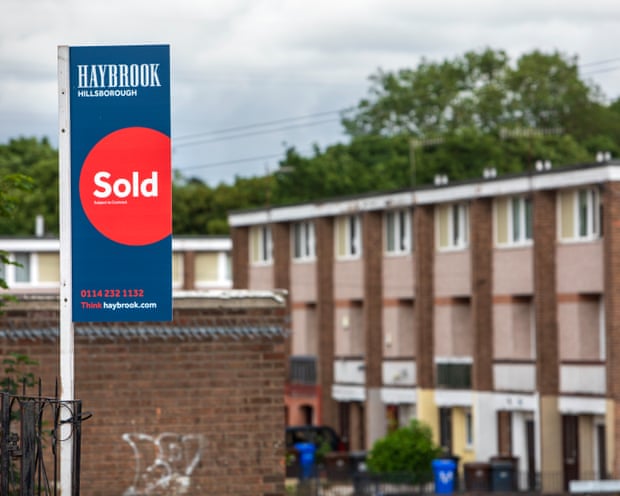
Many ex-council homes are now rented privately to tenants on housing benefit that costs taxpayers £20bn a year. Photograph: Gary Calton/The Guardian

Common Wealth report calls discounted sales of council homes one of the ‘largest giveaways in UK history’

Margaret Thatcher’s right-to-buy scheme has cost UK taxpayers almost £200bn, according to a report into the policy’s contribution to Britain’s housing crisis.

In its report into the sale of millions of council homes to their tenants at steep discounts since 1980, the Common Wealth thinktank said the policy had fuelled vast shortages in social housing and turbocharged inequality.

Describing it as one of the “largest giveaways in UK history”, it said the sale of 1.9m council homes in England had contributed to a situation where one in six private tenants in England now rents a former local authority home.

Calculating the “opportunity cost” of the sales, Common Wealth said the former council homes were now worth an estimated £430bn after taking account of inflation and the surge in property prices since 1980.

Of this sum, the thinktank said £194bn represented the value that was effectively given away when the homes were sold at a discount. Between the years 1980-81 and 2023-24, the discount averaged 43% on the prevailing market price.

See the original article at https://www.theguardian.com/society/2025/aug/03/right-to-buy-england-fuelled-housing-crisis-cost-taxpayers-common-weath-report

Continue ReadingRight to buy in England ‘fuelled housing crisis and cost taxpayers £200bn’

Sweet like chocolate: Alan Milburn’s new deal

Spread the love

https://morningstaronline.co.uk/article/sweet-like-chocolate-alan-milburns-new-deal

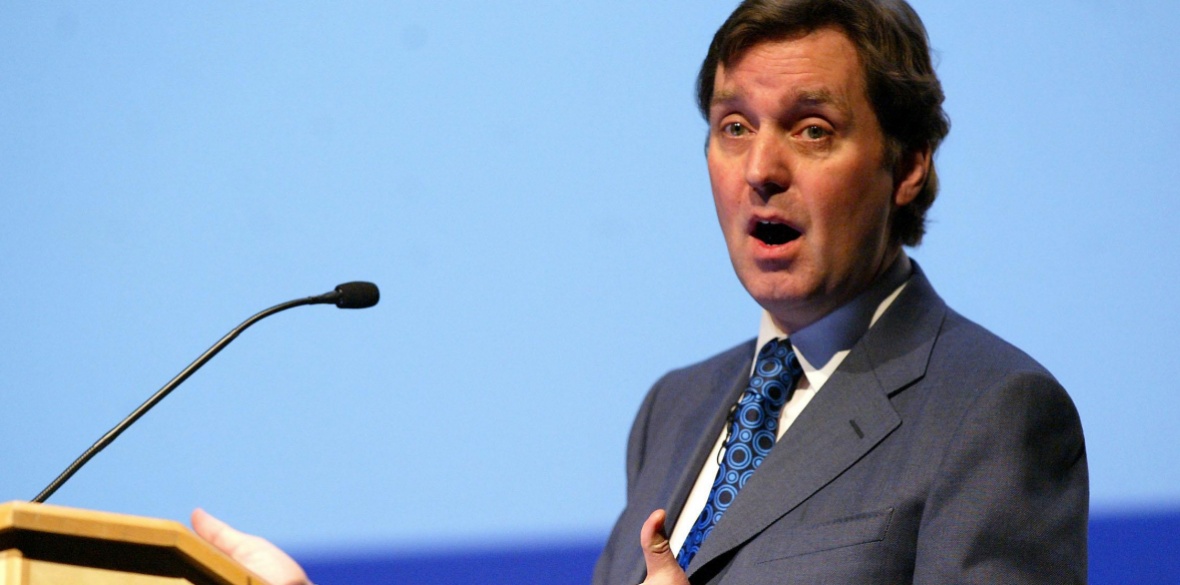
Alan Milburn speaks at the first national conference of the Social Enterprise Coalition, January 25, 2005

Behind a facade of flimsy restrictions, the man who was Tony Blair’s privatisation champion is back in an advisory role, despite the fact he already works for firms that will profit from the selling off of the NHS, writes SOLOMON HUGHES

HEALTH Secretary Wes Streeting says he put Alan Milburn, who was health secretary under Tony Blair, onto the board of the Department of Health “to help government fix health and care.”

But Milburn can’t talk about anything relating “to nutrition, diet, and food, including any work related to the department’s sponsorship of the Food Standards Agency” on that board because he has a part-time job working for Mars Inc.

Appointing someone who works for the firm making Mars Bars to the Department of Health board in the middle of an obesity crisis shows how Streeting values corporate interests above public services.

Milburn was health secretary under Blair from 1999 to 2003. He oversaw the wide-scale privatisation of the NHS. He continued the Margaret Thatcher and John Major governments’ plans to privatise NHS “support services” like cleaning, catering and building management, with the disastrous PFI scheme expanding on his watch.

Milburn also broke new ground by privatising “clinical” services by buying in private operations or giving NHS money to set up privately run clinics. Milburn then cashed in his experience by leaving government and taking on lucrative corporate jobs.

Milburn and his family get around £1-2 million a year from his “advisory” firm, AM Strategy, where all the funds for his “advisory” jobs are collected. Streeting clearly admires both Milburn’s record of privatisation when he was a minister and his highly paid post post-ministerial corporate work.

The Department of Health says Milburn will give up his job as an adviser to Mars Inc at the end of this year, so next year, he will be able to forget all about working for Mars Bars and start discussing obesity.

https://morningstaronline.co.uk/article/sweet-like-chocolate-alan-milburns-new-deal

Continue ReadingSweet like chocolate: Alan Milburn’s new deal