US-Backed Killing of Cartel Boss Unleashes Wave of Violence Across Mexico

Spread the love

Original article by Stephen Prager republished from Common Dreams under Creative Commons (CC BY-NC-ND 3.0). 
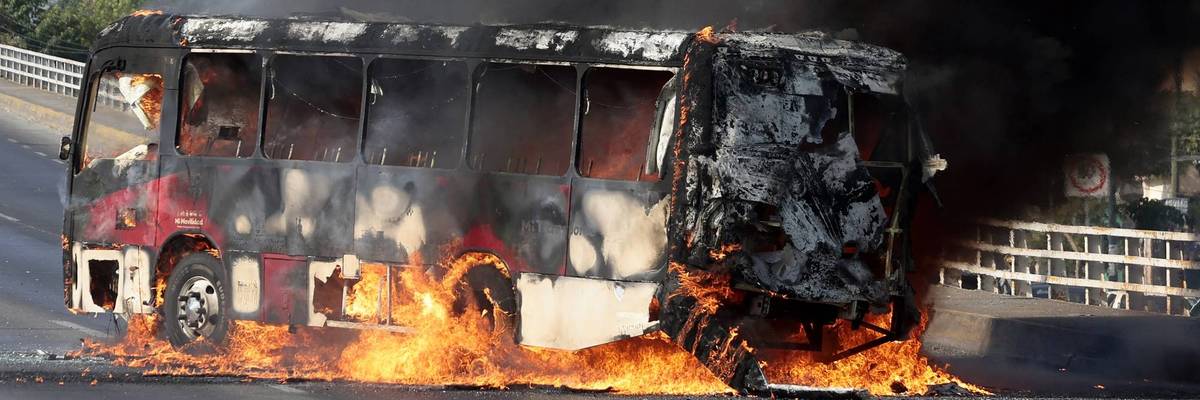
A member of the General Attorney’s Office stands guard near a bus set on fire by organized crime groups in response to an operation in Jalisco to arrest a high-priority security target, at one of the main avenues in Zapopan, state of Jalisco, Mexico, on February 22, 2026. (Photo by Ulises Ruiz/AFP via Getty Images)

The killing of Mexico’s top cartel leader, known as “El Mencho,” has created a power struggle that “could plunge Mexico into almost record levels of violence,” said one expert.

With support from the US, Mexican security forces killed one of the nation’s most powerful cartel bosses on Sunday. Almost immediately, the country descended into violence and chaos.

The killing of Nemesio Oseguera Cervantes—known as “El Mencho”—has set off a violent power struggle within the organization he led, the Jalisco New Generation Cartel (CJNG), which has left civilians caught in the crossfire.

RECOMMENDED…
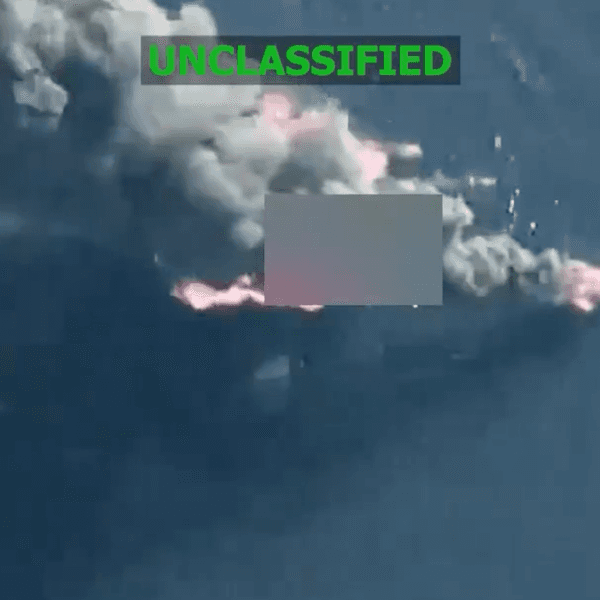
Surveillance footage shows some the US Department of Defense's latest strikes on boats

Trump ‘Murder Spree’ Continues With 11 More People Killed in US Boat Strikes
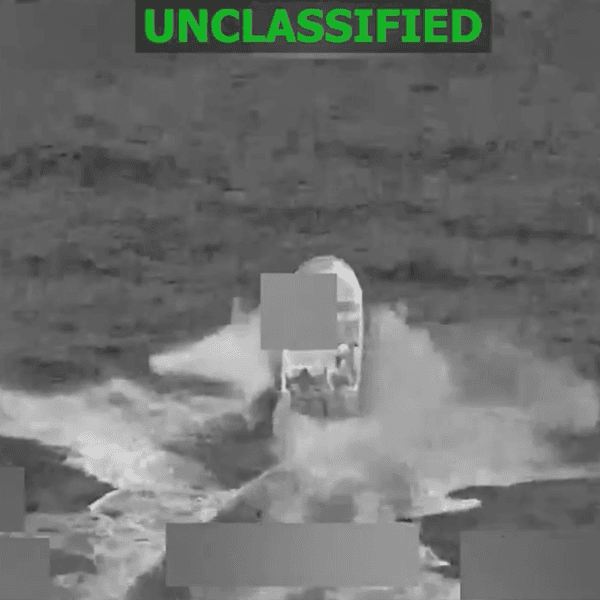
An unclassified surveillance image from US Southern Command

Death Toll Up to 128 People as Trump Pentagon Commits Two More Killings at Sea

As NBC News reported on Sunday evening:

Cars set on fire by cartel members blocked roads in nearly a dozen Mexican states and left smoke billowing into the air. Jalisco’s capital, Guadalajara, was turned into a ghost town Sunday night as civilians hunkered down. Later, authorities announced they had cleared most of the more than 250 cartel roadblocks across 20 states.

Several Mexican states canceled school Monday, and local and foreign governments warned citizens to stay inside as violence erupted.

The sudden outbreak of violence has created a state of terror for many ordinary people in Mexico. One Guadalajara resident, Maria Medina, told Agence France-Presse that men with guns showed up at the gas station where she works, ordered everyone to leave, and set the building on fire.

“I thought they were going to kidnap us. I ran to a taco stand to take cover with the people there,” Medina said.

The US State Department has urged Americans in parts of Mexico to “seek shelter and remain in residences or hotels.” Many flights out of the country have been canceled, leaving tourists stranded.

Visitors at the popular Jalisco beach resort of Puerto Vallarta have been forced into hiding as gunmen have taken over the streets.

One father in Seattle told the local news station Fox 13 that he received frightened texts from his daughter, who was visiting the area, around 3:30 in the afternoon, describing the chaos.

“The text she sent, talking about, ‘The whole city is on fire, and we are hiding at home,’” he said. “’The cartel are outside right now watching the citizens and making sure the military does not come in. The police are not here to help. We are hiding.’”

According to one open-source effort to map the fallout, at least 19 of Mexico’s 32 states had seen outbreaks of violence as of Sunday evening.

So far, no civilian deaths have been confirmed. However, according to the Associated Press, at least 25 members of the National Guard have been killed since El Mencho’s death.

United States forces were not reportedly involved in the operation that led to El Mencho’s death. However, US fingerprints are all over the attack.

In a statement on Sunday night, White House Press Secretary Karoline Leavitt said the US “provided intelligence support to the Mexican government in order to assist with an operation” in which El Mencho was killed.

She added that “President [Donald] Trump has been very clear—the United States will ensure narcoterrorists sending deadly drugs to our homeland are forced to face the wrath of justice they have long deserved.”

The attack comes after months of threats from Trump to use US military force to take out cartel leaders, against the wishes of Mexican President Claudia Sheinbaum.

At a press conference on Monday, Sheinbaum said that despite the previous day’s chaos, “the country is at peace.”

“We awoke today with no blockades,” she said. “All activity has practically been reestablished.”

Several news outlets have described the killing of El Mencho as a direct response to US sabre-rattling, which has ramped up following last month’s operation to abduct Venezuelan President Nicolás Maduro.

El Mencho, who founded CJNG around 2010, has been “public enemy number one” for the US Drug Enforcement Agency (DEA) for nearly a decade, for his role in turning the cartel into a hyper-violent organization that coordinated global drug operations.

While CJNG has been considered one of the largest suppliers of Mexican fentanyl, heroin, and methamphetamine to the US—even greater than the more famous Sinaloa Cartel—experts say it’s unlikely that the killing of its 59-year-old kingpin will do much to solve the problem.

“What we’ve seen in the past is that the removal of the kingpin doesn’t necessarily affect significant network disruption,” Anthea McCarthy-Jones, an expert in Latin America at the University of New South Wales, told the Australian Broadcasting Corporation. “The removal of the leader doesn’t have any impact on the day-to-day relations and the relationships that facilitate this kind of global drug trafficking operation.”

US Deputy Secretary of State Christopher Landau boasted that taking out “one of the bloodiest and most ruthless drug kingpins” was “a great development for Mexico, the US, Latin America, and the world.”

But David Mora, the senior Mexico analyst at the International Crisis Group (ICG), said it will likely trigger more instability.

“In the absence of a direct succession, a power vacuum is created that opens the door to violent realignments within the organization,” Mora told AFP.

Chris Dalby, an organized crime expert who has written a book about the Jalisco cartel, told The Guardianthat this power struggle could culminate in a full-scale civil war if no successor emerges to fill El Mencho’s shoes.

“If no one can, if the CJNG finally splinters, you have four or five different lieutenants with the manpower, the weaponry, and the criminal empires to build their own fiefdoms—and that could plunge Mexico into almost record levels of violence,” said Dalby.

The explosion of violence and instability following the death of just one cartel leader has mirrored what critics warned may follow if the US attempted to bring about the “total elimination” of drug cartels using airstrikes and special operations forces.

“At best, US military strikes in Mexico will weaken the cartels over the short term,” wrote fellows Daniel DePetris and Christopher McCallion in a July paper for the think tank Defense Priorities. “At worst, they will cause the cartels to splinter even further, spiking the level of violence, straining the Mexican government’s military resources, and causing significant blowback against Americans in both Mexico and the United States.”

Original article by Stephen Prager republished from Common Dreams under Creative Commons (CC BY-NC-ND 3.0). 

Donald Fuhrump says that Amerikkka doesn't bother with crimes or charges anymore, not being 100% Amerikkkan and opposing his real estate intentions is enough.
Donald Fuhrump says that Amerikkka doesn’t bother with crimes or charges anymore, not being 100% Amerikkkan and opposing his real estate intentions is enough.
Orcas discuss Donald Trump and the killer apes' concept of democracy. Front Orca warns that Trump is crashing his country's economy and that everything he does he does for the fantastically wealthy.
Orcas discuss Donald Trump and the killer apes’ concept of democracy. Front Orca warns that Trump is crashing his country’s economy and that everything he does he does for the fantastically wealthy.
Elon Musk urges you to be a Fascist like him, says that you can ignore facts and reality then.

Continue ReadingUS-Backed Killing of Cartel Boss Unleashes Wave of Violence Across Mexico

400,000 in Mexico City’s Zócalo celebrate one year of Claudia Sheinbaum’s government

Spread the love

Original article by Tallis Boerne Marcus republished from peoples dispatch under a Creative Commons Attribution-ShareAlike 4.0 (CC BY-SA) license.

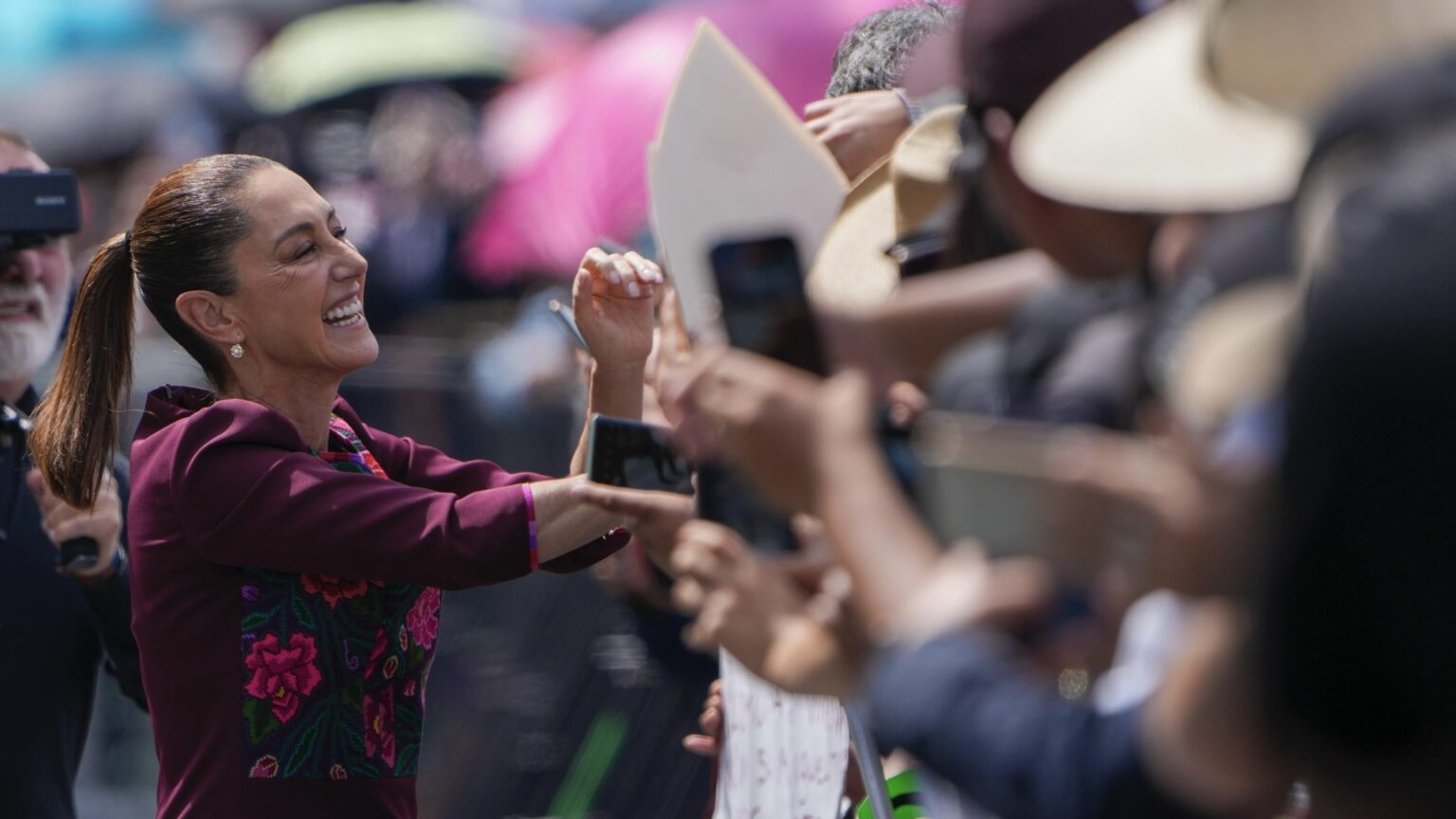
Mexican President Claudia Sheinbaum greets supporters in the Zócalo on October 5, marking one year of her administration. Photo: MORENA / X

In her speech to a full Zócalo, Sheinbaum reviewed her government’s major accomplishments in a year of global turbulence largely amid a US tariff war and military threats

Mass mobilizations have been a feature of Claudia Sheinbaum’s first year presiding over Mexico, and to finish her first “accountability” tour of Mexico and mark one year of governance, she had her biggest yet. More than 400,000 people came out to watch her speak for nearly an hour on Sunday, October 5, reflecting on her and the party’s achievements in the first year of her term, and the continued “fourth transformation” of Mexico.

In recent weeks, Sheinbaum has visited all 31 states of Mexico, outlining her administration’s current projects, plans and results in each state.

The communication strategy of MORENA, the governing party, is very front-facing, with both Sheinbaum and her predecessor Andrés Manuel López Obrador hosting daily press conferences from Monday to Friday, and then generally traveling to one or two parts of Mexico over the weekend. This has proven extremely effective in countering the narratives from the large press corporations that own and operate the majority of Mexican media outlets, as well as of course maintaining closer communication and accountability with the people of Mexico.

Sheinbaum has faced significant challenges in her first year, most notably due to relations with the administration of US President Donald Trump, with problems ranging from tariff threats even to members of his administration suggesting unilateral military intervention against Mexico. While Trump has threatened Mexico with tariffs at every turn, Sheinbaum’s firm but open stance has proved effective in negotiations with Trump and today the country has managed to achieve important exceptions to the aggressive tariff regime.

Sheinbaum arrives at one year in charge with historic levels of approval, depending on the poll you choose your approval rate is somewhere between 72% and 79%. While other countries around the world aren’t as comprehensive in approval polls as Mexico, this likely makes Sheinbaum the most popular leader in the world.

Her approval is above 70% in all states of Mexico and remarkably, she even has over 70% approval from voters of the three opposition parties in Mexico, the centrist party Movimiento Ciudadano and the right-wing parties of PAN and PRI.

So, how did she get to that level of popularity and what are her challenges in maintaining or growing it? Here are some of the points mentioned by Sheinbaum in her speech and the highlights from her first year governing Mexico.

Reiterating economic achievements

  • Sheinbaum began by reiterating some of the economic achievements, both that MORENA has accomplished since 2018, and some of the present moment.
  • Between 2018 and 2014, 13.5 million Mexican, Mexico is now the second least unequal country in the Americas, behind only Canada, and the income gap between the richest and poorest was reduced from 27 to 14 times over.
  • Annual inflation has settled at 3.7% percent, unemployment is at 2.7%, a record level of foreign direct investment was reached and annual economic growth is expected at 1.2%.

Sheinbaum’s initiatives from her first 12 months.

  • Sheinbaum created three new social programs. One is Salud Casa por Casa, a door-to-door free healthcare system for the elderly, where healthcare professionals come into their home for regular check ups. Another is Pensión Mujeres Bienestar, which gives women their pension from 60 years of age, rather than 65, to recognize unpaid work in the home. The final is Beca “Rita Cetina”, which is a universal scholarship for all secondary students in public schools, this is a payment every two months of 1900 pesos (USD 103) to cover schooling costs.
  • The constitutional recognition of several rights, such as the right for women to live lives free from violence, the right of access to the internet, the right of access to housing, the right to social programs and more.
  • Mexico has served more than 86,000 deported Mexicans who have been deported from the US in special comprehensive care centers, under a program called ‘Mexico embraces you”. This includes registering them into Mexicans social security systems to assist them with access to housing, employment and transportation to their area of origin, as well as food and shelter in the meantime.
  • Sheinbaum said the “4T is bringing back the trains”, with many rail projects underway, after they were previously privatized in the late 90s. These make up more than 3000kms of railway across the country, including two trains from Mexico City, to Pacucha and Queretaro respectively, and further expansion of the Interoceanic train, which is a key part of Mexico’s attempt to create an alternative trade corridor to the Panama Canal.
  • Sheinbaum emphasized the administration’s goal to “promote equality and the recognition and just development of women in Mexico.” The current government has created The Secretariat for Women as an official government ministry, opened a national support line for women, has opened the first 678 free centers for women that focus on comprehensive care for women, but the administration is aiming to build 2,500 in total. The government is also aiming to build 1,000 early education and childcare centers, which will provide free childcare to children from 40 to 1,000 days old.
  • Sheinbaum has also made access to water a key feature of her first year in charge. About four billion cubic meters of water have been de-privatized, a new agricultural irrigation technology program is being developed across 13 states, and there are 20 new strategic drinking water and sanitation projects.
  • The Sheinbaum administration will build 1.7 million homes, 400,000 of those for Mexicans without social security, and the rest with accessible loan offers for those who earn less than two minimum wages.
  • Another key feature of her first year in charge has been more scientific investment and projects, with funding for scientific research projects increasing by 193%. These include the production of an electric car, a project for Mexico to make its own semiconductors, the production of observation satellites and more.

Security

A challenge moving forward for Sheinbaum will be continuing to manage the security situations, although her early strategies have proved effective.

52% of Mexicans rank insecurity and drug trafficking as the most important issue affecting the country, and 63% of Mexicans living in urban areas consider it unsafe to live in their city. This figure rose from the previous year, but in fairness, levels were historically low before.

Sheinbaum and Omar Garcia Harfuch, her secretary of security, have taken a different approach to security than AMLO had. Sheinbaum and Garcia Harfuch also worked together when Sheinbaum was the mayor of Mexico City, and homicides dropped 50% in the six years they worked together.

Sheinbaum’s shift was towards a more direct and carefully coordinated strategy against crime and drug trafficking was clear. In her first 100 days of governing operations against criminal groups went up 597%, arrest numbers grew by 1216%, confiscated weapons went up 5811% and drug seizures went up 1000%.

The results have been swift, with Sheinbaum reporting a 32% reduction in homicides over her first year. Between September 2024 and July 2025, there was an average of 64.9 homicides per day. While these numbers are stark, it is a marked improvement from the 98.5 per day that Mexico was experiencing in 2018, when MORENA first came to power.

In 2007, before Felipe Calderon’s aggressive, US-backed security strategy, Mexico was experiencing 24.3 daily homicides.

Mexico also recently managed to get the United States to sign an agreement to attempt to limit the inflow of weapons from the US into Mexico. This is a huge point for Mexican security as even the US itself has recognized that 74% of weapons used by organized crime groups in Mexico arrive illegally from the United States.

However, Mexican political commentator and editor of Mexico Decoded, Viri Rios makes the point that this agreement focuses only on increased border surveillance and inspection, and misses the core problem of dangerous weapons being too easily acquired and severely unregulated in the US.

In theory, the US agreeing to this new policy will give them more accountability for the guns that continue to arrive in Mexico.

Early results are extremely promising, but Sheinbaum’s grapple with security and US relations will be critical moving forward.

Tallis Boerne Marcus is an Australian journalist currently based in Mexico City.

Original article by Tallis Boerne Marcus republished from peoples dispatch under a Creative Commons Attribution-ShareAlike 4.0 (CC BY-SA) license.

Continue Reading400,000 in Mexico City’s Zócalo celebrate one year of Claudia Sheinbaum’s government