Trump’s Venezuela Drug War Gambit and the Militarization Playbook at Home

Spread the love

This article by Michelle Ellner republished from Common Dreams under Creative Commons (CC BY-NC-ND 3.0).

National Guard troops are deployed to the Washington Monument as part of US President Donald Trump’s mobilization of law enforcement on August 12, 2025 in Washington, DC. (Photo by Andrew Leyden/Getty Images)

Whether it’s a wall in the desert or barricades in front of the White House, the message is the same: Perceived threats, real or manufactured, are met with troops, not talks.

US President Donald Trump has quietly authorized the Pentagon to carry out military operations against what his administration calls “narco-terrorist” networks in Latin America. On paper, it’s a counter-narcotics policy. In practice, it serves as a green light for open-ended US military action abroad, bypassing congressional approval, sidestepping international law, and stretching the definition of “national security” until it becomes a catchall justification for the use of force.

The directive allows the US to target groups unilaterally labeled as both criminal and terrorist. Once that designation is made, the military can operate without the consent of the targeted country, a move that violates international law. In a region with a long history of US-backed coups, covert wars, and destabilization campaigns, the risk of abuse isn’t hypothetical; it’s inevitable.

While the order applies across Latin America, Venezuela stands at the top of the list. The Trump administration has accused President Nicolás Maduro’s government of working with transnational cartels, and has doubled the bounty on him to $50 million (double the bounty for Osama bin Laden). It’s a lawfare tactic designed to criminalize a head of state and invite mercenaries and covert operatives to participate in regime change. The accusations fueling this escalation have grown increasingly far-fetched casting Maduro in turn as a partner of Colombia’s FARC, the head of the “Cartel de los Soles,” a patron of Venezuela’s Tren de Aragua, and now, as an ally of Mexico’s Sinaloa Cartel. a charge even Mexico’s own president says has no evidence, revealing how politicized and unfounded this allegation is.

The core premise of the accusation is that Maduro is involved in a cocaine trafficking network of Venezuelan military and political figures called Cartel de los Soles. The Venezuelan government denies the cartel’s existence, calling it a fabrication to justify sanctions and regime change efforts. Multiple independent investigations have shown no hard evidence exists and that this narrative thrives in a media-intelligence echo chamber. Reports from outlets like Insight Crime cite anonymous US sources; those media stories are then cited by policymakers and think tanks, and the cycle repeats until speculation becomes policy.

The communities in Caracas and Los Angeles, in the Venezuelan plains, and in the US-Mexico border may seem worlds apart, but they are facing the same war machine.

Fulton Armstrong, a professor at American University and a former longtime US intelligence officer, has stated that he knows no one in the intelligence community, apart from those currently in government, who believes in the existence of the Cartel de los Soles.

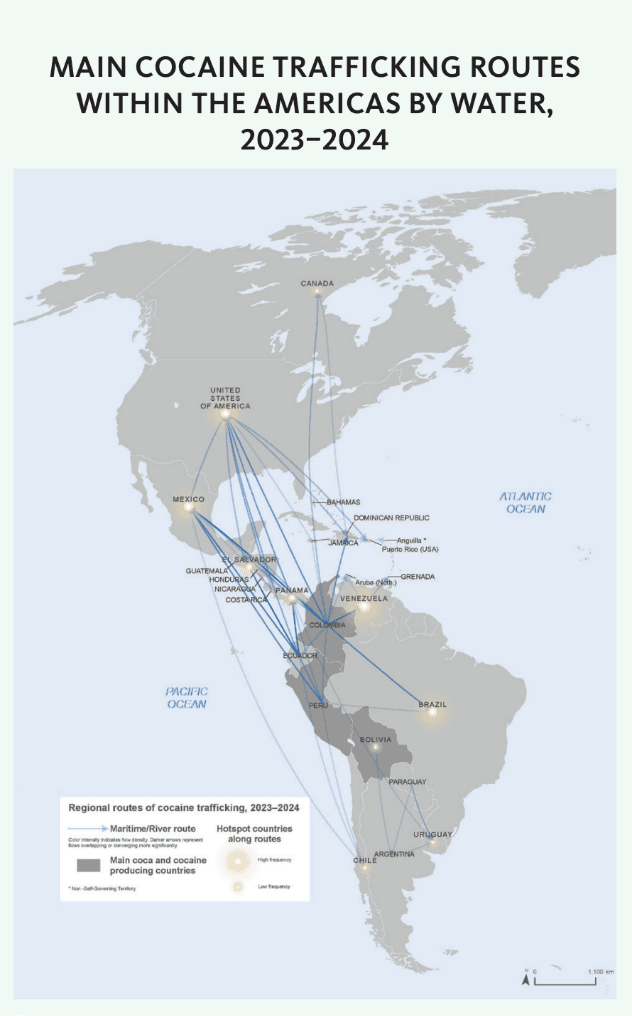
Drug monitoring data also contradict this narrative. The Washington Office on Latin America (WOLA) reports that only about 7% of US-bound cocaine transits through the Eastern Caribbean via Venezuela, while approximately 90% takes Western Caribbean and Eastern Pacific routes. The United Nations Office on Drugs and Crime’s 2025 World Drug Report likewise confirms that trafficking remains concentrated in major Andean corridors, not through Venezuela. Yet Venezuela is targeted anyway, not for its actual role in the drug trade, but because neutralizing its government has become a pillar of US foreign policy, seen in Washington as a step toward reshaping the country’s political system and prying open its economy to foreign control.
The “narco-terror” label put on Venezuela also attempts to rope Venezuela into the US fentanyl crisis, despite the absence of evidence that the country plays any role in fentanyl trafficking. Even US drug enforcement assessments make no mention of Venezuela as a source or transit point.

This link exists only in political rhetoric, a way to fold Venezuela into a domestic public health crisis and recycle the same logic used to brand it a “national security threat.” That accusation dates back to 2015 when then-President Barack Obama created the legal and political scaffolding for an open-ended campaign of coercion. Once the “narco-terror” framework is in place, Washington can sustain and escalate military measures over time, regardless of the immediate pretext.

This framing turns a political standoff into a declared security imperative. It broadens the range of permissible military tools, from ISR (intelligence, surveillance, reconnaissance) to direct action.

The pattern is familiar. In Panama (1989), Colombia (2000s), and Honduras (2010s), US militarized antidrug campaigns failed to dismantle supply chains or reduce trafficking volumes. What they did accomplish was shifting routes, militarizing criminal actors, and destabilizing governments, and left societies more fragile—costing lives and destroying communities in the process.

The Mirror at Home: Militarization and Communities of Color

The same militarized logic driving US policy in Venezuela is being applied inside the United States. In August 2025, President Trump signed an executive order placing the DC Metropolitan Police Department under federal control and deployed the National Guard, citing a public safety “emergency,” despite official data showing violent crime at multiyear lows. Even US law enforcement statistics contradict the White House narrative, but the administration dismissed them, casting the city as overrun by “roving mobs,” “wild youth,” and “drugged-out maniacs.”

DC is only one example. The same militarized logic has sent thousands of troops to the US-Mexico border, converted military bases into detention centers from Texas to New Jersey, and stationed soldiers inside Immigration and Customs Enforcement detention facilities in over 20 states. In Los Angeles, Marines and National Guard units patrolled immigrant neighborhoods in a show of force, a deployment beaten back only by mass community resistance and the threat of labor action.

Whether it’s a wall in the desert or barricades in front of the White House, the message is the same: Perceived threats, real or manufactured, are met with troops, not talks. The playbook never changes: In Venezuela, the “threat” is cast as narco-terrorism; in the US, it’s a “border surge” or a manufactured public safety emergency built on racially coded depictions of Black and brown communities. In both cases, the logic is identical: Treat political disputes and social crises as security emergencies, sideline diplomacy and community solutions, usurp greater executive powers, and make military force a routine tool of governance.

The Real Threat

Trump’s “narco-terror” authorization uses the language of fighting drugs and crime to mask a deeper project: expanding the military’s role in governance and normalizing its use as a tool of political control both at home and abroad.

In Latin America, that means more interventions against governments the US wants to topple. At home, it means embedding the military deeper into civilian life, particularly in Black and brown neighborhoods.

The communities in Caracas and Los Angeles, in the Venezuelan plains, and in the US-Mexico border may seem worlds apart, but they are facing the same war machine. Until we reject militarization in all its forms, the targets will keep shifting, but the people under the gun will look the same.

This article by Michelle Ellner republished from Common Dreams under Creative Commons (CC BY-NC-ND 3.0).

Continue ReadingTrump’s Venezuela Drug War Gambit and the Militarization Playbook at Home

US sends troops to southern Caribbean in new threat to Venezuela

Spread the love

Original article by Lorenzo Santiago republished from peoples dispatch under a Creative Commons Attribution-ShareAlike 4.0 (CC BY-SA) license.

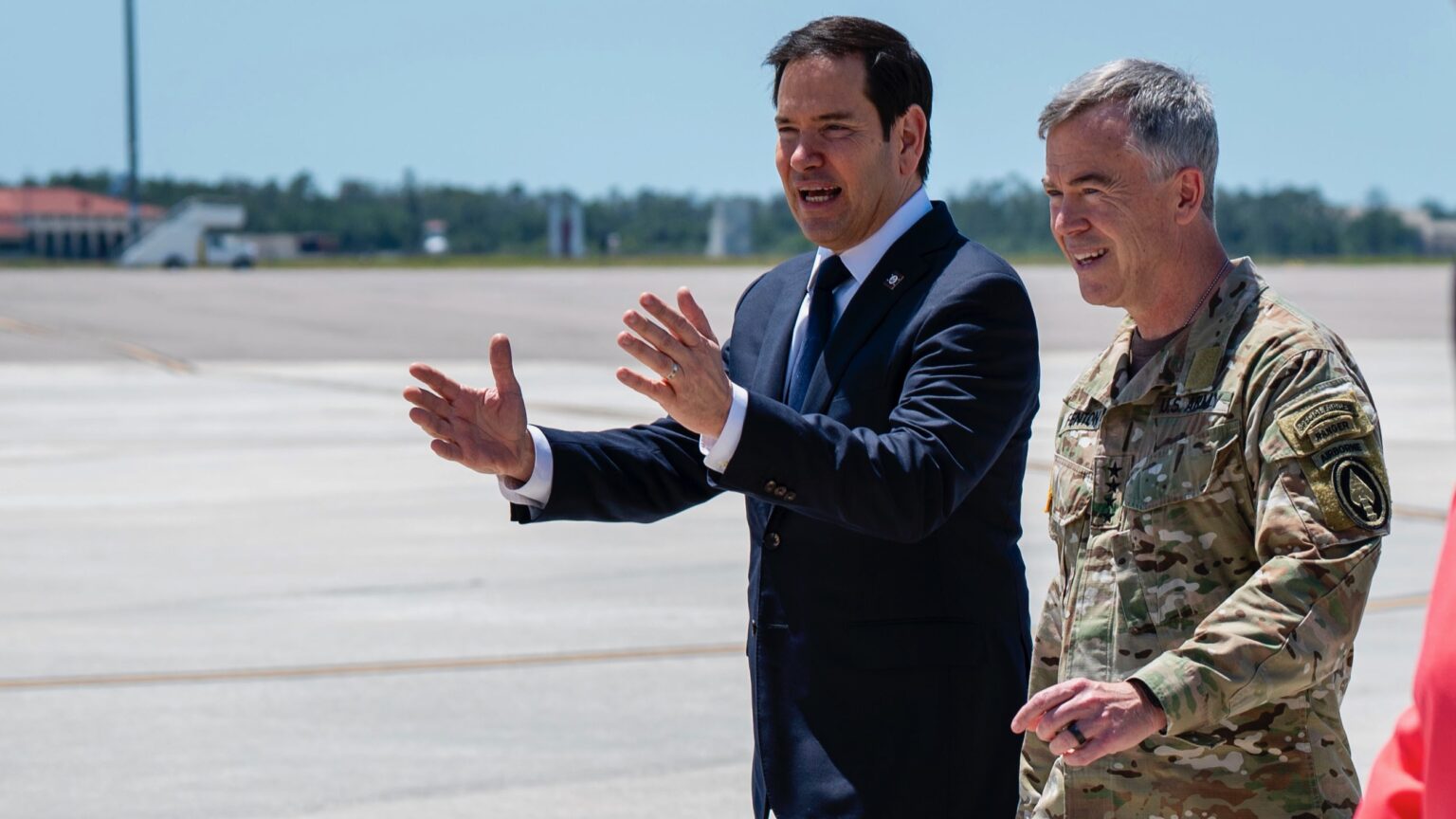
Secretary of State Marco Rubio meets with US Special Operations Command in April, 2025. Photo: X

The action was announced by Secretary of State Marco Rubio, who called the Venezuelan government a “criminal organization”.

US Secretary of State Marco Rubio confirmed Thursday, August 14, that he is sending troops to the southern Caribbean Sea to carry out military operations in the region. He said the goal is to arrest Latin American drug traffickers and linked one of these groups to Venezuelan President Nicolás Maduro.

Rubio reinforced, without presenting evidence, the White House narrative that Maduro is the leader of the Cartel de los Soles (Cartel of the Suns), an alleged criminal organization. On July 25, the US State Department classified the group as an international terrorist group.

Now, Rubio has stepped up his game, stating that he is sending air and naval troops to control cartels that bring “poison” to the US. He stated that drug trafficking is a threat to US security and again called the Maduro government a “criminal organization”.

“These are groups that are operating with impunity in international waters, simply exporting to the United States poison that is killing, that is destroying communities… The Cartel de los Soles is one of the largest criminal organizations that exist in the hemisphere, which unfortunately has not been given enough attention. It is a cartel that today is indicted in the federal courts of the United States. It is not a government, the Maduro regime is not a government, it is a criminal organization,” Rubio said in a statement.

The Secretary of State did not provide details of the operation, but said the goal is to intercept the flow of drugs in the region. 

Venezuelan military personnel interviewed by Brasil de Fato do not believe the United States could launch a military attack against the country. Sectors within the Armed Forces say they have not definitively ruled out any possibility, but understand the dispatch of planes and ships as yet another threat and a show of force by the White House. 

The decision follows a report published last week by the New York Times. The report stated that Trump had signed a secret executive order directing the Pentagon to begin using “military force” against certain Latin American drug cartels considered terrorists. The order authorizes direct military operations at sea and in other countries.

Henry Navas Nieves, head of the Master’s program in Military History at the Bolivarian Military University of Venezuela, agrees with this thesis and states that the US learned from the wars in Iraq and Afghanistan, two conflicts that had a very high political, military, and economic cost for people in the United States.

“Since Obama, a new model of US warfare against expanding countries has emerged. They have abandoned direct armed confrontations and learned that it was possible to overthrow Muammar Gaddafi in Libya without deploying any soldiers. And they apply and replicate this. The use of their own military forces is inconvenient in these cases, and they resort to harassment and unilateral coercive measures,” Nieves told Brasil de Fato.

The military understands that the White House’s logic is based on encouraging conflicts and attacks by paramilitary and far-right groups in Venezuelan territory. 

This week, the Venezuelan government announced that it had demobilized a new attempted attack against strategic structures in Venezuela. Interior Minister Diosdado Cabello said on Tuesday, August 12, that security forces had identified terrorist plans organized by far-right sectors in conjunction with paramilitaries.

According to him, explosives were seized that had the capacity to hit targets at a distance of up to 1.2 kilometers and were intended to be used to attack hospitals, gas stations, and political figures.

One of the targets was Venezuela Plaza in downtown Caracas. According to Cabello, the group intended to blow up the Monument to the Victory of the Great Patriotic War against Nazism, a memorial to the Soviet Union, which was inaugurated in the first half of this year. 

Navas claims that these new US military threats are “inexplicable” because they are based on an unfounded accusation: that Maduro leads a criminal organization.  

“The Venezuelan government has actually dealt a severe blow to drug trafficking. These aggressive measures also respond to Venezuelan police operations against the far right, which attempted to organize terrorist attacks, something that was denounced and dismantled by security forces, in addition to the tons of explosives seized,” he stated. 

Escalation in threats

Since the July 27 municipal elections, the US has increased its attacks on the Venezuelan government. In an interview with Fox News, US Attorney General Pamela Bondi said that more than USD 700 million in Maduro’s assets had been seized. She said that these were “mansions, cars, planes, and jewelry”, but presented no evidence and gave no indication of the location of these assets.

Navas argues that this escalation of threats is the result of a profound crisis the US is experiencing, involving a struggle between different conservative wings. He believes Rubio’s group seeks dominance in the region to regain the “sympathy” of its support base in Florida, where the Latin American far-right living in the US is concentrated.

“There is a mosaic of interests in the US vying for space and seeking to control the White House’s political decisions. Rubio leads one of them, and he is putting pressure on the government to launch an offensive against Venezuela in an attempt to overthrow the government. This is an escalation and a response to the Maduro government’s advance, which has seen significant victories in the recent regional, legislative, and municipal elections,” he said.

Last week, the US announced an increase to USD 50 million (approximately R$270 million) in the reward for information leading to the arrest of President Nicolás Maduro. The message was promptly responded to by the Venezuelan government. Foreign Minister Yván Gil called the announcement “a ridiculous political propaganda operation and a joke.” 

Read more: US increases bounty on Venezuelan President Nicolás Maduro to 50 million

Another speaker was Defense Minister Vladimir Padrino López. He called this “immoral” and emphasized that criminal groups operating in Venezuela, such as the Aragua Train, have been “completely dismantled”. 

Maduro also refuted the accusations and said that the Venezuelan response could be “the beginning of the end of the American empire”. This Thursday, August 14, the president called the US advance a “war of declarations”. 

The heightened tension also resonated with the Venezuelan far right. Former extreme-neoliberal congresswoman and opposition figure María Corina Machado thanked the Republican president on Thursday for “pressuring to defeat this criminal organization”.

Original article by Lorenzo Santiago republished from peoples dispatch under a Creative Commons Attribution-ShareAlike 4.0 (CC BY-SA) license.

Elon Musk urges you to be a Fascist like him, says that you can ignore facts and reality then.
Donald Fuhrump says that Amerikkka doesn't bother with crimes or charges anymore, not being 100% Amerikkkan and opposing his real estate intentions is enough.
Donald Fuhrump says that Amerikkka doesn’t bother with crimes or charges anymore, not being 100% Amerikkkan and opposing his real estate intentions is enough.
Continue ReadingUS sends troops to southern Caribbean in new threat to Venezuela

Spanish parliament fast-tracks arms embargo bill against Israel

Spread the love

This work by Middle East Monitor is licensed under a Creative Commons Attribution-NonCommercial-ShareAlike 4.0 International License.

People carrying an inflatable of a bomb with the words “End arms trade with Israel” passing by the Spanish Parliament in Madrid, Spain on 5 October 2024 [Marcos del Mazo/LightRocket via Getty Images]

The Spanish parliament decided Tuesday to accelerate the passage of an arms embargo bill against Israel, according to media reports, Anadolu Agency said.

The Sumar, Podemos, Republican Left of Catalonia (ERC), Basque EH Bildu and the Galician Nationalist Bloc (BNG) parties submitted a petition to the Congressional Bureau demanding the urgent procession of the bill, said the El Mundo newspaper.

The request, also supported by Prime Minister Pedro Sanchez’s Socialist Party, was approved, halving the timeline and accelerating the process.

It came after parliament passed a non-binding motion on May 20 that urged the government to impose an arms embargo on Israel in response to its military operations in the Gaza Strip.

The motion, introduced by the leftist Sumar alliance, part of the ruling coalition, along with opposition parties Podemos and the Republican Left of Catalonia (ERC), was approved in a 176-171 vote.

READ: Spain pushes for 2-state solution at international meeting on Gaza in Madrid

This work by Middle East Monitor is licensed under a Creative Commons Attribution-NonCommercial-ShareAlike 4.0 International License.

UK Labour Party government ministers Keir Starmer, Angela Rayner and Rachel Reeves explain that they are partners complicit in Israel's Gaza genocide. The UK has provided Israel with arms, military and air force support. They explain that they don't do gas chambers but do do forced marches, starvation, destroy hospitals, mass-murders of journalists and healthcare workers.
UK Labour Party government ministers Keir Starmer, Angela Rayner and Rachel Reeves explain that they are partners complicit in Israel’s Gaza genocide. The UK has provided Israel with arms, military and air force support. They explain that they don’t do gas chambers but do do forced marches, starvation, destroy hospitals, mass-murders of journalists and healthcare workers.
Experiencing issues with this image not appearing. I suspect because it's so critical of Zionist Keir Starmer's support of and complicity in Israel's genocides.
Genocide denier and Current UK Prime Minister Keir Starmer is quoted that he supports Zionism without qualification. He also confirms that UK air force support has been essential in Israel’s mass-murdering genocide. Includes URLs https://www.declassifieduk.org/keir-starmers-100-spy-flights-over-gaza-in-support-of-israel/ and https://youtu.be/O74hZCKKdpA
Continue ReadingSpanish parliament fast-tracks arms embargo bill against Israel