Spending watchdog warns £38bn cost of Sizewell C nuclear plant is ‘risky’

Spread the love

https://www.theguardian.com/business/2026/may/20/spending-watchdog-warns-38bn-cost-of-sizewell-c-nuclear-plant-is-risky

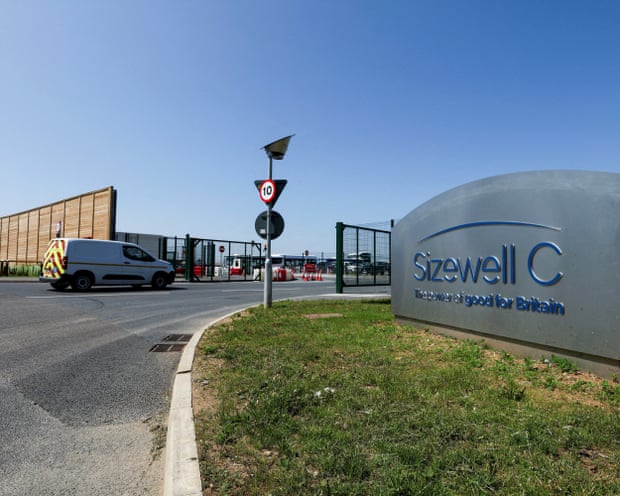
The NAO overall savings for households from the plant could be outstripped by the cost of supporting its construction until almost halfway through its 60-year operational life. Photograph: Chris Radburn/Reuters

National Audit Office says potential benefits are ‘considerable but uncertain’ while risks are ‘immediate and substantial’

The cost of the government’s £38bn nuclear plant in Suffolk is subject to “significant uncertainty” and may outweigh the benefits for UK households until at least 2064, according to the government’s spending watchdog.

The National Audit Office (NAO) has warned that although the potential benefits of the Sizewell C nuclear plant are considerable, they remain uncertain. The risks, however, are “immediate, substantial and borne by the public”.

The government claims the nuclear reactor, expected to generate the equivalent of enough low-carbon electricity to power 6m homes when it begins operations in the late 2030s, could save £2bn a year from the electricity system compared with using other low-carbon technologies.

However, for households the overall savings could be outstripped by the cost of supporting its construction until almost halfway through its 60-year operational life. The project could take even longer to “break even” if there are cost overruns or delays, the NAO warned.

“Sizewell C is a project of exceptional scale, complexity and significance for taxpayers,” said Sir Geoffrey Clifton-Brown, the chair of the public accounts committee, which oversees the work of the NAO. “Experience from comparable nuclear projects in the UK and overseas highlights their vulnerability to delays and cost overruns.”

Stop Sizewell C said the risks surrounding the project “could easily turn Sizewell C into a financial disaster” while the funding model meant its investors were “the only ones who can’t lose”.

The NAO has urged the government to mitigate the risk by using “close monitoring, greater transparency to parliament, and by securing value for money from the significant public and private investment”.

Continues at https://www.theguardian.com/business/2026/may/20/spending-watchdog-warns-38bn-cost-of-sizewell-c-nuclear-plant-is-risky

A government spokesperson said investing in large-scale nuclear power was the “only way to get our country off the rollercoaster of volatile global gas markets”.

What about big renewable then e.g. generation from tides? We reliably have huge tides.

Continue ReadingSpending watchdog warns £38bn cost of Sizewell C nuclear plant is ‘risky’

‘A blow to staff, patients, and local communities’

Spread the love

https://morningstaronline.co.uk/article/blow-staff-patients-and-local-communities

 A taped off section inside a school which has been affected with sub standard reinforced autoclaved aerated concrete (Raac)

Campaigners dismayed as government plans to replace hospitals built with Raac delayed again

FURTHER delays in replacing hospitals built with Raac concrete are a “blow” to NHS staff, as campaigners wanted to prevent the “severe risk of collapsing floors and ceilings.”

The government’s spending watchdog announced today that a pledge to deal with reinforced autoclaved aerated concrete (Raac) in seven hospitals by 2030 would not be met.

A report from the National Audit Office (NAO) found that the infrastructure plans, drawn up by the previous Conservative government, would only be completed by 2032 and 2033.

Despite the new timeline, the NAO also claimed that some new building projects are already facing pressure to finish for their revised deadline.

The watchdog also said that by the end of 2025, works to alleviate the risks of Raac have already cost more than £500 million.

Campaigners and unions hit back, warning that longer delays will mean “greater risks” for patients and NHS staff, and will mean  “higher costs” to fix the issues plaguing NHS hospitals.

Raac is a lightweight material which was used widely in the 1960s and ’80s to build public buildings such as hospitals and schools.

Continues at https://morningstaronline.co.uk/article/blow-staff-patients-and-local-communities

Continue Reading‘A blow to staff, patients, and local communities’

Poor regulator driving soaring water bills, watchdog finds

Spread the love

https://morningstaronline.co.uk/article/poor-regulator-driving-soaring-water-bills-watchdog-finds

‘A wholesale betrayal of the people and our environment’

 Campaigners say privatised water has failed the public and the environment

REGULATORS have fuelled soaring water bills by not encouraging private companies to spend “what they need to deliver the performance expected,” a damning public spending watchdog report concluded today.

The National Audit Office (NAO) highlighted “inconsistent responsibilities” and gaps in oversight within the Department for Environment, Food and Rural Affairs (Defra) and the sector’s regulators.

The watchdog examined the effectiveness of sector regulators — Ofwat, the Environment Agency, and the Drinking Water Inspectorate — as well as Defra, which sets policies for the sector in England.

It found that complex and lengthy regulatory frameworks have contributed to “worsening investor perception of the sector” which will need to attract “investment and spend at a rate not seen before” to meet its “significant environmental and supply challenges.”

NAO head Gareth Davies said: “Given the unprecedented situation facing the sector, Defra and the regulators need to act urgently to address industry performance and resilience to ensure the sector can meet government targets and achieve value for money over the long term for bill payers.”

Article continues at https://morningstaronline.co.uk/article/poor-regulator-driving-soaring-water-bills-watchdog-finds

Continue ReadingPoor regulator driving soaring water bills, watchdog finds